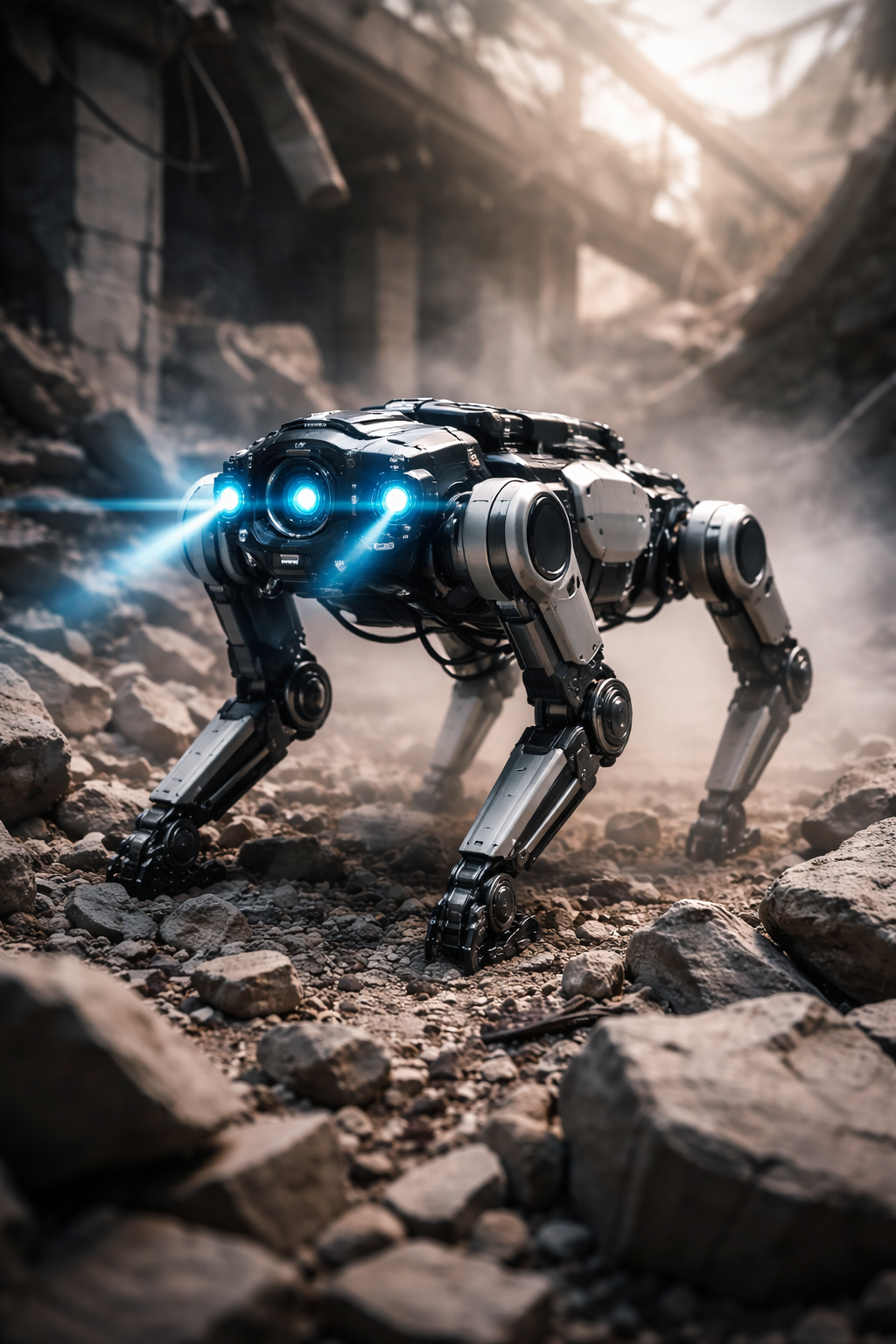
As of March 2026, the integration of autonomous systems into disaster recovery has shifted from experimental prototypes to mission-critical infrastructure. Whether navigating the radioactive corridors of a decommissioned nuclear plant or scanning for life beneath earthquake-induced rubble, autonomous robots are performing tasks that are fundamentally too dangerous, too tight, or too complex for human responders.
Definition and Scope Autonomous robots in disaster recovery refer to unmanned ground (UGV), aerial (UAV), and underwater (AUV) vehicles capable of sensing their environment and making operational decisions without continuous human intervention. Unlike traditional teleoperated machines, these systems use “Agentic AI”—a hybrid of analytical and generative AI—to map terrain, identify victims, and manage logistics in real-time.
Key Takeaways
- Safety First: Robots reduce human exposure to radiation, toxic gases, and structural collapses.
- Speed of Response: Autonomous swarms can map 10 square kilometers of disaster zone in under 30 minutes.
- High-Fidelity Data: Integration of LiDAR and thermal sensors provides sub-centimeter accuracy for structural assessments.
- Operational Resilience: Recent 2025/2026 advancements in “drone handover” allow for 24/7 continuous monitoring.
Who This Is For This guide is designed for emergency management professionals, civil engineers, robotics researchers, and policy makers looking to understand the current state of humanitarian robotics. It serves as a technical and strategic roadmap for deploying autonomous fleets in high-stakes environments.
1. Nuclear Containment: The Fukushima Daiichi Decommissioning (2026 Update)
Fifteen years after the Great East Japan Earthquake, the Fukushima Daiichi Nuclear Power Station remains the world’s most demanding testing ground for disaster robotics. As of March 2026, the mission has moved from simple reconnaissance to the active removal of highly radioactive fuel debris.
The Challenge of “Dark” Radiation
In Units 1, 2, and 3, radiation levels remain high enough to “fry” standard electronic circuits within minutes. Conventional silicon-based sensors fail, and GPS signals are non-existent within the thick containment vessels.
The Solution: The 21-Meter Robotic Boom
In early 2026, TEPCO (Tokyo Electric Power Company) highlighted the deployment of a new 21-meter remotely operated and semi-autonomous boom. This system, designed in collaboration with Mitsubishi Heavy Industries and Veolia Nuclear Solutions, features:
- Radiation-Hardened Circuitry: Using specialized vacuum-tube-like transistors and lead-shielded processors.
- Dexter™ Haptic Feedback: A system that allows human operators to “feel” the resistance when the robot’s manipulator arm touches debris, ensuring delicate fuel rods are not crushed.
- SLAM Navigation: Because GPS is unavailable, the robot uses Simultaneous Localization and Mapping (SLAM) via laser-range finders to build a 3D map of the reactor’s interior in real-time.
Case Study Outcome
While full-scale debris removal has been adjusted to a 2037 timeline due to the extreme complexity of the task, the 2025-2026 test runs in Unit 2 succeeded in retrieving minute “pinch-samples” of melted fuel. This was only possible because the robot could autonomously adjust its posture to avoid snagged cables and fallen structural beams that had stymied previous attempts.
2. Earthquake Recovery: The Ishikawa Peninsula Legacy and SERR Prototypes
In January 2024, the Noto Peninsula in Japan suffered a devastating 7.6-magnitude earthquake. This event marked a turning point for quadrupedal robots—often called “robotic dogs”—in urban search and rescue (USAR).
The “Spot” and Ghost Robotics Deployment
The Japan Ground Self-Defense Force (JGSDF) deployed Ghost Robotics Q-UGVs to navigate areas where roads were entirely blocked by landslides. Unlike wheeled vehicles, these four-legged robots could:
- Climb over 45-degree rubble piles.
- Deliver 10kg medical payloads to isolated villages.
- Establish ad-hoc mesh networks using Starlink terminals mounted on their backs, restoring communication to “blackout” zones.
2026 Advancement: The SERR and RescueNet
By early 2026, the Smart Earthquake Rescue Robot (SERR) has entered field testing in seismic-prone regions of Greece and Italy. The SERR utilizes a proprietary AI model known as RescueNet, a CNN-LSTM architecture that fuses three data streams:
- Visual: Identifying human shapes in dusty, low-light environments.
- Thermal: Using Grid-Eye sensors to detect body heat through cracks in concrete.
- Acoustic: High-gain microphones filtered by AI to recognize the specific frequency of human tapping or muffled shouting, while ignoring the “noise” of shifting rubble.
Common Mistake: Early responders often relied on single-sensor robots. In dusty earthquake zones, RGB cameras are often blinded. Modern 2026 standards require Sensor Fusion—the simultaneous use of thermal, LiDAR, and acoustic data.
3. Wildfire Mitigation: Autonomous Swarms and Aerial Handovers
Wildfires have become more frequent and intense, particularly in the Western United States and Australia. As of March 2026, the strategy has shifted from “reactive suppression” to “autonomous persistence.”
The “Drone Handover” Breakthrough
One of the primary limitations of UAVs has been battery life. In 2025, researchers at Macquarie University developed a seamless drone handover system. When a drone’s battery drops below 15%, it signals a second drone at a base station. The second drone launches, uses computer vision to “find” the first drone in mid-air, and takes over the surveillance path within milliseconds. This allows for 24/7 uninterrupted monitoring of fire fronts.
Case Study: The 2025 Australian “Lightning Chasers”
During the 2025 fire season in Victoria, Australia, autonomous swarms were used to “chase” lightning storms.
- Task: Small drones (scouts) identified “sleeper fires”—smoldering roots ignited by lightning strikes that are invisible to satellites.
- Action: Once a hotspot was confirmed, the swarm autonomously dispatched a Heavy-Lift UAV (such as the Drone Amplified Ignis System) to drop incendiary spheres for a controlled backburn or retardant to douse the spark before it became a “megablaze.”
4. Maritime and Flood Response: AI Think Tanks in China
Flooding remains the most expensive natural disaster globally. In 2025 and early 2026, China’s Zhejiang province introduced a new category of recovery tech: Water Conservancy Robots.
Smart Xiao Yu and the Sea Turtle
Named “Smart Xiao Yu” and “Smart Xiao Chuan,” these AI-powered platforms act as “real-time think tanks.” They don’t just swim; they compute.
- Predictive Analytics: By integrating with the DeepSeek AI model, these robots analyze rainfall and river flow data to predict breach points 30 minutes before they occur.
- The Sea Turtle Robot: Developed by Harbin Engineering University (Sept 2025), this AUV mimics the flipper movements of a sea turtle. Its “low-disturbance” propulsion allows it to glide centimeters above the seafloor without stirring up sediment, making it perfect for searching for submerged vehicles or victims in turbid floodwaters.
Outcome
In the 2025 floods of the Haihe River Basin, these autonomous surface vessels (USVs) reduced the time needed to generate evacuation plans from 30 minutes to 30 seconds, saving an estimated 400 lives through earlier warning triggers.
5. Subterranean Exploration: The Legacy of DARPA and the RoBoa
Mining accidents and collapsed tunnels represent the most claustrophobic rescue scenarios. Following the DARPA SubT Challenge, a new breed of Soft Robotics has emerged in 2026.
The ETH Zurich RoBoa
The RoBoa, a snake-like robot developed at ETH Zurich, uses a soft, inflatable textile tube to “grow” into spaces.
- Mechanism: Instead of sliding (which causes friction and can trigger further collapses), the RoBoa “everts”—the tip of the robot is constantly unfolding from the inside out.
- Use Case: In a 2025 mine collapse case study, the RoBoa traveled 50 meters into a narrow, unstable vent to deliver oxygen and a two-way communication cable to trapped miners.
6. Hazardous Materials (Hazmat) and Industrial Recovery
Industrial accidents involving chemical leaks or explosive gases require robots that are not just autonomous, but explosion-proof (ATEX certified).
Brokk AB and Shark Robotics
In 2025, Canadian mining operations and European oil refineries expanded their use of the Colossus (by Shark Robotics) and Brokk demolition robots.
- Autonomous Gas Mapping: These robots are equipped with “electronic noses” that can identify specific chemical signatures (e.g., Ammonia, Chlorine, Methane) and autonomously map the “leak plume.”
- Safe Demolition: Using autonomous “point-and-click” demolition, these robots can remove unstable walls in a burning factory without a human operator ever entering the “hot zone.”
7. The Technology Stack: How Autonomy Works in 2026
To understand these case studies, one must look at the underlying “Agentic” architecture that makes them possible.
Agentic AI and VLM+VLA
In 2026, the industry has moved beyond simple “if-then” logic. Robots now use Vision-Language-Action (VLA) models. This allows a human commander to give a natural language command like: “Search the northwest corner of the warehouse for anyone wearing a red jacket and report any structural cracks.” The robot’s AI:
- Interprets the goal (Semantic reasoning).
- Plans the path (Analytical AI).
- Executes the search while adapting to obstacles (Embodied AI).
SLAM and V2X Communication
- Lidar-Based SLAM: Essential for “GPS-denied” environments like tunnels or deep forests.
- V2X (Vehicle-to-Everything): Allows a UGV on the ground to talk to a UAV in the air. If the ground robot sees a wall it can’t climb, it “asks” the drone for an alternative route.
8. Common Mistakes in Deploying Autonomous Systems
Despite the high-tech appeal, failures are common. Through 2024-2026, several “Common Mistakes” have been identified:
- Ignoring the “Human-in-the-Loop”: Fully autonomous systems can sometimes prioritize “efficiency” over “human comfort.” For example, a robot might find a victim but fail to provide the psychological reassurance a human voice can offer. 2026 designs now include integrated LED displays and speakers to say, “Help is on the way.”
- Overestimating Battery in Extreme Heat: High-intensity fires reduce battery efficiency by up to 40%. Teams often fail to account for the energy needed to run cooling fans for the robot’s onboard AI processors.
- Data Overload: Sending 4K video from 50 drones simultaneously can crash local mesh networks. Modern systems use Edge Computing, where the robot only sends “detections” (e.g., “Found person at Coord X”) rather than raw video.
- Hardware Fragility: Using consumer-grade drones in “dirty” environments. Dust, smoke, and moisture can clog motors. 2026 SAR robots must be IP67 rated at a minimum.
9. Ethical and Operational Guardrails
As robots take on more decision-making power, the “Human-Robot Teaming” (HRT) protocol becomes essential.
- Prioritization Ethics: If a robot detects two victims but can only deliver one medical kit, how does it choose? As of March 2026, international standards (IEEE P7000 series) dictate that robots must never make triage decisions; they must relay the data to a human medical officer.
- Data Privacy: In disaster zones, robots often capture images of people in vulnerable states. 2026 “Humanitarian Robotics” guidelines require on-device blurring of faces before data is uploaded to a cloud server.
Conclusion
The transition of autonomous robots from “expensive toys” to “essential teammates” is complete. The case studies from Fukushima to the Noto Peninsula demonstrate that while robots cannot yet replace the intuition and empathy of a human rescuer, they can vastly extend a rescuer’s reach and ensure their safety.
As we look toward the remainder of 2026 and into 2027, the focus will shift toward Interoperability. The goal is a “Universal Disaster Protocol” where a Swiss-made RoBoa can seamlessly share data with a Chinese-made USV and an American-made UAV. For emergency agencies, the next step is not just buying a robot, but building the digital infrastructure to support a heterogeneous autonomous fleet.
Next Steps for Implementation:
- Audit your current SAR equipment for “autonomous-ready” sensor ports.
- Invest in training for “Robot Supervisors” who can manage AI-human teaming.
- Develop local mesh network capabilities to support GPS-denied navigation.
FAQs (Schema-Style)
Q1: Can autonomous robots actually find people buried deep under concrete? A1: Yes. Using a combination of thermal imaging, LiDAR to detect structural voids, and acoustic sensors that “listen” for heartbeats or tapping, robots can locate survivors that are invisible to the naked eye. In 2025 tests, the SERR prototype achieved a 94% accuracy rate in survivor detection.
Q2: How do these robots communicate if cell towers are down? A2: They use ad-hoc mesh networking (like LoRaWAN or specialized RF links) and satellite backhaul (such as Starlink). This allows them to create their own local “Wi-Fi bubble” over the disaster site.
Q3: Are these robots too expensive for local fire departments? A3: While high-end systems like the Boston Dynamics Spot are significant investments ($75k+), the market is scaling. As of 2026, modular SAR drones are available for under $5,000, and many agencies use “Robot-as-a-Service” (RaaS) models to lease equipment during high-risk seasons.
Q4: Do robots work in the rain or heavy smoke? A4: Yes, provided they are IP67 rated. While “visible light” cameras fail in smoke, Thermal (LWIR) cameras and LiDAR can “see” through smoke and fog by detecting heat signatures and laser reflections rather than light.
Q5: What happens if the robot gets stuck? A5: Most 2026 autonomous robots feature “Self-Righting” mechanisms. Quadrupeds can stand back up after a fall, and drones have “turtle mode” to flip themselves over. If a robot is truly pinned, it acts as a stationary communication beacon for other robots in the swarm.
References
- TEPCO (March 2026): Technical Progress Report on Unit 2 Fuel Debris Investigation. Tokyo Electric Power Company Holdings.
- IEEE Spectrum (2026): Agentic AI: The New Frontier for Embodied Robotics in Disaster Zones. IEEE Xplore Digital Library.
- International Federation of Robotics (IFR): World Robotics Report 2025: Service Robots in Humanitarian Missions.
- MDPI Sensors (March 2026): Survey on Reconnaissance Autonomous Robotic Systems for Disaster Management. Vol. 26, Issue 5.
- DARPA (2025): Legacy of the Subterranean Challenge: Implementing Soft Robotics in Mine Rescue.
- ETH Zurich (2025): The RoBoa Project: Snake-Like Eversion Robots for Structural Collapse.
- Science Robotics: Bio-inspired Propulsion in Underwater Search and Rescue: The Sea Turtle AUV Case Study. (Wang et al., 2025).
- NIST (National Institute of Standards and Technology): Standard Test Methods for Response Robots in Disaster Environments (2026 Revision).
- IFRC (International Federation of Red Cross): Ethics and Privacy in Humanitarian Robotics: 2026 Guidelines.
- Mitsubishi Heavy Industries: Next-Generation Decommissioning Systems for Hazardous Environments (Technical White Paper).