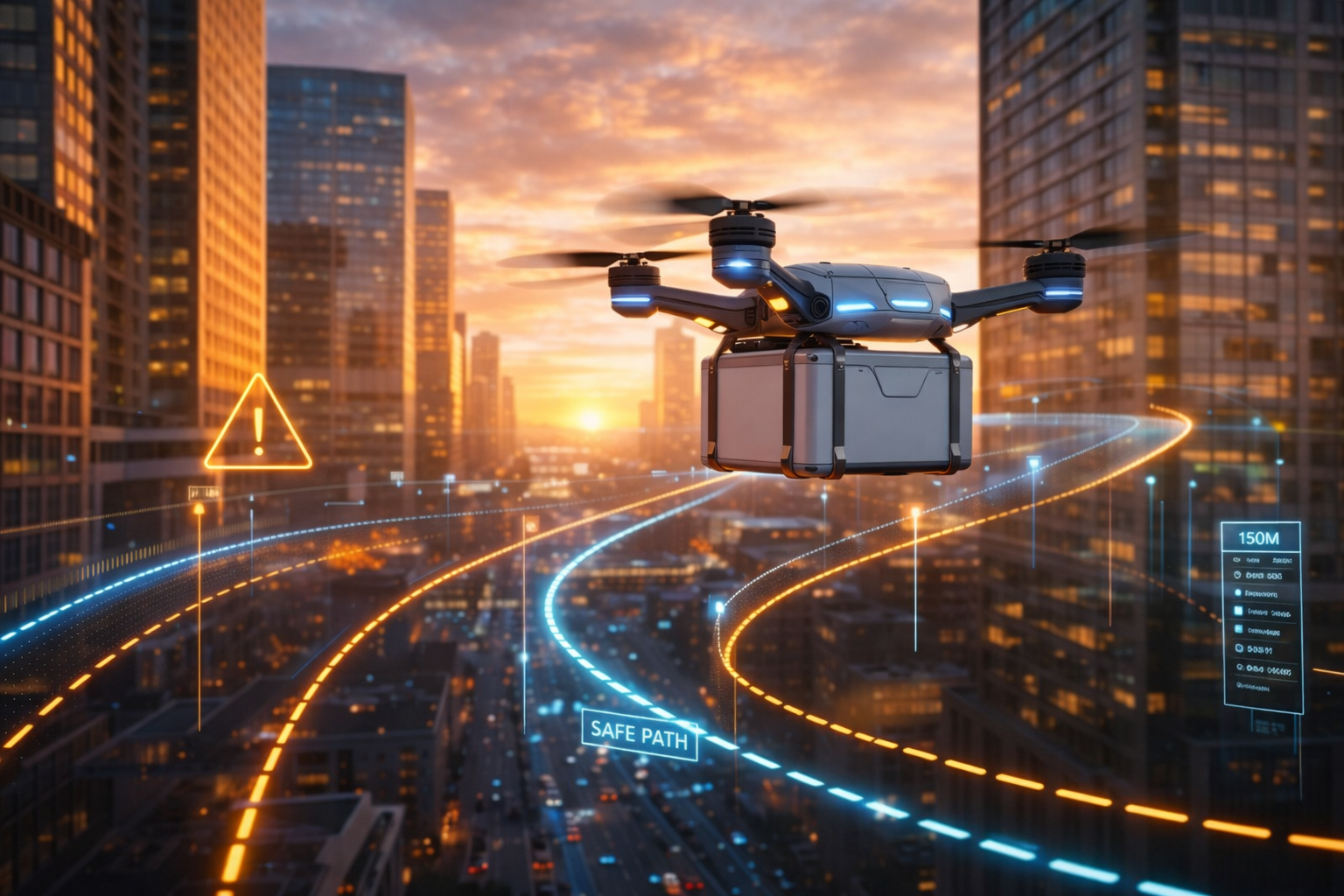
As of March 2026, the uncrewed aviation industry has officially moved past the “experimental” phase. We have entered an era where autonomous drones—aircraft capable of making real-time flight decisions without active human stick-and-rudder input—are becoming a normalized part of our global supply chain and infrastructure management. However, with this technological leap comes a dense thicket of rules, safety protocols, and geopolitical restrictions that every operator, from the solo commercial pilot to the enterprise fleet manager, must master.
Definition and Scope
An autonomous drone in 2026 is defined not just by its hardware, but by its integration into the Unmanned Traffic Management (UTM) ecosystem. Unlike “automated” drones that follow a pre-programmed GPS breadcrumb trail, true autonomous systems utilize Detect and Avoid (DAA) sensors and AI-driven pathfinding to navigate dynamic environments. Regulations in 2026 focus heavily on how these machines interact with crewed aircraft and how they communicate their intent to civil aviation authorities.
Key Takeaways for 2026
- Normalization of BVLOS: Beyond Visual Line of Sight (BVLOS) is no longer a “waiver-only” privilege; it is increasingly handled under performance-based rules like the FAA’s Part 108.
- The Hardware Pivot: Due to the expiration of various grace periods in the American Drone Security Act, many foreign-made drones are now prohibited from federally funded projects.
- Digital Identification: Remote ID is fully enforced globally. If your drone isn’t broadcasting its digital “license plate,” it is effectively grounded.
- The Rise of ADSPs: Automated Data Service Providers (ADSPs) are now the bridge between your drone and Air Traffic Control (ATC).
Who This Guide Is For
This guide is designed for commercial drone operators, logistics planners, public safety officials, and regulatory compliance officers. Whether you are transitioning a fleet to autonomous delivery or setting up a long-range infrastructure inspection program, the following sections provide the technical and legal roadmap for the current year.
Safety & Legal Disclaimer: This article provides an overview of the regulatory landscape for informational purposes only. It does not constitute legal advice. Aviation laws are subject to rapid change; always consult with the FAA (US), EASA (EU), or your local Civil Aviation Authority (CAA) and a qualified aviation attorney before beginning new operations.
The FAA Landscape: Transitioning from Part 107 to Part 108
For a decade, Part 107 was the gold standard for commercial drone flight in the United States. However, Part 107 was built on the assumption of a “human-in-the-loop” who could see the aircraft. As of March 2026, the industry is shifting toward the proposed and partially implemented Part 108 framework, which specifically addresses BVLOS and autonomous operations.
Understanding Part 108 and BVLOS Normalization
The primary goal of Part 108 is to move away from the cumbersome waiver process. In the past, if you wanted to fly a drone beyond your line of sight, you had to prove to the FAA that you could do so safely for every specific mission. Under the 2026 framework, the FAA has established performance-based standards.
This means that if your drone meets specific technical requirements—such as having a certified DAA system and a redundant Command and Control (C2) link—you can operate within “routine” BVLOS parameters without a separate waiver. This shift has unlocked the potential for 24/7 autonomous monitoring of pipelines, railways, and power lines.
The Role of ADSPs (Automated Data Service Providers)
Under the 2026 rules, the FAA doesn’t just watch your drone; it monitors the data stream provided by your ADSP. These third-party providers act as a digital traffic cop. When your autonomous drone plans a flight, it submits its “operational intent” to the ADSP. The ADSP then checks for:
- Airspace Conflicts: Are there other drones or crewed aircraft in the path?
- Weather Hazards: Is the localized wind speed exceeding the drone’s safety limits?
- Temporary Flight Restrictions (TFRs): Is there a sudden emergency or VIP movement in the area?
Without an active subscription to a certified ADSP, most autonomous commercial flights in 2026 are restricted to very low-altitude “shielded” operations.
The European Context: EASA U-space and Class Markings
While the US has focused on performance standards, the European Union Aviation Safety Agency (EASA) has doubled down on U-space—a highly structured digital ecosystem for drone integration.
The Reality of U-space
As of January 1, 2026, U-space is fully active in major European hubs like Paris, Berlin, and Madrid. U-space is a set of services provided in “designated geographical zones.” In these zones, autonomous drones are required to utilize:
- Network Remote ID: Constant broadcasting of telemetry via cellular or satellite links.
- Dynamic Capacity Management: The system can “close” a section of airspace if it becomes too crowded.
- Traffic Information Services: Real-time alerts about all other users in the sky.
Class Markings (C0 to C6)
The transition period for “legacy” drones has ended. As of March 2026, every drone sold in the EU must carry a Class Marking (C0 through C6).
- C5 and C6: These are the critical categories for autonomous operators. C5 covers “Standard Scenarios” for VLOS, while C6 is the gateway for autonomous BVLOS in sparsely populated areas.
- The Specific Category: If your operation doesn’t fit into a Standard Scenario, you must use the SORA (Specific Operations Risk Assessment) process. This is a 10-step methodology that evaluates the “Ground Risk” (who is below you) and “Air Risk” (who is around you) to determine the required safety integrity level of your drone’s AI.
Geopolitics and the “Covered List”: The Hardware Ban
One of the most significant shifts in the 2026 landscape is the impact of the American Drone Security Act and the FCC’s Covered List.
The End of Foreign-Dominance in Government Fleets
By March 2026, the grace period for using drones manufactured in “covered foreign countries” (primarily China, Russia, Iran, and North Korea) for federally funded projects has officially expired. This includes any project receiving federal grants, such as infrastructure mapping for state DOTs or agricultural research funded by the USDA.
The FCC (Federal Communications Commission) has also added specific drone manufacturers to its “Covered List,” citing concerns over data exfiltration and software vulnerabilities. This has forced a massive market shift toward Blue UAS (Department of Defense-vetted) and Green UAS (Association for Uncrewed Vehicle Systems International-vetted) platforms.
What is a “Domestic End Product”?
To bypass these restrictions, many operators are looking for drones that meet the Buy American Standard. In 2026, a drone is typically considered “domestic” if the cost of its US-made components exceeds 60% of the total cost. This has led to the rise of modular autonomous platforms where the airframe might be imported, but the critical “brains”—the flight controller, GPS, and DAA sensors—are domestically produced.
Technology Pillars: Remote ID, DAA, and C2 Links
Compliance in 2026 is no longer about just “having a license”; it is about the “equipage” of the aircraft.
Remote ID 2.0
While Remote ID became mandatory years ago, 2026 has seen the rollout of Remote ID 2.0. This updated standard requires not only the drone to broadcast its position but also the Ground Control Station (GCS) to broadcast its location. This is to ensure that in an emergency, law enforcement can immediately locate the human supervisor of an autonomous system.
Detect and Avoid (DAA) Standards
The “holy grail” of autonomous flight is Detect and Avoid. In 2026, the industry has standardized around ASTM F3442. This standard defines how a drone must “see” other aircraft.
- Active DAA: Using radar or LiDAR to actively ping the environment.
- Passive DAA: Using high-resolution cameras and AI computer vision to identify the silhouette of a Cessna or a helicopter miles away.
- Cooperative vs. Non-Cooperative: A compliant autonomous system must be able to avoid “non-cooperative” targets (aircraft without transponders) to operate in unsegregated airspace.
Command and Control (C2) Link Reliability
For autonomous drones, the “link” is the lifeline. In 2026, regulators are increasingly requiring multi-path C2 links. This means the drone must have at least two ways to talk to the operator or the ADSP (e.g., 5G/6G cellular + SATCOM). If one link fails, the drone must have a programmed Failsafe Maneuver, such as immediate loitering or landing in a pre-vetted “Safe Landing Zone.”
Global Snapshots: Canada, Australia, and Beyond
Regulations are becoming more harmonized, but local nuances remain critical for international firms.
Canada: Level 1 Complex Certification
Transport Canada introduced a major update in late 2025. As of March 2026, they have established the Level 1 Complex certification for BVLOS.
- The Exam: Operators must pass a new, more rigorous online exam and a flight review specifically for BVLOS.
- The RPOC: Organizations must now hold a Remotely Piloted Aircraft Systems Operator Certificate (RPOC), which functions like a mini-airline certificate, requiring a safety management system (SMS).
Australia: Part 103 MOS
The Civil Aviation Safety Authority (CASA) in Australia has finalized its Part 103 Manual of Standards (MOS) for 2026. Australia is unique in its focus on “broad area” BVLOS trials, allowing autonomous drones to fly over vast agricultural tracts with minimal equipment as long as the “Air Risk” is statistically negligible.
Pakistan: The New Drone Policy 2026
In March 2026, Pakistan has also matured its drone laws, categorizing drones into Class I to Class V based on weight. Autonomous flights now require “Type Certification” from the Pakistan Civil Aviation Authority (PCAA), and all commercial drones over 250g must be registered on the national “Drone Portal.”
Sector-Specific Impacts: Where the Rules Hit the Ground
Drone Delivery
The regulations for “Last Mile Delivery” are the most stringent. In 2026, delivery drones must operate under Part 135 (in the US) or the Certified Category (in the EU). This requires the same level of safety oversight as a regional airline. Key requirements include:
- Noise Certification: Drones must meet specific decibel levels to fly over residential areas.
- Redundant Propulsion: The ability to stay airborne even if one motor fails.
- Encrypted Data: Mandatory end-to-end encryption for all customer data and video feeds.
Agriculture and Spraying
Agricultural drones (often weighing over 55 lbs) fall under Part 137 in the US. The 2026 update has streamlined the “Multiple Drone Operation” rule. A single operator can now supervise up to five autonomous spraying drones simultaneously, provided they are using a certified “Swarm Management” software that prevents mid-air collisions.
Infrastructure Inspection
This is the fastest-growing sector for autonomy. The 2026 rules allow for “One-to-Many” operations in remote areas. A bridge inspector can sit in a central office in Chicago and supervise ten autonomous bridge-scanning drones in rural Nebraska. This is permitted because the drones are operating in “sheltered” airspace (within 100 feet of the structure), which the FAA deems low-risk.
Data Privacy, Cybersecurity, and Insurance
As drones become “computers with wings,” the legal focus has shifted from “where you fly” to “what you record.”
The “Privacy Impact Assessment” (PIA)
In both the US and EU, commercial autonomous operators are now frequently required to conduct a PIA before starting a recurring mission. This assessment must outline:
- How long data is stored.
- How “personally identifiable information” (PII), like faces or license plates, is blurred.
- Who has access to the cloud storage where the drone uploads its data.
Insurance in the Autonomous Era
Standard liability insurance is no longer sufficient for BVLOS. As of March 2026, insurers are looking for “AI Performance Liability.” This covers instances where a drone’s autonomous algorithms make an incorrect decision (e.g., misidentifying a power line and crashing). To get these policies, operators must provide “Log Audits” to prove their software is running the latest FAA/EASA-vetted firmware.
Common Regulatory Mistakes in 2026
Even seasoned pros can trip up on the new rules. Here are the most common “red flags” seen in 2026 audits:
- Ignoring the ADSP Requirement: Many operators still think a Part 107 license is a “license to fly anywhere.” In 2026, if you are BVLOS without an ADSP link, you are in violation of the “Aviation Intent” rules.
- Using Legacy Hardware on Federal Sites: Using a 2022-era DJI drone for a state-funded mapping project can result in the immediate forfeiture of the grant and heavy fines.
- Mishandling “Lost Link” Protocols: If your drone is programmed to “Return to Home” (RTH) but your flight path takes it through a new TFR or a busy corridor, you are liable for any deconfliction issues. In 2026, RTH must be “Dynamic”—the drone should find the safest, not just the shortest, path.
- Neglecting the “Operator” vs. “Pilot” Distinction: Organizations often forget that they are the “Operator” and responsible for the SMS (Safety Management System), regardless of who is holding the controller.
Conclusion
The regulatory landscape of March 2026 is undeniably complex, but it is also the foundation of a multi-billion dollar industry. We have moved away from the “Wild West” and into a structured, digital-first environment. For those who invest in the right technology—specifically Remote ID 2.0, ASTM-compliant DAA, and ADSP integration—the rewards are massive. Autonomous drones are now doing the “Dull, Dirty, and Dangerous” work at a scale never before seen.
To stay compliant, your next steps should be:
- Audit Your Fleet: Identify any hardware that falls under the 2026 “Covered List” and plan for decommissioning or restricted use.
- Upgrade Your Certifications: If you are still operating solely under basic VLOS rules, begin the training for Part 108 (US) or the Level 1 Complex (Canada) categories.
- Select a Digital Partner: Partner with a certified ADSP to ensure your autonomous missions are visible and authorized in the global UTM system.
The sky is no longer the limit; it is a highly managed, digital resource. By respecting the rules, we ensure the safety of the skies and the continued growth of autonomous flight.
FAQs (Schema-Style)
Q: Can I still fly my DJI drone for commercial work in the US in 2026? A: Yes, for private commercial work (e.g., real estate, private inspections), provided the drone is Remote ID compliant. However, you cannot use it for any project that involves federal funding or on “critical infrastructure” sites as defined by the latest CISA guidelines.
Q: Do I need a human “spotter” for autonomous BVLOS in 2026? A: Not necessarily. Under Part 108 and EASA’s Specific Category (with a high-integrity SORA), a certified DAA system can act as a “digital observer,” replacing the need for a human visual observer (VO).
Q: What is the maximum altitude for an autonomous drone in 2026? A: The standard limit remains 400 feet (122 meters) Above Ground Level (AGL). However, “Standard Scenarios” now exist for infrastructure inspections that allow flight up to 100 feet above the top of a structure, even if that structure exceeds 400 feet.
Q: How do I register an autonomous drone in the EU? A: You must register as an “Operator” in the country where you reside or have your principal place of business. You will receive a unique Operator ID that must be uploaded into your drone’s Remote ID system.
Q: Is insurance mandatory for autonomous drones? A: In almost all jurisdictions, yes. Most commercial contracts in 2026 require a minimum of $1M–$5M in aviation liability coverage, with specific riders for “Autonomous Operations.”
References
- Federal Aviation Administration (FAA): Part 108 Rulemaking and BVLOS Normalization Report (Update March 2026).
- European Union Aviation Safety Agency (EASA): U-space Integration and Easy Access Rules for UAS (2026 Edition).
- Transport Canada: Advisory Circular (AC) 922-001: Level 1 Complex RPAS Operations.
- Civil Aviation Safety Authority (CASA): Part 103 Manual of Standards for Uncrewed Aircraft.
- ASTM International: F3442/F3442M-23: Standard Specification for Detect and Avoid Systems.
- Federal Communications Commission (FCC): PSHSB Covered List of Equipment and Services (January 2026 Update).
- International Civil Aviation Organization (ICAO): Model UAS Regulations and Global UTM Framework.
- CISA: Critical Infrastructure Drone Security Guide (2026).
- JARUS: Guidelines on Specific Operations Risk Assessment (SORA 2.5).
- AUVSI: Green UAS Certification Standards for Cybersecurity.