Disclaimer: This article covers topics related to legal rights, civil liberties, and law enforcement technologies. It is for informational purposes only and does not constitute legal advice. If you have specific legal concerns regarding surveillance or police conduct, please consult a qualified attorney.
Artificial intelligence is reshaping how societies maintain order, prevent crime, and administer justice. From algorithms that predict where crimes might occur to software that identifies suspects in crowded public spaces, AI in law enforcement has moved from science fiction to daily reality. However, this technological leap brings a profound tension between the promise of enhanced public safety and the protection of fundamental civil liberties.
As of January 2026, police departments worldwide are increasingly adopting data-driven tools to optimize resources and solve cases faster. Yet, this adoption is often met with scrutiny regarding privacy, potential bias, and the lack of transparency in how these “black box” systems operate. Understanding this balance is no longer just for policy experts; it is essential for every citizen interacting with modern society.
In this guide, “AI in law enforcement” refers to the use of machine learning, computer vision, and predictive analytics by civilian police forces (municipal, state, and federal) for crime prevention, investigation, and public monitoring. It does not cover military applications or foreign intelligence espionage, though the technologies often overlap.
Key Takeaways
- Dual-Edged Sword: AI tools can drastically reduce investigation times and identify patterns human analysts miss, but they also risk automating historical biases.
- Predictive Policing Risks: Algorithms trained on historical crime data can create “feedback loops,” over-policing already marginalized communities without necessarily reducing crime.
- Surveillance Scope: The combination of facial recognition, license plate readers, and video analytics is creating a near-total surveillance capabilities in some urban areas.
- Transparency Gap: Many AI tools used by police are proprietary, meaning defense attorneys and the public often cannot inspect the algorithms for errors or bias.
- Regulation is Lagging: While frameworks like the EU AI Act are setting standards, regulations in many jurisdictions remain fragmented and reactive rather than proactive.
Who This Is For (and Who It Isn’t)
This guide is designed for:
- Civic-minded citizens concerned about privacy rights and government surveillance.
- Policy makers and community leaders looking for a framework to evaluate new police technologies.
- Law enforcement professionals seeking to understand the ethical implications and best practices for responsible AI deployment.
- Students and researchers in criminology, sociology, or technology ethics.
This guide is not for:
- Developers looking for code-level tutorials on building computer vision models.
- Individuals seeking specific legal counsel regarding a current criminal case.
Understanding AI in Modern Policing
To discuss the ethics of AI, we must first understand what these systems actually do. AI in policing is not a “RoboCop” scenario; it is largely bureaucratic, analytical, and invisible. It operates in the background of dispatch systems, camera feeds, and database queries.
The Shift to Data-Driven Policing
Historically, policing relied on reactive responses—waiting for a 911 call—and officer intuition. In the last two decades, the philosophy shifted toward “intelligence-led policing,” which emphasizes data analysis to guide operations. AI accelerates this by processing vast amounts of structured data (arrest records, dispatch logs) and unstructured data (body camera footage, social media posts) to find correlations.
Core Technologies in Use
- Computer Vision: This includes facial recognition technology (identifying faces from images/video) and object detection (spotting a weapon or a specific vehicle type).
- Natural Language Processing (NLP): Used to transcribe body camera audio, analyze police reports for trends, or monitor social media for threat detection.
- Predictive Analytics: Algorithms that calculate the probability of crime occurring in a specific location (place-based) or the likelihood of an individual being involved in a crime (person-based).
- Pattern Recognition: Systems that link disparate crimes (e.g., recognizing that three burglaries in different districts share a distinct modus operandi).
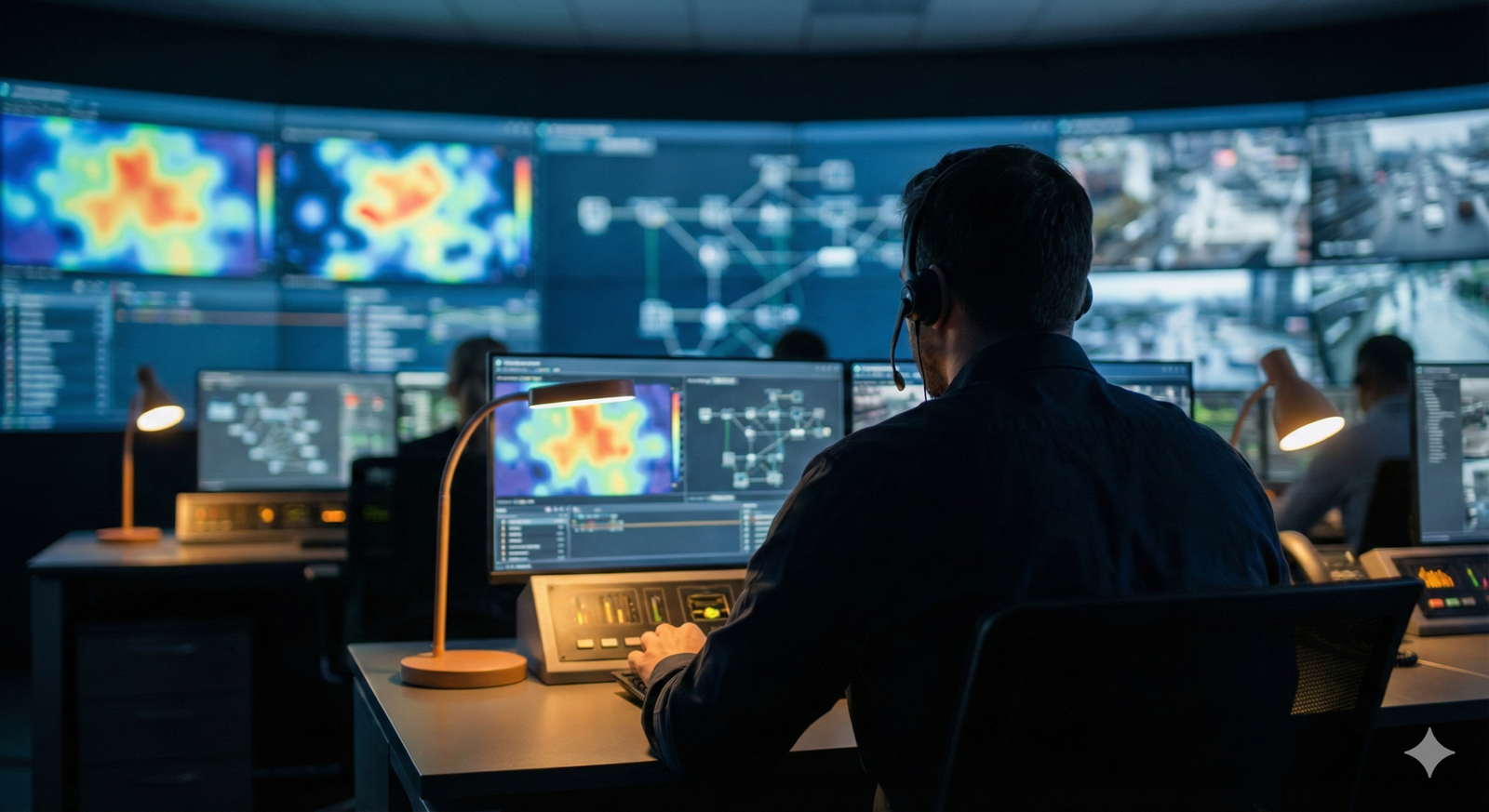
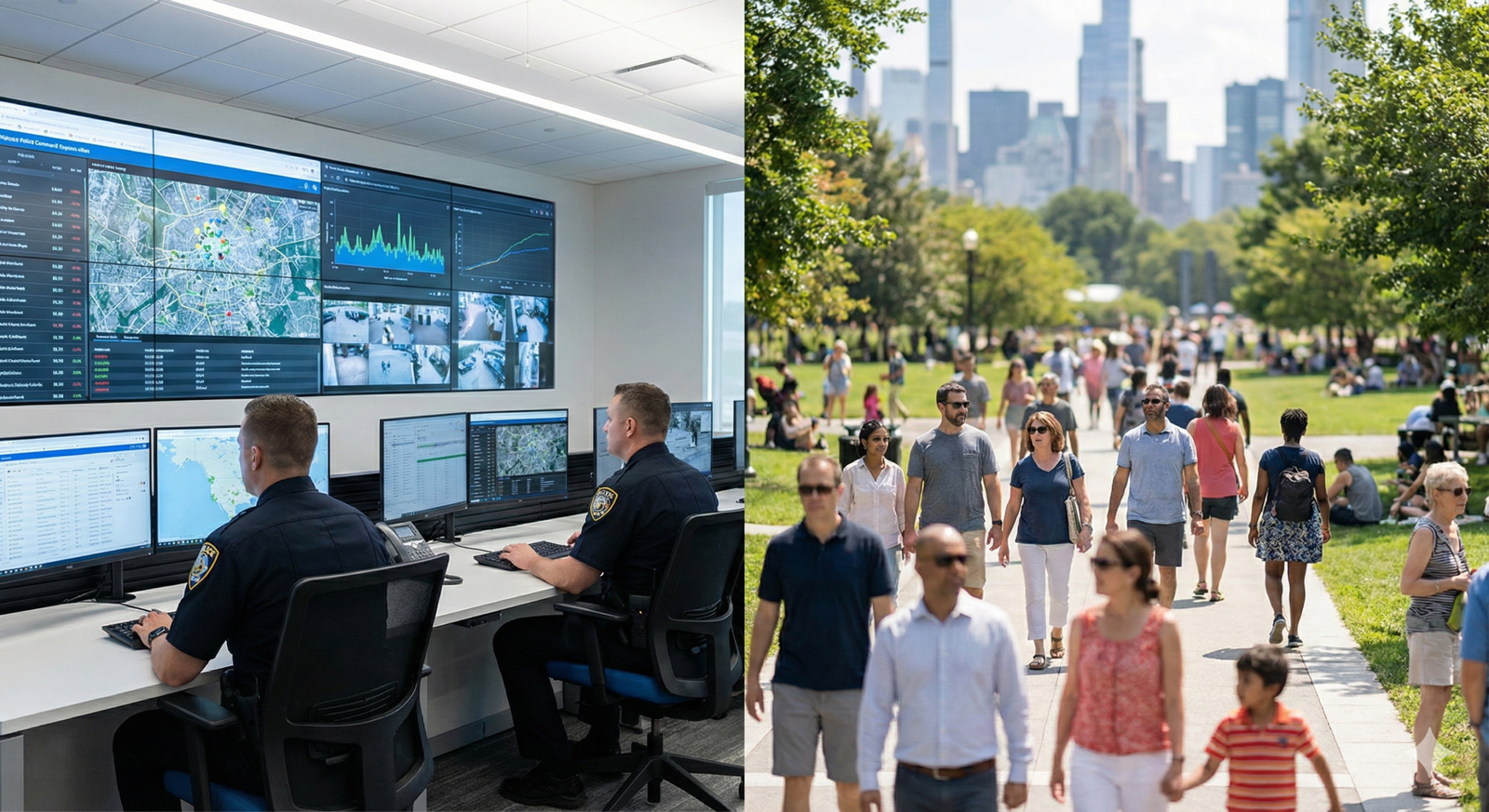
In practice, these tools are often integrated into Real-Time Crime Centers (RTCCs), where analysts view a unified dashboard of camera feeds, gunshot detection alerts, and license plate scans.
How AI Tools Are Used in Practice
The application of AI varies significantly by jurisdiction, budget, and local laws. However, four primary categories of tools dominate the landscape.
1. Facial Recognition Technology (FRT)
Facial recognition is perhaps the most controversial tool. It generally functions in two ways:
- 1:1 Verification: Matching a live face to a specific ID photo (e.g., unlocking a phone or verifying identity at a secure checkpoint). This is generally viewed as lower risk.
- 1:N Identification: Comparing a probe image (e.g., a still from a CCTV camera) against a database of millions of mugshots or driver’s license photos to find a match.
In Practice: A detective uploads a grainy photo of a robbery suspect. The system returns five “candidate” matches with confidence scores. The detective is supposed to treat this as a lead, not probable cause, but in high-pressure environments, the machine’s suggestion often carries undue weight.
2. Predictive Policing
Predictive policing encompasses two distinct approaches:
- Place-Based (Hotspot) Prediction: The algorithm divides a city into small grids (sometimes as small as 500 square feet). It analyzes past crime data, weather, time of day, and even phases of the moon to predict where property crimes or violence are most likely to occur. Patrol cars are then routed to these “boxes” during high-risk times.
- Person-Based Prediction: Much more controversial, this attempts to identify individuals most likely to be perpetrators or victims of gun violence. These systems generate “strategic subject lists” or “heat lists.”
3. Automated License Plate Readers (ALPR)
While ALPRs have existed for years, AI has supercharged them. Modern cameras don’t just read plates; they use “vehicle signature recognition” to identify the make, model, color, and distinct features (like a bumper sticker or dent) of a car, even if the plate is missing. This data is aggregated into massive databases, allowing police to reconstruct a vehicle’s historical travel patterns.
4. Gunshot Detection and Acoustic Surveillance
Sensors placed on rooftops or streetlights listen for the acoustic signature of a gunshot. AI algorithms filter out fireworks or car backfires and triangulate the location of the shot, dispatching officers often before a 911 call is made. While effective at detecting incidents, these systems raise concerns about false alerts and the continuous acoustic monitoring of neighborhoods.
The Case for AI: Enhancing Public Safety
Proponents of AI in law enforcement argue that when used correctly, these tools are force multipliers that save lives and improve justice.
Efficiency and Resource Allocation
Police departments often face staffing shortages. AI helps allocate limited resources more effectively. Instead of random patrols, officers can be deployed to areas where data suggests they are needed most. This efficiency can reduce response times for critical incidents.
Solving Cold Cases
One of the most powerful applications of AI is in reviewing cold cases. Algorithms can scan decades of fingerprint data or DNA profiles much faster than humans, finding matches that were previously missed due to technology limitations or human error. Similarly, facial recognition has been used to identify victims of human trafficking or John/Jane Does who have been unidentified for years.
Removing Human Bias (Theoretically)
Ideally, an algorithm is purely mathematical. It does not get tired, it does not hold personal grudges, and it does not feel fear. Proponents argue that a well-calibrated objective risk assessment tool could theoretically be less biased than a human judge or officer who might carry implicit subconscious biases. For example, data-driven staffing could ensure police presence is based on crime reports rather than an officer’s hunch about a “bad neighborhood.”
Investigating Complex Financial Crimes
In white-collar crime, AI is indispensable. It can analyze millions of banking transactions to spot money laundering patterns that no team of human auditors could detect. This capability is crucial for combating organized crime and terrorism financing.
The Civil Liberties Challenge: Privacy and Surveillance
The introduction of AI into policing fundamentally alters the relationship between the state and the individual. The primary friction point is the erosion of privacy and the potential for a “chilling effect” on civil rights.
The Death of Obscurity
Traditionally, citizens enjoyed “privacy by obscurity.” You could walk down a street, and while you might be seen, you were not tracked, logged, and indexed. AI eliminates this. With the integration of facial recognition and gait analysis into CCTV networks, it is becoming technically feasible to track a person’s movements across a city retroactively.
Civil liberties advocates argue this constitutes a warrantless search. If the police can rewind a month of your life to see everyone you met, every political rally you attended, and every doctor’s office you visited, the Fourth Amendment protection against unreasonable searches is effectively bypassed by technology.
The Chilling Effect on Free Speech
When citizens know—or suspect—they are being watched by sophisticated AI, they change their behavior. This is known as the chilling effect. People may be less likely to attend protests, meet with dissident groups, or express controversial opinions if they believe their face is being scanned and logged in a police database. This undermines First Amendment rights not by direct prohibition, but by subtle intimidation.
Mosaic Theory and Aggregation
The “Mosaic Theory” in legal terms suggests that while a single data point (seeing a car at a corner) might not be invasive, the aggregation of thousands of points creates a complete picture of a life that is invasive. AI excels at this aggregation. It stitches together credit card data, ALPR hits, facial recognition scans, and social media activity to create a comprehensive profile that reveals intimate details of a person’s life without a warrant ever being signed.
Algorithmic Bias and Discrimination
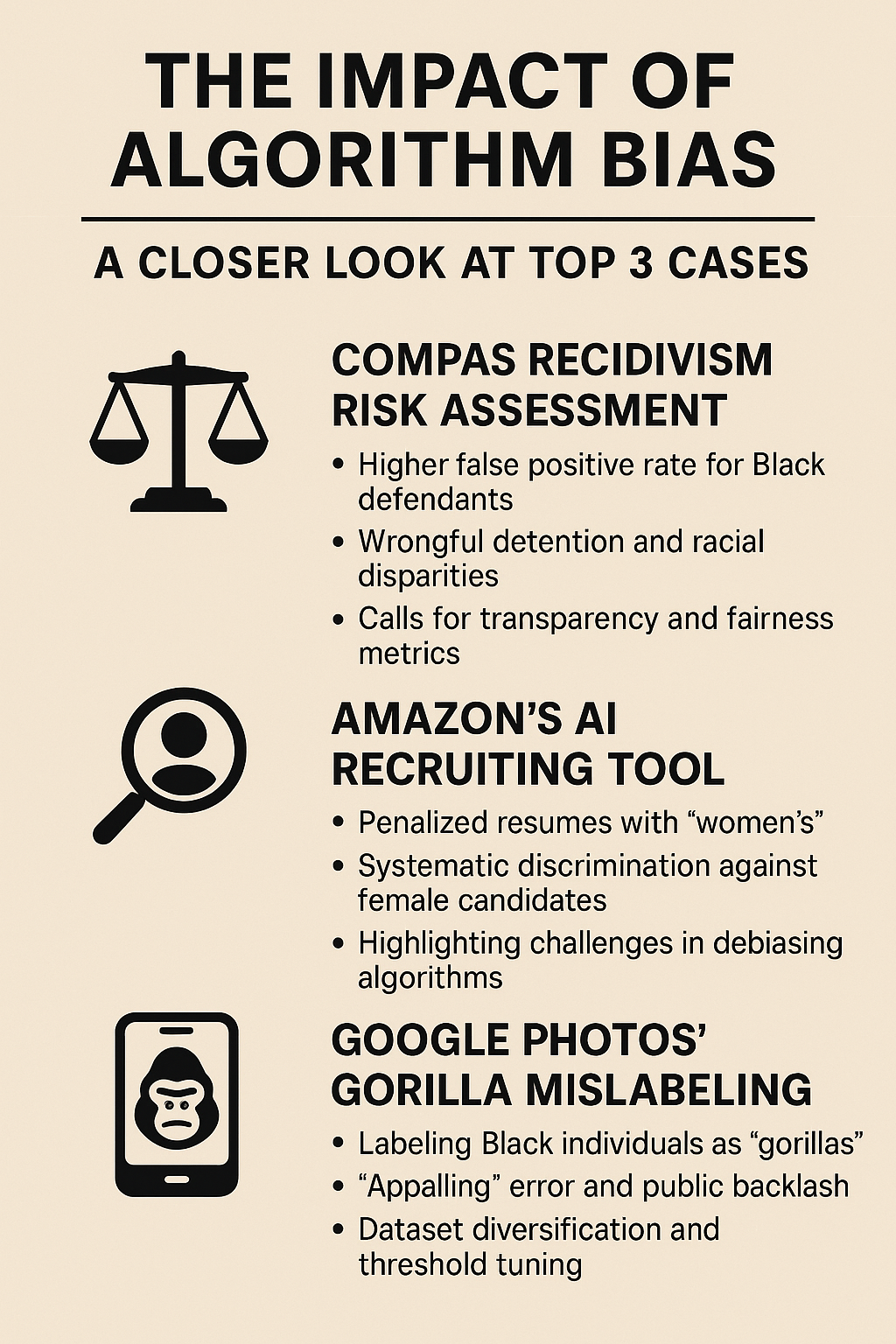
Perhaps the most pervasive issue with AI in law enforcement is algorithmic bias. Contrary to the idea that machines are neutral, AI systems often inherit and amplify the prejudices of the world they analyze.
The “Dirty Data” Problem
AI models are trained on historical data. In many jurisdictions, historical policing data is fraught with bias. If a neighborhood has been heavily over-policed for decades, there will be more arrest records and crime reports from that area, regardless of the actual crime rate compared to other areas.
When a predictive policing algorithm is fed this data, it learns that “Crime happens in Area A.” It then directs more officers to Area A. These officers, simply by being there, observe more infractions (even minor ones) and make more arrests. This new data is fed back into the system, reinforcing the prediction. This is the feedback loop: the algorithm predicts policing, not necessarily crime.
Facial Recognition Disparities
Technologically, facial recognition has struggled with demographic accuracy. As of 2026, while top-tier algorithms have improved, many systems still deployed in the field show higher error rates for:
- People with darker skin tones.
- Women (compared to men).
- Younger and older subjects (compared to middle-aged adults).
A study by the National Institute of Standards and Technology (NIST) historically highlighted these disparities. When these flawed tools are used in investigations, they lead to wrongful arrests. There have been documented cases where innocent individuals were arrested solely because an algorithm mismatched their face with a grainy surveillance image of a suspect.
Automation Bias
This refers to the human tendency to trust the machine over one’s own judgment or contradictory evidence. When an AI system flags a car as “stolen” or a person as “high risk,” officers may subconsciously lower their threshold for using force or detaining the individual, assuming the computer “knows” something they don’t. This effectively shifts the burden of proof onto the citizen to prove the machine wrong.
Accountability and Transparency Mechanisms
A major hurdle in governing police AI is the lack of transparency. We cannot hold a system accountable if we do not know how it works or when it is being used.
The Black Box Problem
Many AI tools are developed by private vendors who claim their algorithms are “trade secrets” or proprietary intellectual property. When defense attorneys challenge the validity of an AI-driven identification in court, vendors often fight to keep the source code and training data secret. This denies defendants their due process right to confront the evidence against them. If an algorithm sent you to jail, you should have the right to know if that algorithm is flawed.
Shadow IT and Lack of Oversight
In some cases, police departments have acquired AI tools without public debate or city council approval, using discretionary funds or federal grants. This “shadow IT” procurement means that surveillance infrastructure is built silently, without privacy impact assessments or community input.
Accountability Frameworks
Effective governance requires three layers of accountability:
- Ex Ante (Before): Rigorous testing and impact assessments before a tool is purchased. Does it work? Is it biased? Is it necessary?
- In Medias Res (During): Real-time auditing and “human-in-the-loop” requirements. An AI should never make a final decision on an arrest or detainment; it should only provide information to a trained officer.
- Ex Post (After): Regular audits of how the tool was used. Did it disproportionately target specific demographics? Were the predictions accurate?
Regulatory Landscape and Governance
The legal framework for AI in law enforcement is currently a patchwork of local ordinances, state laws, and emerging federal guidance.
The US Landscape
As of 2026, there is no single comprehensive federal law governing police AI in the United States. Instead, regulation happens at the edges:
- Local Bans: Several cities (e.g., San Francisco, Boston, Portland) have at various times banned or placed moratoriums on government use of facial recognition.
- State Legislation: States like Illinois (BIPA) and California have passed privacy laws that indirectly constrain how biometric data can be collected and used.
- Federal Guidance: The Department of Justice and NIST provide standards and voluntary frameworks, but compliance is often not mandatory for local agencies.
The EU Approach
The European Union has taken a stricter stance with the EU AI Act. This legislation categorizes AI systems by risk. “Real-time remote biometric identification” (live facial recognition) in publicly accessible spaces by law enforcement is generally prohibited, with narrow exceptions for serious crimes (terrorism, kidnapping) and subject to judicial authorization. This places the burden on police to prove necessity before deployment.
Global Variations
- United Kingdom: Uses FRT more liberally than the EU, often deploying “Live Facial Recognition” vans in high-traffic areas, though this faces ongoing legal challenges regarding the right to privacy.
- China: Represents the other end of the spectrum, integrating AI, widespread surveillance, and social scoring into a comprehensive state monitoring apparatus, illustrating the potential extreme of unchecked AI policing.
Common Mistakes in Implementation
When agencies rush to adopt AI without proper groundwork, failure is common. These pitfalls undermine public trust and can lead to legal liability.
1. Technological Solutionism
This is the belief that complex social problems (like crime) can be solved purely with technology. Buying a predictive policing software suite does not address the root causes of crime, such as poverty, lack of education, or addiction. When cities spend millions on software while cutting social services, they are engaging in solutionism.
2. Lack of Community Engagement
Implementing surveillance towers or gunshot detection microphones in a neighborhood without consulting the residents is a recipe for backlash. It reinforces the narrative that the police are an occupying force rather than public servants. Successful implementations require transparency and community buy-in before the contract is signed.
3. Ignoring False Positives
Agencies often focus on the “hits” (successful identifications) and ignore the “misses” (false positives). If a system is 99% accurate but scans 100,000 people a day at a sports stadium, that is 1,000 innocent people flagged as criminals daily. Failing to have a protocol for managing these false positives leads to harassment of innocent citizens.
4. Mission Creep
Tools purchased for one narrow purpose often expand into others. An ALPR system bought to recover stolen cars might eventually be used to track individuals for minor infractions or to enforce civil fines. Without strict policy limits, the scope of surveillance naturally expands over time.
Best Practices for Responsible Deployment
For law enforcement agencies that wish to use AI ethically, and for citizens demanding better governance, the following best practices are the gold standard.
1. Mandatory Privacy Impact Assessments (PIA)
Before acquiring any new technology, agencies should conduct a PIA. This document must detail what data is collected, how long it is kept, who has access, and the potential risks to civil liberties. This assessment should be public.
2. The “Human-in-the-Loop” Standard
AI should never execute an enforcement action autonomously. A human officer must review the AI’s output and verify it independently. For example, a facial recognition match should lead to a detective investigating the lead, not an immediate arrest warrant.
3. Public Use Policies and Audits
Agencies must publish clear policies defining acceptable use. Furthermore, independent third parties should audit the algorithms for bias and accuracy annually. If a vendor refuses to allow an independent audit, the agency should not buy the tool.
4. Limited Retention Periods
Data should not be kept forever. “Data minimization” principles suggest that if a license plate scan or video clip is not relevant to an active investigation, it should be deleted after a short period (e.g., 30 days). This prevents the creation of massive historical databases of innocent people’s movements.
5. Vendor Transparency Requirements
Procurement contracts should require vendors to disclose accuracy rates across different demographics and allow for court review of the technology when it is used as evidence in criminal proceedings.
Future Trends: The Next Decade of Policing
Looking ahead, the integration of AI will become deeper and more subtle.
- AI-Enhanced Body Cameras: Future body cams will likely have real-time capabilities, identifying suspects or translating languages on the fly for officers. This turns every patrol officer into a mobile surveillance node.
- Virtual Reality (VR) Training: AI-driven VR is becoming the standard for de-escalation training, allowing officers to practice navigating complex mental health crises or high-stress encounters in a safe, simulated environment.
- Predictive Prosecution: The logic of predictive policing is moving into the courts, with AI tools advising judges on bail and sentencing decisions based on “risk of recidivism” scores. This carries the same bias risks as policing algorithms.
- The Rise of “Clean Data”: Acknowledging the bias in historical data, researchers are working on synthetic data generation and “de-biasing” techniques to create fairer algorithms, though the efficacy of these methods is still being proven.
Related Topics to Explore
To deepen your understanding of the intersection between technology and rights, consider exploring these related concepts:
- Fourth Amendment in the Digital Age: How legal definitions of “search” and “seizure” are evolving with technology.
- Surveillance Capitalism: How private data collection by corporations feeds into government surveillance.
- Algorithmic Transparency Standards: The technical methods used to open the “black box” of AI.
- Smart Cities and Privacy: The implications of municipal sensors and IoT devices on urban anonymity.
- Biometric Data Privacy Laws: Detailed breakdowns of laws like BIPA (Illinois) and GDPR (Europe).
Conclusion
The integration of AI in law enforcement is not a binary choice between safety and tyranny. It is a complex negotiation of values. On one hand, AI offers the genuine potential to solve heinous crimes, locate missing children, and allocate public resources more efficiently. On the other, it poses a structural threat to privacy, anonymity, and equality under the law.
Balancing these forces requires active participation. We cannot leave the rules of engagement solely to software vendors or police departments. Robust civilian oversight, strict legal guardrails, and a commitment to transparency are the only ways to ensure that the AI tools of tomorrow serve the public rather than subjugating it.
As we move forward, the question is not whether AI will be used in policing—it already is. The question is whether we can build the legal and ethical frameworks fast enough to keep up with the code.
Next steps: If you are concerned about surveillance in your community, look up your local city council agenda to see if any police technology contracts are up for review, or check if your local police department publishes an annual transparency report on their use of surveillance technology.
FAQs
1. Is predictive policing legal in the United States? Yes, predictive policing is generally legal in the United States and is used by police departments in major cities like Los Angeles, Chicago, and New York. However, specific applications can be challenged in court if they are proven to be discriminatory or if they violate Fourth Amendment protections against unreasonable search and seizure. The legal landscape is evolving, and some cities have voluntarily discontinued these programs due to public backlash.
2. Can facial recognition alone be used as evidence to convict someone? In most jurisdictions, a facial recognition match is considered an investigative lead, not positive identification. It is not sufficient probable cause for an arrest or a conviction on its own. Police are expected to find corroborating evidence (like fingerprints, witness testimony, or DNA) to support the AI’s finding. However, defense attorneys argue that in practice, the AI match often prejudices the investigation.
3. What is the “Black Box” problem in AI policing? The “Black Box” problem refers to the lack of transparency in how AI algorithms make decisions. Because the software is often proprietary intellectual property owned by private vendors, the inner workings (the code and logic) are hidden from the public, the police who use them, and the defendants accused by them. This makes it difficult to detect errors or bias within the system.
4. Does AI in policing reduce crime rates? The evidence is mixed. While some studies suggest that predictive policing can reduce crime in targeted hotspots in the short term, other comprehensive reviews have found little to no long-term reduction in crime rates compared to traditional policing methods. Critics argue that any perceived reduction often comes at the cost of community trust and may simply displace crime to adjacent areas.
5. How does AI affect minority communities? AI often disproportionately impacts minority communities due to algorithmic bias. Facial recognition systems have historically had higher error rates for people of color. Additionally, predictive policing relies on historical crime data; if a community has been over-policed in the past, the algorithm will continue to target it, creating a feedback loop of surveillance and arrest that disproportionately affects marginalized groups.
6. Can I opt out of police facial recognition surveillance? generally, no. If you are in a public space, you have no reasonable expectation of privacy regarding your face being visible. Therefore, if police are using cameras equipped with facial recognition in public areas, you cannot legally opt out. Some jurisdictions have banned the technology locally, but in places where it is legal, implied consent applies to public spaces.
7. What is the difference between place-based and person-based predictive policing? Place-based predictive policing forecasts where and when crime is likely to happen (e.g., predicting a burglary hotspot on a specific street corner). Person-based predictive policing attempts to forecast who is likely to be involved in a crime, either as a victim or a perpetrator, often generating “risk scores” for individuals based on their criminal history and social networks.
8. Are there federal laws regulating AI in US law enforcement? As of early 2026, there is no comprehensive federal law regulating AI in law enforcement. There are various executive orders and agency guidelines (like those from the DOJ), but enforceable legislation remains largely at the state and local levels. The lack of a federal standard leads to a fragmented landscape where rights and protections vary significantly depending on the zip code.
9. How accurate are gunshot detection systems? Accuracy varies. Vendors claim high accuracy rates (often above 90%), but independent audits and community reports often show high rates of false positives—alerts triggered by fireworks, car backfires, or construction noise. These false alerts can send police into neighborhoods on “high alert” for a shooting that never happened, potentially increasing the risk of dangerous confrontations.
10. What role do “Fusion Centers” play in AI policing? Fusion Centers are state-owned and operated hubs that facilitate information sharing between local, state, and federal agencies. They act as the central nervous system for AI policing, aggregating data from ALPRs, facial recognition, and intelligence reports. They allow a local police department to access data and AI capabilities that they might not be able to afford or manage on their own.
References
- National Institute of Standards and Technology (NIST). (2024). Face Recognition Vendor Test (FRVT) Ongoing. NIST. https://www.nist.gov/programs-projects/face-recognition-vendor-test-frvt
- European Union. (2024). The AI Act: Regulation of the European Parliament and of the Council Laying Down Harmonised Rules on Artificial Intelligence. Official Journal of the European Union. https://artificialintelligenceact.eu/
- American Civil Liberties Union (ACLU). (2023). The Dawn of Robot Surveillance: AI, Video Analytics, and Privacy. ACLU.
- U.S. Department of Justice. (2025). Law Enforcement Guidelines for the Responsible Use of Facial Recognition Technology. Office of Justice Programs. https://www.justice.gov/
- Electronic Frontier Foundation (EFF). (2024). Street-Level Surveillance: Automated License Plate Readers (ALPRs). EFF.
- Richardson, R., Schultz, J., & Crawford, K. (2019). Dirty Data, Bad Predictions: How Civil Rights Violations Impact Police Data, Predictive Policing Systems, and Justice. New York University Law Review.
- Lum, K., & Isaac, W. (2016). To predict and serve? Significance Magazine, Royal Statistical Society. https://significancemagazine.com/
- Bureau of Justice Assistance. (2024). Real-Time Crime Center (RTCC) Guidelines and Standards. U.S. Department of Justice. https://bja.ojp.gov/
- Georgetown Law Center on Privacy & Technology. (2022). The Perpetual Line-Up: Unregulated Police Face Recognition in America. Georgetown Law. https://www.perpetuallineup.org/
- United Nations Human Rights Council. (2023). The right to privacy in the digital age: Report of the Office of the United Nations High Commissioner for Human Rights. UN OHCHR. https://www.ohchr.org/en/issues/digitalage/pages/digitalageindex.aspx