| Situation | Lighter approach fits | Full feature store fits |
|---|---|---|
| Team size | 1-3 ML engineers, one or two models | Multiple teams, dozens of models sharing features |
| Serving latency needs | Batch or near-real-time is fine | Sub-100ms online serving required |
| Training-serving skew risk | Low, single codebase computes features | High, separate training and serving pipelines |
| Point-in-time correctness | Manually managed joins, small datasets | Automated time-travel joins across huge histories |
| Governance and lineage needs | Informal, small blast radius | Regulated industry, audit requirements |
What a Feature Store Actually Does
A feature store is a specialized data system that sits between raw data sources and the models that consume them. Its job is narrow but important: compute features once, store them in a form that both training and serving code can read, and guarantee that the value a model sees at inference time matches the value it would have seen during training. That last guarantee is the one people underestimate until they get burned by it.
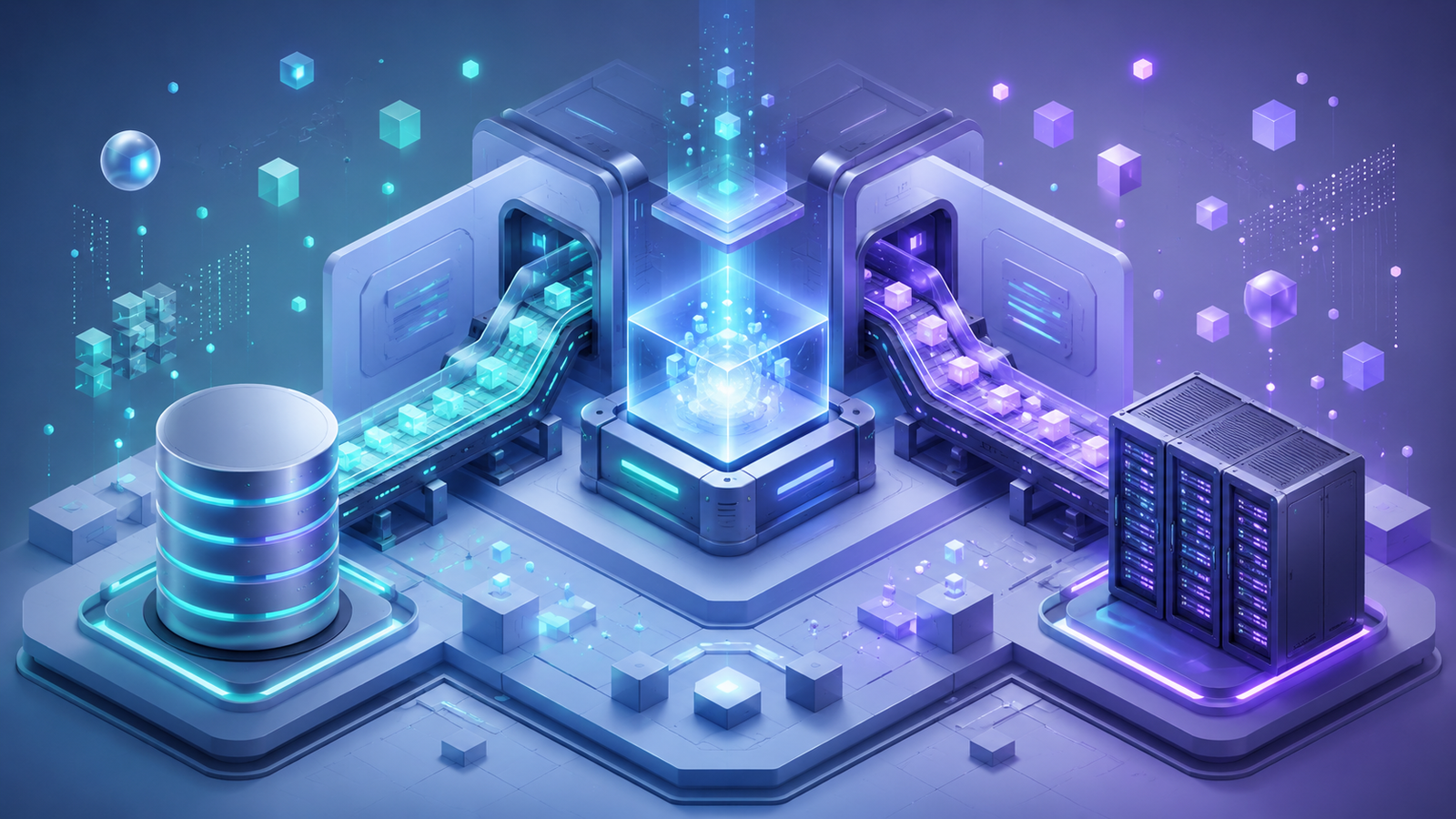
Under the hood, a feature store is really two systems wearing one API. The offline store holds historical feature values, usually on top of a data lake or warehouse, and supports point-in-time joins so a training job can reconstruct exactly what a feature looked like at any past timestamp. The online store holds only the latest value for each entity key, and serves it back in single-digit or low double-digit milliseconds because a live prediction request cannot afford to scan a data warehouse. Feature stores put both behind a shared definition so the transformation logic that produced a feature at training time is the same logic that produces it at serving time.
That shared definition is what prevents training-serving skew, one of the most common and hardest-to-detect bugs in production machine learning. Training-serving skew happens when the code path that computes a feature during model training diverges from the code path that computes it during live inference. A subtle difference, like a different null-handling rule or a different time window for an aggregation, can silently degrade a model’s accuracy without throwing an error anywhere. If you have never diagnosed a model that scored great offline and mediocre online, this is very often the cause, and it is one of the pitfalls we cover in more depth in our piece on MLOps in the LLM era.
Feature reuse is the second pillar. Without a shared store, every team tends to reimplement the same features, a rolling 30-day purchase count, a user’s average session length, a merchant’s fraud rate, inside their own pipeline. That duplication multiplies maintenance cost and introduces silent inconsistencies between teams computing what should be the identical number. A feature store turns each feature into a registered, versioned, discoverable asset that other teams can query rather than reinvent. The cost of skipping this is rarely visible on a single team’s roadmap; it shows up later as a data science team spending a sprint reconciling why their churn model and the marketing team’s churn model disagree about the same customer, only to discover both were computing “days since last purchase” with a slightly different definition of a day boundary.
The 2026 Tooling Landscape
The market has settled into a few clear categories rather than one dominant winner.
| Tool | Category | Best fit | Tradeoff |
|---|---|---|---|
| Feast | Open source, self-hosted | Teams wanting full architectural control | Running it well requires real operational investment, often estimated around 0.3 FTE of ongoing maintenance |
| Tecton | Managed platform | Real-time production pipelines with heavy online serving | Proprietary transformation DSL makes migrating away costly |
| Databricks Feature Store | Platform-integrated | Teams already standardized on Databricks and Unity Catalog | Tightest value when you are already on Delta Lake and Lakebase |
| SageMaker Feature Store | Cloud-managed | AWS-native teams wanting a single managed service for offline and online paths | Offline time-travel queries and online low-latency serving are bundled but tied to AWS |
Feast remains the default open-source choice for teams that want to own their infrastructure and avoid vendor lock-in, but that control comes with a real operational tax: someone on the team needs to understand its materialization jobs, its registry, and its online store backend well enough to keep it running when something breaks at 2am. Tecton, by contrast, is built specifically around point-in-time correct backfills and low-latency online serving, which makes it a strong fit for real-time personalization and fraud use cases, but its proprietary transformation language means that once you commit, rewriting everything to leave is expensive. Databricks Feature Store and SageMaker Feature Store both take the “feature store as a feature of a bigger platform” approach, which is convenient if you are already deep in that ecosystem and much less convenient if you are not.
None of these tools compete purely on features anymore; they compete on how much of your existing stack they can plug into without a rewrite. A team already storing everything in Delta Lake will find Databricks Feature Store nearly frictionless to adopt because governance, lineage, and online serving are already wired into Unity Catalog. A team spread across a more heterogeneous stack, multiple clouds, a mix of batch and streaming sources, tends to gravitate toward Feast specifically because it refuses to assume any single storage backend, at the cost of needing someone to own that flexibility operationally.
When a Shared Feature Library Plus a Cache Is Enough
Here is the honest part most vendor content skips: a large share of teams evaluating a feature store do not need one yet. If you have one or two models, a small ML team, and a single codebase that computes features for both training and serving, you can get most of the benefit of a feature store with three much simpler pieces.
- A shared feature library. A well-documented internal Python package (or equivalent) with feature-computation functions that both your training pipeline and your serving code import from the same place. This alone eliminates most training-serving skew because there is only one implementation to diverge.
- A cache for hot features. Redis or a similar key-value store in front of your database gives you the low-latency online lookups a feature store would provide, without the registry, materialization jobs, and governance layer.
- A convention for point-in-time joins. If your training data volume is modest, a disciplined SQL pattern (join on event time, not current time) gets you point-in-time correctness without a dedicated time-travel engine.
This lighter stack breaks down once you cross certain thresholds: multiple teams building models that need the same features, online serving latency requirements tight enough that a general-purpose cache with no feature-specific tooling becomes painful to operate, or regulatory requirements that demand full lineage and audit trails on every feature value ever served. At that point, the operational cost of a full feature store platform is smaller than the cost of the inconsistencies and duplicated work it prevents.
Figure: Where the Feature Store Threshold Sits
As model count and team count grow, the cost of duplicated feature logic rises faster than the fixed cost of operating a feature store platform, crossing over somewhere between three and ten actively maintained models depending on team structure.
Point-in-Time Correctness, Explained Simply
Point-in-time correctness means that when you build a training example for an event that happened on a given date, every feature value in that example reflects only information that was actually available at that moment, nothing from the future. Getting this wrong is one of the most common sources of data leakage: a fraud model trained on “current” account age instead of “account age at the time of the transaction” will look suspiciously accurate offline and then fail badly in production, because in production it never has access to future information.
Feature stores solve this with time-travel joins: given a table of historical feature values with timestamps, and a table of labeled events with their own timestamps, the join operation automatically picks the most recent feature value that existed strictly before each event. Both SageMaker Feature Store’s offline API and Databricks Feature Store’s point-in-time join support this natively. Doing it by hand in raw SQL is possible but easy to get subtly wrong, especially across many features and tables, which is exactly why teams that hit this pain point tend to become feature store converts almost overnight.
Governance, Lineage, and Discovery
Beyond serving and correctness, a mature feature store adds a layer that smaller setups often lack entirely: a searchable catalog of what features exist, who owns them, what they depend on, and which models consume them. In regulated industries, this lineage is not optional; auditors want to know exactly which upstream data fed a decision. In less regulated settings it is still valuable because it prevents the quiet duplication problem described earlier, and it makes onboarding new ML engineers faster because they can search for an existing feature instead of writing a new one from scratch.
Migration Patterns: Moving To or Away From a Feature Store
Adoption rarely happens as a single cutover, and the teams that report the least pain treat it as an incremental migration rather than a rewrite. The typical sequence starts with an audit: list every feature currently computed across every model, note which ones are duplicated across teams, and rank them by how many consumers each one has. The highest-reuse features move first, since that is where the shared-definition benefit pays off immediately and visibly, which also builds internal buy-in for the migration before it touches lower-priority features.
The reverse migration, moving away from a feature store, is rarer but does happen, usually when a team over-adopted a heavyweight platform for a use case that shrank rather than grew, or when a vendor’s proprietary transformation layer became a bigger liability than the skew problem it solved. Teams in this position generally keep the online cache layer (since low-latency serving is still needed) and replace only the offline governance and materialization tooling with something lighter, rather than tearing out the entire stack at once.
A build-versus-buy decision also hides inside this migration question. Building on Feast means investing engineering time in operations rather than licensing fees; buying Tecton, Databricks, or SageMaker Feature Store means paying for a managed experience but accepting the platform’s opinions about how transformations are defined and where data must live. Neither choice is universally correct, and the right answer usually tracks whichever constraint, engineering time or platform flexibility, is scarcer for a given organization at a given point in its growth.
Common mistake
Teams adopt a full feature store platform before they have more than one model consuming shared features, then spend more engineering time operating the platform than they would have spent maintaining a simple shared library. Match the tool to the actual number of consumers, not to what a vendor’s roadmap slide implies you will need eventually.
What worked
Several teams that outgrew a shared-library approach reported the smoothest transitions came from adopting Feast or a managed store only after cataloging their existing features and migrating the highest-reuse ones first, rather than attempting a full cutover of every feature on day one.
Frequently Overlooked Details
- Materialization lagThe delay between a feature being computed offline and becoming available in the online store; if this lag is longer than your prediction latency budget, “real-time” features are not actually real-time.
- Entity keysThe join keys (user ID, merchant ID, session ID) that link features across the offline and online stores; inconsistent key definitions are a frequent source of silent join failures.
- Backfill costRecomputing historical feature values when a feature definition changes can be computationally expensive and is often the hidden cost behind adding “just one more feature.”
- Feature versioningChanging a feature’s logic without versioning it breaks reproducibility for every model trained on the old definition.
- Cold startNew entities with no historical feature values need a defined fallback, otherwise online serving returns nulls that models were never trained to handle.
Feature Store or Not: A Practical Decision Framework
| Signal | Weight toward feature store | Weight toward lightweight approach |
|---|---|---|
| Number of models sharing features | 5 or more | 1-2 |
| Online serving latency budget | Under 50ms | Seconds are acceptable |
| History of skew incidents | Has happened before | Never observed |
| Compliance and audit requirements | Formal lineage required | Informal tracking acceptable |
| Dedicated MLOps headcount | Available | None available |
Score honestly against your actual situation rather than an aspirational future headcount. Teams frequently over-provision for a scale they might reach in two years, paying the operational tax the entire time they are smaller. A useful exercise is to run this scoring exercise quarterly rather than once, since the answer legitimately changes as a team grows, and locking in a decision made at five people while evaluating tools meant for fifty rarely ages well in either direction. If your team is investing in building out a broader platform function to support this kind of decision, see our related piece on building an ML platform team.
How This Connects to the Rest of the ML Stack
A feature store rarely exists in isolation. It typically sits alongside a model monitoring layer that watches for drift in the very features the store serves, see our deep dive on model monitoring in production, an experimentation layer that validates whether new features actually move business metrics, covered in our guide to A/B testing ML models, and increasingly, retrieval infrastructure for LLM-based applications, where the “features” are embeddings and the correctness question looks a lot like the one covered in our RAG architecture guide. Reproducibility concerns overlap too; see our piece on reproducible ML for how feature versioning ties into broader experiment reproducibility.
Glossary
- Offline store
- The historical feature repository used for training, typically built on a data lake or warehouse, optimized for large batch reads rather than low latency.
- Online store
- The low-latency key-value store that serves the most recent feature values to live prediction requests, typically returning results in single or low double-digit milliseconds.
- Training-serving skew
- A mismatch between the feature values a model saw during training and the values it sees during live inference, usually caused by divergent code paths computing the same feature.
- Point-in-time join
- A join operation that matches each labeled event to the feature values that existed at or before that event’s timestamp, preventing future information from leaking into training data.
- Materialization
- The process of moving computed feature values from the offline store into the online store so they become available for real-time serving.
Key Takeaways
- A feature store’s core value is preventing training-serving skew by putting one shared definition behind both the training and serving code paths.
- Point-in-time correctness prevents data leakage by ensuring training examples only see information available at the time of the original event.
- Feast offers full control but real operational overhead, often estimated around 0.3 FTE of ongoing maintenance.
- Tecton is strong for real-time serving but its proprietary transformation DSL creates migration lock-in.
- Databricks Feature Store and SageMaker Feature Store both bundle offline time-travel and online serving, but tie you to their respective platforms.
- A shared feature library plus a simple cache covers most of the benefit for teams with one or two models and no hard real-time latency requirement.
- The right time to adopt a full feature store is when duplicated feature logic across teams costs more engineering time than operating the platform would.
FAQs
Do small ML teams need a feature store?
Usually not right away. A small team with one or two models can typically get most of the benefit, mainly consistent feature logic between training and serving, from a shared internal library and a basic cache, reserving a full feature store platform for when multiple teams or models start sharing features.
What is the main problem a feature store solves?
The primary problem is training-serving skew, where the code that computes a feature during training differs from the code that computes it during live inference, causing silent accuracy degradation that is hard to diagnose without a shared definition.
Is Feast free to run in production?
Feast itself is open source and free to license, but running it reliably in production requires real engineering investment, commonly estimated at around 0.3 FTE, to manage its materialization jobs, registry, and online store backend.
How is Tecton different from Feast?
Tecton is a managed platform built specifically around point-in-time correct backfills and low-latency online serving, while Feast is a self-hosted open-source project giving teams more architectural control at the cost of more operational responsibility.
What does point-in-time correctness actually prevent?
It prevents data leakage, where a model is accidentally trained on information that would not have been available at the actual moment of prediction, which typically makes offline evaluation metrics look better than real-world performance.
Can a feature store fix training-serving skew on its own?
Only if teams actually route both training and serving through its shared feature definitions. Installing a feature store while keeping separate ad hoc feature computation code elsewhere still leaves the underlying skew risk in place.
What is materialization lag and why does it matter?
Materialization lag is the delay between a feature being computed offline and becoming available in the online store; if this lag exceeds your prediction latency budget, features marketed as real-time are effectively stale by the time they are served.
Should a regulated industry always use a full feature store?
Regulated industries generally benefit more than most from a full feature store because of the lineage, versioning, and audit trail requirements that come with formal governance, which a lightweight shared library typically cannot provide out of the box.
- Reintech, Feature Store Comparison 2026: Feast vs Tecton vs Amazon SageMaker Feature Store
- Tacnode Blog, Feature Store Comparison: Feast vs Tecton vs Databricks 2026
- MLOps Platforms, Feature Store Comparison 2026: Feast, Tecton, Hopsworks, and the Managed Options
- Databricks Blog, What is a Feature Store: A Complete Guide to ML Feature Engineering
- Databricks Documentation, Feature Store Overview and Glossary
- AWS, Amazon SageMaker Feature Store for Machine Learning
- Several Clouds, Choosing the Right Feature Store: Feast vs Amazon SageMaker