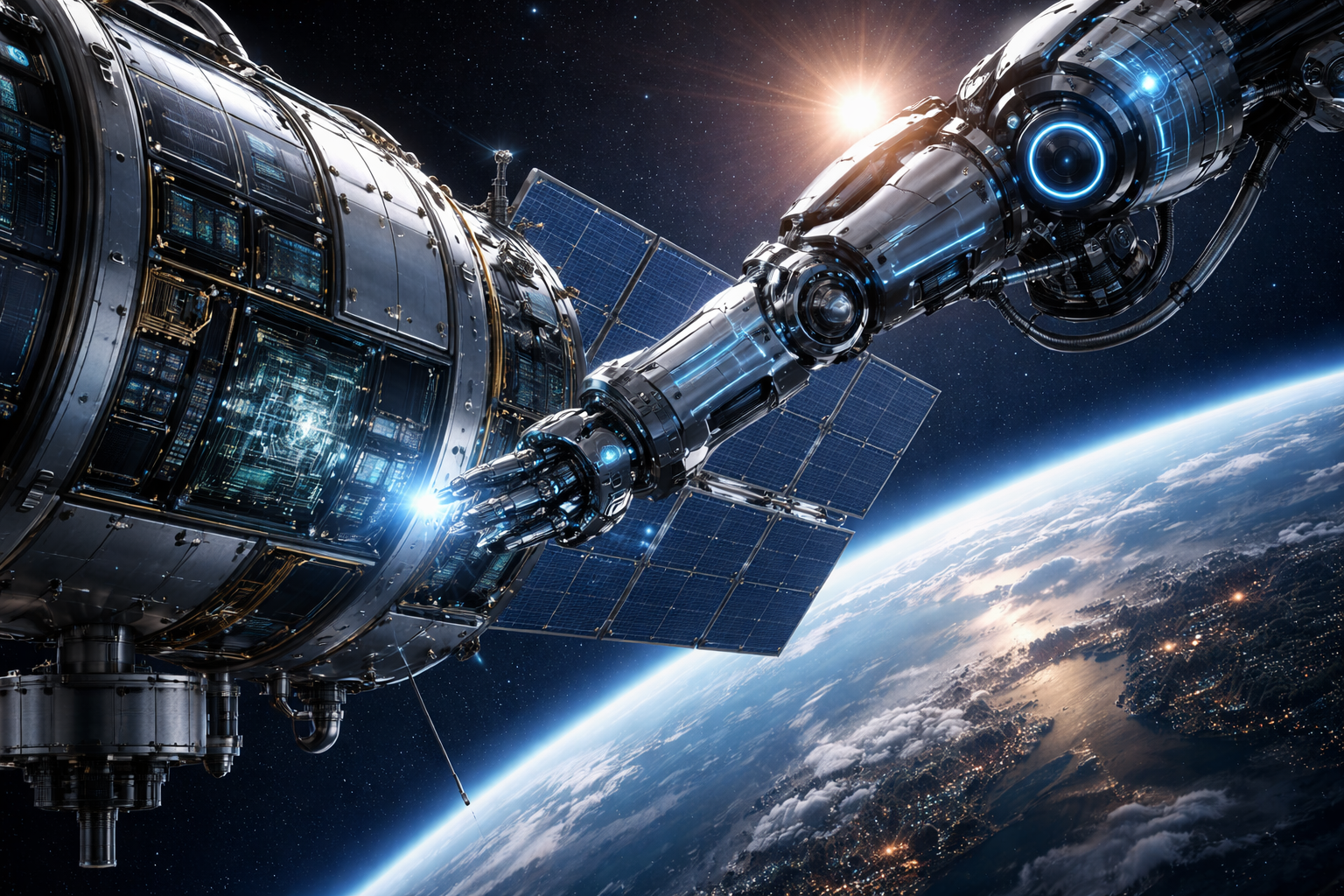
The silent expanse above our atmosphere is no longer just a vacuum for observation; it has become a bustling hub of critical infrastructure. As of March 2026, the orbital environment is more crowded and vital to terrestrial life than ever before. From the GPS signals that guide our cars to the high-frequency trading data that fuels global economies, our modern world relies on a fragile web of satellites. However, for decades, these assets were “one-and-done”—launched with a fixed lifespan and left to die or drift once their fuel ran out or a single component failed.
This “launch and forget” era is officially over. We have entered the age of space robotics and On-Orbit Servicing (OOS). By integrating advanced Artificial Intelligence (AI) with highly dexterous robotic systems, space agencies and private enterprises are now capable of refueling, repairing, and even upgrading infrastructure while it remains in orbit. This shift is not just about saving money; it is about space sustainability. With over 15,000 active satellites projected by 2030, the risk of the “Kessler Syndrome”—a catastrophic chain reaction of collisions—is a looming threat. AI-driven robots are the designated “janitors” and “mechanics” of the final frontier, ensuring that the orbital highways remain clear and functional for generations to come.
Key Takeaways
- Life Extension: AI-driven robots can refuel and repair satellites, extending their operational life by decades.
- Debris Mitigation: Autonomous systems are being deployed to capture and de-orbit “space junk.”
- Autonomy is Vital: Due to signal latency (delay), robots must use edge computing and AI to make real-time decisions during docking.
- Sustainability: Maintaining existing infrastructure is significantly more cost-effective and environmentally friendly than launching replacements.
Who This Is For: This guide is designed for aerospace enthusiasts, investors in the burgeoning “space economy,” policymakers focused on orbital safety, and technology professionals interested in how AI operates in extreme, non-terrestrial environments.
The New Paradigm: From “One-and-Done” to In-Orbit Maintenance
Historically, the space industry operated on a rigid, disposable model. If a $300 million communication satellite ran out of hydrazine fuel or experienced a solar array deployment failure, it became a multi-ton piece of expensive orbital debris. This was largely due to the “Tyranny of the Rocket Equation”—it was too heavy and too expensive to send human mechanics into high orbits.
As of early 2026, the paradigm has shifted toward In-Space Servicing, Assembly, and Manufacturing (ISAM). The goal is to treat satellites more like high-performance aircraft: assets that can be refueled, modified, and maintained throughout their lifecycle.
The Problem of Accessibility
Most critical satellites reside in either Low Earth Orbit (LEO) or Geostationary Orbit (GEO). While LEO is relatively accessible (about 500–2,000 km up), GEO sits at a staggering 35,786 km. Sending humans to GEO for a repair mission is currently a logistical and financial impossibility. Robotics, specifically those equipped with AI-driven autonomy, provide the only viable solution for maintaining these high-altitude assets.
Shifting Economics
The economic incentive is clear. A refueling mission might cost $50 million, but it can protect a revenue stream of $200 million per year for a satellite that would otherwise be decommissioned. This has birthed a new market segment—the “orbital logistics” sector—which analysts expect to exceed $5 billion in value by 2030.
The Role of AI in Orbital Robotics
In space, traditional “remote control” from Earth doesn’t work for high-precision tasks. Even at the speed of light, signals to a satellite in GEO take roughly 240 milliseconds to travel one way. When a robotic arm is inches away from a sensitive docking port, a quarter-second delay is an eternity. This is why AI-driven autonomy is the heart of modern space robotics.
Autonomous Rendezvous and Proximity Operations (ARPO)
The most dangerous part of any maintenance mission is the “approach.” Two objects traveling at 17,500 miles per hour must meet with the delicacy of a needle threading through a haystack. AI algorithms, specifically Reinforcement Learning (RL), allow the servicer spacecraft to calculate its own approach trajectory in real-time.
The AI processes data from multiple sensors—LIDAR, stereoscopic cameras, and infrared—to create a 3D map of the target. It must account for:
- Solar Glare: Which can blind traditional optical sensors.
- Tumbling: Decommissioned satellites often spin unpredictably.
- Microgravity Dynamics: Every action has an equal and opposite reaction; if the robot pushes the satellite, it pushes itself away too.
Machine Vision and Non-Cooperative Target Tracking
Most satellites currently in orbit were never designed to be serviced. They don’t have “handles” or standardized docking ports. This makes them “non-cooperative targets.” AI-powered machine vision allows a robot to recognize a target based on its silhouette and surface features (like antennas or thrusters). Using Convolutional Neural Networks (CNNs), the robot can identify the exact “grapple point” even if it has never seen that specific satellite model before. It can distinguish between a sturdy structural bolt and a fragile solar cell.
Edge Computing: Processing at the Speed of Light
To eliminate the latency of Earth-based control, space robots utilize edge computing. The “brain” of the AI is located on the spacecraft itself. Radiation-hardened AI chips (like those being developed by Nvidia and Lockheed Martin) allow the robot to process terabytes of sensor data locally, making millisecond adjustments to its thrusters and robotic joints without waiting for “permission” from ground control.
Key Capabilities of AI-Driven Space Robots
What exactly can these robots do once they reach their target? The capabilities have expanded far beyond simple mechanical arms.
1. Refueling and Fluid Transfer
Fuel is the primary “life force” of a satellite. Once the propellant is gone, the satellite can no longer maintain its precise orbit or point its antennas at Earth.
- AI’s Role: The robot must use high-precision sensors to find the fuel fill/drain valve—usually hidden under layers of thermal insulation (MLI). AI identifies the precise location to “cut” through the insulation and attach the refueling nozzle without causing a leak.
2. Structural Repairs and Upgrades
Space is a harsh environment. Micrometeoroids and solar radiation can damage sensitive equipment.
- Robotic Surgery: Modern manipulators have “force-feedback” sensors that allow the AI to “feel” the resistance of a screw or the tension of a wire. This prevents the robot from accidentally crushing the target.
- Swapping Modules: Future satellites are being designed with modular architectures. An AI robot could theoretically fly up, pull out an outdated 2024-era sensor, and “plug in” a 2030-era upgraded camera.
3. In-Space Assembly and Manufacturing (ISAM)
Why launch a massive telescope that might break during the vibrations of a rocket launch? AI robots are now being used to build structures in orbit.
- Robotic Spiders: Some concepts involve “spider-like” robots that crawl across a structure, 3D-printing components or welding struts to create massive antennas or solar farms that would be too large to fit inside a rocket fairing.
The Space Junk Crisis: Active Debris Removal (ADR)
One of the most urgent applications of AI in space is cleaning up the “orbital junkyard.” Since the launch of Sputnik in 1957, humanity has left thousands of spent rocket stages, dead satellites, and fragments of metal in orbit.
The Threat of the Kessler Syndrome
If the density of objects in LEO becomes high enough, a single collision can create a cloud of debris that triggers more collisions. This could eventually create a permanent “shell” of debris, making space launches impossible for centuries.
AI “Garbage Trucks”
Active Debris Removal (ADR) missions utilize AI to hunt down pieces of junk. This is exceptionally difficult because debris is often:
- Tumbling: Spinning at high speeds.
- Unpredictable: Made of unknown materials.
- Small: Hard to track with ground-based radar.
ClearSpace-1, a landmark mission by the European Space Agency (ESA), uses AI to guide a “chaser” satellite that deploys a quartet of robotic arms to “hug” a piece of debris and pull it down into the atmosphere to burn up safely. The AI’s job is to synchronize the chaser’s rotation with the tumbling debris so they don’t collide and create more junk.
Case Studies: The Machines Already in Orbit
It is important to understand that this is not science fiction; these missions are happening right now.
| Mission/Project | Organization | Capability | Status (As of March 2026) |
| MEV-1 & MEV-2 | Northrop Grumman | Life Extension (GEO) | Active. Successfully docked with Intelsat satellites to provide propulsion. |
| ClearSpace-1 | ESA / ClearSpace | Debris Removal | Operational. Currently targeting the Vespa adapter for de-orbiting. |
| Canadarm3 | MDA / CSA | Lunar Gateway Maintenance | In Development. Will use high-level AI to maintain the station without humans present. |
| ASIMOV | AIKO / Italian Space Agency | Autonomous Navigation | Active. Testing AI “autopilot” for satellite inspection. |
| OSAM-1 (Legacy) | NASA | Refueling/Assembly | Canceled (2024). Served as a critical R&D baseline for current ISAM projects. |
The Success of the Mission Extension Vehicle (MEV)
Northrop Grumman’s MEV is the gold standard for current OOS. It doesn’t actually “refuel” the target. Instead, it docks with the satellite’s liquid apogee engine and acts as a “jetpack,” using its own thrusters to keep the older satellite in its proper position. This successfully extended the life of Intelsat 901 by five years, a feat that was previously thought impossible.
The Hardened Hardware: Designing for the Void
Building a robot for Earth is hard; building one for space is an engineering nightmare. AI software is only as good as the hardware it inhabits.
1. Radiation Hardening
The radiation in space can “flip” bits in a computer’s memory, causing AI to hallucinate or crash. Engineers use Rad-Hard processors, which are often generations behind terrestrial chips in speed but can survive the solar wind. To compensate, modern AI for space uses distributed computing, where multiple chips verify each other’s work.
2. Thermal Management
In orbit, the side of the robot facing the sun can reach 120°C (248°F), while the side in the shadow can drop to -180°C (-292°F). AI systems must constantly monitor thermal sensors and adjust heaters or radiators to prevent the electronic “brain” from frying or freezing.
3. Lubrication and Vacuum Welding
In a vacuum, standard oils and greases evaporate. Furthermore, if two clean pieces of metal touch in space, they can permanently fuse together—a phenomenon called cold welding. Robotic joints must be coated in specialized dry lubricants or gold-plating, and the AI must be programmed to avoid certain contact patterns that could lead to “seizing.”
Common Mistakes in Orbital Robotics Development
Even with the best AI, things can go wrong. Here are the most common pitfalls identified by space agencies:
- Over-Reliance on Simulation: AI trained solely in a digital “physics engine” often fails when it encounters the “Sim-to-Real Gap.” The lighting in space is much harsher (blacker blacks, brighter whites) than on Earth, which can confuse machine vision.
- Ignoring Non-Cooperative Dynamics: Designers often assume a satellite will be steady. In reality, any contact—even a light touch—can send a dead satellite into a chaotic spin.
- Neglecting Cybersecurity: As satellites become more autonomous and “smarter,” they become targets for hacking. An AI robot could theoretically be hijacked and used as a weapon to de-orbit a competitor’s satellite.
The Economic and Geopolitical Impact of Robotic Servicing
The ability to maintain infrastructure in space has massive implications for life on Earth.
1. Lowering the Barrier to Entry
When satellites can be repaired rather than replaced, the “cost of failure” drops. This allows smaller nations and startups to enter the space sector with lower insurance premiums and longer-term business models.
2. The Strategic “High Ground”
Geopolitically, the nation that controls the “tow trucks” and “mechanics” of space controls the infrastructure. If a country can refuel its own spy satellites while theirs run out of gas, it gains a significant strategic advantage. This has led to the development of “Space Domain Awareness” (SDA) programs to monitor robotic activity in orbit.
3. Environmental Responsibility
We are finally treating the orbital environment as a limited natural resource. By using AI to remove debris, we are practicing Active Space Stewardship. This is the orbital equivalent of cleaning plastic out of the ocean.
Ethical and Legal Governance in an Autonomous Orbit
Who is responsible if an AI-driven robot accidentally crashes into a multi-billion dollar space station?
The Outer Space Treaty of 1967
The foundational law of space states that nations are responsible for all objects launched from their territory. However, it does not mention AI autonomy. There is currently a global push for a “Cyber-Physical Protocol for Space” to establish:
- Liability: Determining if the software developer, the hardware manufacturer, or the operator is at fault for a collision.
- “Human-in-the-Loop”: Most current regulations require a human to “green-light” any critical move (like a final docking) to prevent AI-driven accidents.
- Transparency: Requiring nations to announce their servicing missions to avoid being mistaken for “killer satellites” or space weapons.
Conclusion: The Future of Our Orbital Home
As we look toward 2030 and beyond, the role of AI in space will only grow. We are moving toward a future where “Satellite Servicer Constellations” are as common as roadside assistance on Earth. These robots will not just be fixing what we have; they will be the workforce that builds the Lunar Gateway, maintains asteroid mining outposts, and constructs the massive solar arrays needed for Space-Based Solar Power.
The integration of AI and robotics in space represents a fundamental shift in human history. We are no longer just visitors in the stars; we are becoming residents. By maintaining our orbiting infrastructure, we ensure that the digital heart of our civilization continues to beat, safely and sustainably.
Next Steps for Readers:
- Watch: Look up the live tracking of the ClearSpace-1 mission to see the world’s first active debris removal in real-time.
- Investigate: Research Modular Satellite Design—the next wave of infrastructure designed specifically to be serviced by AI robots.
- Advocate: Support international policies for Zero Debris to ensure space remains a resource for everyone.
Would you like me to generate a detailed comparison table of the AI algorithms currently used by NASA vs. ESA for autonomous docking?
FAQs
Q: Can a robot refuel any satellite?
A: Not yet. Most older satellites were not designed with refueling in mind. Robots must use advanced AI and specialized cutting tools to “hack” into the fuel systems. However, “servicing-friendly” satellites with standardized ports are now becoming the industry standard.
Q: Does AI replace human astronauts in space maintenance?
A: AI replaces humans in hazardous or high-latency environments (like high-orbit repairs). However, humans remain essential for high-level decision-making and repairing complex, one-of-a-kind failures that AI hasn’t been trained for.
Q: What happens to the “space junk” after a robot captures it?
A: In most cases, the robot pushes the junk toward Earth’s atmosphere. Upon re-entry, the debris (and sometimes the robot itself) burns up due to the intense heat of friction, leaving nothing behind but dust.
Q: How does the AI “see” in the pitch-black of space?
A: Space isn’t always dark; the sun is incredibly bright. AI uses a combination of LIDAR (laser-based distance measuring) and Infrared cameras to “see” the heat signature of a satellite even when it is in the shadow of the Earth.
Q: Is there a risk of AI robots being used as weapons?
A: Yes. Any robot capable of docking with a satellite is theoretically capable of damaging it. This is why international transparency and “Space Domain Awareness” are critical for global security.
References
- NASA Space Technology Mission Directorate (STMD). “On-Orbit Servicing, Assembly, and Manufacturing (ISAM) National Strategy.” [Official Document].
- European Space Agency (ESA). “ClearSpace-1: The first mission to remove a piece of space debris from orbit.” [ESA Mission Docs].
- Northrop Grumman. “Mission Extension Vehicle (MEV) Operational Overview.” [Company Technical Report].
- McKinsey & Company (2024). “The $1.8 Trillion Space Economy: Growth Through Sustainability.” [Market Analysis].
- Stanford University (2025). “Machine Learning in Microgravity: Improving Robotic Pathfinding on the ISS.” [Academic Journal].
- United Nations Office for Outer Space Affairs (UNOOSA). “Guidelines for the Long-term Sustainability of Outer Space Activities.” [International Treaty].
- IEEE Robotics & Automation Society. “A Comprehensive Survey of Space Robotic Manipulators for On-Orbit Servicing.” [Technical Paper].
- SpaceNews (2026). “The State of Orbital Logistics: A Mid-Decade Review.” [Industry News].
- JAXA (Japan Aerospace Exploration Agency). “ADRAS-J Mission: Commercial Debris Inspection and Characterization.” [Project Site].
- MIT Department of Aeronautics and Astronautics. “Stochastic Trajectory Optimization for Non-Cooperative Spacecraft Docking.” [Research Paper].