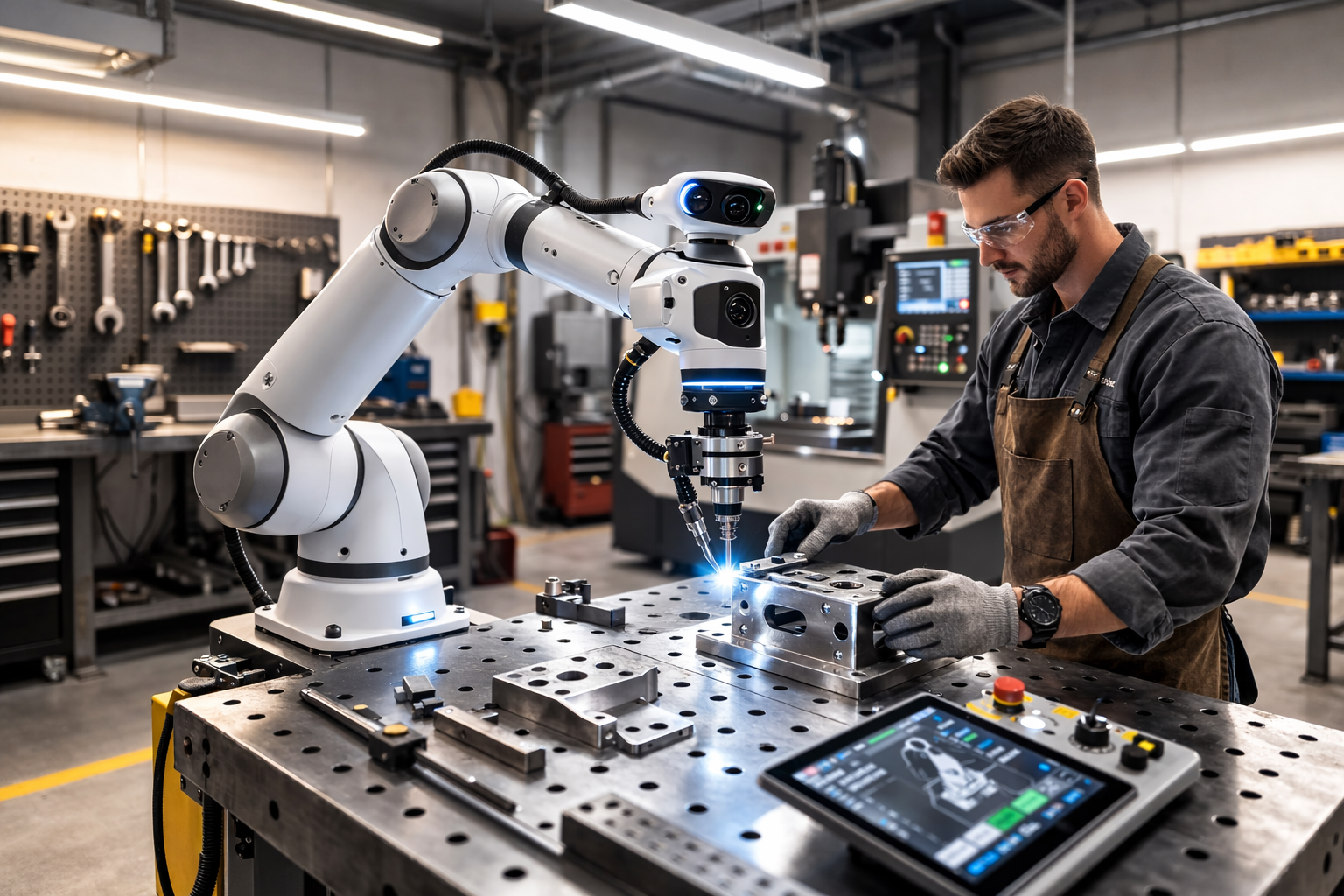
In the landscape of modern production, the “iron curtain” of traditional automation is falling. For decades, industrial robotics was the exclusive playground of automotive giants and massive electronics assembly plants—places where a robot could be bolted to the floor to perform the same weld ten million times without deviation. However, as of March 2026, a new era has taken hold: the era of the adaptive industrial robot.
Unlike their predecessors, adaptive robots are defined by their ability to perceive, reason, and adjust to their environment in real time. They do not just follow a rigid script; they use a combination of machine vision, artificial intelligence (AI), and advanced sensor fusion to handle variability. This shift is particularly transformative for Small and Medium Enterprises (SMEs) that previously found traditional automation too expensive, too complex, and too rigid for their “Low-Volume, High-Mix” (LVHM) production cycles.
Key Takeaways
- Flexibility Over Force: Adaptive robots can switch between tasks in minutes, making them ideal for small batches.
- Accessibility: The rise of “No-Code” interfaces and AI-driven teaching has eliminated the need for specialized robotics engineers on-site.
- Cost-Effectiveness: New financial models, such as Robot-as-a-Service (RaaS), have lowered the barrier to entry for shops with limited capital.
- Safety Evolution: The latest ISO 10218:2025 standards facilitate seamless human-robot collaboration without the need for restrictive safety cages.
Who This Is For
This guide is designed for SME owners, plant managers, and industrial engineers who are navigating the transition from manual labor to “smart” automation. Whether you run a 10-person machine shop or a specialized food processing facility, understanding adaptive robotics is now a prerequisite for staying competitive in a volatile global market.
Defining the “Adaptive” Shift: Beyond the Cage
To understand why adaptive robots are rising so quickly in small manufacturing, we must first define what makes them “adaptive.” Traditional industrial robots are essentially blind. They move to a coordinate ($X$, $Y$, $Z$) and execute a command. If the part is two millimeters out of place, the robot fails.
Adaptive robots, however, utilize Edge AI and Machine Vision to “see” and “feel.” As of early 2026, the industry has moved away from simple “if-then” logic toward Agentic AI—systems that can perceive an obstacle or a misaligned part and calculate a new path autonomously.
Traditional vs. Adaptive Automation
| Feature | Traditional Industrial Robots | Adaptive Industrial Robots (2026) |
| Setup | Permanent, bolted, caged | Mobile, flexible, uncaged |
| Programming | Complex Scripting (Python/C++) | Natural Language / Lead-through teaching |
| Environment | Highly Structured | Dynamic and Unstructured |
| Task Variety | Single-purpose | Multi-purpose (Universal) |
| SME Viability | Low (High ROI threshold) | High (Rapid deployment) |
Safety Disclaimer: While adaptive robots are designed for collaboration, all industrial machinery carries inherent risks. A comprehensive risk assessment in accordance with local labor laws and ISO 10218:2025 must be conducted before deployment.
The Technological Pillars of 2026 Robotics
The “Rise” we are seeing isn’t due to a single invention, but rather the convergence of four critical technologies that have reached maturity this year.
1. Advanced Machine Vision and Sensor Fusion
In 2026, 3D vision systems have become standardized. Adaptive robots now use “Global Shutter” cameras and LiDAR to create a real-time point cloud of their workspace. This allows them to perform Bin Picking—the ability to reach into a disorganized box of parts and pick the correct one regardless of orientation.
Sensor Fusion takes this further by combining vision with haptic (touch) feedback. If a robot is assembling a delicate electronic component, it doesn’t just rely on its “eyes”; it feels the resistance in its robotic grippers to ensure it doesn’t crush the part.
2. Generative and Agentic AI
The most significant breakthrough in the last 12 months has been the integration of Large Language Models (LLMs) into the robot’s operating system. In a small shop, an operator can now say, “Hey, pick up those brass fittings and place them in the CNC tray,” and the robot’s AI agent decomposes that request into a series of spatial movements. This “No-Code” revolution has democratized automation.
3. Edge Computing and Low Latency
For a robot to be truly adaptive, it cannot wait for a cloud server to tell it to stop if a human reaches into its path. The shift to Edge Computing—where the “brain” is located on the robot itself—allows for millisecond-level response times. This is the backbone of modern Collaborative Robots (Cobots).
4. Soft Robotics and Advanced End-Effectors
Traditional grippers were steel claws. Today’s adaptive systems often use Soft Robotics—pneumatic, flexible fingers that can pick up a strawberry as easily as a bolt. For small manufacturers in the food, beverage, or pharmaceutical sectors, this has opened doors that were previously locked.
Why Small Manufacturing is the New Frontier
Historically, SMEs were the last to automate. Today, they are the fastest-growing segment in the robotics market. Several factors are driving this “bottom-up” revolution.
The Labor Shortage Paradox
Despite advancements in technology, the manufacturing labor gap has widened. Older skilled workers are retiring, and younger generations are less inclined toward repetitive manual tasks. Adaptive robots don’t replace these workers; they augment them. A single technician in 2026 can oversee a “fleet” of three or four adaptive robots, shifting their role from “manual laborer” to “workflow designer.”
Low-Volume, High-Mix (LVHM) Requirements
Small shops thrive on variety. They might make 50 custom bicycle frames on Monday and 200 medical device components on Tuesday. Traditional robots would require a week of reprogramming for such a switch. Adaptive robots can be “re-taught” in under thirty minutes. This Flexible Automation is the only way for SMEs to compete with the economies of scale enjoyed by larger corporations.
The “Reshoring” Movement
As of March 2026, supply chain volatility has led many North American and European firms to move production closer to home. To offset higher local labor costs, these firms are leaning heavily on adaptive robotics to maintain high output with a smaller, highly-skilled footprint.
Practical Applications for SMEs
How are these machines actually being used on the shop floor today? Let’s look at three high-growth areas.
Precision Welding and Fabrication
Small metal shops are using adaptive cobots for TIG and MIG welding. The robot uses vision sensors to track the seam of a joint in real-time. If the metal has warped slightly due to heat, the robot adjusts its torch path instantly.
- Common Mistake: Buying a robot without considering the power requirements. Ensure your shop’s electrical grid can handle the “spikes” during high-torque robotic movements.
Machine Tending
This is perhaps the “lowest hanging fruit” for SME ROI. A robot sits in front of a CNC machine or an injection molder, loading raw materials and unloading finished parts. Because the robot is adaptive, it can detect if a part didn’t eject properly and pause the machine before damage occurs, something “dumb” automation cannot do.
Quality Inspection
Using AI-powered vision, adaptive robots can inspect parts for microscopic cracks or color deviations. In a small manufacturing setting, this replaces the tedious task of manual gauging, ensuring 100% quality control without slowing down the line.
Financial Strategy: The “Robot-as-a-Service” (RaaS) Model
One of the biggest hurdles for an SME has always been the initial capital expenditure (CapEx). A high-end adaptive robot arm can still cost between $35,000 and $75,000.
In 2026, the Robot-as-a-Service (RaaS) model has become the standard. Instead of buying the hardware, the manufacturer pays a monthly subscription fee.
- Benefits of RaaS:
- No large upfront investment.
- Maintenance and software updates are included.
- Ability to scale the “fleet” up or down based on seasonal demand.
- Treats automation as an operational expense (OpEx) rather than a capital one, providing tax advantages in many jurisdictions.
Workforce Upskilling: The Human Element
A common fear is that “adaptive” means “replacement.” However, the 2026 data shows a different trend: Human-Robot Collaboration.
As robots take over the “Dull, Dirty, and Dangerous” tasks, the SME workforce must evolve. This is known as Workforce Upskilling. Employees who used to spend eight hours a day palletizing boxes are now being trained in “Robot Supervision.” They learn how to troubleshoot AI vision errors and optimize the robot’s pathing. This not only increases the shop’s productivity but also leads to higher wages and better job satisfaction for the workers.
Pro Tip: Start a “Champion Program.” Identify one or two tech-savvy employees and give them the lead on the first robotic pilot. When the rest of the team sees their peers successfully “managing” a robot, the fear of displacement diminishes.
Implementation Roadmap: A 4-Phase Plan for SMEs
Don’t try to automate your entire factory in a weekend. Successful “Rise” follows a modular, measured approach.
Phase 1: The “Pain Point” Audit
Identify the bottleneck. Is it the welder who is overworked? The packing station that’s too slow? Choose one specific, repetitive task.
Phase 2: The Pilot Program
Deploy a single adaptive cobot. Focus on a task where the robot can work alongside a human. This allows the team to get comfortable with the machine’s “presence.”
Phase 3: Data Integration (IIoT)
Connect your robot to your shop’s network. Start collecting data on “Cycle Time” and “Error Rates.” Use this data to justify the ROI for the next machine.
Phase 4: Full-Scale Modular Automation
Expand to other departments. Because the robots are adaptive and often mobile (mounted on pedestals with wheels), you can move “Robot A” from the welding station to the packing station as your weekly orders fluctuate.
Common Mistakes in SME Robotics Implementation
Even with “smart” robots, things can go wrong. Avoid these three pitfalls:
- Over-complicating the First Task: Many SMEs try to automate their most complex assembly first. Start with “Pick and Place” or simple “Machine Tending.” Build confidence before moving to high-precision tasks.
- Ignoring the “End-Effector”: The robot arm is just a tool; the robotic gripper is what does the work. SMEs often spend 90% of their budget on the arm and 10% on the gripper, only to find the gripper can’t handle their specific part.
- Underestimating Training Time: While “No-Code” is easier, it’s not “No-Training.” Budget at least 20–40 hours of training for your lead operators to truly master the adaptive features.
The Future: 2027 and Beyond
As we look past March 2026, the next frontier for adaptive robots in small manufacturing is Swarm Intelligence. This involves multiple small robots communicating with each other to complete a large task—like four small arms working together to hold and weld a complex chassis.
Furthermore, the integration of Digital Twins will allow small shop owners to simulate an entire robotic setup on their tablet before they even rent the hardware, ensuring the ROI is guaranteed before a single bolt is turned.
Conclusion
The rise of adaptive industrial robots in small manufacturing is not just a technological trend; it is a fundamental shift in how we think about production. By moving away from rigid, expensive, and intimidating automation toward flexible, AI-driven, and collaborative systems, SMEs are finally gaining the tools they need to thrive in a globalized economy.
The “Adaptive” label isn’t just about the robot’s ability to adjust to a part—it’s about a manufacturer’s ability to adjust to the world. In 2026, the shops that embrace these “intelligent colleagues” are seeing higher margins, safer floors, and a more engaged workforce.
Next Steps:
- Conduct a “Dull/Dirty/Dangerous” Audit of your floor this week.
- Consult an Integrator specialized in SMEs to discuss RaaS options.
- Review the ISO 10218:2025 safety guidelines to understand how your layout might change.
The barrier to entry has never been lower. The question is no longer if you will automate, but how fast you can adapt.
FAQs
1. What is the difference between a Cobot and an Adaptive Robot?
A “Cobot” (Collaborative Robot) is a category of robot designed to work safely near humans. An “Adaptive Robot” refers to the software and sensor capability—it means the robot uses AI and vision to change its behavior based on environmental changes. Most modern adaptive robots are also cobots, but not all cobots have high-level adaptive intelligence.
2. How much does it cost to implement an adaptive robot in 2026?
While high-end models can cost $50,000+, many SMEs are now using RaaS models starting at $2,000–$4,000 per month. Entry-level adaptive arms, like those from Standard Bots or Universal Robots, often see a full ROI in 8 to 14 months depending on labor costs.
3. Do I need a computer programmer on staff to run these?
No. Most 2026 adaptive robots use “Lead-through” teaching (physically moving the arm to show it what to do) or Natural Language interfaces where you “chat” with the robot to set its parameters. Basic technical literacy is required, but a CS degree is not.
4. How do adaptive robots handle “safety” without cages?
They use Speed and Separation Monitoring. Integrated LiDAR and 3D vision create virtual “zones.” If a human enters the “Warning Zone,” the robot slows down. If the human enters the “Stop Zone,” the robot cuts power instantly. This is governed by the ISO 10218:2025 standard.
5. Can adaptive robots work with irregular materials like fabric or food?
Yes. This is where Soft Robotics and Machine Vision shine. Unlike traditional robots that expect a uniform shape, adaptive systems can identify the “center of gravity” for an irregular object and adjust their grip pressure accordingly.
References
- International Federation of Robotics (IFR). (2025). World Robotics 2025 Report: Industrial Robots. Official Website.
- International Organization for Standardization. (2025). ISO 10218:2025 – Robotics: Safety Requirements for Industrial Robots. ISO Catalog.
- National Institute of Standards and Technology (NIST). (2026). The Impact of AI on Small Business Manufacturing. NIST.gov.
- MIT Technology Review. (2025). The Generative AI Revolution in Robotics. MIT Review.
- Oxford Economics. (2026). Reshoring and Automation: The New SME Landscape. Oxford Academic.
- IEEE Robotics & Automation Society. (2026). Sensor Fusion and Edge AI in Decentralized Manufacturing. IEEE Xplore.