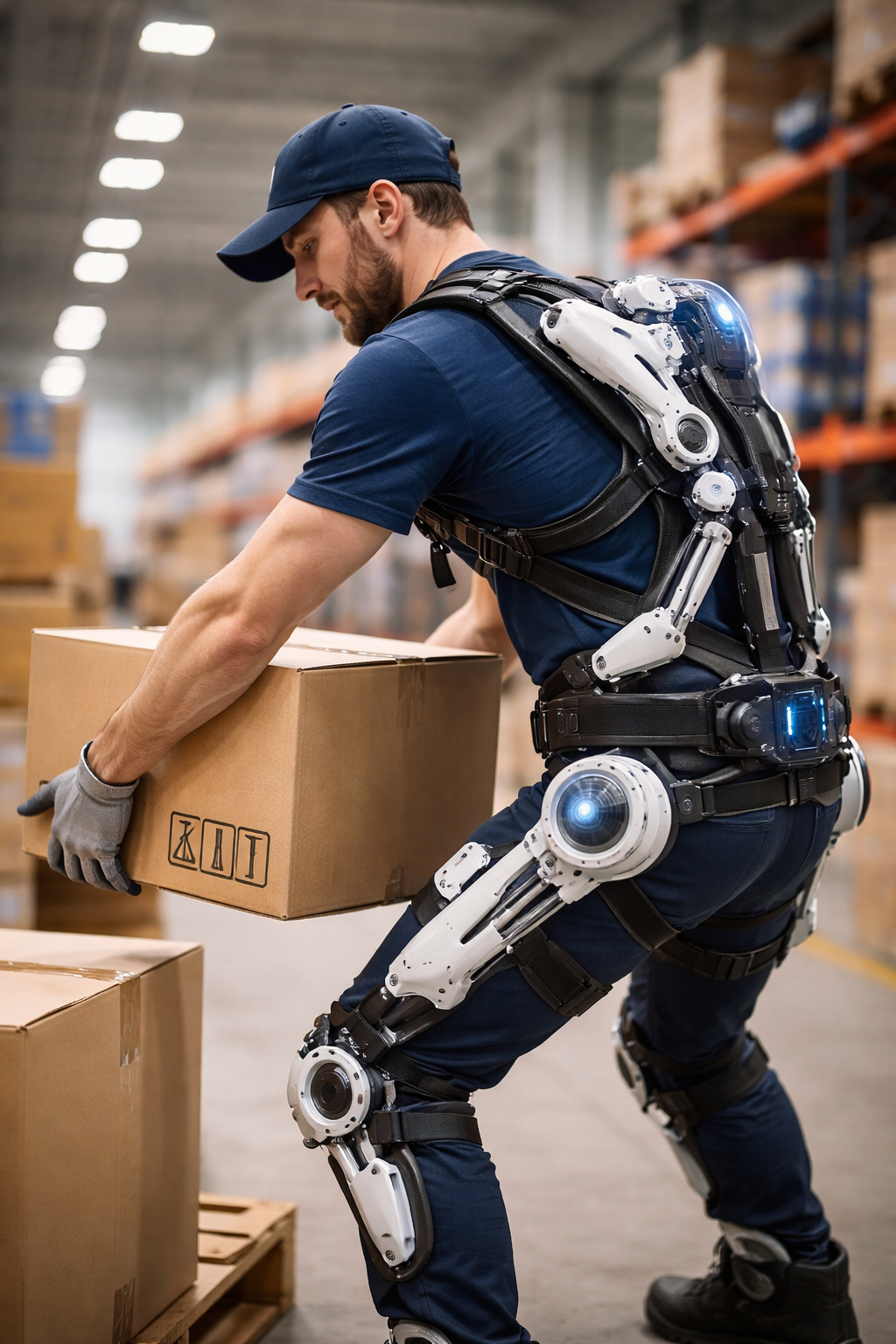
As of March 2026, the industrial landscape is undergoing a silent revolution. It isn’t just about robots replacing humans; it is about “augmenting” them. Workplace exoskeletons—wearable devices designed to support, protect, and enhance the physical capabilities of workers—have moved from the realm of science fiction into the standard operating procedures of global logistics, manufacturing, and construction firms.
What are Workplace Exoskeletons?
A workplace exoskeleton is a wearable structure that works in tandem with the user. Unlike a standalone robot, the exoskeleton relies on the human’s intelligence and decision-making while providing mechanical assistance to the musculoskeletal system. These devices redistribute weight, provide joint support, and reduce the metabolic cost of repetitive tasks. By absorbing the “mechanical tax” of physical labor, they aim to eliminate the chronic pain and acute injuries that have historically plagued manual trades.
Key Takeaways
- Injury Prevention: Primarily targets Musculoskeletal Disorders (MSDs), which account for over 30% of all worker injury and illness cases.
- Types of Support: Includes passive (spring-based) and active (motor-powered) systems for the back, shoulders, and lower limbs.
- Operational Efficiency: Reduces worker fatigue, leading to higher precision and fewer errors toward the end of shifts.
- Human-Centric: Keeps aging, experienced workers in the field longer by protecting their joints and spine.
Who This Guide is For
This guide is designed for Safety Directors (EHS), Operations Managers, Physical Therapists, and Business Owners who are looking to modernize their workforce safety protocols. Whether you are managing a small warehouse or a multinational automotive assembly plant, understanding the nuances of wearable robotics is essential for maintaining a competitive, healthy workforce in 2026.
Safety & Financial Disclaimer: While exoskeletons are designed to reduce strain, they are not a substitute for proper ergonomic training or medical advice. Consult with a qualified ergonomist before implementation. Financial projections regarding ROI are estimates based on industry averages and may vary by sector.
1. The Anatomy of Modern Exoskeletons: Passive vs. Active Systems
To understand how these devices reduce strain, we must first categorize them by their power source. As of 2026, the market is divided into two primary categories, each serving distinct functional needs.
Passive Exoskeletons
Passive systems are the “workhorses” of the current industrial era. They do not use batteries or motors. Instead, they utilize springs, dampers, and gas struts to store and release energy.
- How they work: When a worker bends down, the exoskeleton’s springs compress, storing energy. As the worker stands back up, the springs release that energy, providing a “boost” to the muscles.
- Pros: Lightweight (usually 2–5 kg), no charging required, lower cost, and high reliability.
- Best for: Repetitive lifting, static leaning, and overhead assembly.
Active (Powered) Exoskeletons
Active systems use electric motors, actuators, and sensors to provide external power.
- How they work: Sensors detect the user’s intent (e.g., the beginning of a leg movement) and trigger motors to provide torque.
- Pros: Can provide significantly more force than passive units, adaptable to various weights, and can actively “lift” loads for the user.
- Best for: Heavy-duty logistics, moving irregularly shaped heavy objects, and rehabilitation.
Hybrid Systems
A growing trend in 2026 is the hybrid model. These use passive structures for general support but include small “boost” motors that only engage during peak exertion. This maximizes battery life while providing the high-level support of an active suit.
2. Targeted Support: Which Body Parts Benefit Most?
Exoskeletons are rarely “full-body” suits in the workplace. Instead, they are modular, targeting specific areas prone to injury.
Lumbar and Back Support
Back injuries are the single most expensive and common workplace injury. Back-support exoskeletons focus on the L5/S1 vertebrae—the pivot point for most lifting tasks.
- The Benefit: They can reduce the load on the lower back by up to 40% during a lift.
- The Science: By creating a “bridge” between the chest and the thighs, the device bypasses the spine, transferring the weight directly to the legs.
Shoulder and Overhead Support
In industries like aerospace or automotive assembly, workers often spend hours with their arms above their heads. This leads to rotator cuff tears and chronic shoulder fatigue.
- The Benefit: Shoulder exoskeletons provide a “cradle” for the arms. It feels to the worker as if their arms are weightless.
- The Science: These devices use gravity-compensation mechanisms to neutralize the weight of the arms and the tools being held.
Lower Limb and “Chairless Chairs”
For workers who must stand for 8–10 hours a day, lower limb exoskeletons provide relief to the knees and ankles.
- The “Chairless Chair”: This is a wearable exoskeleton that allows a worker to “sit” in mid-air. It locks into a supporting structure when the worker assumes a sitting posture, reducing the strain on the legs and back without requiring a physical chair that would clutter the workspace.
3. The Biomechanics of Strain Reduction
To appreciate the “Human-First” value of this technology, we must look at the biomechanics. Human muscles operate via ATP (energy) consumption. When muscles are under constant tension, they produce lactic acid, leading to fatigue.
Reducing Metabolic Cost
Studies have shown that using a well-fitted exoskeleton can reduce the metabolic cost of a task by 10% to 15%. While that may seem small, over an eight-hour shift, this is the difference between a worker going home exhausted and a worker having the energy to enjoy their family life.
Pressure Distribution
One of the primary “hidden” benefits of exoskeletons is pressure distribution. Instead of a heavy tool putting 10 lbs of pressure on a single wrist joint, an exoskeleton can distribute that 10 lbs across the entire forearm and upper arm structure, reducing the risk of localized tendonitis.
4. Industry-Specific Use Cases
Manufacturing and Assembly
In the automotive sector, companies like Ford and BMW have integrated shoulder exoskeletons for underbody assembly.
- Example: A worker installing bolts on the underside of a vehicle performs thousands of overhead reaches. The exoskeleton reduces the peak muscle activity in the deltoids by nearly 50%.
Logistics and Warehousing
With the 2026 demand for “instant delivery,” warehouse workers are moving faster than ever. Back-support suits are becoming mandatory in some high-volume fulfillment centers.
- Common Mistake: Buying one-size-fits-all suits. Warehousing requires high mobility (walking and climbing stairs), so suits must be “articulated” to allow for a full range of motion.
Construction and Masonry
Construction is the “final frontier” for exoskeletons due to the rugged, unpredictable environment.
- Developments in 2026: We are seeing more “power-assist” gloves that help masons grip heavy bricks or stone, reducing the incidence of carpal tunnel syndrome.
5. The ROI of Exoskeletons: The Business Case
Investing in wearable robotics is not just a “perk”; it is a strategic financial move.
Indirect Cost Savings
While the direct cost of an exoskeleton (ranging from $2,500 to $20,000 as of early 2026) can be high, the indirect savings are massive:
- Reduced Workers’ Comp Claims: A single back surgery can cost a company upwards of $100,000 in direct and indirect costs.
- Lower Turnover: Workers are less likely to quit if their jobs aren’t physically punishing.
- Aging Workforce Retention: In many developed nations, the average age of a skilled tradesperson is over 45. Exoskeletons allow these highly skilled individuals to stay in the workforce longer.
Productivity Metrics
Data suggests that while exoskeletons don’t necessarily make a worker “faster” at the start of a shift, they prevent the “afternoon slump.” A worker wearing a suit at 3:00 PM is often 15% more productive than a worker without one, simply because they aren’t fighting physical exhaustion.
6. Overcoming Implementation Barriers
Despite the benefits, exoskeleton adoption often faces “human” hurdles.
The “Cyborg” Stigma
Workers may initially feel self-conscious or fear that the machine is a precursor to being replaced by a robot.
- Solution: Frame the exoskeleton as “high-performance PPE” (Personal Protective Equipment), similar to a helmet or steel-toed boots.
Heat and Comfort
Wearing a frame over clothing can be hot. In 2026, many manufacturers have integrated moisture-wicking materials and “air-gap” designs to improve airflow.
- Common Mistake: Ignoring worker feedback on comfort. If a suit is uncomfortable, the worker will find a reason not to wear it.
Training and Fitment
An improperly fitted exoskeleton can actually cause injury by shifting loads to parts of the body not designed to handle them. Professional “fitting” sessions are mandatory.
7. Safety Standards and Regulations in 2026
The regulatory environment has finally caught up with the technology.
ISO 13482:2014 and Beyond
This ISO standard focuses on the safety of personal care robots, which includes workplace exoskeletons. It mandates:
- Emergency Egress: The ability to remove the suit in under 10 seconds in case of an emergency.
- Torque Limits: For active suits, there must be hard-coded limits to ensure the machine cannot move a limb past its natural range of motion.
OSHA’s Stance
As of 2026, OSHA (Occupational Safety and Health Administration) has not yet mandated exoskeletons, but they have issued “General Duty Clause” guidance suggesting that in environments with high MSD rates, wearable intervention should be considered part of a comprehensive ergonomic program.
8. Step-by-Step Implementation Guide
If you are ready to bring exoskeletons into your facility, follow this roadmap:
- The Ergonomic Audit: Identify the “hot spots” in your facility where workers report the most pain or where turnover is highest.
- The “Task-Fit” Analysis: Match the task to the suit. Don’t use a back-support suit for overhead painting.
- Pilot Program: Select 5–10 “champion” workers to test the devices for 30 days. Their buy-in is critical for broader adoption.
- Data Collection: Measure fatigue levels, heart rate (if possible), and worker qualitative feedback.
- Scaling: Once the ROI is proven in one department, roll out the technology facility-wide.
9. Common Mistakes to Avoid
- Treating it as a “Superhuman” Suit: Never encourage workers to lift more than the legal limit just because they are wearing an exoskeleton. The suit is for reducing strain on normal loads, not for turning people into forklifts.
- Skipping Maintenance: These are precision machines. Dust, grime, and sweat can degrade the joints. Establish a weekly cleaning and inspection cadence.
- Neglecting Battery Management: For active suits, ensure you have a “hot-swap” battery station. A dead exoskeleton is just “dead weight” that adds to worker strain.
10. The Future of the Augmented Workforce
What does the rest of 2026 and beyond look like? We are moving toward Smart Exoskeletons. These devices use AI to “learn” the specific gait and movement patterns of the wearer, providing more intuitive support over time. They will also function as data collection hubs, alerting managers if a worker’s posture suggests they are becoming dangerously fatigued before an injury even occurs.
The goal is a “Zero-Injury” workplace where physical labor is a choice of movement, not a sentence of chronic pain.
Conclusion
Workplace exoskeletons represent the most significant leap in occupational safety since the invention of the hard hat. By addressing the root cause of the majority of workplace injuries—physical overexertion and repetitive strain—these devices offer a path toward a more sustainable, inclusive, and productive industrial future.
The transition to an augmented workforce requires more than just capital investment; it requires a cultural shift. Employers must view their workers as valuable biological assets that deserve the best mechanical protection available. As we have seen throughout this guide, the benefits extend far beyond the balance sheet. When a worker goes home with a healthy back and energized shoulders, the entire community benefits.
Next Steps for Your Business: Would you like me to help you draft an Ergonomic Audit Checklist specifically tailored to your industry to see if your workers would benefit from exoskeleton technology?
FAQs
1. Are exoskeletons heavy to wear?
Modern passive exoskeletons typically weigh between 4 and 12 pounds. Because they are designed to distribute their own weight through the frame into the ground or the user’s hips, they often feel much lighter once they are properly strapped in.
2. Can exoskeletons be worn over any clothing?
Generally, yes. However, for safety and comfort, they should be worn over relatively form-fitting work clothes. Loose clothing can get caught in the hinges or actuators of the device.
3. How long do the batteries last in active exoskeletons?
As of 2026, most industrial active suits offer 4 to 6 hours of continuous use. Most companies utilize a “hot-swap” system where a second battery is charging while the first is in use, allowing for 24/7 operation.
4. Do I need a special license to operate one?
No license is required, but “certified user training” is highly recommended. This ensures the worker knows how to put the suit on correctly and how to move with the device rather than fighting against it.
5. Will wearing an exoskeleton make my muscles weak?
This is a common concern. However, workplace exoskeletons are designed for “assist-as-needed.” They don’t do all the work; they simply take the “peak” off the load. Studies have shown that they do not cause muscle atrophy when used during standard work shifts.
References
- ISO 13482:2014 – Robots and robotic devices — Safety requirements for personal care robots.
- National Institute for Occupational Safety and Health (NIOSH) – Center for Occupational Robotics Research (CORR) Reports 2025-2026.
- Journal of Biomechanics – Metabolic Cost and Muscle Activity Reduction in Passive Exoskeleton Users (2025).
- OSHA Technical Manual – Section VII: Chapter 1 – Back Disorders and Injuries.
- International Journal of Industrial Ergonomics – Long-term impact of wearable robotics on worker retention in logistics.
- Stanford University Robotics Lab – Human-in-the-loop optimization of wearable devices.
- Mayo Clinic – Musculoskeletal Disorders: Prevention and Workplace Intervention.
- ASTM International – Committee F48 on Exoskeletons and Exosuits Standards.