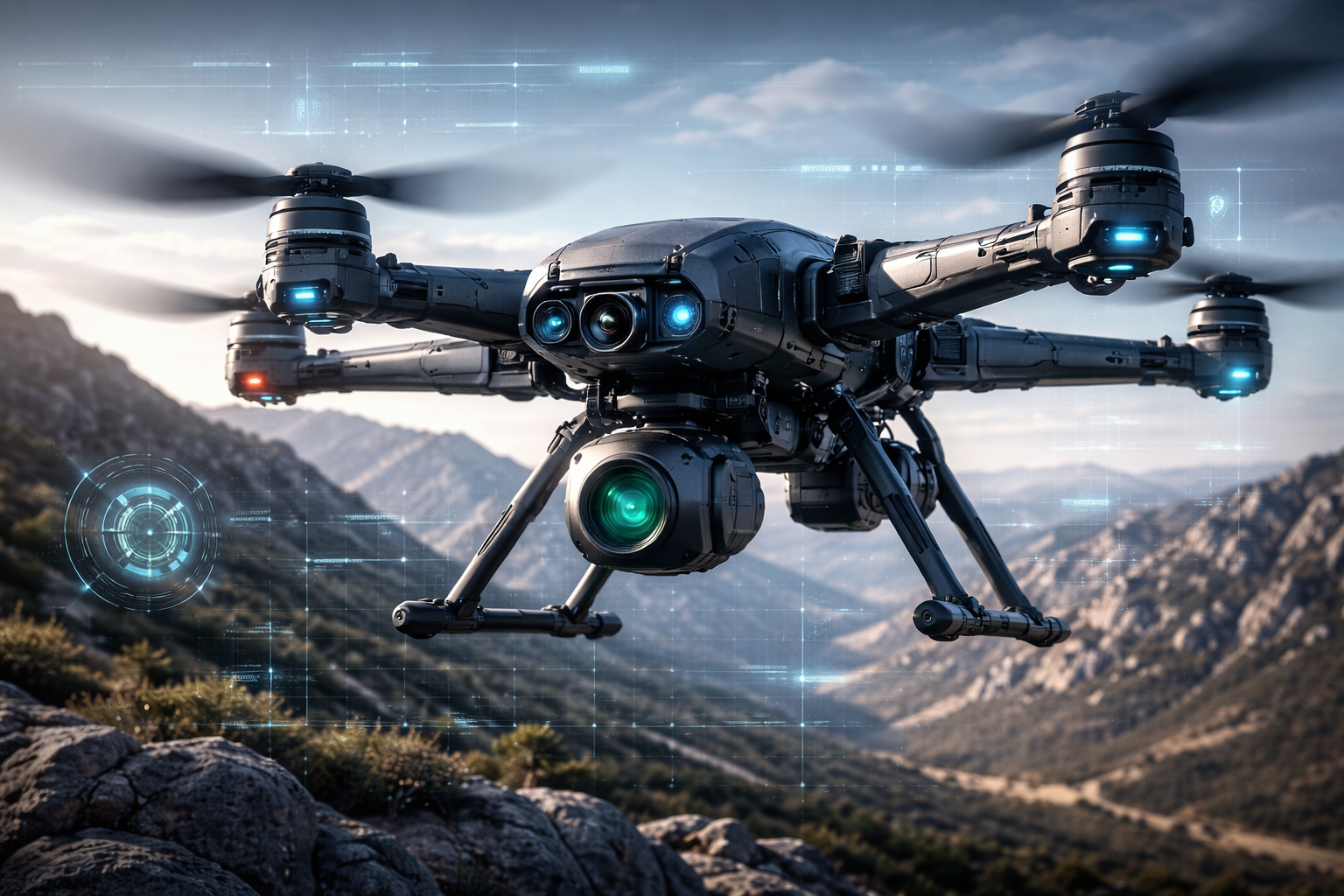
As of March 2026, the character of global conflict has undergone a fundamental shift. The “democratization of precision,” once a theoretical concept, is now a brutal battlefield reality. The integration of Tactical AI into Unmanned Aerial Systems (UAS) has transformed drones from simple remote-controlled scouts into autonomous, decision-making entities capable of operating in the world’s most contested environments. Simultaneously, the rapid rise of these threats has birthed a multi-billion-dollar Counter-UAS (C-UAS) industry, creating a high-stakes “cat-and-mouse” game of technological evolution.
Tactical AI in this context refers to the deployment of machine learning algorithms and high-performance edge computing directly onto drone hardware. This allows for real-time target recognition, autonomous navigation in GPS-denied environments, and the coordination of “swarms” that can overwhelm traditional air defenses.
Key Takeaways
- Autonomy is the New Stealth: As electronic warfare (EW) makes remote piloting unreliable, AI-driven terminal guidance has become the primary method for ensuring mission success.
- The Layered Shield: Effective defense no longer relies on a single “silver bullet” but a fusion of radar, radio-frequency (RF) jamming, directed energy (lasers/microwaves), and kinetic interceptors.
- The Cost-Per-Kill Dilemma: Modern defense strategy is shifting toward “attritable” mass—using thousands of low-cost AI drones to deplete the adversary’s expensive missile stockpiles.
- Edge Intelligence: Onboard processing (Edge AI) is now mandatory for bypassing the “latency gap” and operating without a constant link to a ground station.
Who This Is For
This deep dive is designed for defense policy makers, military procurement officers, aerospace engineers, and security analysts who need to understand the 2026 landscape of autonomous warfare. It provides a technical and strategic roadmap of the systems currently defining sovereignty and security on the modern front line.
1. The Core of Tactical AI: Edge Computing and Computer Vision
The most significant leap in drone technology since 2024 has not been in aerodynamics or battery life, but in onboard intelligence. In the early stages of the Ukraine-Russia conflict, drones were largely dependent on a “man-in-the-loop” via a radio link. Today, the “human-on-the-loop” or even “human-out-of-the-loop” models are becoming standard.
The Physics of Edge AI
In 2026, tactical drones are equipped with specialized Neural Processing Units (NPUs) capable of trillions of operations per second (TOPS) while drawing minimal power. This “Edge AI” architecture is critical because it allows the drone to process high-definition video feeds locally.
- Autonomous Target Recognition (ATR): Using deep neural networks, drones can now distinguish between a civilian vehicle and a T-72 tank in milliseconds, even under heavy camouflaging or smoke screens.
- SLAM (Simultaneous Localization and Mapping): In GPS-denied environments—common in urban warfare or near heavy jamming—AI uses visual odometry to “see” its way through a forest or building, mapping the terrain as it flies.
The Death of the Remote Pilot?
While FPV (First Person View) racing-style drones still require high-skill pilots for certain maneuvers, tactical AI is rapidly closing the gap. Systems like the Helsing HX-2 and the latest Anduril iterations utilize “terminal AI,” where a pilot merely designates a general target area. Once the drone enters the “kill zone,” it takes over, navigating the final 500 meters autonomously to ignore any jamming signals meant to sever the pilot’s link.
2. Offensive Evolution: Loitering Munitions vs. FPV Drones
The distinction between a “missile” and a “drone” has largely evaporated. As of 2026, we categorize offensive aerial threats into two primary buckets: Purpose-Built Loitering Munitions and Weaponized Commercial FPVs.
Loitering Munitions (LMs)
LMs, often called “kamikaze drones,” are designed for endurance. They can “loiter” over a target area for 40 to 60 minutes, searching for high-value targets like radar installations or command centers.
- The Lancet-3M and Switchblade 600: These systems have evolved to include multi-modal seekers. They don’t just “see”; they listen for RF emissions and use infrared (IR) to track heat signatures, making them nearly impossible to hide from.
- The “Mother-ship” Concept: Larger drones now carry and release “sub-munitions”—smaller AI drones that act as a pack, coordinated to strike a single target from multiple angles simultaneously.
The FPV Revolution
What started as a hobbyist’s toy has become the world’s most feared precision-strike weapon.
- Cost Efficiency: A $500 FPV drone, strapped with a PG-7V rocket motor, can destroy a $10 million main battle tank.
- Precision: AI-assisted stabilization allows even novice pilots to fly a drone through a narrow bunker slit or into an open tank hatch.
- Scale: In 2026, production is no longer measured in hundreds, but in millions. National initiatives, like the U.S. Replicator program, aim to field thousands of these “attritable” (expendable) systems to achieve victory through sheer mass.
3. The Counter-Drone Ecosystem: A Layered Defense Strategy
Defending against a $500 drone with a $2 million Patriot missile is a losing mathematical proposition. Modern C-UAS (Counter-Unmanned Aircraft Systems) are built on the principle of asymmetric defense.
Detection: The Multi-Sensor Fusion
You cannot kill what you cannot see. Tactical AI is used here to reduce “false positives” (like birds or wind-blown debris).
- AESA Radars: Active Electronically Scanned Array radars are now small enough to be mounted on a pickup truck, detecting micro-drones at ranges of 5–10 km.
- SIGINT (Signals Intelligence): Passive RF sensors listen for the unique “fingerprint” of a drone’s control link or video feed.
- Acoustic Sensors: AI-trained microphones can identify the specific motor hum of different drone models, providing a last line of detection in urban canyons.
Neutralization: Soft Kill vs. Hard Kill
Once a threat is identified, the system must decide how to neutralize it based on the environment.
| Technology | Type | Best Use Case | Cost per Shot |
| RF Jamming | Soft Kill | Area denial, preventing remote control. | Near Zero |
| GPS Spoofing | Soft Kill | Misleading a drone’s navigation system. | Near Zero |
| Directed Energy (Laser) | Hard Kill | Precision destruction of sensors/optics. | ~$1.00 (Electricity) |
| High-Power Microwave (HPM) | Hard Kill | Defeating swarms by “frying” all electronics. | ~$10.00 |
| Kinetic Interceptors | Hard Kill | Physical destruction (nets, bullets, drones). | $500 – $50,000 |
4. Directed Energy: The “Killer App” for Swarms
The most significant C-UAS breakthrough of 2025–2026 is the operationalization of High-Power Microwaves (HPM) and High-Energy Lasers (HEL).
High-Power Microwaves (HPM)
Systems like the Epirus Leonidas represent the ultimate “shield” against swarms. Unlike a laser, which must “dwell” on a target to burn through it, HPM emits a wide-angle pulse of electromagnetic energy. In a recent 2025 test, an HPM system successfully neutralized a swarm of 49 drones in under two seconds. It doesn’t need to aim perfectly; it simply creates a “no-fly zone” where electronics cease to function.
High-Energy Lasers (HEL)
Lasers provide “precision at the speed of light.” As of 2026, systems like the Iron Beam (Israel) and AMP-HEL (USA) are being integrated into standard air defense tiers.
- Pros: Instantaneous impact, deep “magazine” (as long as there is power), and zero collateral damage from falling shrapnel.
- Cons: Atmosphere-dependent (fog, rain, and smoke can degrade the beam’s effectiveness).
5. Swarm Intelligence: The Hive Mind on the Battlefield
A single drone is a nuisance; a thousand drones acting as a single organism is a strategic nightmare. Swarm intelligence involves drones communicating with each other in real-time to share target data, de-conflict flight paths, and coordinate attacks.
How Swarms Work
- Decentralized Control: There is no “leader” drone. If 10% of the swarm is shot down, the remaining 90% automatically redistribute tasks. This makes them incredibly resilient to traditional air defenses.
- Saturated Defenses: A swarm is designed to exhaust the enemy’s interceptors. By the time a defender has reloaded their kinetic systems, the final wave of the swarm has reached its target.
The NATO “Drone Wall”
In late 2025, several NATO countries proposed a “Drone Wall” along the eastern flank. This isn’t a physical wall, but a persistent, AI-managed network of thousands of autonomous sensors and interceptor drones. It creates a digital “tripwire” that can react to incursions faster than any human command structure.
6. Electronic Warfare (EW): The Invisible Battlefield
In 2026, the airwaves are as crowded as the physical sky. Electronic Warfare is the primary “soft” counter to tactical AI drones, but it is a rapidly shifting front.
The Evolution of Jamming
Standard “noise jamming”—blasting a frequency with interference—is becoming less effective.
- Frequency Hopping: Modern AI drones can hop across hundreds of frequencies per second to find a clear channel.
- AI-Driven Signal Analysis: Advanced EW systems now use machine learning to “predict” where a drone’s signal will hop next and preemptively jam it.
Spoofing and Cyber Takeover
“Cyber-C-UAS” involves hijacking the drone’s software rather than just blocking its signal. Systems like D-Fend’s EnforceAir can identify a drone’s unique protocol and “force” it to land in a safe area or return to its launch point—revealing the operator’s location.
7. Common Mistakes in Drone & C-UAS Integration
As the field moves fast, many organizations fall into predictable traps. Avoiding these is essential for maintaining a competitive edge.
- Reliance on a Single Modality: Relying solely on RF jamming is a mistake in 2026. If the adversary switches to fiber-optic-controlled drones or autonomous terminal guidance, your jammers become useless. Defense must be multi-modal.
- Ignoring “Cost-per-Intercept”: Using a $100,000 interceptor drone to kill a $500 quadcopter is a strategy for bankruptcy. Successful defense requires matching the cost of the effector to the cost of the threat.
- Neglecting the Legal/Civic Impact: In urban environments, using HPM or kinetic rounds can damage civilian infrastructure or cause “friendly fire” on domestic wireless networks. C-UAS systems must have “surgical” modes for non-combat zones.
- Slow Procurement Cycles: The “software” of drone warfare changes every 3–6 months. Traditional 10-year military procurement cycles are incompatible with the “drone age.”
8. Ethics, Policy, and the OODA Loop
The ultimate question of 2026 remains: Should an AI be allowed to pull the trigger?
The OODA Loop Compression
The OODA loop (Observe, Orient, Decide, Act) is the fundamental cycle of combat. Tactical AI compresses this loop from minutes to milliseconds. If an adversary’s AI can decide and act faster than a human operator, the human becomes a liability.
- Meaningful Human Control: Most Western doctrines still require a “human-in-the-loop” for lethal decisions. However, as swarm attacks become faster, the pressure to move toward “autonomous authorized” modes is mounting.
- The UN Debate: As of early 2026, international debate at the UN regarding “Lethal Autonomous Weapons Systems” (LAWS) remains deadlocked. While some nations call for a total ban, others argue that AI is more precise and leads to fewer civilian casualties than human-guided systems.
Conclusion: The Path Forward
The integration of Tactical AI into drone and counter-drone technology has permanently altered the geometry of the battlefield. We are no longer in an era where “bigger and more expensive” guarantees victory. Instead, the winner of tomorrow’s conflict will be determined by software agility, mass, and the ability to operate at the edge.
For defense professionals, the next steps are clear:
- Invest in “Attritable” Mass: Shift procurement focus from a few “exquisite” platforms to thousands of low-cost, AI-enabled units.
- Prioritize Sensor Fusion: Ensure that C-UAS systems can “see” across the entire spectrum—RF, EO/IR, and Radar—to counter the rise of autonomous, silent threats.
- Modernize the Industrial Base: Adopt software-first manufacturing processes that allow for weekly updates to drone algorithms to counter new EW threats.
The “Drone Age” is not coming; it is here. Our ability to adapt to these autonomous systems will define the security of nations for the next decade.
FAQs
1. Can AI drones fly without GPS?
Yes. Modern tactical AI drones use Visual SLAM (Simultaneous Localization and Mapping) and inertial navigation systems. They “see” the terrain and recognize landmarks to calculate their position, making them immune to GPS jamming or spoofing.
2. How do you stop a swarm of 100+ drones?
Traditional defenses fail against swarms. The most effective counters are High-Power Microwaves (HPM), which can disable dozens of drones with a single pulse, and electronic warfare systems that can disrupt the “mesh network” the drones use to communicate.
3. Are FPV drones different from loitering munitions?
Yes. FPV (First Person View) drones are typically agile multirotors (quadcopters) built for speed and manual precision, often used for short-range strikes. Loitering munitions are usually fixed-wing aircraft designed for longer endurance and autonomous searching over a target area.
4. What is the “Replicator” initiative?
The U.S. Department of Defense’s Replicator initiative is a strategic program aimed at fielding thousands of low-cost, autonomous, and attritable systems within 18 to 24 months to counter an adversary’s numerical advantage in traditional platforms.
5. Will AI eventually replace human pilots entirely?
In high-threat environments where communication is impossible, AI will likely handle the majority of flight and targeting. However, humans will still be required for high-level mission planning, ethical oversight, and strategic decision-making.
References
- U.S. Department of Defense (DoD): Replicator Initiative Progress Report (2025). Official directive on mass-scale autonomous systems.
- Center for Strategic and International Studies (CSIS): The Evolution of Loitering Munitions in the 2020s. Analysis of tactical shifts.
- Royal United Services Institute (RUSI): Electronic Warfare and the Autonomy Gap: Lessons from Eastern Europe.
- Anduril Industries: Lattice OS: AI-Enabled Command and Control for the Modern Frontier. Technical whitepaper.
- IEEE Xplore: Onboard Deep Learning for Micro-UAS: Challenges and Solutions in Edge Computing (2025).
- Epirus Inc.: Leonidas HPM: Operational Testing and Swarm Defeat Capability.
- Helsing AI: Software-Defined Defense and the HX-2 Platform.
- The Economist Intelligence Unit: The Global Drone Market and Defense Procurement Trends 2026.
- Jane’s Defence Weekly: Counter-UAS Technology Monitor (Q1 2026).
- MIT Lincoln Laboratory: Autonomous Navigation in GPS-Denied Environments. Technical report.