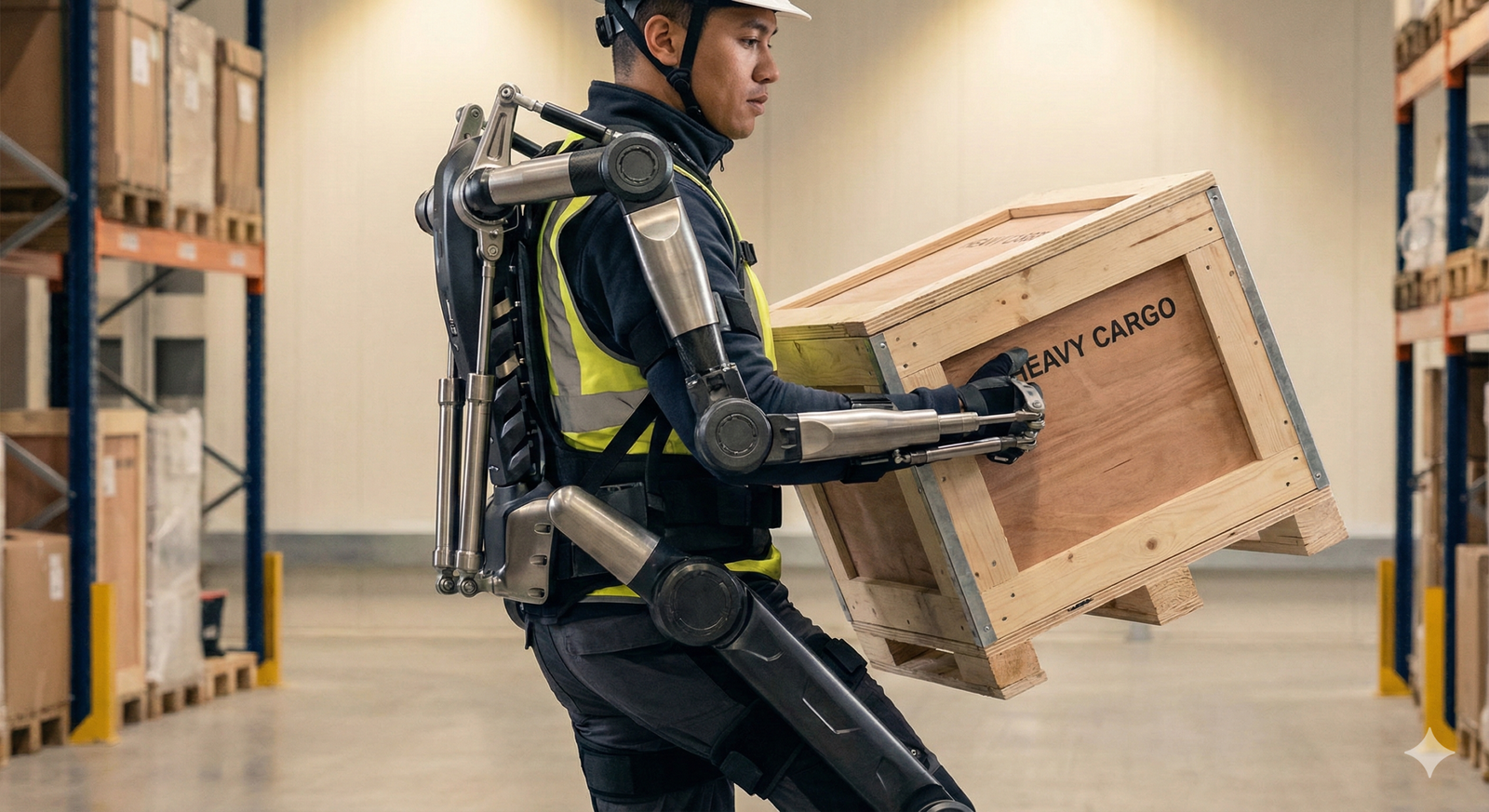
Imagine lifting a 100-pound industrial component as if it weighed no more than a bag of groceries. For decades, this concept was confined to science fiction and comic books—the “Iron Man” fantasy of mechanical strength. Today, however, strength-enhancing exoskeleton suits are a deployed reality in warehouses, construction sites, and logistics hubs around the world. These devices are not just about creating super-soldiers; they are fundamentally reshaping how we approach physical labor, safety, and human endurance.
In this guide, “strength-enhancing exoskeleton suits” refers to wearable robotic or mechanical devices designed to augment human physical capabilities, specifically load-bearing capacity and lifting force. We will focus primarily on industrial and commercial applications where these suits prevent injury and boost productivity, while briefly touching on military and rehabilitation contexts where relevant.
Medical Disclaimer: While this article discusses devices that prevent injury and aid physical movement, it does not constitute medical advice. For specific rehabilitation needs or medical conditions, always consult a qualified healthcare professional or physical therapist.
Key Takeaways
- Augmentation vs. Automation: Exoskeletons keep the human in the loop, combining human decision-making with robotic strength, unlike fully autonomous robots.
- Active vs. Passive: Understanding the difference between powered systems (motors/batteries) and passive systems (springs/dampers) is critical for choosing the right tool.
- Injury Prevention: The primary ROI for most businesses is not just speed, but the significant reduction of musculoskeletal disorders (MSDs) and fatigue.
- Integration Challenges: Adoption requires overcoming hurdles like battery life, comfort, hygiene, and worker acceptance.
- Cost Reality: Prices range from a few thousand dollars for passive vests to over $100,000 for full-body powered suits as of January 2026.
What Are Strength-Enhancing Exoskeletons?
At its core, a strength-enhancing exoskeleton is a wearable machine that works in tandem with the user. Unlike a forklift or a crane, which are operated by a human, an exoskeleton is worn on the human. It mimics the structure of the human musculoskeletal system to provide structural support, assist with movement, or amplify force.
The Scope of Human Augmentation
It is important to distinguish what is “in scope” for this technology. We are looking at devices that:
- Redistribute Load: Transferring weight from weaker parts of the body (like the lower back or shoulders) to the ground or stronger muscle groups.
- Add Energy: Using motors to supply torque to joints, effectively making a heavy object feel lighter.
- Stabilize Posture: Locking in place to allow a worker to hold a heavy tool overhead for extended periods without fatigue.
Out of Scope: This guide focuses less on purely medical devices designed solely for paralysis rehabilitation (walking assistance for paraplegics), although the underlying technology often overlaps. Our focus here is on enhancing able-bodied performance.
How They Work: The Anatomy of an Exosuit
Most modern strength-enhancing suits rely on a combination of three core systems:
- The Frame: Usually made of lightweight materials like carbon fiber, aluminum, or soft textiles. Rigid frames offer higher load capacity, while soft exosuits (textile-based) offer better mobility.
- Actuators (The “Muscles”):
- Electric Motors: The most common in active suits, providing precise torque.
- Pneumatics/Hydraulics: Used for extremely heavy lifting but often require tethering or bulky pumps.
- Springs/Elastic Elements: Used in passive suits to store and release energy (e.g., absorbing energy when you squat, releasing it to help you stand up).
- Sensors and Control Systems: To feel “natural,” the suit must predict the user’s intent. Sensors detect muscle electrical activity (EMG), joint angles, and pressure. AI algorithms process this data in milliseconds to ensure the suit moves with the user, not against them.
Active vs. Passive Systems: Choosing the Right Tool
The exoskeleton market is bifurcated into two main categories. Understanding the distinction is the first step in any procurement or research process.
1. Passive Exoskeletons
Passive suits do not use batteries, motors, or computers. They rely purely on physics—springs, dampers, and lever systems—to redistribute weight or store energy.
- How it works: Think of a spring-loaded door. When you bend forward (flexion), elastic bands stretch and store energy. When you stand back up (extension), that energy is released, assisting your back muscles.
- Best for: Repetitive, specific tasks like overhead assembly, holding heavy tools, or frequent squatting.
- Pros: Lightweight, cheaper (typically $2,000–$6,000), no charging required, low maintenance.
- Cons: Limited strength augmentation (typically 10–30% assist); can restrict range of motion if not fitted perfectly.
2. Active (Powered) Exoskeletons
Active suits are robots you wear. They utilize battery-powered actuators to mechanically drive the user’s limbs.
- How it works: When the user initiates a lift, sensors detect the movement. The onboard computer commands motors at the hip, knee, or shoulder to apply torque, effectively lifting the load for the user.
- Best for: Handling variable heavy loads, dynamic environments, and tasks requiring significant force multiplication (e.g., making 100 lbs feel like 10 lbs).
- Pros: Significant strength increase, reduces metabolic cost (heart rate/oxygen consumption), customizable support levels.
- Cons: Heavy (the suit itself adds weight), expensive ($30,000 to $100,000+), battery life limitations, complex maintenance.
Top Use Cases for Strength Augmentation
The adoption of exoskeleton suits is driven by a crisis in industrial labor: the human body wears out faster than the job is done. Here is where the technology is making the biggest impact as of January 2026.
Industrial Logistics and Warehousing
In the age of e-commerce, the volume of packages moved manually is staggering. Even light packages, when lifted thousands of times a day, lead to fatigue and injury.
- The Problem: The “Pick and Place” dilemma. Automation cannot yet match the dexterity of a human hand for diverse package shapes, but human backs fail under the volume.
- The Solution: Powered lumbar exoskeletons (like those from German Bionic) protect the lower back during lifting, analyzing lifting posture in real-time and alerting the user to unsafe movements.
Automotive Manufacturing
Car manufacturing involves repetitive overhead work—installing exhaust pipes, tightening bolts under a chassis, or inspecting undercarriages.
- The Problem: Keeping arms raised above the head restricts blood flow and fatigues shoulder muscles rapidly (the “gorilla arm” effect).
- The Solution: Passive shoulder support exoskeletons (like the EksoWorks Vest) lock the arms in place or provide spring assist, allowing workers to hold tools overhead for hours with minimal strain. Major manufacturers like Ford and Toyota have been pioneers in this specific use case.
Construction and Heavy Industry
Construction sites are unstructured environments where standard automation (robots on rails) fails.
- The Problem: Moving heavy materials (cement bags, drywall, steel beams) across uneven terrain.
- The Solution: Full-body powered suits (like the Sarcos Guardian XO) allow a single operator to lift heavy beams or machinery components without a crane, reducing the crew size needed for a lift and improving safety.
Military and Defense
While Hollywood depicts combat suits with weapons, the reality of military exoskeletons is focused on logistics and logistics alone.
- The Problem: Soldiers carry enormous loads (ammo, batteries, comms gear), often exceeding 100 lbs, leading to chronic knee and back injuries.
- The Solution: Knee and hip exoskeletons (like the Lockheed Martin ONYX) reduce the metabolic cost of marching, allowing soldiers to cover more ground with less fatigue.
Leading Models and Manufacturers
The market is crowded, but a few players have established themselves as leaders in reliability and capability.
Note: Product specifications and availability are current as of January 2026.
1. German Bionic (Cray X / Apogee)
- Type: Active (Powered).
- Focus: Logistics and Warehousing.
- Key Feature: Their “Smart Safety Companion” software not only helps lift (providing up to 66 lbs of support per lift) but also connects to the industrial IoT to track worker fatigue levels and suggest breaks.
2. Sarcos Robotics (Guardian XO)
- Type: Full-body Powered.
- Focus: Heavy Industry / Defense.
- Key Feature: This is the closest to the sci-fi ideal. It is a massive, battery-powered suit that can lift up to 200 lbs repeatedly without the operator feeling the strain. It is fully untethered (battery-operated) and uses sophisticated force feedback so the operator can “feel” the load for precision placement.
3. Ekso Bionics (EksoWorks / Evo)
- Type: Passive (mostly).
- Focus: Construction / Auto Manufacturing.
- Key Feature: The Evo vest is an upper-body passive exoskeleton designed to alleviate the burden of overhead work. It is lightweight, relatively low-cost, and has seen widespread adoption in automotive assembly lines.
4. Mawashi Science & Technology (UPRISE)
- Type: Passive/Hybrid.
- Focus: Military / Special Forces.
- Key Feature: Focused on load carriage, the UPRISE exoskeleton acts like an external spine, transferring the weight of a heavy backpack directly to the ground, bypassing the soldier’s spine and knees.
The Benefits of Human Augmentation
Why are companies investing millions in this hardware? The data points to three main drivers.
1. Reduction of Musculoskeletal Disorders (MSDs)
MSDs are the leading cause of worker disability and compensation claims globally. Back pain alone costs the industry billions annually. Exoskeletons attack this problem at the source by reducing the spinal compression forces during a lift. Studies have shown that active back-support exoskeletons can reduce peak muscle activity in the lumbar region by 50% or more.
2. Solving the Labor Shortage / Aging Workforce
The industrial workforce in many developed nations is aging. Older workers have the skills and experience but may lack the physical stamina of their youth. Exoskeletons act as an equalizer, allowing older workers to remain in physically demanding roles longer without risk of injury. Furthermore, by making the work less physically punishing, these roles become more attractive to a wider demographic, including those who might not historically have the upper body strength for heavy industry.
3. Increased Productivity (The Nuance)
Early marketing claimed exoskeletons would make workers move faster. In reality, the productivity gain comes from endurance. An unassisted worker slows down significantly after 4 hours of lifting due to fatigue. An assisted worker maintains a steady pace throughout an 8-hour shift. The “sprint” speed might be the same, but the “marathon” performance is vastly superior with an exoskeleton.
Challenges and Limitations
Despite the benefits, exoskeletons are not a magic bullet. Implementation failures are common when organizations ignore these limitations.
1. Comfort and Fit
The human body is soft, squishy, and uniquely shaped; robots are rigid. This interface—where the machine touches the human—is the failure point. If a suit rubs, pinches, or causes excessive sweating, workers will refuse to wear it. “Donning and doffing” time (putting it on and taking it off) is also a friction point; if it takes 10 minutes to put on, it kills efficiency.
2. The “Sensorimotor” Mismatch
In active suits, there is a tiny delay (latency) between the human deciding to move and the suit responding. Even a few milliseconds of lag can feel unnatural or “fighting the suit.” While 2026 technology has minimized this, it remains a challenge in highly dynamic movements (e.g., catching a falling object).
3. Battery Density
For powered suits, energy density is the bottleneck. To lift heavy loads all day, you need heavy batteries. Manufacturers must balance the weight of the battery against the operational time. Most heavy-duty suits require “hot-swappable” batteries to function through a full shift.
4. Hygiene and Maintenance
In a warehouse, suits are often shared between shifts. Textile components (straps, padding) absorb sweat and must be washable or replaceable. The mechanical components require maintenance in dusty, dirty environments, adding to the total cost of ownership.
Safety and Ethical Implications
When we strap powerful motors to a human body, safety is paramount. This falls under high-stakes safety considerations (YMYL).
Dependency and Muscle Atrophy
A common concern is whether using an exoskeleton will cause the worker’s own muscles to weaken (atrophy) over time.
- The Consensus: Current research suggests that for heavy industrial tasks, the exoskeleton is reducing “over-exertion” rather than eliminating effort entirely. The worker is still moving and engaging muscles, just within a safe zone. However, reliance on the suit for every movement is something physiologists are monitoring closely.
False Sense of Security
There is a risk of “risk compensation.” A worker wearing a suit that allows them to lift 200 lbs might attempt to lift 300 lbs, believing they are invincible. This can lead to catastrophic failure of the suit or injury to body parts not supported by the exoskeleton.
Data Privacy
Modern active suits collect data: how many lifts, movement speed, break times, and posture quality. While this is great for safety analytics, it raises privacy concerns. Can this data be used to punish a worker for being too slow? Ethical governance of this biometric data is essential for worker trust.
How to Evaluate and Implement Exoskeletons
If you are a business leader considering this technology, do not just buy a fleet of suits. Follow this implementation framework.
Phase 1: Assessment and Task Analysis
Identify the specific problem. Is it back pain? Shoulder fatigue?
- Do not apply an exoskeleton to a task that should be automated entirely. If a robot arm can do it, use a robot arm. Exoskeletons are for tasks that require human judgment and flexibility.
Phase 2: Pilot Testing
Select a small group of “champion” users—workers who are open to technology and vocal about feedback.
- Test different types: Try a passive vest vs. an active unit.
- Measure benchmarks: Record fatigue levels and output before the pilot to compare against the results.
Phase 3: Employee Buy-in
This is the most critical step. If workers feel the suit is being forced on them to squeeze out more productivity, they will reject it. Frame the narrative correctly: “This is a tool to protect your back so you can go home and play with your kids without pain.”
Phase 4: Integration and Training
Develop protocols for hygiene (cleaning pads), storage, and battery charging. Train workers not just on how to wear it, but on the limitations of the suit (what not to lift).
Who This Is For (and Who It Isn’t)
Who this is for:
- Warehouse Managers: Looking to reduce high turnover and injury rates in picking departments.
- Construction Safety Officers: Seeking to mitigate risks in manual material handling.
- Logistics Planners: Dealing with heavy, irregular cargo that cannot be conveyed.
- Aging Workers: Individuals wanting to extend their careers in manual trades.
Who this isn’t for:
- Office Workers: If you have back pain from sitting, you need ergonomic chairs, not an exoskeleton.
- Total Automation Replacement: If the task is strictly repetitive (e.g., moving a box from point A to point B on a fixed path), an industrial robotic arm is cheaper and faster.
- Athletic Performance: These suits are heavy and designed for work, not for helping you run a faster marathon or dunk a basketball (yet).
Future Trends: Soft Robotics and Brain Interfaces
As of 2026, the technology is evolving toward “Soft Robotics.” Traditional exoskeletons are rigid skeletons. Soft exosuits use cables and textiles to pull on the limbs, mimicking muscles directly. This significantly reduces weight and improves comfort.
Furthermore, research into Brain-Computer Interfaces (BCI) is advancing. Currently, suits detect muscle twitches (EMG). In the future, the suit might read the neural signal from the brain before the muscle even fires, creating a seamless, zero-latency augmentation that feels like a true extension of the body.
Conclusion
Exoskeleton suits enhancing human strength have graduated from experimental prototypes to essential industrial tools. By effectively merging human intelligence and adaptability with machine durability and power, they offer a pragmatic solution to the physical limits of the human body.
For businesses, the question is no longer “do they work?” but rather “how do we integrate them?” The technology promises a safer, more inclusive future for manual labor—one where the job no longer breaks the worker.
Next Steps: If you are considering exoskeletons for your team, start by conducting a “pain point audit” of your workflow to identify tasks with the highest frequency of musculoskeletal injuries, and contact a manufacturer for a site-specific demo.
FAQs
1. How much does a strength-enhancing exoskeleton cost? As of 2026, prices vary widely by technology. Passive suits (using springs) typically range from $2,000 to $6,000 per unit. Active, powered industrial suits generally range from $30,000 to over $100,000, usually sold via “Robotics-as-a-Service” (RaaS) leasing models to lower upfront costs.
2. Can I buy an exoskeleton to help me move furniture at home? Technically, yes, but it is likely impractical. Most strength-enhancing suits are designed for industrial environments and require training. However, lighter passive back-support vests are becoming available to consumers for DIY and gardening, typically costing around $500–$1,500.
3. Do exoskeletons make you weaker over time? Current industrial research suggests that when used correctly for heavy tasks, they do not cause significant muscle atrophy. They reduce the peak load that causes injury but still require muscle engagement for balance and coordination. However, they should not be worn 24/7; proper use involves balancing assisted work with natural movement.
4. How long do the batteries last on powered suits? Battery life depends on the intensity of use (how much weight is being lifted and how often). Most modern industrial suits offer 4 to 8 hours of continuous operation and usually utilize hot-swappable batteries so the suit does not need to be plugged in during a shift.
5. Are exoskeletons comfortable to wear? Comfort has improved but remains a hurdle. They can be hot, heavy, and restrictive if not fitted perfectly. Manufacturers now use breathable textiles and adjustable frames, but wearing a 10–20 lb machine all day takes getting used to.
6. What is the difference between a medical and an industrial exoskeleton? Medical exoskeletons are designed for rehabilitation (helping paralyzed patients walk) and focus on precise, slow movements and supporting the full body weight. Industrial exoskeletons focus on augmentation (making a healthy person stronger/safer) and prioritize durability, speed, and heavy lifting capacity.
7. Can an exoskeleton prevent all back injuries? No. While they significantly reduce the risk by lowering spinal compression forces, they cannot prevent injuries caused by slips, trips, or improper use of the suit. They are a risk reduction tool, not a guarantee.
8. Do military exoskeletons carry weapons? Generally, no. The primary focus of current military exoskeleton programs (like US Army or DARPA initiatives) is logistics—helping soldiers carry heavy packs, load ammunition, and reduce fatigue during marches. The “combat suit” concept faces significant power supply and mobility challenges.
9. How heavy is the exoskeleton suit itself? Passive vests can weigh as little as 5–8 lbs. Active lower-body or back-support suits often weigh 15–25 lbs. Full-body powered suits meant for heavy lifting can weigh 150+ lbs, but they support their own weight, so the user does not feel it.
10. What happens if the battery dies while lifting? Safety standards require fail-safes. If power is lost, the suit generally locks in place or slowly descends (dampening) rather than dropping the load instantly. Most systems also give ample warning before a battery is critically low.
References
- ASTM International. (n.d.). Committee F48 on Exoskeletons and Exosuits. Standards and safety guidelines for the exoskeleton industry. https://www.astm.org/committee-f48
- Sarcos Technology and Robotics Corporation. (2025). Guardian XO Specification Sheet and Safety Data. Official Manufacturer Documentation.
- German Bionic. (2025). The Future of Manual Work: Data and Insights from the Cray X. https://www.germanbionic.com
- National Institute for Occupational Safety and Health (NIOSH). (2023). Occupational Exoskeletons: Usage and Safety. Centers for Disease Control and Prevention. https://www.cdc.gov/niosh/topics/exoskeletons/default.html
- Ekso Bionics. (2025). Industrial Exoskeletons for Automotive and Construction Applications. https://eksobionics.com
- IEEE Spectrum. (2024). The State of Soft Robotics and Wearable Augmentation. https://spectrum.ieee.org
- Journal of Occupational and Environmental Hygiene. (2023). Efficacy of Exoskeletons in Reducing Musculoskeletal Disorders in Industrial Environments. https://www.tandfonline.com/journals/uoeh20
- U.S. Army Research Laboratory. (2024). Soldier Center Research on Exoskeleton Load Carriage. https://www.arl.army.mil