Smart contracts for NFTs let you encode how tokens are minted, transferred, and paid for—without manual intervention. Put simply, you write rules once and the chain enforces them forever. To automate minting and royalties, you’ll map supply, pricing, metadata, and payout logic into code, then expose safe entry points for buyers and marketplaces. The result is predictable mints and automatic creator earnings on primary and secondary sales. This guide gives you a complete workflow, with guardrails to avoid costly mistakes and practical examples you can adapt. This is technical education, not legal or financial advice; consult qualified professionals for compliance and tax matters.
At a glance, the 12 steps you’ll follow:
- Choose the token standard and metadata approach.
- Design supply, phases, and pricing.
- Make payments safe and withdrawals reliable.
- Implement mint functions (public, allowlist, signatures).
- Set up metadata, storage, and freeze rules.
- Add royalty logic the right way.
- Lock down roles and decide on upgrade paths.
- Optimize gas for scale and fairness.
- Test thoroughly with unit, fuzz, and scenario tests.
- Deploy and configure with care.
- Integrate cleanly with marketplaces and wallets.
- Monitor, respond, and maintain over time.
1. Select the Right NFT Standard and Structure Your Metadata
Choosing between ERC-721 and ERC-1155 defines how your NFTs behave, how efficient they are to mint, and how easily marketplaces can index them. ERC-721 represents one unique token per ID, ideal for 1/1 art or collections where each token is distinct. ERC-1155 supports semi-fungible and batch operations, so it shines when you have multiple editions of the same asset or need cost-effective batch mints. Your metadata strategy should be decided at the same time: off-chain via IPFS/Arweave with a stable gateway, or fully on-chain if your art and attributes are small enough to encode. To automate royalties later, plan your token URIs and collection-level settings so marketplaces can read them consistently. By aligning standard, metadata, and indexing expectations from the start, you avoid refactors that break existing tokens.
Quick comparison
| Standard | Best for | Batch minting | Metadata URI | Typical use |
|---|---|---|---|---|
| ERC-721 | 1/1s, PFP collections | Limited | tokenURI(id) | Art, collectibles |
| ERC-1155 | Editions, game items | Strong | uri(id) | Gaming, passes |
How to decide
- Uniqueness vs. editions: If every token is unique and you rarely batch mint, ERC-721 is simple and widely supported.
- Throughput needs: If you plan large drops or multi-edition items, ERC-1155’s batch functions can cut costs.
- Metadata mutability: If you’ll freeze metadata later, ensure your baseURI and “reveal” plan won’t strand holders.
- Tooling ecosystem: Ensure your standard aligns with libraries you’ll use (e.g., OpenZeppelin) and marketplaces you target.
Common mistakes
- Mixing ERC-721 assumptions into ERC-1155 code paths (and vice versa).
- Relying on a single centralized server for metadata.
- Hard-coding gateway URLs without a strategy for redundancy.
Close the loop by writing down your choice and its implications for mint flow and royalty reading. This clarity drives every decision that follows.
2. Define Supply, Phases, Pricing, and Allowances
Automating minting starts with crisp rules: total supply, per-wallet limits, and mint phases. You’ll typically model a presale/allowlist phase and a public phase, each with its own price and capacity. Add optional phases such as team/reserve mints and airdrops. Prices can be flat, tiered, or free-mint with limits to prevent bots from draining supply. When you encode these constraints on-chain, your contract becomes the single source of truth that the front end and marketplaces can respect, minimizing disputes and manual interventions. Clear, deterministic phase logic also makes testing and monitoring far easier.
How to structure phases
- Presale (allowlist): Lower price, stricter per-wallet caps, Merkle-proof access.
- Public sale: Standard price, broader limits, optional cooldown between mints.
- Reserve/team: Owner-only or role-protected mint for partners or operations.
- Airdrop/claims: Signature-based claims for specific addresses to reduce gas waste.
Numbers & guardrails
- Per-wallet caps: Commonly 1–5 in presale, 2–10 public; tune based on demand.
- Total supply: Pick a hard cap and enforce it in code; avoid “soft caps” that invite surprises.
- Phase timers: Avoid long gaps; bots monitor mempools. Prefer clear start/stop toggles and block-time buffers.
Mini case: Suppose you plan 10,000 tokens, with 2,000 for presale and 8,000 for public. Presale price is 0.03 ETH with a 2-per-wallet cap; public price is 0.05 ETH with a 5-per-wallet cap. If 1,100 wallets mint 2 each in presale, you’ve sold 2,200, exceeding your allocation. Encode a rule that caps presale total at 2,000 and automatically redirects additional presale demand to public phase. This one guardrail prevents over-allocation and costly refunds.
Close this step by documenting supply math and caps in comments and tests, so future changes won’t silently break guarantees.
3. Make Payments Safe and Withdrawals Predictable
When ETH flows into your contract, your job is to avoid reentrancy, rounding errors, and stuck funds. Use the pull over push pattern for outbound payments: store balances and let recipients withdraw, instead of pushing funds in the same transaction that might reenter your contract. For mint pricing, multiply quantity by price and reject fractional underpayments. For exactness, prefer msg.value == price * quantity over >= to avoid silent overpays. If you split revenue to multiple stakeholders, implement a deterministic splitter or use a well-audited library; keep math in basis points to avoid floating-point confusion. Add a withdrawal function gated by roles, and test it under edge cases like zero balance, reentrancy attempts, and paused states.
Checklist
- Require exact payment amounts and revert on mismatch.
- Use a reentrancy guard on mint and withdraw paths.
- Keep a simple, readable revenue-splitter with basis points totaling 10,000.
- Store balances and let parties withdraw; avoid pushing ETH in mint.
- Emit events for mints, payments received, and withdrawals.
Mini case
You sell 3 tokens at 0.04 ETH each to a buyer. price * qty = 0.12 ETH. Your split is 85% to creator, 15% to collaborator. On withdraw, creator gets 0.102 ETH and collaborator 0.018 ETH. If the buyer accidentally sends 0.1201 ETH, revert and tell them to try again with the exact amount. This keeps accounting clean and auditable.
By building payment logic that’s boring by design, you protect buyers and avoid emergency patches later.
4. Implement Mint Functions: Public, Allowlist, and Signature-Based
Automating minting means exposing entry points that enforce your rules without manual checks. Implement public mint that respects per-wallet caps and total supply, allowlist mint that verifies a Merkle proof against a committed root, and optionally signature-based mint (often called “voucher” or “lazy” mint) where the contract accepts an ECDSA signature from a trusted signer to authorize a purchase. Signature-based flows reduce on-chain storage and let you encode per-buyer terms (quantity, price, deadline) off-chain. Always include nonces or expiry to prevent replay. For ERC-1155, leverage batch functions to reduce gas for multi-token mints. Emit descriptive events so indexers can track mints by phase.
How to do it
- Public mint: Check msg.value, per-wallet, and remaining supply; call _safeMint/_mint.
- Allowlist mint: Verify MerkleProof.verify and mark the address as consumed or respect per-wallet caps.
- Signature mint: Recreate a hash of terms, recover signer, and enforce nonce/expiry.
- Batching: For ERC-1155, use mintBatch to mint multiple IDs in one call.
Numbers & guardrails
- Timebox signatures with a deadline block or timestamp.
- Use domain separators to prevent cross-contract signature reuse.
- Size Merkle trees so proof lengths stay manageable (e.g., < 32 nodes).
Mini case: You issue signatures allowing up to 3 mints at 0.03 ETH each before a given deadline. Each signature encodes (buyer, maxQty=3, price=0.03, deadline, nonce). A buyer mints 2 now and 1 later; the contract tracks usage against the signed cap, and the nonce prevents a second signature from being replayed. This gives flexibility without sacrificing control.
Finish by asserting that each mint path reaches the same internal _mint logic, so token accounting stays consistent across phases.
5. Set Up Metadata, Storage, and “Reveal” Without Surprises
Metadata is the soul of NFTs. Decide whether you will store assets and JSON metadata off-chain (commonly IPFS/Arweave) or on-chain if compact enough. For off-chain, upload assets first, then JSON files with stable content hashes. In your contract, implement a baseURI and, if using a delayed reveal, a temporary placeholder URI. When you “reveal,” switch the baseURI once, and consider implementing a freeze to prevent accidental changes. Always think through gateway redundancy: holders expect images to load reliably even if one gateway is down. For on-chain metadata, encode SVG or compressed assets and return JSON in tokenURI.
Mini-checklist
- Upload final assets and metadata to content-addressed storage.
- Implement tokenURI or uri to return stable, deterministic paths.
- Plan a one-way freezeMetadata() if immutability is part of your promise.
- Emit an event on reveal so marketplaces can reindex.
- Document any dynamic attributes so holders know what can change.
Numeric example
If your collection has 10,000 tokens and each JSON is ~1.2 KB, total metadata is ~12 MB. Hosting this on IPFS with multiple pins is trivial, while moving it on-chain would increase deployment cost significantly. If you need small, fully on-chain art, aim for sub-10 KB per token using SVG and compression techniques.
Completing this step eliminates the most common holder complaint: confusing or broken metadata at reveal.
6. Add Royalties with EIP-2981 and Practical Fallbacks
Royalties let you encode a preferred creator fee for secondary sales, communicated via a standard interface. Implement EIP-2981 so marketplaces can query royaltyInfo(tokenId, salePrice) and receive the recipient address and amount. Recognize that enforcement depends on marketplace behavior; the contract advertises royalties, but not every venue will route them automatically. To maximize outcomes, pair on-chain royalties with simple, transparent primary-sale splits and, where relevant, collection-level royalty settings that marketplaces can read. Keep royalty math in basis points (e.g., 500 = 5.00%) and expose functions to adjust it within a sane cap.
How to do it
- Implement royaltyInfo and store recipient + bps (collection-wide or per-token).
- Cap royalties (e.g., max 1,000 bps) to prevent fat-finger errors.
- Add events when royalties change; document your policy clearly.
- Consider a Split contract for multi-party payouts and easier accounting.
Numbers & guardrails
- Typical creator fees range from 250–750 bps; pick a defensible number and keep it stable.
- For a 1.5 ETH sale at 500 bps, royalty amount is 0.075 ETH.
- Keep at least one admin path to update the royalty recipient if a wallet is compromised.
By using the standard and being transparent about your policy, you give marketplaces everything they need to do the right thing while your primary mints and internal splits remain fully automated.
7. Lock Down Roles, Permissions, and Upgrade Paths
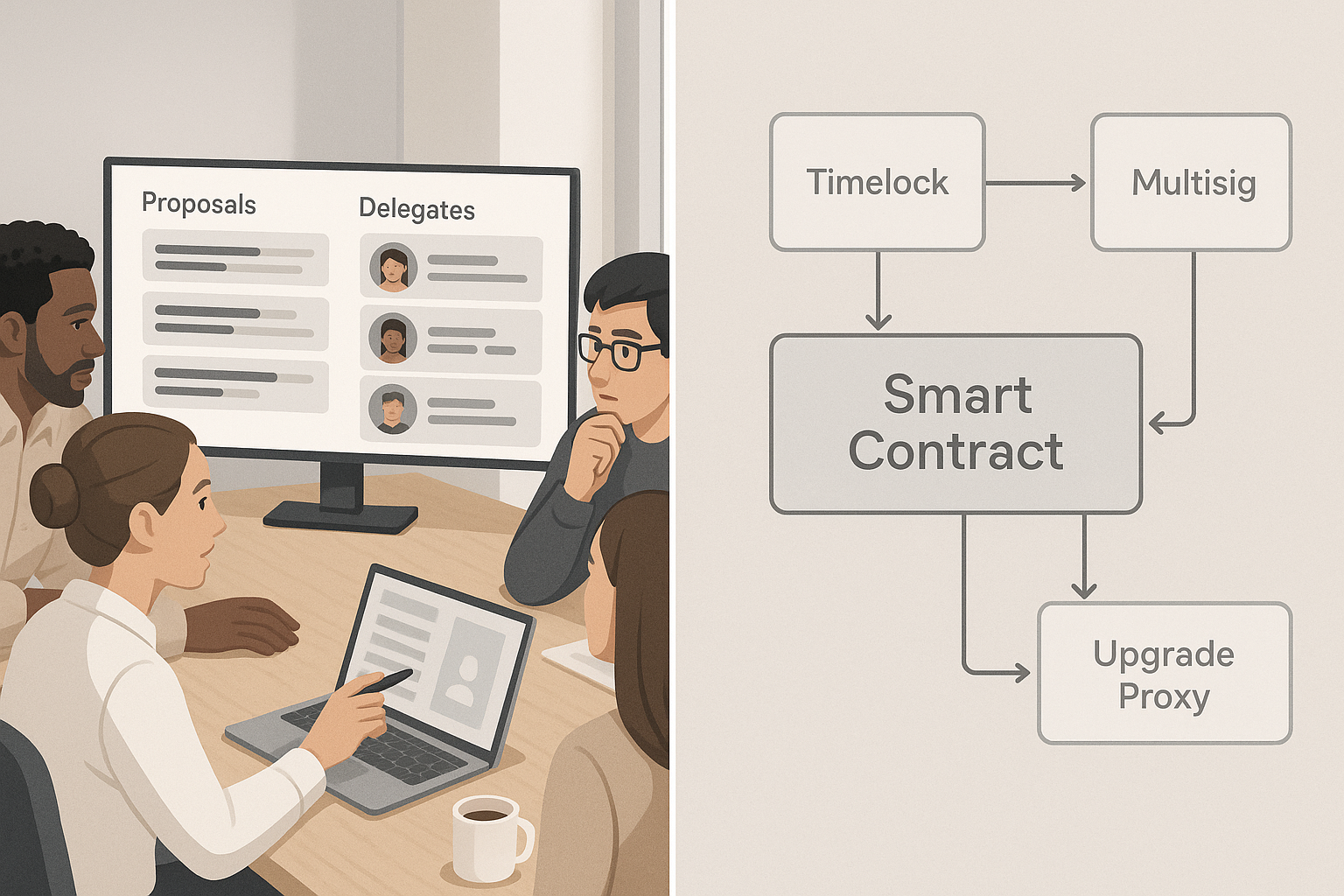
Automating doesn’t mean giving up control. Introduce role-based access control so only authorized accounts can toggle phases, set URIs, or update royalty recipients. Libraries like Ownable or AccessControl keep permission checks readable. Decide early whether your contract is upgradeable (proxy pattern) or immutable. Upgradeable proxies allow feature additions, but they add operational complexity and new risk surfaces. If you go immutable, expose carefully chosen setters you might need once (e.g., baseURI, royalty recipient) and then permanently lock them via a freeze or renounce ownership when appropriate. For operational safety, consider a multisig for admin actions and a pause switch for emergencies.
Practical tips
- Separate admin from treasury addresses to minimize impact of a single key loss.
- Require a time-delayed “two-step” transfer of ownership to avoid accidental renounce.
- If using upgradeable proxies, document initializer ordering and storage layout rules.
- Use role names that mirror business actions: MINTER, URI_SETTER, PHASE_SETTER.
Close this step by writing a minimal runbook for admin actions so teammates can perform routine tasks without guesswork.
8. Optimize Gas and Throughput Without Sacrificing Safety
Gas efficiency matters to buyers and to you. Small improvements compound across thousands of mints. Pack storage where possible, avoid unbounded loops, and prefer events over on-chain lists for historical data. For ERC-721, patterns like batch-minting and compressed ownership tracking can reduce per-mint costs; for ERC-1155, built-in batch functions are a win. Keep price and cap checks early in functions to fail fast. Avoid string concatenations on-chain where feasible; compute predictable URIs with fixed prefixes. Measure everything with gas reports, and be willing to trade a tiny bit of code elegance for a measurable reduction in cost.
Numbers & guardrails
- Saving ~15,000 gas per mint across 10,000 mints can reduce spend by dozens of ETH at busy network conditions.
- Prefer uint256 consistently; mismatched types trigger useless casts.
- Use immutable variables for constants to save storage reads.
Mini case
You switch from individual ERC-721 mints to a batch-mint pattern that amortizes event and bookkeeping costs. If single mints average 110,000 gas and batch mints shrink to 80,000 gas per token in a 5-token batch, buyers save ~30,000 gas each, or ~150,000 gas per batch. That saving directly improves user experience and reduces failed transactions.
Optimizing with discipline preserves safety while making your mint more welcoming.
9. Test with Unit, Fuzz, and Scenario Coverage
An automated mint is only as reliable as its tests. Write unit tests for each guardrail (caps, payments, allowlist, royalties). Add fuzz tests to explore unexpected inputs and sequencing, especially around signature verification and reentrancy protections. Create scenario tests that mimic real drops: presale sells out, public begins, metadata reveals, and multiple buyers mint concurrently. Include adversarial tests with bots attempting to bypass per-wallet caps or spam approvals. Verify that events emit consistently so off-chain indexers remain accurate. Finally, simulate withdrawals and royalty queries to ensure reporting logic is dependable.
What to cover
- Payment exactness, cap enforcement, and supply invariants.
- Merkle proofs, signature recovery, and nonce/expiry behavior.
- Pause and unpause paths; emergency stops; ownership transfers.
- Royalty math across prices and tokens.
Mini case
In a scenario test, 500 simulated wallets each attempt 2 presale mints with randomized timing. The test ensures no wallet exceeds the cap, total presale allocation is respected, and late presale attempts are correctly rejected or redirected. A final assertion checks that total events equal actual mints, preventing indexing drift.
With strong tests, your automation works under pressure instead of only under perfect lab conditions.
10. Deploy Cleanly and Configure with Care
Deployment is more than pressing “publish.” Choose a chain that fits your audience and cost profile, and document the exact compiler, optimizer settings, and constructor parameters you use. Verify the contract source so marketplaces and wallets can read it. Initialize admin roles, set baseURI or placeholder URI, and configure royalties before announcing mint times to buyers. Seed allowlist roots and signer addresses in a single, auditable transaction if possible. Keep a record of the deployed addresses, events from the first block, and any configuration flags you flipped. Redundancy matters—maintain secure backups of admin keys and any IPFS pins.
Post-deploy checklist
- Verify source and publish ABI.
- Set royalty recipient and bps; emit events.
- Initialize phases to a safe default (paused).
- Test a canary mint end-to-end before opening gates.
- Announce only after a successful dry run.
Deploy with intention and you’ll spend launch day watching dashboards, not firefighting.
11. Integrate with Marketplaces, Wallets, and Indexers
Automation only pays off if others can interact with your contract smoothly. Ensure your contract adheres to the standard interfaces wallets and marketplaces expect, emit conventional events, and keep tokenURI responses fast and well-formed. If certain venues filter operators or require extra approval patterns, respect user expectations by keeping approval flows clear and reversible. Make sure your royalty interface is implemented exactly to spec so compatible marketplaces can read your preferences. Provide a concise developer page with your contract address, ABI, and key functions; this reduces integration friction and spares your support inbox.
Integration tips
- Test approvals and transfers with multiple wallets to ensure UX is straightforward.
- Confirm that name, symbol, and URIs render as expected across sites.
- Keep metadata content-type correct; malformed JSON slows indexing.
- Emit Transfer events during reveals only if necessary; avoid noisy, nonstandard events.
By making your contract legible and predictable to the broader ecosystem, you reinforce the automation you worked so hard to achieve.
12. Monitor, Respond, and Maintain Over Time
Automation is not abdication. You need visibility into mints, transfers, and royalties to catch anomalies early. Stream events to a dashboard and set alerts for spikes in failed transactions, unusual approvals, or a sudden drop in metadata availability. If your design includes a pause switch, document when to use it and how to resume safely. Keep a small backlog of maintenance tasks—such as refining royalty recipients, rotating signer keys, or pinning additional gateways—and schedule them rather than reacting ad hoc. If you promised immutability, plan the precise moment you’ll freeze metadata and communicate it in advance.
Practical monitoring metrics
- Mint success rate, median gas used, and revert reasons by function.
- Volume of secondary transfers and realized royalty receipts.
- Response times for tokenURI and asset gateways.
- Admin actions: who executed them, and why.
Ending with a steady cadence of observation and small, deliberate changes preserves trust and ensures your automated system continues to serve creators and collectors.
Conclusion
Smart contracts for NFTs turn minting and royalty handling into code that runs the same way every time. By choosing the right standard, setting precise phase and pricing rules, hardening your payment paths, and implementing both allowlist and signature-based mints, you turn a chaotic launch into a calm, repeatable process. Thoughtful metadata planning and a clean royalty implementation keep holders happy and marketplaces aligned. Role-based controls, gas optimizations, thorough testing, careful deployment, and proactive monitoring round out a system that handles demand without manual intervention. Treat each step as a commitment to clarity, and your project will reward you with fewer surprises, happier collectors, and dependable creator earnings. Copy-ready CTA: Put these steps into your backlog today and ship an automated mint that pays creators—on day one.
FAQs
1) What’s the practical difference between ERC-721 and ERC-1155 for creators?
ERC-721 treats each token as unique and is the default for 1/1 art and profile-picture collections. ERC-1155 lets you issue multiple editions of the same token ID and batch-mint efficiently, which cuts costs for large runs or game items. If your drop involves identical passes or items, ERC-1155 is usually cheaper; if every piece is distinct, ERC-721 is simpler and broadly supported. Your choice also influences metadata: tokenURI(id) for ERC-721 and uri(id) for ERC-1155.
2) How do allowlists with Merkle proofs actually work?
You compute a Merkle root from a list of wallet addresses (optionally with per-wallet caps). The contract stores the root, and buyers submit a short proof that verifies their inclusion without revealing the entire list. This allows constant-time verification and keeps gas costs down. Always include a way to prevent double-spends (per-wallet counters) and expose events so you can audit who minted under the allowlist phase.
3) Are royalties enforceable purely on-chain?
Standards like EIP-2981 let your contract advertise the preferred royalty amount and recipient, and compatible venues can query and honor it. Not every venue routes royalties automatically, so consider primary-sale splits and transparent policies to align expectations. Keep royalties in basis points, cap changes, and broadcast any updates through events so indexers and marketplaces can reflect your intent.
4) What is “lazy minting” or signature-based minting?
Instead of pre-allocating every token, you sign off-chain vouchers authorizing specific mints (address, quantity, price, deadline). Buyers submit the voucher, the contract verifies the signature, and minting happens only when there’s demand. This reduces storage and gives you fine-grained control over who can mint what. Include nonces and expiries to stop replay attacks, and log consumed vouchers for auditing.
5) Should I freeze metadata, and if so, when?
Freezing metadata means you promise no further changes to token attributes or media links. It’s a trust signal to collectors and helps marketplaces cache assets confidently. If you plan a staged “reveal,” freeze after the final state is published and verified by your community. Make the freeze one-way and emit an event; document what, if anything, remains dynamic (e.g., on-chain traits or evolving game stats).
6) What’s a safe way to split revenue among multiple parties?
Use a simple splitter that holds balances and lets each party withdraw. Define shares in basis points that sum to 10,000 and test edge cases like zero balance or partial withdrawals. Avoid pushing ETH in the same call that receives it; reentrancy protections and clear events help keep your accounting dependable and auditable.
7) How do I protect against bots draining a free mint?
Combine per-wallet caps, allowlists for the earliest phase, and, if needed, signature-based caps with expiries. Keep the public phase tolerant of high demand but enforce strict caps and fast reverts. Consider a small, non-refundable fee to deter spam for purely free mints, and monitor live metrics so you can pause if something goes off the rails.
8) Do I need an upgradeable proxy?
Only if you expect to change core logic after deployment and you’re prepared to manage the complexity. Proxies allow feature additions but introduce new risks and operational overhead. Many creators choose immutable contracts and expose a handful of safe setters for configuration, then renounce ownership or freeze critical fields. If you do use a proxy, document initializers and storage layout rules meticulously.
9) What testing scope is “enough” for a mint contract?
Aim for unit tests covering every revert path and success path for mint, allowlist, signatures, payments, and royalties. Add fuzz tests for signature inputs and ordering, and scenario tests that simulate real buyer behavior under load. Include tests for administrative actions like pausing, changing URIs, and rotating royalty recipients. Strong coverage is your cheapest insurance against launch-day bugs.
10) How should I choose a chain for my drop?
Match your audience and cost profile. Consider transaction fees, wallet support, marketplace presence, and tooling. If your collectors are cost-sensitive or you need high throughput, a chain with lower fees may be appropriate. Whatever you choose, verify your contract, publish your ABI, and dry-run the entire mint path to ensure buyers have a smooth experience.
References
- ERC-721 Non-Fungible Token Standard — Ethereum Foundation: https://eips.ethereum.org/EIPS/eip-721
- ERC-1155 Multi Token Standard — Ethereum Foundation: https://eips.ethereum.org/EIPS/eip-1155
- EIP-2981: NFT Royalty Standard — Ethereum Foundation: https://eips.ethereum.org/EIPS/eip-2981
- OpenZeppelin Contracts — Documentation: https://docs.openzeppelin.com/contracts
- IPFS — Content Addressed, Versioned, P2P File System: https://docs.ipfs.tech
- Arweave — Permanent Data Storage Documentation: https://docs.arweave.org
- Hardhat — Ethereum Development Environment: https://hardhat.org/hardhat-runner/docs
- Foundry — Smart Contract Development Toolkit: https://book.getfoundry.sh
- Ethereum Smart Contract Best Practices — ConsenSys Diligence: https://consensys.github.io/smart-contract-best-practices
- Merkle Trees — Ethereum Wiki: https://ethereum.org/developers/docs/data-structures-and-encoding/merkle-trees