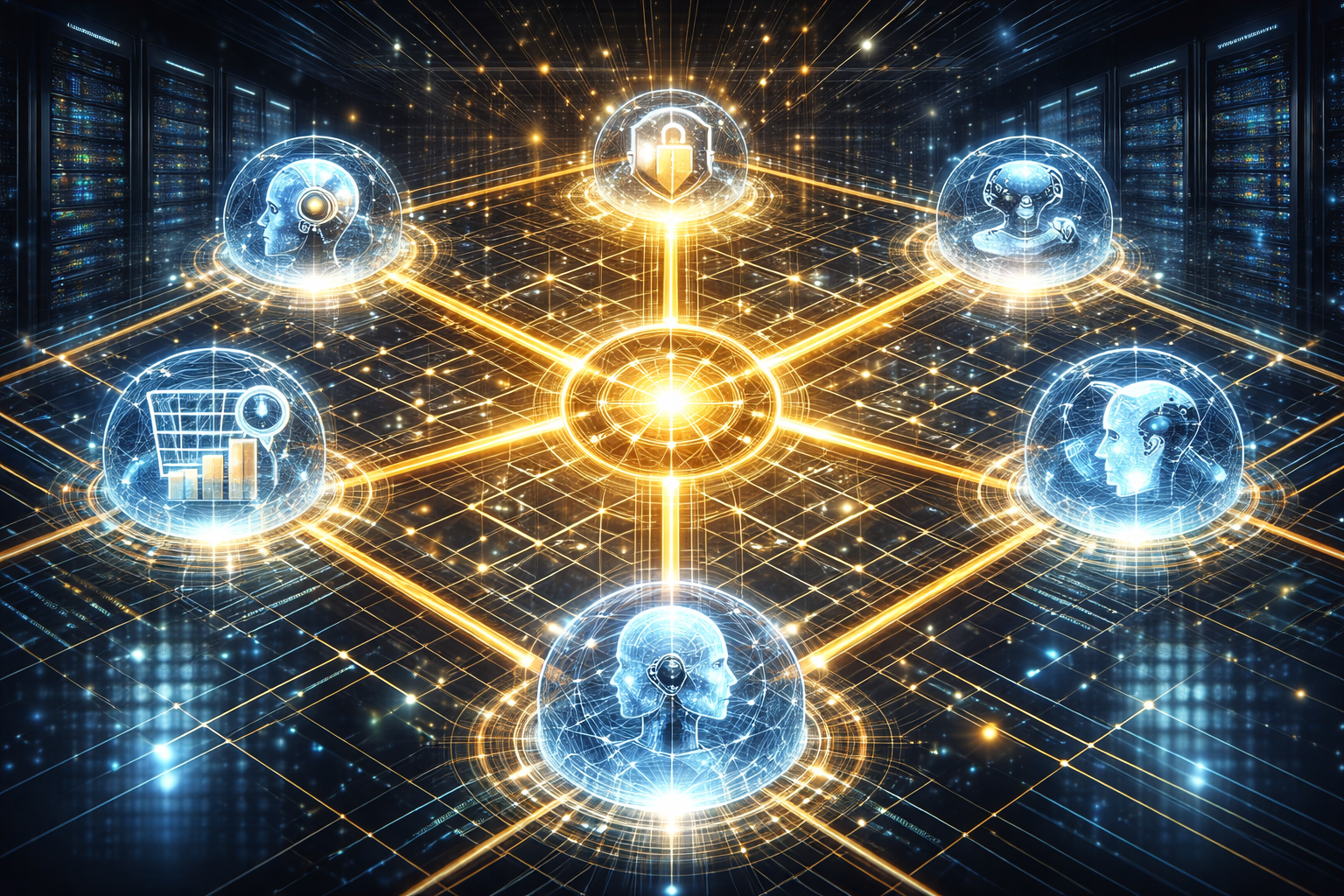
The year 2026 has officially been dubbed “The Year of the Agent Swarm.” As of March 2026, the artificial intelligence landscape has shifted decisively away from monolithic, “one-size-fits-all” Large Language Models (LLMs) toward distributed, highly specialized Multi-Agent Systems (MAS). In this new era, the primary challenge is no longer just “making an agent work,” but rather “making agents work together.” This is where Multi-Agent Systems Interoperability becomes the backbone of the modern enterprise.
Definition of Multi-Agent Systems Interoperability
At its core, interoperability in MAS is the ability of autonomous agents—often built by different teams, using different frameworks, and hosted on diverse cloud environments—to discover one another, communicate intent, share context, and execute collaborative tasks without manual “hard-coding” of integrations. It is the digital “lingua franca” that allows a procurement agent from one company to negotiate seamlessly with a logistics agent from another.
Key Takeaways
- The Three-Layer Stack: Interoperability in 2026 is defined by three distinct layers: MCP (Tool-to-Agent), A2A (Agent-to-Agent), and WebMCP (Agent-to-Web).
- The NIST Factor: The 2026 NIST AI Agent Standards Initiative has introduced mandatory frameworks for Agent Identity and Audit Trails, making “Shadow AI” a thing of the past.
- Standardization over Customization: Successful scaling now relies on open-source protocols managed by the Agentic AI Foundation (under the Linux Foundation) rather than proprietary vendor APIs.
- Security as a Protocol: Interoperability standards now bake-in “Least Privilege” access, ensuring agents only share the data required for a specific sub-task.
Who This Is For
This guide is designed for AI Architects, CTOs, and Senior Developers who are moving past the “POC” (Proof of Concept) phase and are tasked with scaling agentic workflows across an enterprise. Whether you are building a decentralized supply chain or a multi-departmental financial oracle, understanding these 2026 standards is essential for avoiding the “Refactoring Debt” predicted by Gartner for non-compliant systems by 2027.
1. The Evolution of MAS: From Silos to Swarms
To understand where we are in March 2026, we must look at the rapid maturation of AI architecture over the last 24 months. In 2024, agents were largely “wrappers” around a single model. In 2025, we saw the rise of internal “agentic workflows” where a single orchestrator managed a few sub-agents.
By 2026, the “Silo Problem” reached a breaking point. Companies realized that if their customer service agent couldn’t talk to their shipping partner’s logistics agent, the promise of “autonomous business” was a myth. This led to the massive industry push for the standards we use today.
The Shift to “Small and Many”
Modern MAS architecture favors a “Micro-Agent” approach. Instead of one massive model trying to handle research, coding, and legal compliance, we now deploy:
- Planner Agents: Decompose complex goals into task graphs.
- Specialist Agents: Execute specific domain tasks (e.g., Python execution, SQL querying).
- Verifier Agents: Act as “critics” to ensure output quality and safety.
- Compliance Agents: Real-time monitors that check actions against legal and ethical guardrails.
The challenge of 2026 isn’t the intelligence of these individual units—it’s the latency and accuracy of the handshakes between them.
2. The Three-Layer Protocol Architecture of 2026
The “Protocol Wars” of 2025 ended with a clear three-layer hierarchy that now governs how agents interact with the world and each other.
Layer 1: Model Context Protocol (MCP) – The “USB-C for AI”
First introduced by Anthropic and subsequently donated to the Linux Foundation’s Agentic AI Foundation, MCP has become the universal interface for Agent-to-Tool interaction.
As of March 2026, MCP replaces the messy “Function Calling” and custom “Plugins” of the early AI era. If you want an agent to read a Google Sheet, query a Postgres database, or send a Slack message, you no longer write a custom API wrapper. You simply point the agent to an MCP Server.
- How it Works: MCP uses a structured JSON-based communication standard. When an agent connects to an MCP server, it receives a “Manifest” of available tools and resources.
- The Benefit: High portability. An agent built on Claude can use the same MCP server as an agent built on Gemini or GPT-5 without a single line of code change.
Layer 2: Agent-to-Agent Protocol (A2A) – The Social Contract
While MCP handles tools, A2A handles the “Social Layer.” Developed through a collaboration between Google, IBM, and Salesforce, A2A defines how two independent agents collaborate.
A2A covers the four pillars of agent collaboration:
- Discovery: “Who are you and what can you do?” (Uses a Yellow-Pages-style registry).
- Delegation: “I need you to perform task X with these constraints.”
- State Synchronization: “Here is the current status of our shared project.”
- Authentication: Verifying that the requesting agent is authorized by its human owner.
Layer 3: WebMCP – The Structured Web
The newest addition as of early 2026, WebMCP (standardized via the W3C and major browser engines), allows agents to interact with websites as structured data rather than “seeing” them through fragile HTML scraping or screenshots.
Chrome and Edge now expose a navigator.modelContext API. This allows a website to tell an agent: “I am an e-commerce site. Here is my ‘Add to Cart’ function in a format you can understand natively.” This has improved agent efficiency by nearly 90% compared to 2025’s vision-based web browsing.
3. The NIST AI Agent Standards: Governance and Identity
In February 2026, the National Institute of Standards and Technology (NIST) released the AI Agent Standards Initiative. This wasn’t just a technical document; it was a regulatory roadmap for the “Agentic Era.”
The Multi-Agent Identity Standard (MAIS)
In 2026, every enterprise agent must have a Verifiable Identity. NIST standards require agents to use Decentralized Identifiers (DIDs).
- Why it matters: If an agent makes a $50,000 purchase, the blockchain-backed DID ensures we know exactly which agent (and which human owner) is responsible.
- The “Agent Passport”: Before two agents can share data, they perform an automated “ID Check” against a trusted registry.
Audit Trail Requirements
As of March 2026, any multi-agent system operating in regulated industries (Finance, Healthcare, Law) must maintain an Immutable Interaction Log.
- The Standard: Use of the Agent-Log-Schema, which records the “Reasoning Trace” and the specific protocol handshakes (A2A/MCP) used during a task.
- Compliance: This allows auditors to replay an agent swarm’s decision-making process to find exactly where a hallucination or policy violation occurred.
Safety Disclaimer: The implementation of multi-agent systems in financial or medical sectors must comply with local jurisdiction laws (such as the EU AI Act 2026 or US state-level AI safety mandates). Always consult with a certified AI Compliance Officer before deploying autonomous swarms in high-risk environments.
4. Architectural Frameworks for Massive Scaling
Scaling a multi-agent system from 5 agents to 5,000 requires a shift from Centralized Orchestration to Choreographed Decentralization.
Centralized Orchestration (The “Manager” Model)
In smaller systems, a “Manager Agent” (like those found in early LangChain or CrewAI architectures) holds the global state.
- Pros: Easy to debug; clear chain of command.
- Cons: Becomes a massive bottleneck. As “Agent Chatter” increases, the Manager Agent spends 80% of its tokens just managing messages rather than doing work.
Choreographed Decentralization (The “Graph” Model)
In 2026, the gold standard for scaling is the Stateful Graph (popularized by frameworks like LangGraph and BeeAI).
- How it scales: Agents are nodes in a directed graph. The “Interoperability Standard” defines how the edges work. Instead of a manager, agents pass a “Shared State” object.
- Parallelism: Multiple agents can work on different “branches” of a task graph simultaneously. A 2026 study showed this approach reduces “Wall-Clock Time” by 65% for complex research tasks.
The Five-Level Interoperability Maturity Model
To help enterprises assess their readiness, the 2026 NIST initiative defines five levels of MAS maturity:
- Level 1 (Isolated): Single agents, no external tool access.
- Level 2 (Connected): Agents use MCP for tools but cannot talk to other agents.
- Level 3 (Collaborative): Agents use A2A within a single platform (e.g., all inside Salesforce).
- Level 4 (Interoperable): Cross-platform collaboration using A2A and WebMCP.
- Level 5 (Autonomous Ecosystem): Agents dynamically discover, negotiate, and hire other agents across the open web.
5. Security Protocols in the Interoperable Era
Interoperability creates new attack surfaces. In 2026, “Agent-in-the-Middle” attacks and “Prompt Injection via Proxy” are the top concerns for CISOs.
The “Black Box” Execution Pattern
Under the A2A protocol, agents are treated as “Black Boxes.”
- The Principle: Agent A should never see the internal “System Prompt” or “Memory” of Agent B.
- The Protocol: Agent A sends a request; Agent B returns a result. No internal logic is exposed. This prevents an attacker from “poisoning” a swarm by tricking one agent into revealing the secret instructions of the entire system.
Token-Scoped Permissions
The “Least Privilege” model is now enforced at the protocol level.
- Standard Implementation: When an agent delegates a task via A2A, it issues a Short-Lived Delegation Token.
- Example: A “Travel Agent” delegating a payment task to a “Finance Agent” only grants access to a specific $500 limit for 10 minutes. The Finance Agent cannot use that token to access the user’s full bank history.
The Rise of “Guardian Agents”
As of March 2026, any enterprise scaling MAS uses a “Guardian” layer. These are specialized, low-latency agents that sit on the interoperability “Bus” and scan every A2A message for:
- PII Leaks: Accidentally sharing customer data.
- Instruction Injection: Malicious commands hidden in data payloads.
- Cost Spikes: Detecting “Infinite Loops” where two agents keep asking each other the same question (Agent Chatter).
6. Practical Implementation: Building an Interoperable Swarm
Let’s look at a real-world example of how these 2026 standards come together in a Supply Chain Management swarm.
The Scenario
A retail giant wants to automate “Inventory Rebalancing.” If a store in New York is low on umbrellas and a storm is coming, the system should automatically procure more from a supplier in Ohio.
The Agent Roster
- Weather Monitor Agent: Uses WebMCP to scan NOAA forecasts.
- Inventory Agent: Uses MCP to query the internal SQL database.
- Procurement Agent: The “Client” that initiates the A2A handshake.
- Vendor Agent (External): The “Remote” agent owned by the umbrella manufacturer.
The Interoperability Flow
- Discovery: The Procurement Agent queries the “Global Agent Registry” (A2A Standard) for agents with the capability vendor.umbrella.wholesale.
- Authentication: The Procurement Agent provides its NIST-compliant DID. The Vendor Agent verifies this against the retail giant’s public key.
- Negotiation: They use a Standardized Negotiation Schema (part of A2A 2.0). They exchange JSON-RPC messages regarding price, quantity, and delivery dates.
- Execution: Once agreed, the Procurement Agent uses an MCP Tool to trigger a wire transfer, and the Vendor Agent uses its own MCP Tool to schedule a FedEx pickup.
Success Metrics
In 2026, companies implementing this “Standardized Swarm” approach reported:
- Integration Time: Reduced from months (bespoke APIs) to days (A2A/MCP).
- Error Rates: 40% lower due to structured data exchange rather than “fuzzy” natural language commands.
- Cost: Significant token savings by using specialized small models (like Llama 4-8B) for sub-tasks rather than a single GPT-5 call.
7. Common Mistakes in Scaling Multi-Agent Architectures
Even with 2026 standards, scaling is fraught with “Agentic Anti-Patterns.” Avoid these common pitfalls:
Mistake 1: “The Chatty Agent” (Unbounded Communication)
The most common cause of MAS failure in 2026 is Communication Overhead.
- The Error: Agents sending too many status updates or “clarifying questions.”
- The Fix: Implement “Message Budgeting” at the A2A level. If a task isn’t resolved in 5 exchanges, escalate to a human.
Mistake 2: Missing “Semantic Alignment”
Just because two agents use the same protocol (A2A) doesn’t mean they understand the same concepts.
- The Error: One agent thinks “Price” includes tax; the other thinks it doesn’t.
- The Fix: Use Standardized Ontologies. In 2026, the IEEE P2997 standard provides domain-specific schemas (e.g., Finance-Schema-v2) that agents must agree to before starting a task.
Mistake 3: Hard-Coding Agent Addresses
- The Error: Programming Agent A to always talk to Agent B at https://api.agent-b.com.
- The Fix: Use Dynamic Discovery. Agents should look up capabilities, not addresses. This allows you to swap out “Agent B” for a newer, cheaper, or more accurate model without breaking the system.
Mistake 4: Ignoring the “Human-in-the-Loop” (HITL) Protocol
- The Error: Building a completely autonomous system with no way for a human to intervene.
- The Fix: The A2A-H (Human) extension. This protocol allows an agent to “pause” its state and send a structured request to a human dashboard, then resume once the human provides approval or guidance.
8. Industry Use Cases: MAS Interoperability in Action
Use Case: Smart City Energy Management
In 2026, smart grids use MAS to balance energy loads.
- Interoperability: Thousands of small agents (in EVs, smart thermostats, and solar panels) use MCP to monitor local hardware and A2A to negotiate energy “buy/sell” prices with the central Utility Agent.
- Result: A 22% reduction in peak load demand through decentralized, millisecond-scale negotiation.
Use Case: Personalized Healthcare Swarms
A patient’s “Health Advocate Agent” coordinates with “Specialist Agents” at different hospitals.
- Interoperability: Because hospital systems are fragmented, agents use WebMCP to pull data from patient portals and A2A to share relevant medical history (encrypted via Zero-Knowledge Proofs).
- Result: Elimination of redundant testing and “lost in translation” medical errors.
Use Case: Collaborative Coding and DevOps
Development teams now use “Agentic Pods.”
- Interoperability: A “Coder Agent” writes code, a “Security Agent” scans it using MCP-based tools (like Snyk or SonarQube), and a “Deploy Agent” handles the CI/CD pipeline.
- Result: Software deployment cycles have shrunk from days to minutes, with “AI-Verified” security checks built into the interoperability flow.
Conclusion: The Path to Agentic Maturity
Scaling Multi-Agent Systems in 2026 is no longer an experimental endeavor; it is a rigorous engineering discipline. The transition from “Cool AI Demo” to “Resilient Enterprise Infrastructure” relies entirely on the adoption of the interoperability standards we have explored.
By embracing the Three-Layer Protocol Architecture (MCP, A2A, and WebMCP) and adhering to the NIST AI Agent Standards, organizations can build systems that are not only powerful but also secure, compliant, and future-proof.
As we look toward the second half of 2026, the focus will shift even further toward Cross-Organizational Swarms, where agents from different companies form temporary “Flash Organizations” to solve specific problems. The winners in this new economy will be the ones who didn’t just build the best agents, but the ones who built the most cooperative agents.
Your Next Steps
- Audit Your Stack: Ensure your current agent projects are MCP-compliant. Moving your tool-calling to MCP now will save hundreds of hours in future model migrations.
- Implement Identity: Start assigning DIDs to your agents. Even for internal systems, verifiable identity is the first step toward secure scaling.
- Adopt a Graph-Based Orchestrator: If you are still using linear “Manager” models, begin refactoring toward Stateful Graphs to reduce latency and improve parallelism.
- Stay Informed: Follow the Agentic AI Foundation and NIST CAISI updates. In a field moving this fast, a standard can evolve in a matter of months.
FAQs
1. What is the difference between MCP and A2A?
MCP (Model Context Protocol) is designed for Agent-to-Tool or Agent-to-Data interactions. It allows an agent to “use” a database or an API. A2A (Agent-to-Agent) is for Agent-to-Agent interaction, focusing on how two autonomous entities negotiate, delegate tasks, and share a common goal.
2. Is FIPA still relevant for MAS in 2026?
While the FIPA (Foundation for Intelligent Physical Agents) standards laid the groundwork in the early 2000s, they are largely considered “Legacy” in 2026. Modern protocols like A2A and MCP are built for the LLM era, utilizing JSON-RPC and RESTful patterns that are more compatible with today’s web-scale infrastructure.
3. How do I prevent my agents from getting into an “Infinite Loop” of talking?
This is known as “Agent Chatter.” In 2026, interoperability standards include TTL (Time-to-Live) and Max-Turn headers in the message metadata. You should also deploy a Guardian Agent to monitor the message bus and kill any swarms that exceed their token or turn budget.
4. Can an agent built on OpenAI’s GPT-5 work with a Google Gemini agent?
Yes, this is the primary goal of the A2A Protocol. As long as both agents (and their respective orchestration layers) are A2A-compliant, they can discover each other’s capabilities and collaborate regardless of the underlying LLM.
5. What are the security risks of WebMCP?
WebMCP allows agents to see the web in a structured way, but it opens risks like Indirect Prompt Injection, where a malicious website hides “Agent Instructions” in its metadata. To mitigate this, 2026 browsers include an Agent Sandbox that strips executable commands from WebMCP payloads.
References
- NIST (2026). Announcing the AI Agent Standards Initiative for Interoperable and Secure Agents. [Official Documentation].
- Agentic AI Foundation / Linux Foundation (2025). Model Context Protocol (MCP) Specification v2.1. [Open Source Standard].
- IEEE (2026). IEEE P2997: Standard for Multi-Agent System Communication and Ontological Alignment. [Draft Standard].
- Gartner (2025). Strategic Technology Trends 2026: The Rise of Agentic AI Swarms. [Industry Report].
- Anthropic (2025). The USB-C for AI: How MCP is Unifying the AI Ecosystem. [Technical Whitepaper].
- Google & IBM (2025). The Agent-to-Agent (A2A) Protocol: A Collaborative Framework for Autonomous Systems. [Consortium Paper].
- W3C (2026). WebMCP: Extending the Model Context Protocol to the Browser. [Web Standard Recommendation].
- ACM (2026). Multi-Agent Systems Will Rescript Enterprise Automation in 2026. [Peer-Reviewed Journal].
- ISO (2025). ISO/IEC 42001:2023 – Information Technology – Artificial Intelligence – Management System. [Standard Compliance Update].