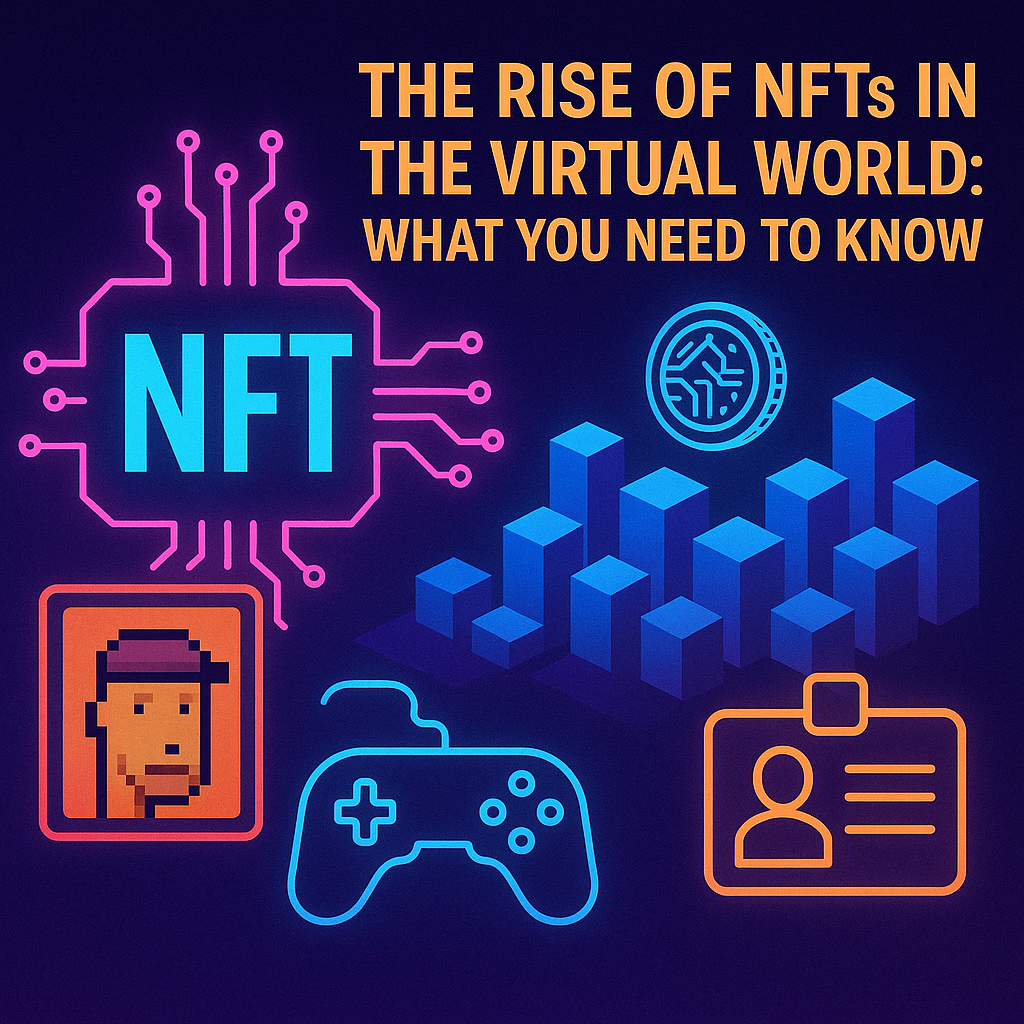
In the past 10 years, Non-Fungible Tokens (NFTs) have gone from being a modest blockchain experiment to a multi-billion-dollar trend that is transforming how we think about owning things online. NFTs leverage the portions of blockchain technology that can’t be changed to make digital assets one of a kind, easy to find, and easy to move. These properties make them useful for art, games, virtual real estate, and other things. NFTs are becoming the most significant part of owning things online as virtual worlds and the metaverse become more prominent. They run everything, from virtual land to things in games. This article talks about how NFTs are getting increasingly popular online. It explains about where they come from, how the market works, how they might be used, the problems they cause, and what the future holds for them.
1. What are NFTs, and how do they work?
A Non-Fungible Token (NFT) is a unique digital certificate that lives on a blockchain and shows that you possess a specific object or piece of content. You can’t trade NFTs like you can with cryptocurrencies like Bitcoin and Ethereum. Each NFT has its own ID and metadata that set it apart from other NFTs.
ERC-721 is the technological standard that made NFTs real on Ethereum in 2018. EIP-721 was written by William Entriken, Dieter Shirley, Jacob Evans, and Nastassia Sachs. It talks about ERC-721. This standard provides smart contract functions like ownerOf and transferFrom to make sure that wallets and markets can work together.
Making and Selling:
- Minting: Creators utilize smart contracts to make NFTs and keep track of things like the URL of the artwork and the name of the author. They can do this on-chain or in off-chain storage systems like IPFS.
- Trading: Decentralized marketplaces like OpenSea make it easy to buy, trade, and move NFTs. The blockchain keeps a record of every transaction forever.
2. The History of NFTs: The First Tests
- Colored Coins (2012): These early versions were based on Bitcoin and added metadata to satoshis, which made it seem like tokens could be generated from ownership.
- ERC-721 and CryptoKitties (2017–2018):
- CryptoKitties: This blockchain game, which came out in late 2017, made digital collectibles popular and put a lot of stress on Ethereum’s network, indicating that there was a need for unique tokens.
- Standardization: ERC-721 made it feasible to make NFTs, which led to a variety of various projects in art, gaming, and other disciplines.
- Market Boom (2020–2021):
- In March 2021, Christie’s sold Beeple’s “Everydays” for $69 million. This made people more interested in NFTs.
- NFTs are becoming more popular with businesses. For example, Nike and Gucci have explored NFT drops for smart wearables and keeping track of where they originated from.
3. The size of the market and what is happening in it
The value of the global market
The market cap for NFTs was around $5.92 billion in the middle of 2024, and sales were over $7.6 million every day.
Statista says that in 2024, the market will be valued $683.9 million. Then, in 2025, it will reduce by 11% to $608.6 million, which means the corporation is getting bigger and more solid.
How much work is being done
- There were 11.6 million trades in the first quarter of 2024, and the total value of those trades reached $3.9 billion, which is 50% more than the same time previous year.
- Sales dropped 42% to $466 million in June 2024, which showed that the market was slowing down and that seasonal tendencies were at effect.
In the future
Fact.MR forecasts that by 2034, the worldwide NFT market would be worth $407.7 billion and will expand by 23% a year. New ideas in virtual real estate and tokenized services will help this growth happen.
4. Important Uses in the Digital World
4.1 Digital Art and Collectibles
NFTs come with smart contracts that automatically pay artists when their work is sold again.
The best art NFTs are CryptoPunks and Bored Ape Yacht Club. They all sold for more than $10 million.
4.2 Virtual Real Estate Metaverse Plots
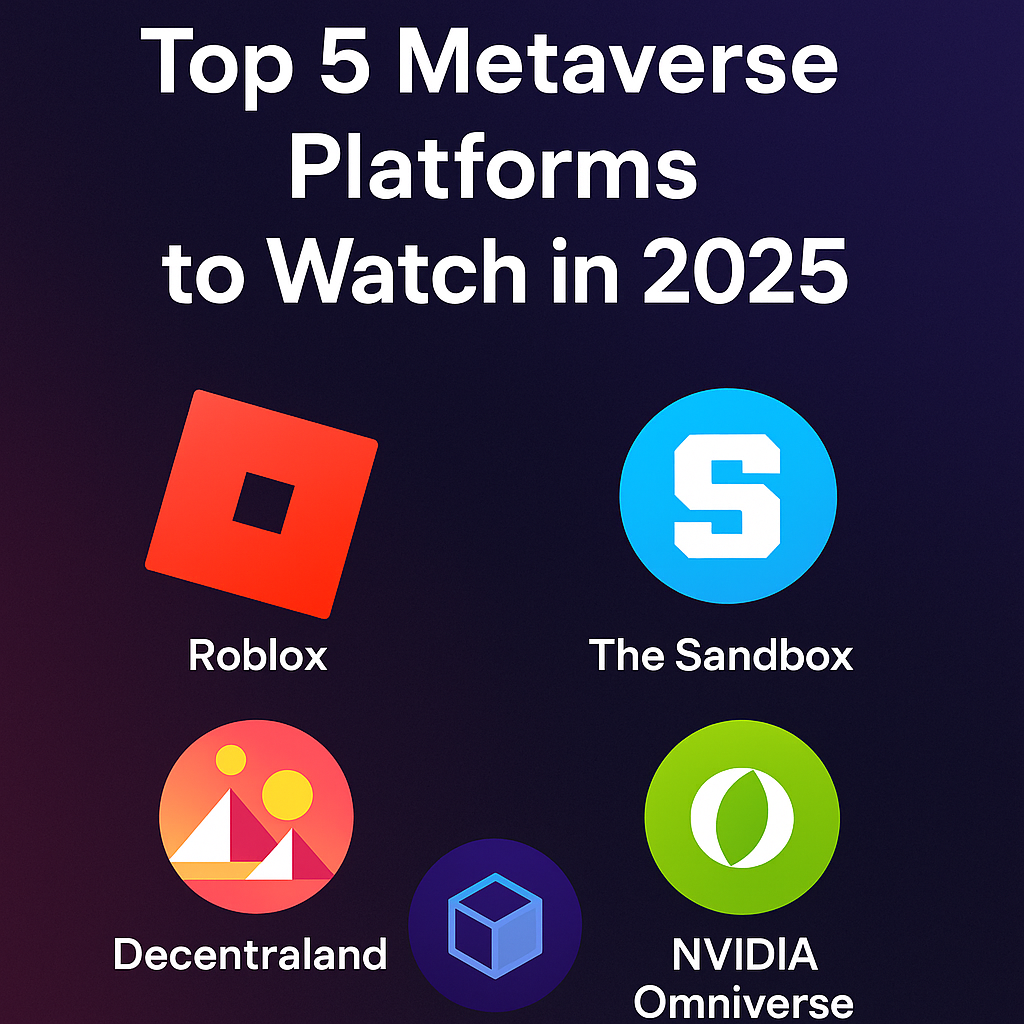
Platforms like Decentraland and The Sandbox let people buy, rent, and turn plots of land into NFTs that can be used as virtual dwellings.
Brand Experiences: Nike and Gucci, for example, have created virtual stores on Decentraland and leveraged NFTs to get consumers interested in their products.
4.3 Interoperability of In-Game Assets
Players can transport NFT game assets between games that function with them. This means they really own the items instead of just renting them.
Play-to-Earn Models: Players can make real money by playing games like Axie Infinity. This makes the economy of games more fair.
4.4 Access and Identity
NFTs let you join unique groups, like the events that only members of the Bored Ape Yacht Club may go to.
Digital Identity: People use tokenized avatars and badges to verify their identities at virtual conferences and on social media.
5. Large NFT Marketplaces and Platforms
- OpenSea was the biggest NFT marketplace in January 2022, at $13.3 billion. You can produce NFTs and other types of assets for free with its tools.
- Rarible is a marketplace where users may vote on how much to charge and what features to add.
- Foundation and SuperRare are curated sites that specialize on high-quality digital art and have tougher editing standards.
- Gaming-Centric: Both Immutable X and Axie Marketplace strive to make it easier and cheaper to trade gaming gear.
6. Things to consider about from a technical and environmental point of view
6.1 Fees and Scalability of Blockchain
- Cost of Gas: When the Ethereum network is busy, it can be quite expensive to make and transport currencies. Polygon and Immutable X are two instances of layer-2 solutions that are cheaper.
6.2 Criticism of Proof-of-Work for Energy Use
Before the Merge, Ethereum required a lot of energy. Some sources indicate that creating only one NFT might be like driving a car for hundreds of miles.
Switching to Proof-of-Stake: Ethereum’s Merge in September 2022 lowered energy utilization by more than 99%, which helped relieve anxieties about the environment.
7. The law as it is, hazards, and scams
7.1 Wash trading to change the market and make money
A big investigation indicated that wash trading led to more than 8.7 million transfers and 5,330 sales. It cost at least $3.96 million, which made it tougher to figure out how much it really cost.
7.2 Fraud and Intellectual Property
There have been issues with fraudulent NFTs and plagiarism in open markets. To verify sure anything is legitimate, it’s a good idea to look into the creator’s name and history.
More and more websites are utilizing moderating tools and procedures to check people’s identities to stop scams.
7.3 The Future of Securities Laws
People still don’t agree on whether some NFTs constitute securities. This can suggest that the rules are exceedingly stringent.
Taxes: Different sections of the country are making it obvious what kinds of events you have to pay taxes on. Minting, trading gains, and airdrops are all taxed as capital gains in various places.
8. Frequently asked questions (FAQs)
- What makes an NFT different from a digital currency?
NFTs are special tokens that represent certain things. Cryptocurrencies, on the other hand, are units of value that can be traded for each other. - What do I need to do to get my first NFT?
To buy ETH, you need to set up a crypto wallet (like MetaMask), buy ETH on an exchange, connect to a marketplace like OpenSea, and either bid or buy straight away. - Are NFTs a decent way to put your money to work?
Like all other assets, NFTs have hazards. Only work on initiatives with solid communities, clear plans, and well-known creators to avoid speculative bubbles. - How can I get petrol for less money?
You have to pay gas fees to utilize Ethereum. Do commerce at off-peak hours or use Layer-2 networks like Polygon to avoid paying high fees. - How do you make sure you get your money?
Smart contracts can automatically transfer some of the money from secondary sales back to the people who made them. This means that they will always be able to get money. - Can you break into NFTs or steal them?
Tokens are protected on the blockchain, but if hackers identify a hole in your wallet, say through a phishing attack, they can steal them. Use hardware wallets and strong security mechanisms.
Thoughts at the End
People now buy and sell products online in a different way because of NFTs. They give people who build things, collect things, and belong to online groups new methods to indicate that they own something and make money. NFTs will be a key part of how value is presented, traded, and experienced online as virtual worlds and the metaverse get better. The market faces issues such not being able to grow, harming the environment, being scrutinized by regulators, and fraud. But emerging technologies like proof-of-stake, Layer-2 scaling, and enhanced identity protocols promise to make it more stable and easier to use. By understanding about the technical foundations, market dynamics, and best practices for authenticity, stakeholders may proactively navigate the NFT landscape. This will help them get the most out of virtual worlds that feature digital assets that can be traded.
References
- Non-fungible token (Wikipedia). Available at: Wikipedia
- ERC-721: Non-Fungible Token Standard (EIP-721). Available at: https://eips.ethereum.org/EIPS/eip-721 Wikipedia
- NFT statistics in 2024: Growth trends and outlook (Kraken). Available at: Kraken
- 49 NFT Statistics 2025 – Worldwide Data & Market Forecast (DemandSage). Available at: DemandSage
- Global NFT Stats: Market Share Chart, Dominance & Heatmap (CoinGecko). Available at: CoinGecko
- Chen, S., et al. “The Dark Side of NFTs: A Large-Scale Empirical Study of Wash Trading.” arXiv:2312.12544 (2023). Available at: arXiv
- OpenSea (Wikipedia). Available at: Wikipedia
- NFT Market Report: Sales Fall 42% In June 2024 (NFTEvening). Available at: NFT Evening