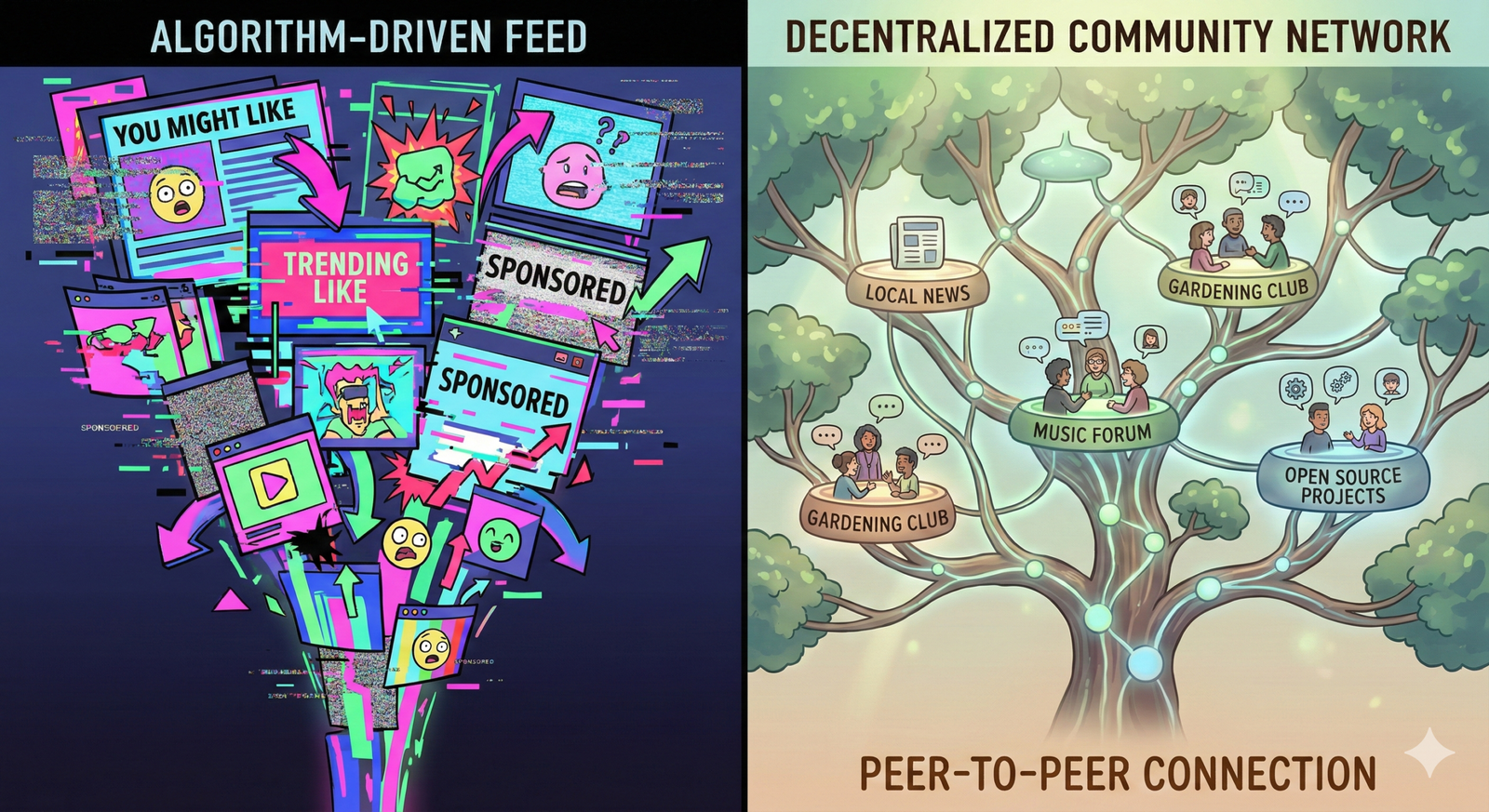
For nearly a decade, the internet has been dominated by a handful of “walled gardens”—massive, centralized platforms where an opaque algorithm dictates what we see, when we see it, and who we interact with. We grew accustomed to the infinite scroll, the dopamine hits of likes, and the friction of trying to build a community on rented land. But the tide is turning. We are currently witnessing a massive sociological and technological shift: the return of forums and the meteoric rise of decentralized social networks.
This shift is not merely nostalgia for the internet of the late 90s or early 2000s. It is a reaction to “algorithmic fatigue,” privacy encroachments, and the realization that bigger is not always better when it comes to human connection. Users are seeking smaller, safer, and more structured spaces—places where conversation trumps content, and where communities set their own rules.
In this guide, “decentralized social networks” refers primarily to federated platforms (like those in the Fediverse) and open protocols where no single company owns the network. “Forums” refers to topic-based, asynchronous community spaces, ranging from classic bulletin boards to modern iterations like Discord or Lemmy.
Key Takeaways
- The “Enshittification” Factor: Users are fleeing centralized platforms because the user experience has degraded in favor of advertising and algorithmic manipulation.
- The Fediverse Explained: Decentralized networks allow you to pick a provider (server) while still communicating with everyone on the network, similar to email.
- Structure Over Stream: Forums are returning because topic-based threading offers better knowledge retention and deeper discussion than chronological streams.
- Digital Sovereignty: The new wave of social media prioritizes user ownership of data and the portable social graph—you take your followers with you.
- Barriers Remain: Decentralized networks introduce friction, such as choosing a server and understanding technical concepts, which hinders mass adoption.
The Decline of the “Town Square” Model
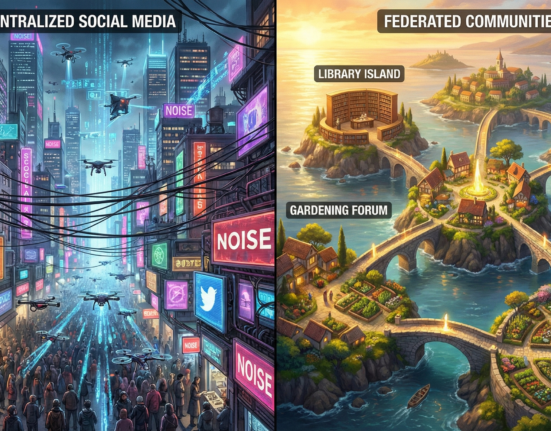
To understand the return of forums and the rise of decentralized networks, we must first understand why the current model is failing. For years, platforms like Twitter (now X), Facebook, and Instagram pitched themselves as the “global town square.” The promise was that everyone could talk to everyone.
However, the reality of the global town square has proven to be chaotic, unmoderated, and overwhelmingly noisy.
The Algorithm Trap
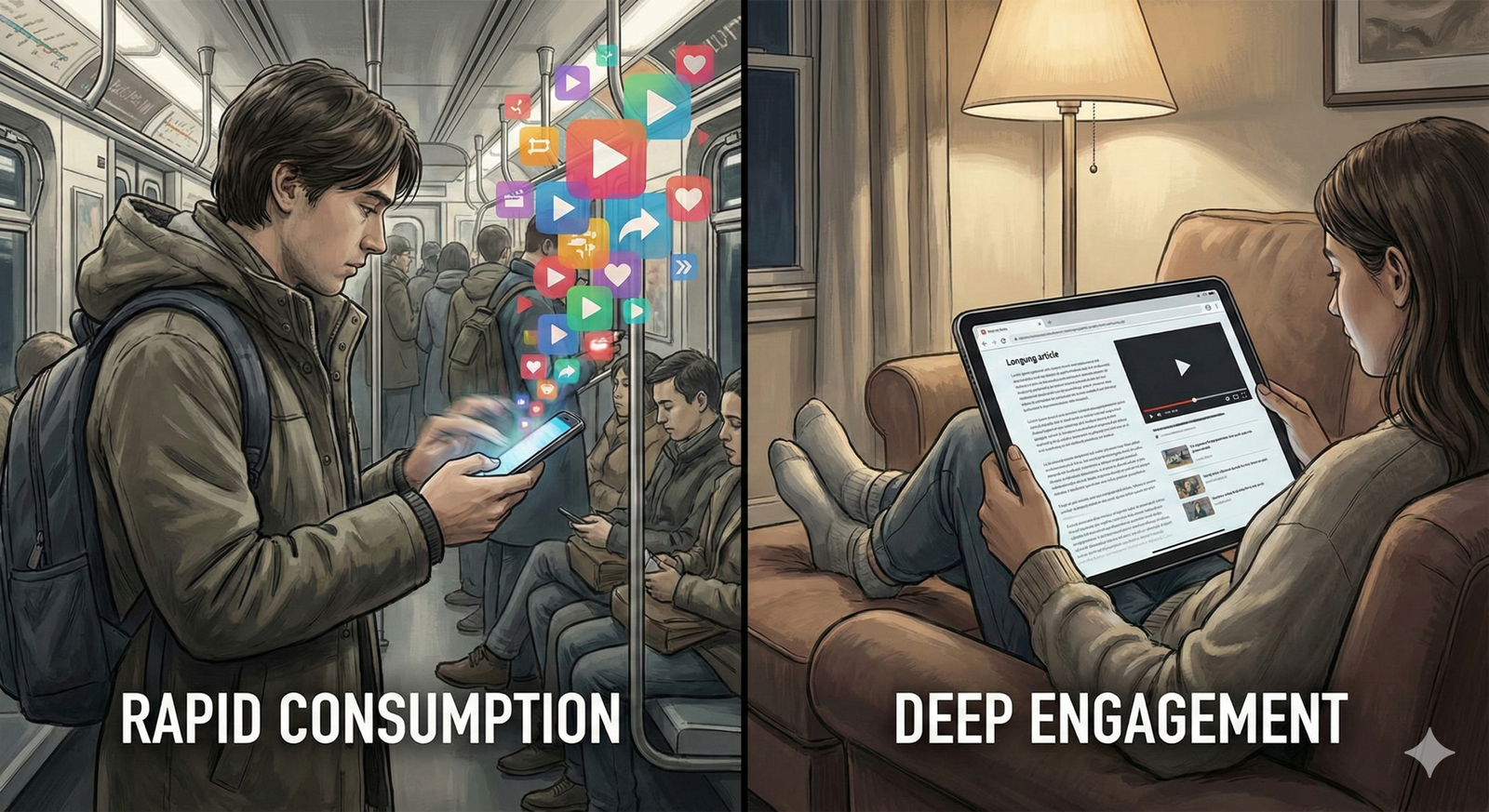
Centralized platforms run on an attention economy. Their primary goal is not to connect you with friends or helpful communities; it is to keep your eyes on the screen to show you ads. To achieve this, algorithms prioritize content that evokes strong emotional reactions—often outrage, anger, or extreme validation.
This leads to:
- Context Collapse: Your professional tweet is seen by your family, your high school friends, and anonymous trolls, all interpreted differently.
- Passive Consumption: Users spend more time scrolling and less time interacting.
- Reach throttling: Creators and community leaders find that their posts only reach a fraction of their followers unless they pay for visibility.
The “Cozy Web” Migration
In response, users are retreating to the “Cozy Web.” This term describes private or semi-private spaces where the public cannot easily gaze in. WhatsApp groups, Discord servers, Slack communities, and private subreddits are the modern equivalent of the living room rather than the town square. This migration has paved the way for the resurgence of structured forums and the adoption of open protocols.
Part 1: The Renaissance of the Forum
Forums never truly went away, but they were overshadowed by the dominance of social media feeds. Today, they are being rediscovered as superior tools for community building and knowledge management.
Why Forums Work Better Than Feeds
The fundamental difference between a social feed and a forum is organization.
- Feeds are ephemeral: A post on X or Instagram has a lifespan of minutes or hours. Once it scrolls off the screen, it is effectively gone. It is difficult to search for and impossible to organize.
- Forums are archival: Forums are organized by topic (taxonomy). A thread started three years ago about “How to fix a leaky faucet” or “Best sci-fi books of the 90s” is just as accessible and valuable today as it was then.
The Modern Forum Landscape
The “return” isn’t just about reviving phpBB boards from 2003 (though those still exist). It involves modern platforms that hybridize chat and threading.
1. Reddit and Its Alternatives
Reddit kept the flame of the forum alive for the mainstream internet. However, recent API changes and corporate decisions have alienated many power users, driving them toward decentralized alternatives (discussed later, like Lemmy). Reddit proves that people still crave “sub-communities” dedicated to specific interests rather than personality-driven feeds.
2. Discord: The Real-Time Forum
Discord started as a chat app for gamers but morphed into a massive network of semi-private forums. While it relies heavily on chat (synchronous), its “Channels” and “Threads” features allow for forum-like organization.
- Pros: High engagement, privacy, immense customization.
- Cons: Not indexed by search engines (knowledge is trapped), “notification fatigue.”
3. Discourse and Circle
For brands and creators, platforms like Discourse (open source) and Circle offer white-label forum experiences. These are becoming popular for course creators, software companies, and niche hobby groups who want to own their data and styling, distinct from a Facebook Group.
Community vs. Audience
The revival of forums signals a shift from building an audience to building a community.
- Audience: One-to-many. The creator speaks; the followers listen (and maybe comment).
- Community: Many-to-many. The members talk to each other. The value comes from the network of peers, not just the leader.
Part 2: Decentralized Social Networks (The Fediverse)
While forums address the structure of conversation, decentralized networks address the ownership and control of the connection. This is the realm of the “Fediverse” (Federated Universe).
What is Federation? (The Email Analogy)
The easiest way to understand decentralized social media is to think about email.
- Centralized (Walled Garden): Imagine if Gmail users could only email other Gmail users, and Google determined which emails you were allowed to see. That is Facebook or X.
- Federated (Decentralized): You have a Gmail account, but you can email someone with Outlook, Yahoo, or a corporate email address. No single company owns “Email.” It is an open standard.
In the Fediverse, platforms work the same way. You sign up on one server (often called an “instance”), but you can follow and interact with users on any other server in the network.
The Protocol Revolution: ActivityPub and AT Protocol
The magic behind this interoperability is the “Protocol.” Just as the web runs on HTTP and email runs on SMTP, decentralized social networks run on social protocols.
1. ActivityPub
This is the dominant standard, maintained by the World Wide Web Consortium (W3C). It powers Mastodon, PixelFed, Lemmy, and PeerTube. Even Meta’s Threads has begun integrating ActivityPub support, validating the technology’s importance.
- How it works: It standardizes how a message is sent from one server to another, meaning a video app (PeerTube) can talk to a microblogging app (Mastodon).
2. The AT Protocol (Bluesky)
Created initially within Twitter by Jack Dorsey and now independent, the AT Protocol powers Bluesky. It focuses heavily on “account portability”—the ability to move your entire identity, follows, and data to a new host without losing your connections.
Key Platforms in the Decentralized Ecosystem
| Platform | Analogue/Equivalent | Best For | Protocol |
| Mastodon | X / Twitter | Short-form text, news, microblogging | ActivityPub |
| Lemmy / Kbin | Threaded discussions, link aggregation, upvoting | ActivityPub | |
| PixelFed | Image sharing, photography portfolios | ActivityPub | |
| PeerTube | YouTube | Video hosting, streaming | ActivityPub |
| Bluesky | X / Twitter | Text, memes, public conversation | AT Protocol |
| Nostr | None (Unique) | Censorship-resistant, crypto-adjacent text | Nostr (Relays) |
Why “Instances” Matter
In a centralized network, there is one moderation policy for everyone. If you post something that violates the global rules, you are banned.
In a decentralized network, every “Instance” (server) has its own rules.
- example.social might be a general-purpose server with strict rules against hate speech.
- tech.chat might be exclusively for programmers, banning political talk.
- art.place might only allow image posts.
This allows for community-led moderation. If you don’t like the rules of your server, you can move to another one (or host your own) without losing access to the wider network. This creates a “market of moderation” rather than a monopoly.
Part 3: Why the Shift is Happening Now
Several converging factors have accelerated the move toward these platforms in 2024 and beyond.
1. The “Enshittification” Lifecycle
Coined by writer Cory Doctorow, “enshittification” describes how platforms die:
- They are good to their users to lock them in.
- They abuse their users to make things better for business customers (advertisers).
- They abuse those business customers to claw back all value for themselves.
- They die.
Users are currently feeling stage 2 and 3 on major platforms. Feeds are full of “suggested posts” rather than friends; search results are SEO-spam; and customer support is non-existent. Decentralized networks, usually funded by donations or user subscriptions rather than ads, escape this cycle.
2. The Desire for “Digital Sovereignty”
Creators and businesses are realizing that building a business on a centralized platform is “building on rented land.” An algorithm change or a random account ban can destroy a livelihood overnight.
- In decentralization: You own your social graph. If a Mastodon server shuts down, you can export your followers and move elsewhere. No single CEO can turn off your reach.
3. Niche over Broad
The internet culture is fragmenting. We are moving away from the “monoculture” (everyone watching the same TV show and tweeting about it) toward micro-cultures. Forums and federated servers are architecturally designed for this. A Lemmy community dedicated to mycology doesn’t need to appeal to a global audience; it just needs to serve mushroom enthusiasts well.
Part 4: Challenges and Barriers to Adoption
Despite the benefits, decentralized networks face significant hurdles before they can overtake the giants.
The “Onboarding Friction”
Signing up for Facebook takes 10 seconds. Signing up for Mastodon involves choosing a server, understanding that your login for one server works elsewhere, and navigating a slightly clunkier interface. This cognitive load is a massive filter that keeps casual users away.
Discovery Problems
Algorithms, for all their faults, are excellent at showing you things you didn’t know you liked. In a decentralized, chronological feed, discovery is manual. You have to actively hunt for interesting people and hashtags. There is no AI spoon-feeding you entertainment. For many, this feels like “work.”
Fragmentation and Drama
Decentralization solves the “one dictator” problem but introduces the “thousand petty tyrants” problem. Server admins can be capricious. Servers can “defederate” (block) other servers, creating fractured splinternets where parts of the network cannot talk to other parts. Navigating these server politics can be exhausting.
Sustainability
Running a server costs money (hosting, storage, bandwidth). Most Fediverse instances are run by volunteers on donations. If a server administrator runs out of money or motivation, the server can disappear. While data is portable, the stability of the infrastructure is less guaranteed than a venture-backed behemoth (though even those are not immortal).
Part 5: How to Navigate the New Social Landscape
If you are a user, creator, or brand looking to enter this space, the strategy differs significantly from traditional social media marketing.
For Individual Users: How to Join
- Choose a “Home Base” carefully: Don’t just join the biggest server (like mastodon.social). Look for a medium-sized instance aligned with your interests (e.g., hachyderm.io for tech, fosstodon.org for open source).
- Use tools to find friends: Tools like “Fedifinder” can scan your X/Twitter following list to see who has moved to the Fediverse.
- Introduce yourself: The culture in decentralized spaces is conversational. Write an #introduction post.
- Curate, don’t consume: You are the algorithm. Follow hashtags aggressively. Mute keywords you don’t want to see.
For Brands and Creators: “The Soft Sell”
You cannot buy ads on Mastodon. You cannot boost posts with money.
- Be a participant, not a broadcaster: Broadcasting press releases will get you blocked. You must engage in replies and discussions.
- Host your own instance: The ultimate power move for a brand (e.g., BBC, Medium, or Flipboard) is to host their own ActivityPub instance. This verifies their identity instantly (e.g., @user@social.bbc.com) and gives them total control over their data and moderation.
- Focus on Forums for Support: If you have a product, moving support from Twitter DMs to a Discourse forum creates a searchable knowledge base that reduces support ticket volume over time.
Future Outlook: The Hybrid Model
We are unlikely to see the total death of centralized social media. Instead, we are moving toward a hybrid ecosystem.
- The “Mullet” Strategy: Users will keep a presence on centralized platforms (Business in the front) for reach and discovery, while maintaining active participation in forums/decentralized groups (Party in the back) for deep engagement and community.
- Bridging: We will see more bridges connecting these worlds. Tools that cross-post from Bluesky to Mastodon, or aggregators that pull forum discussions into a unified inbox.
- Regulatory Support: The EU’s Digital Markets Act (DMA) is pushing for interoperability. This may eventually force gatekeepers like WhatsApp or Messenger to open up to smaller protocols, fueling the decentralized fire.
Conclusion
The return of forums and the rise of decentralized social networks represents a maturing of the internet. We are waking up from the fever dream of the algorithmic feed and remembering that the internet was originally designed to be a network of networks—a place for connection, not just consumption.
While the learning curve is steeper, the rewards—ownership, privacy, and genuine community—are worth the climb. Whether you are a user tired of rage-bait or a creator looking for safety, it is time to stake your claim in the open web.
FAQs
1. What is the difference between Mastodon and a forum like Reddit?
Mastodon is a microblogging platform similar to X (Twitter), where content is displayed in a chronological stream. Reddit is a forum-based platform where content is organized by topic (Subreddits) and threaded discussions. However, decentralized alternatives to Reddit, like Lemmy, exist within the Fediverse.
2. Can I message someone on Bluesky from Mastodon?
Currently, not natively. Bluesky uses the AT Protocol, while Mastodon uses ActivityPub. However, “bridging” tools are being developed that may allow cross-communication in the future.
3. Is the Fediverse safe?
Safety varies by server. Because there is no central authority, moderation depends on the administrator of your specific instance. However, you have robust tools to block users and even entire domains (servers) that you find problematic.
4. Why are brands hesitant to join decentralized networks?
Brands hesitate because there are no ad platforms to target users, analytics are harder to track (due to privacy focus), and there is a perceived risk of appearing alongside unmoderated content if they federate with “bad” servers.
5. Do I need to pay to use these networks?
Most decentralized networks are free to use, but they rely on donations. It is good etiquette to contribute a small monthly amount to your server administrator to cover hosting costs, though it is rarely mandatory.
6. What happens if my server shuts down?
If your server announces a shutdown, you can usually export your data (followers, mutes, blocks) and migrate to a new server. If a server disappears without warning, you may lose your data, which highlights the importance of choosing a reputable instance or hosting your own.
7. Is Threads part of the decentralized web?
Meta’s Threads has begun integrating ActivityPub, meaning Threads users can follow Mastodon users and vice versa. However, Threads itself remains a centralized platform owned by Meta, creating a hybrid model that some purists in the decentralized community view with skepticism.
8. Can I host my own social network?
Yes. Because the software (like Mastodon or Lemmy) is open-source, anyone with a domain name and a server can host their own instance. This gives you total control over your data and rules, effectively making you the “CEO” of your own social micro-platform.
References
- Doctorow, C. (2023). Social Quitting. Locus Magazine. https://locusmag.com/2023/01/commentary-by-cory-doctorow-social-quitting/
- W3C. (2018). ActivityPub Recommendation. World Wide Web Consortium. https://www.w3.org/TR/activitypub/
- Pierce, D. (2023). The Future of Social Media is a Lot Less Social. The Verge. https://www.theverge.com/
- Mastodon. (n.d.). Documentation and Server List. Joinmastodon.org. https://joinmastodon.org/
- Bluesky. (2024). The AT Protocol: A Guide. Bluesky Web. https://atproto.com/guides/overview
- Newport, C. (2019). Digital Minimalism: Choosing a Focused Life in a Noisy World. Portfolio/Penguin.
- Electronic Frontier Foundation. (2023). The Fediverse: A New Era of Social Media. EFF.org. https://www.eff.org/
- Lemmy. (n.d.). A Link Aggregator for the Fediverse. Join-lemmy.org. https://join-lemmy.org/