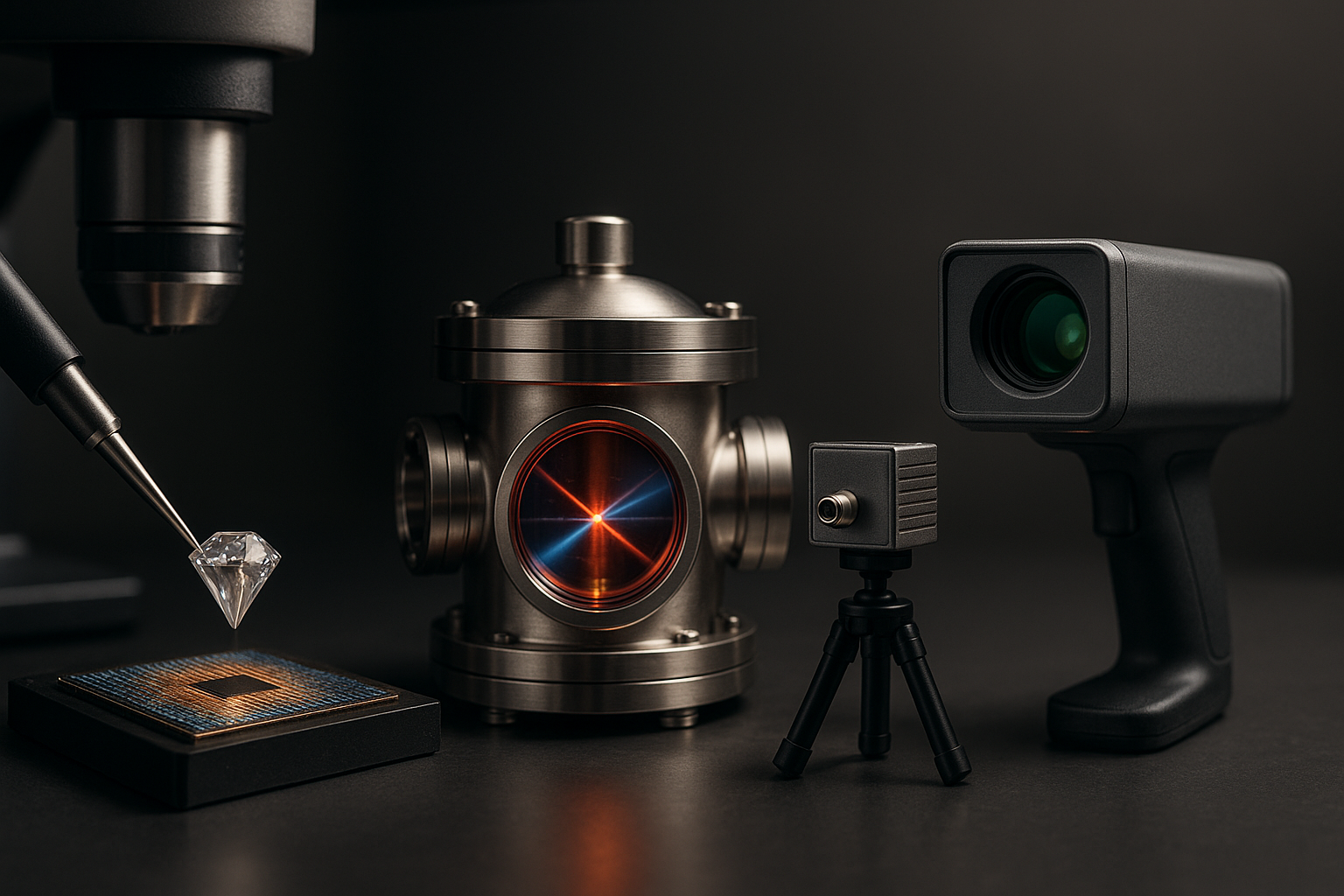
Quantum Sensors and Materials have moved from lab curiosities to deployable tools that measure the previously unmeasurable. In plain language: quantum sensors use fragile quantum states—of atoms, photons, or spins in solids—to detect magnetic and electric fields, rotation, gravity, time, and even trace gases with extreme precision. This guide gives you the 12 innovations that matter, what they actually do, where they shine (and where they don’t), and the realistic numbers to watch. You’ll leave knowing which platforms fit your use case, how to evaluate vendor claims, and what guardrails to apply before you run a pilot.
Quick definition: A quantum sensor is any device whose measurement performance fundamentally relies on quantum properties (superposition, entanglement, or quantized energy levels). Quantum materials, meanwhile, are engineered solids—like graphene or defect-engineered diamond—whose quantum behavior enables outstanding sensing.
Skim list of the 12 you’ll meet below: scanning NV microscopes, wearable OPM-MEG, cold-atom inertial IMUs, absolute quantum gravimeters, Rydberg RF receivers, superconducting photon detectors (SNSPDs/KIDs), quantum gas lidar for methane, graphene Hall sensors, zero- to ultralow-field NMR, field-grade diamond vector magnetometers, quantum-diamond diagnostics, and magnetic-navigation systems.
1. Scanning NV Magnetometry for Chip and Materials Imaging
Scanning NV (nitrogen-vacancy) magnetometry is the go-to when you need nanoscale, quantitative magnetic maps of devices or materials under realistic conditions (ambient, vacuum, or cryogenic). An NV center is a single atomic defect in diamond whose spin state shifts in response to local magnetic fields; reading the spin optically turns diamond into a needle-tip magnetometer. Startups have productized this: turnkey microscopes place a diamond tip within tens of nanometers of your sample to resolve current paths, domain walls, and skyrmions—all without invasive probes. The result is quantitative vector magnetometry with spatial resolution set mainly by tip-to-sample distance, enabling failure analysis in advanced ICs, magnetic device R&D, and 2D-magnet studies.
How it works
A scanning probe (AFM-style) carries a diamond tip containing a single NV center. A green laser and microwaves drive the NV spin; the emitted red fluorescence encodes the local magnetic field via optically detected magnetic resonance (ODMR). By rastering the tip, you recover a quantitative magnetic map and, with inversion, current density. Because the NV is point-like, resolution scales with the stand-off distance ddd, making sample preparation and tip engineering central. qzabre.com
Numbers & guardrails
- Resolution: ≈0.86 × d (e.g., 20 nm stand-off → ~17 nm lateral resolution).
- Magnetic sensitivity: application-dependent; scanning favors spatial resolution over ultimate fT/√Hz sensitivity.
- Sample constraints: metallic surfaces can heat under laser; cryo operation improves stability but adds overhead.
Tools & examples
- Qnami ProteusQ (turnkey scanning NV microscope), QZabre Quantum Scanning Microscope (QSM) and tips; use cases include current imaging in chips and magnetic textures in 2D magnets. Qnamiqzabre.com
Bottom line: If you need nanoscale, quantitative magnetometry under realistic environments, scanning NV is uniquely capable—just budget for tip care, stand-off control, and thermal management.
2. Wearable OPM-MEG: Quantum Brain and Nerve Imaging Without Cryogenics
Optically pumped magnetometers (OPMs) enable magnetoencephalography (MEG) and peripheral nerve mapping with femto-tesla sensitivities—without the cryogens and room-sized magnets of SQUID systems. The breakthrough is wearable, head-conformal helmets that bring sensors millimeters from the scalp, improving signal-to-noise and allowing movement during scans (crucial for pediatrics and ambulatory tasks). Startups now ship 50–128-channel systems, with triaxial sensors and dynamic field compensation that hold zero field while subjects move, laugh, or read.
Why it matters
Getting sensors close to the sources boosts signal by orders of magnitude. OPM-MEG can run in flexible shielded rooms, accommodate varied head sizes, and enable tasks that static systems make awkward or impossible. Clinical uses span epilepsy, presurgical mapping, and longitudinal monitoring; research uses include language, vision, and sensorimotor studies. PMC
Numbers & guardrails
- Per-sensor noise: ~10–25 fT/√Hz; gradiometric configurations reach ~6 fT/√Hz.
- Channel counts: 50–128 today; higher channel counts are in development.
- Operational needs: shielding and dynamic field control are essential; heating of OPMs must be managed in dense arrays. MIT Press DirectPMC
Tools & vendors
- FieldLine HEDscan (head-mounted OPM-MEG), QuSpin OPMs for research, Twinleaf magnetometers for ZULF and biomagnetics; commercial deployments demonstrate full-head arrays. Fieldline MedicalQuspin
Bottom line: For non-invasive functional neuroimaging with flexible setups and naturalistic behavior, OPM-MEG is the practical quantum option; evaluate vendors on shielding, calibration workflows, and thermal comfort.
3. Cold-Atom Inertial IMUs: Drift-Resilient Navigation Without GPS
Cold-atom interferometers measure acceleration and rotation by tracking the phase of matter-waves split and recombined by laser pulses. In plain terms: clouds of laser-cooled atoms form the world’s most stable test masses. When packaged as accelerometers and gyros, they deliver drift-resilient inertial navigation that can hold position for long periods without external fixes—vital underground, underwater, or in contested airspace. Aerospace primes and startups are co-developing flight-qualified units today.
How it works
A light-pulse atom interferometer (e.g., Mach–Zehnder) imprints phase proportional to acceleration or rotation. Careful laser phase control, vibration isolation, and common-mode rejection suppress classical noise. Hybridization with classical IMUs combines bandwidth and robustness.
Numbers & guardrails
- Stability: significantly longer holdover than classical sensors; program documents cite >10× improvements in stability for holdover time.
- Size/weight/power (SWaP): improving; still larger than MEMS; hybrid approaches dominate near-term deployments.
- Integration: sensitive to vibrations; active isolation and model-based fusion are mandatory. Center for Global Security Research
Ecosystem
- AOSense and partners on GPS-free navigation prototypes; major flight testing narratives underscore feasibility.
Bottom line: If you need assured navigation in GPS-denied environments, cold-atom IMUs are the benchmark for long-term stability—plan for hybridization and robust environmental isolation.
4. Absolute Quantum Gravimeters for Geoscience and Civil Monitoring
Absolute quantum gravimeters measure tiny changes in local gravity by timing atom interferometers as atoms fall in a vacuum. Unlike classical relative meters, they are self-calibrating and can run continuously, enabling groundwater tracking, void detection, volcanic precursors, and infrastructure health monitoring. Field-deployable units now pair portability with µGal-level precision and white-noise behavior that averages down rapidly. Exail
Numbers & guardrails
- Sensitivity (quiet site): specified around 500 nm s⁻² Hz⁻½, averaging to ~10 nm s⁻² in ~1 h; vendor literature highlights 1 µGal precision and continuous operation.
- Cadence: ~0.5–2 Hz drop rate depending on model.
- Use constraints: seismic noise, wind, and ground motion limit near-term deployments; careful siting and averaging mitigate.
Vendors & emerging players
- Exail (AQG line) ships field units and outdoor variants; Atomionics is building mobile gravimetry platforms for resource exploration with AI-assisted 3D modeling. Exail
Mini case: Mapping a buried void beneath a roadway requires detecting gravity anomalies on the order of tens of nm s⁻². With 1-minute averages achieving ~100 nm s⁻² precision per station, a grid of 5 m spacing can reveal voids a few meters across—tightening confirmation by repeat passes and seismic correlation.
Bottom line: For absolute, long-term gravity baselines in geoscience and civil monitoring, quantum gravimeters are practical today—budget for environmental noise control and survey design.
5. Rydberg-Atom RF Receivers: Antenna-Free, Ultra-Broadband Sensing
Rydberg atoms behave like tiny, tunable RF probes: highly excited electrons give these atoms colossal electric-dipole moments, making them exquisitely sensitive to RF and microwave fields. Instead of an antenna, a vapor cell and lasers perform electromagnetically induced transparency (EIT) spectroscopy; the RF field perturbs atomic levels, which the optics read out. Startups are engineering compact spectrum sensors that span from sub-MHz into the mm-wave/THz regime, with absolute field calibration rooted in atomic physics.
Why it matters
Rydberg sensors can be frequency-agile and compact, and they naturally measure phase, amplitude, and frequency. Their small aperture relaxes form-factor constraints for close-range spectrum awareness, electromagnetic compliance, and potentially low-probability-of-intercept comms.
Numbers & guardrails
- Frequency coverage: vendor claims span DC→THz by tuning laser/Rydberg states; practical systems target bands of interest.
- Sensitivity: literature reports down to tens of nV cm⁻¹ Hz⁻½ in optimized superhet configurations.
- Limits: blackbody radiation, vapor-cell physics, and optical alignment set floors; system robustness is an active engineering focus.
Who to watch
- Rydberg Technologies (field demos of atomic RF comms) and Infleqtion’s Sqywire quantum RF receiver. The Quantum Insider
Bottom line: If you need broadband, small-aperture RF sensing with atomic accuracy, Rydberg receivers belong on your shortlist—evaluate on shielding, tuning workflows, and calibration.
6. Superconducting Photon Detectors (SNSPDs & KIDs): Seeing Single Photons Reliably
Superconducting nanowire single-photon detectors (SNSPDs) and kinetic-inductance detectors (KIDs/MKIDs) are the workhorses of ultra-low-light sensing. SNSPDs pair >90% system detection efficiency with <15 ps timing jitter and near-zero dark counts—ideal for quantum communications, deep-space optical links, time-of-flight ranging, and quantum LiDAR. KIDs, meanwhile, excel in scalability: frequency-multiplexed resonators create kilopixel arrays for astronomy and thermal photon sensing. Startups deliver multi-channel racks, mid-IR options, and custom devices tuned to target wavelengths.
Numbers & guardrails
- SNSPD efficiency: >90% near 950 nm; >80% near 1550 nm; jitter <15 ps typical.
- Dead time: ns–tens of ns, enabling high count rates; recovery dynamics depend on bias and nanowire geometry.
- Operating temp: typically below 2.5 K for top performance; cryo integration and fiber coupling dominate system cost/risk.
Mini table (scan quickly)
| Metric | SNSPD (typical) | MKID/KID (typical) |
|---|---|---|
| Efficiency | 80–>90% (band-tuned) | Moderate; array-focused |
| Timing jitter | <15 ps | µs–ms scale (not timing-optimized) |
| Pixel count | 1–32+ channels | 1,000s via RF multiplex |
| Temp | ~0.8–2.5 K | ~0.1–1 K |
Bottom line: If your application hinges on counting or timing individual photons, SNSPDs are unmatched; if you need large imaging arrays, KIDs rule—plan for cryogenics and fiber/microwave packaging.
7. Quantum Gas LiDAR for Methane: Imaging, Locating, Quantifying
Quantum-enabled gas lidar combines absorption spectroscopy with single-photon detection to visualize and quantify methane plumes across assets and terrain. The value is end-to-end LDAR (leak detection and repair): imaging identifies sources, quantification prioritizes fixes, and cloud analytics drive reporting. Startups pair cameras, edge controllers, and SaaS dashboards, and increasingly integrate with independent emissions analytics ecosystems.
How it works
A pulsed laser illuminates the scene at a methane absorption line; a single-photon detector array captures returns. Differential absorption and time-of-flight yield both range-resolved images and leak rates via inverse modeling. Systems operate from fixed mounts, vehicles, or drones, covering large infrastructures quickly.
Guardrails
- Quantification accuracy depends on wind estimation and plume modeling; dual-look geometries improve robustness.
- Deployment choice: aerial for coverage; tripod/fixed for continuous monitoring around critical assets.
- Data: best-in-class systems stream to analytics platforms for alerts and reporting. qlmtec.com
Bottom line: For actionable methane management—image, locate, and measure with a single instrument—quantum gas lidar is production-ready; validate on end-to-end quant accuracy and integration.
8. Graphene Hall Sensors: Quantum Materials for Cryogenic & High-Field Metrology
Graphene’s high mobility and 2D nature make it an exceptional Hall-effect sensing material. Commercial graphene probes now operate from microtesla to tens of tesla, and from milli-Kelvin to high ambient temperatures—useful for cryogenic labs, magnet test stands, and quantum-processor bring-up, where compact, low-drift field probes are invaluable. Startups fabricate wafer-scale graphene sensors and pack them on cryo-rated PCBs and ceramic packages.
Why it matters
Conventional Hall sensors struggle at cryo temperatures or saturate at high fields. Graphene devices maintain linearity and sensitivity across extreme ranges without flux concentrators, reducing system complexity and bill of materials. Paragraf
Numbers & guardrails
- Field range: µT to >30 T, depending on device.
- Thermal range: mK to industrial temperatures (device-specific).
- Integration: package geometry and wiring loom design dominate cryostat integration; watch for self-heating at ultra-low temperatures. Paragraf
Bottom line: If you need robust field sensing across extremes, graphene Hall sensors are a practical quantum-materials win—spec the exact field/temperature envelope and cabling.
9. Zero- to Ultralow-Field NMR (ZULF): Portable Chemistry Without Big Magnets
ZULF-NMR trades towering superconducting magnets for ultralow magnetic fields and quantum magnetometers (often OPMs). The technique reads rich J-coupling spectra that are robust through metal and heterogeneous media, enabling inline reaction monitoring and portable chemical analysis. Research results now show multichannel “NMR cameras,” with sensitivity comparable to benchtop systems and clear paths to high-throughput assays.
How it works
Samples are pre-polarized (via a small magnet or hyperpolarization methods like SABRE), then moved into near-zero field where OPMs detect nuclear spin evolution. Spectra reflect molecular connectivity rather than high-field chemical shifts, simplifying interpretation for certain classes of compounds and environments. Science
Numbers & guardrails
- Sensitivity: approaching benchtop NMR with multichannel arrays; parallel sample detection demonstrated.
- Constraints: motion and magnetic gradients must be controlled; hyperpolarization logistics can dominate workflow.
- Commercial parts: QuSpin OPMs and open-source control stacks underpin prototypes. arXiv
Bottom line: If you want NMR-grade insights without high-field magnets, ZULF is compelling—design around polarization handling and sample logistics.
10. Field-Grade Diamond Vector Magnetometers: Mapping, PNT, and Subsurface Clues
Beyond microscopes, ensemble NV-diamond sensors in compact heads deliver vector magnetometry for geophysics, navigation, and anomaly detection. With no cryogens and strong temperature stability, these systems can map small changes in Earth’s field, support magnetic-navigation, and identify ferromagnetic targets underground or underwater. Vendors pair sensors with tensor gradiometry and denoising software to pull weak signals from cluttered environments. SBQuantum
How it works
Billions of NV centers in a diamond chip are pumped and probed with lasers; ODMR shifts yield vector components of B. Using multi-axis bias fields and robust fitting, systems return calibrated vectors and gradients. The vector capability improves heading stability and reduces drift versus scalar magnetometers. Element Six
Numbers & guardrails
- Sensitivity: portable vector units report sub-nT/√Hz regimes; handheld demonstrations show ~400 pT/√Hz with low heading error—pointing to rapid progress.
- Use constraints: ambient magnetic clutter and motion induce artifacts; tensor gradiometry and ML-based filtering help. arXiv
Bottom line: For PNT augmentation, UXO surveys, and asset detection with passive sensors, quantum-diamond magnetometers are maturing rapidly—validate vector accuracy and gradient stability in your environment.
11. Quantum-Diamond Diagnostics: pg/mL Biomarkers with Magnetic Readout
Using diamond-NV sensing as the readout for magnetic immunoassays, startups are shipping compact instruments that detect protein and nucleic-acid targets at sub-pg/mL levels with only microliters of sample. The trick is to tag targets with magnetic nanoparticles; NV-diamond imaging or sensing quantifies the particles with single-particle statistics, pushing sensitivity and dynamic range beyond colorimetric and many fluorescence assays. Workflows fit into standard wet-lab benches.
Why it matters
For translational research and drug development, this offers rapid, ultrasensitive assays without expensive optics or complex amplification chemistries. Because the readout is magnetic, samples with high autofluorescence or optical scatter pose fewer problems. SBIR
Numbers & guardrails
- Sample volume: ≤5 µL; hands-on time under an hour reported.
- Sensitivity: <1 pg/mL analytical sensitivity claims on supported targets.
- Caveats: nanoparticle quality and surface chemistry are critical; multiplexing depends on assay design.
Bottom line: If you need benchtop ultrasensitivity without complex optics, quantum-diamond diagnostics are attractive—validate per-assay LoD and controls.
12. Magnetic Navigation Systems: Quantum Sensing Meets ML for GPS-Free Positioning
Magnetic navigation uses quantum magnetometers and ML to match measured vectors and gradients to global or regional magnetic maps. Because the geomagnetic field is stable and spatially structured, it can serve as a passive reference—even inside buildings, underwater, or underground. Startups package flight-ready navigation boxes that fuse magnetic cues with inertial sensors, offering GPS-like holdover and resilience in denied environments.
How it works
Arrays of sensitive magnetometers (often optically pumped or diamond-based) record field vectors while an onboard filter fuses them with IMU data and a map prior. The system continuously estimates pose relative to the map. The advantage is passivity: there’s nothing to jam or spoof because sensors only receive. Q-CTRL
Numbers & guardrails
- Performance: vendor reports claim large-factor improvements over classical magnetic approaches in representative trials; integration with cold-atom inertials further extends holdover.
- Caveats: success depends on map fidelity and environmental stability; ferromagnetic clutter and vehicles require robust modeling.
- Deployment: best results come from pre-mapped corridors (air, sea, land) and periodic map updates. Q-CTRL
Bottom line: For assured PNT without emissions, magnetic navigation is a powerful complement to inertials—pilot in your operating theater with representative clutter and dynamics.
Conclusion
Quantum Sensors and Materials are usable now in three clear lanes: (1) Nanoscale & photonic (NV microscopes, SNSPDs/KIDs) where you need microscopic truth and single-photon timing; (2) Field & infrastructure (OPM-MEG, quantum gravimeters, methane lidar, graphene Hall sensors) where you need deployable precision; and (3) Navigation & RF (cold-atom IMUs, magnetic navigation, Rydberg RF) where resilience and passivity count. Across the board, your buying criteria should prioritize stability over headline sensitivity, calibration workflows, SWaP and thermal budgets, and integration (data pipelines, analytics, and controls). Pair quick feasibility tests with problem-specific guardrails—environmental noise models for gravimetry, thermal and shielding plans for OPM-MEG, cryo packaging for SNSPDs, and wind/plume models for gas lidar.
If you’re standing up a program today, shortlist two or three platforms aligned to your outcome, demand transparent performance plots (noise vs. bandwidth, Allan deviation, jitter histograms), and insist on field-relevant demos. Then scale with confidence. Ready to begin? Pick one high-leverage pilot and a single success metric—then iterate fast.
FAQs
1) What makes a sensor “quantum”—is it only marketing?
No. A quantum sensor’s core measurement relies on quantum properties (e.g., atomic energy levels or quantum coherence). If removing the quantum element leaves you with a fundamentally different (worse) sensor, it qualifies. Examples include NV-diamond magnetometers (spin states), OPMs (atomic polarization), cold-atom interferometers (matter-wave phase), and Rydberg RF sensors (atomic level shifts). Marketing language aside, ask vendors which quantum degree of freedom provides the sensitivity and how it’s preserved.
2) How should I compare vendor sensitivity claims fairly?
Normalize to bandwidth and averaging time (e.g., fT/√Hz, nm s⁻² Hz⁻½) and request Allan deviation plots. For imagers or scanning probes, confirm the spatial resolution–sensitivity trade-off and sample heating. For photon detectors, compare system (not device-only) efficiency and timing jitter. quantumopus.com
3) Do quantum sensors work outside pristine labs?
Yes—several do. OPM-MEG runs in lightweight shields; quantum gravimeters operate indoors and outdoors; methane quantum lidar mounts on tripods, vehicles, or drones; graphene Hall sensors work at mK or high fields. The key is environmental engineering (shielding, isolation, modeling).
4) What’s the difference between NV-diamond and OPM magnetometers?
NV-diamond can do nanoscale scanning or field-grade vector sensing and is solid-state and robust, but scanning sacrifices raw sensitivity for resolution. OPMs excel in raw sensitivity at macroscales and power wearable MEG. Choose NV for nanoscale or vector field mapping; choose OPMs for biomagnetism or unshielded surveys with strong averaging. Qnami
5) How close are cold-atom IMUs to “drop-in” replacements?
They’re not MEMS-sized yet. The pattern is hybridization: classical IMUs for bandwidth + cold-atom for calibration and drift suppression. Evaluate integration (isolation, thermal, laser modules) and holdover metrics against your mission profile.
6) Can Rydberg RF sensors replace all antennas?
Not universally. They shine in broadband sensing, field metrology, and small-aperture monitoring. For high-gain long-range links, conventional antennas still dominate. Expect Rydberg systems first in spectrum awareness and specialized comms.
7) What’s the main bottleneck for SNSPD deployments?
Cryogenics and packaging. Performance is superb—>90% efficiency, <15 ps jitter—but system cost/complexity lives in cryo plumbing, optical coupling, and readout electronics. Plan for uptime, serviceability, and spares.
8) How accurate is methane quantification from quantum lidar?
Accuracy depends on wind estimation, plume modeling, and geometry. Systems that combine imaging with dual-look or wind measurements yield the best quant. Verify with controlled-release tests and cross-check against alternative sensors. World Economic Forum Initiatives
9) Is ZULF-NMR only a lab curiosity?
It’s moving beyond that. Multichannel arrays and robust OPM hardware make portable, scalable systems plausible for inline chemistry and QC. Pilot projects should focus on workflow (pre-polarization, sample handling) and spectral libraries.
10) Are graphene Hall sensors safe to use near quantum processors?
Yes, they’re designed for cryo compatibility and high fields, making them useful for qubit bring-up and magnet calibration. Ensure the wiring and readout don’t introduce vibrations or EMI into your cryostat.
11) How do magnetic-navigation boxes avoid spoofing/jamming?
They’re passive—they only measure the environment—so there’s nothing to jam. The real risk is map mismatch; mitigate with local map updates and sensor fusion (inertial, vision) for robustness. Q-CTRL
12) Where do diamond-based diagnostics fit in a lab stack?
They fit where ultrasensitive, small-volume detection is valuable and optical readouts struggle. Think pharmacokinetics screens, low-abundance biomarkers, or rugged field diagnostics labs. Validate per-assay LoD and run controls rigorously. qdti.com
References
- NV magnetometry – A White Paper by Qnami, HORIBA / Qnami, Jun 16, https://www.horiba.com/int/scientific/resources/news/detail/news/6/2021/nv-magnetometry-a-white-paper-by-qnami/
- ProteusQ™ Scanning NV Microscope, Qnami (product page via QDUSA), Nov 18, https://qdusa.com/products/qnami_scanning_NV_microscope.html
- Scanning NV Microscopy, Oak Ridge National Laboratory, https://www.ornl.gov/content/scanning-nv-microscopy
- Multi-channel whole-head OPM-MEG, NeuroImage, https://pmc.ncbi.nlm.nih.gov/articles/PMC8274815/
- An integrated full-head OPM-MEG system (HEDscan, 128 sensors), Frontiers in Neuroscience, https://www.frontiersin.org/journals/neuroscience/articles/10.3389/fnins.2023.1190310/full
- Beyond GPS—Quantum Navigation Flight Test, Boeing Innovation Quarterly, https://www.boeing.com/innovation/innovation-quarterly/2025/03/beyond-gps-quantum-navigation-flight-test
- Lockheed, Q-CTRL, AOSense: Quantum-enabled INS (DIU), Quantum Computing Report, https://quantumcomputingreport.com/lockheed-martin-and-partners-awarded-contract-to-develop-quantum-enabled-navigation-system-under-dius-tqs-program/
- Evaluation of Exail Absolute Quantum Gravimeters, Journal of Geodesy, https://link.springer.com/article/10.1007/s00190-025-01995-x
- Exail AQG datasheet (outdoor), Exail, https://www.exail.com/media-file/11215/exail-datasheet-aqg-b-quantum-gravimeter.pdf
- Cold atom inertial sensors for navigation applications, Frontiers in Physics, https://www.frontiersin.org/journals/physics/articles/10.3389/fphy.2022.994459/full
- Rydberg Technologies—Quantum RF sensing, Rydberg Technologies, https://www.rydbergtechnologies.com/
- Infleqtion Sqywire—Quantum RF Receiver, Infleqtion, https://infleqtion.com/quantum-rf-receiver/
- Quantum superhet with Rydberg atoms, arXiv, https://arxiv.org/abs/1902.11063
- Single Quantum SNSPD Technology, Single Quantum, https://www.singlequantum.com/technology/
- Quantum Opus SNSPD Product Info, Quantum Opus, https://www.quantumopus.com/web/product-info/
- MKIDs—JPL Microdevices, NASA JPL, https://microdevices.jpl.nasa.gov/capabilities/superconducting-devices/mkids/
- Applications for MKIDs, Applied Sciences, https://www.mdpi.com/2076-3417/11/6/2671
- Quantum Gas LiDAR Technology, QLM Technology, https://qlmtec.com/technology/
- QLM–Project Canary Partnership, Project Canary, https://www.projectcanary.com/press/qlm/
- Graphene Hall Sensors (GHS series), Paragraf, https://www.paragraf.com/hall-sensors/
- EGHKX01P05 Cryo High-Field Graphene Hall Sensor, Paragraf, https://www.paragraf.com/wp-content/uploads/2024/11/EGHKX01P05-Datasheet-PC1-POSA-04.pdf
- High-sensitivity multichannel ZULF-NMR with OPM arrays, arXiv, https://arxiv.org/abs/2407.00929
- What is Quantum Sensing?, Q-CTRL, https://q-ctrl.com/topics/introduction-to-quantum-sensing
- Atomionics GRAVIO/OREO (cold-atom gravimetry + AI), Atomionics, https://www.atomionics.com/technology
- QDTI—Quantum-diamond diagnostics platform, QDTI, https://qdti.com/instrument
- Diamond-based quantum sensors for earth/space, National Research Council Canada, https://nrc.canada.ca/en/stories/diamond-based-quantum-sensors-add-sparkle-earth-space-exploration