Non-fungible tokens (NFTs) are best known for digital art, but their real potential stretches far beyond images. At their core, NFTs are cryptographic records that represent unique rights—use, access, identity proofs, receipts, or claims—on a shared ledger. In plain language: an NFT is a programmable certificate of uniqueness you can verify independently. Below you’ll find 15 practical NFT use cases beyond art, with steps, guardrails, and examples to help you evaluate fit. In short: choose the right token standard, map the real-world right you’re representing, decide how users will hold it, and plan compliance from day one.
Quick evaluation steps (skim this before diving in):
- Define the outcome (access, ownership proof, license, credential, or claim).
- Map the asset and lifecycle (mint → transfer/use → update → revoke).
- Pick a standard (ERC-721 for unique items; ERC-1155 for mixed/batch). ethereum.org
- Decide custody (self-custody wallet, custodial account, or both).
- Add compliance & privacy (KYC/AML where required; data-minimize).
- Pilot small, instrument metrics, and iterate.
Small table—standards at a glance
| Goal | Typical standard | Why |
|---|---|---|
| One-off unique asset | ERC-721 | Simple, widely supported for uniqueness. |
| Many items, some unique, some fungible | ERC-1155 | Single contract manages multiple IDs efficiently (great for games, tickets, merch). |
| Rental/usership without transfer | ERC-4907 (ext. of 721) | Adds a time-bound user role to separate use from ownership. |
| Non-transferable badges/credentials | EIP-5192 (soulbound) | Minimal interface to mark tokens as non-transferable. |
| Royalty signaling | EIP-2981 | Standard way to expose royalty info to marketplaces. |
Neutral note: Some topics touch finance, identity, or health. Treat this guide as education, not legal, financial, or medical advice. For regulated uses, consult qualified professionals in your jurisdiction.
1. Game Items, Progress, and Interoperability
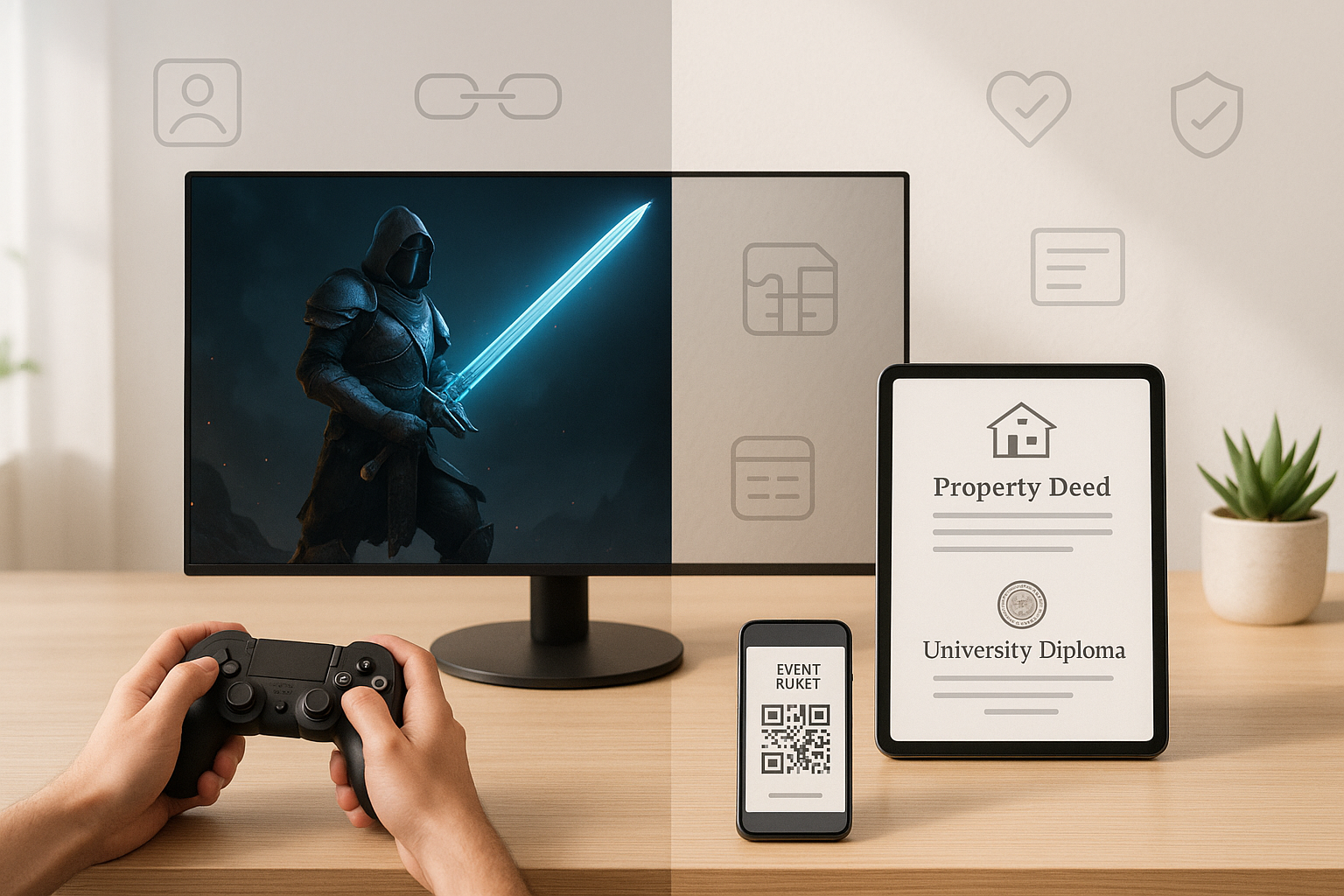
Game studios use NFTs to represent unique items (weapons, skins, land) and time-bound rights (rentals) that move with the player, not just the account. The immediate benefit is portable ownership: a sword you craft or a skin you earn can live in your wallet and be consumed across compatible titles or community tools. Practically, ERC-721 works for truly unique items, while ERC-1155 lets you batch mint consumables like potions and ammo alongside legendaries in one contract. For temporary access—say, lending a mount for a weekend—ERC-4907 extends ERC-721 with a user role that expires automatically without escrow games. This reduces support tickets and prevents accidental transfers during a rental period. The design goal is simple: make in-game value transparent, enforceable by code, and tradable on your terms. ethereum.orgEthereum Improvement Proposals
How to do it
- Model inventory: Map which assets are truly unique (721) vs. stackable (1155).
- Add rentals/usership: Use ERC-4907 for time-bounded use rights (e.g., 72-hour tournament pass on a mount).
- Prevent exploits: Freeze metadata for competitive assets; separate cosmetic from pay-to-win.
- Price sinks: Design burn/upgrade loops to manage inflation of items.
- Player safety: Offer custodial wallets for beginners; allow export to self-custody later.
Numbers & guardrails
- Batching: Minting 10,000 consumables under one ERC-1155 saves contract calls vs. separate ERC-721s, lowering gas and simplifying drops.
- Time-bound rights: ERC-4907’s expires automatically returns use to owner, cutting manual revokes and disputes.
Synthesis: If you need durable, portable player value with clean rental mechanics, a 721/1155 mix plus 4907 covers most gameplay loops without custom plumbing.
2. Real Estate: Titles, Fractional Interests, and Closings
Beyond hype, property workflows benefit from NFTs when they encode who can do what, when funds release, and how records get updated. Two common patterns appear: (1) fractional tokens tied to a compliant trust or special-purpose entity, and (2) title-adjacent records that mirror registry updates. Government-backed pilots show movement: the Dubai Land Department launched a tokenization initiative to enable co-ownership and align token records with the official registry. This is critical: real property law hinges on registries; tokens are useful to the extent they map to those ledgers and legal wrappers. Where registries remain paper-first, NFTs can still streamline escrows, document signing, and audit trails around a transaction platform—so long as outcomes (transfer recorded; liens cleared) sync back to the legally recognized system.
How to do it
- Map the wrapper: House fractional tokens in a compliant SPV or trust; the token confers rights in the entity, which owns the property.
- Sync to registries: Where supported, integrate with land departments; otherwise, automate closing steps and file the deed with the authority. hmlandregistry.blog.gov.uk
- Disburse by milestone: Release escrow when notarized docs and registry confirmations post.
- KYC/AML: Bake identity checks into primary and secondary transfers.
- Disclosures & taxes: Attach immutable disclosures to the token’s metadata; plan tax reporting hooks.
Mini case (illustrative)
A 100-unit income property is wrapped in an SPV and split into 1,000 tokens. Each token entitles the holder to 0.1% of distributions. Closings and KYC are handled in-app; on registry confirmation, the NFT metadata links to deed and title policy hashes. A holder sells 10 tokens; the transfer triggers the platform’s withholding rules and updates the cap table. (Exact legal structuring varies—work with counsel.)
Synthesis: Real estate NFTs work when they mirror legal reality, not replace it; look for jurisdictions and partners that align registry and token records.
3. Digital Identity and Verifiable Credentials
Identity is more than a wallet address. The W3C’s Verifiable Credentials (VC) model lets issuers (universities, employers, governments) sign claims you hold and present later, while Decentralized Identifiers (DIDs) give you portable identifiers independent of centralized directories. NFTs can complement this by anchoring non-transferable badges (using EIP-5192) or linking to a VC that encodes the actual claim. The advantage is selective disclosure: prove you’re over a threshold, licensed, or certified without handing over your full dossier. For organizations, this reduces onboarding friction and fraud. For individuals, it means reusable, tamper-evident credentials you control. The key design choice is privacy: minimize on-chain personal data and store sensitive details in VCs you present off-chain.
Why it matters
- Portable trust: Credentials you can carry across employers and platforms.
- Granular disclosure: Share only what’s needed for a check.
- Revocation clarity: Issuers can revoke or update status without recalling every copy.
Mini-checklist
- Use DIDs for identifiers; issue VCs for claims; use non-transferable NFTs as discoverable badges only if needed.
- Avoid writing PII on-chain; store hashes or references.
- Offer custodial wallets for non-crypto users; allow VC wallets as an alternative.
Synthesis: Combine DIDs, VCs, and non-transferable NFT badges to prove facts about a person or organization while preserving privacy-by-design.
4. Tickets and Access Control
NFTs make event tickets verifiable, programmable, and harder to counterfeit. Organizers can bind a ticket to a wallet, enforce transfer windows, and airdrop perks (set-list, merch coupons) post-show. A notable proof point: UEFA distributed match tickets to the general public via a blockchain-based mobile app for a major fixture, demonstrating that large-scale, app-based distribution is feasible. With NFTs, the same primitive governs entry, resale caps, and post-event collectibles. For venues and promoters, that means fewer chargebacks and clearer secondary rules; for fans, less fraud and a portable memento. The nuance is UX: hide crypto complexity and keep support pathways obvious when phones die or wallets lock.
How to implement
- Bind & unbind: Lock tickets to buyer wallets until a resell window opens.
- Price rules: Cap resale above face value or route royalties to artists/venues.
- On-site fallback: Offer NFC wristbands or code-based reissue for lost devices.
- Aftercare: Drop proof-of-attendance tokens or behind-the-scenes reels.
- Fraud checks: Server-side rate limits and device fingerprinting complement on-chain checks.
Mini case (what this looks like)
A 20,000-seat arena issues NFTs with a “transfer-off” date 72 hours pre-show, preventing last-minute scalping. A royalty flag directs 5% of authorized resales to the promoter. At doors, an offline-capable verifier app checks signatures and prevents duplicate scans.
Synthesis: Treat tickets as programmable access objects; pair on-chain authenticity with resilient, user-friendly door operations.
5. Loyalty and Membership Programs
Memberships become smarter when benefits live in an NFT: access to lounges, early drops, status tiers, or IRL surprises can be updated over time and verified by any partner system. Brands have experimented with tokenized loyalty—sometimes quietly—to deliver perks without making users “do crypto.” The pattern that works: earnable or purchasable passes that unlock experiences, with the crypto layer abstracted and compliance (promotions, consumer protection) baked in. The cautionary tale is public pilots that launched with fanfare and later sunset; that reinforces a design rule—target utility first, not speculation. Mastercard Services
How to do it
- Tiered passes: Bronze/Silver/Gold NFTs map to benefits; use 1155 for batches.
- No-crypto UX: Let users sign up with email; manage a custodial wallet behind the scenes.
- Partner verifications: Allow retailers to verify perks without custody.
- Data minimization: Store purchase data off-chain; link via blinded identifiers.
- Sunset plan: Design clear end-of-life rules for benefits and redemption to avoid backlash.
Numbers & guardrails
- Royalty signaling: If secondary trading is allowed, EIP-2981 standardizes royalty info for marketplaces and partners.
Synthesis: Tokenized memberships can deepen engagement when users get real benefits—and when teams hide the blockchain and lead with experience.
6. Music, Media Rights, and Royalty Flows
NFTs can represent usage rights (a license to sync a track) or revenue rights (a claim to a share of future income via a compliant wrapper). Even when the income share stays off-chain, the NFT is a portable, verifiable proof of entitlement that marketplaces can understand. EIP-2981 gives a common method to expose royalty info to markets, reducing one-off integrations—note that enforcement depends on platform policy, but the signal aligns participants. For creators, NFTs can also gate fan clubs, backstage content, or sample packs tied to terms that outlive any single platform. For labels and publishers, audit trails improve, and splits can be encoded to reduce disputes.
Tools/Examples
- Royalty signaling: EIP-2981 interface for marketplaces.
- Usage tokens: Non-transferable licenses (EIP-5192) for non-resaleable access keys.
- Perk layers: Airdrop stems or tickets to token holders post-release.
Mini case (illustrative math)
A creator sells 1,000 access NFTs at $50 each to finance a music video, earmarking 10% of YouTube ad revenue to a revenue-share entity. Royalty disbursements run quarterly; holders can trade the NFT in allowed windows, while the off-chain registry updates the cap table to reflect current holders.
Synthesis: Think of NFTs as interoperable contracts that package creative rights, perks, and transparent splits—even if cash still flows off-chain.
7. Supply Chain Provenance and Anti-Counterfeit
Linking physical items to on-chain records helps brands prove origin, custody, and authenticity. The heavy lifting comes from standards like GS1 EPCIS (event data for “what, when, where, why”) and enterprise networks such as IBM Food Trust that let participants share traceability data and audit trails. NFTs add a public, consumer-facing anchor: a specific bottle, watch, or component can have a scannable identity that resolves to its history and certifications. For regulated categories (food, pharma), keep sensitive data off-chain and publish proofs or selective data only. The value: faster recalls, fewer gray-market returns, and consumer trust at scan time. GS1
How to do it
- Identity: Assign GS1 identifiers; attach NFC/QR to items.
- Event capture: Log critical tracking events in EPCIS; anchor proofs on-chain.
- Consumer view: Resolve NFT to a read-only page with origin and care notes.
- Partner governance: Define who can append events and how disputes resolve.
- Recall mode: Flip a flag that surfaces recall instructions at scan.
Mini case
A seafood brand logs catch → processing → distribution events in EPCIS and anchors batch proofs as NFTs. A shopper scans a code on a package; the page shows vessel ID, processing facility, and temperature-excursion checks recorded by partners. Global Dialogue on Seafood Traceability
Synthesis: Combine EPCIS for data sharing with NFT anchors for consumer verification; the pairing yields traceability and retail-ready trust.
8. Diplomas, Certifications, and Licenses
Education credentials and professional licenses benefit from verifiability and holder control. Blockcerts popularized issuing tamper-evident digital diplomas and licenses anchored to public chains; more broadly, the W3C VC model lets institutions sign credentials that learners present anywhere. NFTs can act as non-transferable badges pointing to the authoritative VC, letting employers “click to verify” without storing sensitive data on-chain. Institutions also win: fewer transcript requests, faster employer checks, and a global format students can share instantly. The tactical nuance is revocation: instead of deleting, mark a credential as no longer valid and surface the reason in the verifier.
How to do it
- Issue VCs: Sign credentials; publish a revocation list.
- Badge with NFTs: Optionally mint a non-transferable NFT that links to the VC.
- Privacy: Keep grades and PII off-chain; reveal on demand from the holder.
- Longevity: Document how to re-issue credentials if keys rotate or apps change.
Numbers & guardrails
- Friction drop: Digital verification cuts turnaround from days to minutes and reduces cost for registrars—practically significant at scale.
- Key recovery: Publish re-issuance policy for lost wallets; don’t lock learners out.
Synthesis: Pair VCs for the truth with NFTs for the signal so learners control credentials and verifiers can trust results. Blockcerts
9. Naming and Human-Readable Addresses
Crypto addresses are error-prone. Naming systems like Ethereum Name Service (ENS) map alice.eth to a wallet address and other records (profile text, avatars, content hashes). An NFT represents ownership of each name and controls records via a resolver contract. The immediate win is usability: fewer fat-finger errors and smoother onboarding for non-technical users. Organizations can also link verified domains, social handles, and even avatar images to the name. For developers, libraries in popular stacks make reading and writing ENS records straightforward.
Tools/Examples
- ENS Manager & Registrar: Claim names; set primary name for reverse lookups.
- Web3 libraries: Use web3.py or ethers to resolve names in apps. web3py.readthedocs.io
- Records: Add email, URL, or content hash to support decentralized sites.
Mini case
A small studio uses studio.eth as the canonical sender for payouts. Vendors whitelist the ENS name; the resolver points to the current multisig. When treasury rotates wallets, no one must update addresses—only the record.
Synthesis: Treat name-NFTs as user-friendly, updateable pointers that reduce mistakes and centralize contact info.
10. Phygital Authentication for Luxury and Collectibles
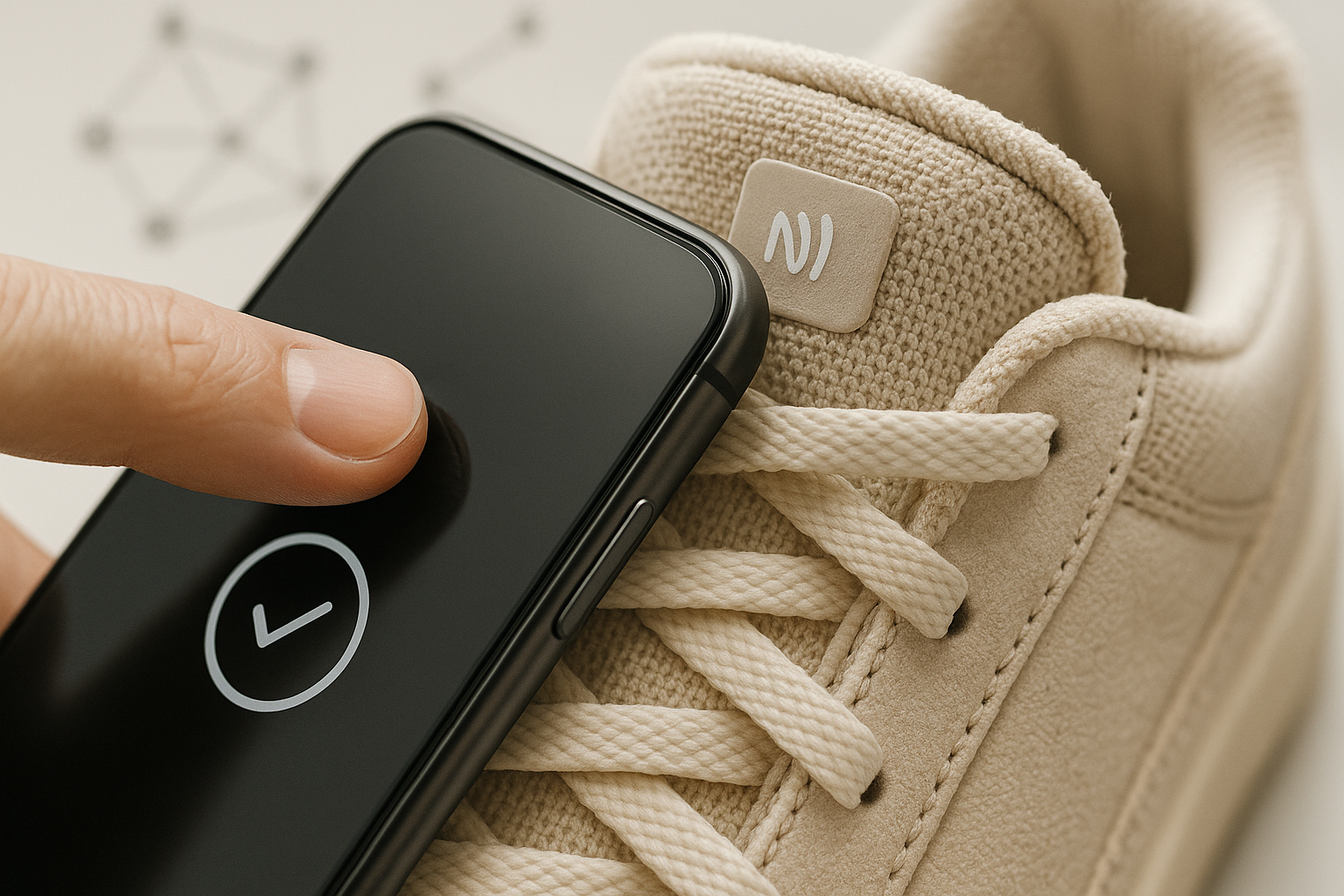
“Phygitals” pair a physical item with a digital twin. An NFC tag or secure QR links the object to an NFT, making authenticity checks and resale provenance easier. For sneakers, watches, or memorabilia, the scan reveals origin, materials, and custody; if the tag is tamper-evident, it also flags removed or swapped components. Brands can add perks: token-gated drops, care guides, or repair histories. The main risk is tag cloning; mitigate with cryptographic tags, secure manufacturing processes, and server-side anomaly detection. The win is lifecycle services—items become updatable products, not static goods.
How to do it
- Embed secure chips: Use NFC tags with cryptographic challenge-response.
- Mint at manufacture: Create NFTs at the end of line; assign to distributor wallets.
- Resale flow: Burn and re-mint on verified inspection to prevent counterfeit recycling.
- Service history: Append repair events to the NFT’s metadata.
Mini case
A limited sneaker run of 5,000 pairs ships with cryptographic NFCs. At resale, marketplace check-in verifies the chip and logs condition photos; if approved, the buyer receives the updated token and a care guide.
Synthesis: Phygitals turn products into living records, improving trust at purchase and making brand services stickier post-sale.
11. Smart Warranties, Receipts, and Product Passports
Post-purchase paperwork gets lost; NFTs can serve as durable, verifiable receipts, warranties, or product passports. When a customer buys a device, an NFT receipt anchors purchase details and links to a privacy-preserving record. Warranty claims become simpler: the wallet proves purchase date and ownership; repair centers update the token with work done. For B2B equipment, the passport can include maintenance schedules and parts provenance. The goal is to shrink friction and fraud in after-sales while giving customers a single “source of truth” they can export if they change email or move countries.
How to do it
- Issue at checkout: Create receipt NFTs that include hashed invoice details.
- Role separation: Keep owners able to transfer the device and its NFT; lock warranty NFTs if they should not trade independently.
- Redemption UX: Let service agents verify without holding custody; support email-to-wallet flows.
- Data design: Store personal data off-chain; keep only proofs and serials publicly visible.
Mini-checklist
- Standardize schemas across products.
- Publish a revocation policy for returns/refunds.
- Offer migration when customers change wallets.
Synthesis: Treat warranties and receipts as living records customers won’t lose and service teams can trust quickly.
12. Healthcare Data Consent and Access Logs
In healthcare, NFTs should not store sensitive records. Instead, they can represent consent tokens and audit pointers—who may access a dataset for what purpose and for how long. Patients hold verifiable credentials describing attributes (age range, condition categories) and grant scoped access via a token a provider can check. Systems append access events to a private log and anchor proofs on-chain to deter tampering. This pattern improves transparency for second opinions, cross-provider referrals, or research participation. It also respects privacy law by keeping protected health information (PHI) off-chain and revealing only necessary info.
Region notes
- EU/UK: Treat tokens as controllers/processors would; ensure lawful basis and minimize identifiers.
- US: Align with HIPAA; use business associate agreements and encrypt end-to-end.
- Global: Prefer consent receipts and revocation endpoints that don’t require blockchain knowledge to use.
Mini-checklist
- Put PHI off-chain; anchor hashes or proofs only.
- Use VCs for attributes; keep NFTs non-transferable to prevent market abuse.
- Provide non-wallet fallbacks for emergencies (break-glass procedures).
Synthesis: Use NFTs as consent and audit signals, not as medical record containers; privacy-by-design is non-negotiable.
13. Carbon Credits and Environmental Instruments
Voluntary carbon markets aim to make credits traceable and high-integrity. NFTs (or NFT-like non-fungible records) can represent unique credits with metadata about project type, methodology, and retirement. Oversight bodies have introduced core carbon principles and programs have pursued alignment to raise quality; at the same time, critics and officials underline that credits must not replace real emissions cuts. For buyers and registries, on-chain instruments can enforce single-use retirement, transparent lineage, and token-gated claims about impact. The priority is integrity: provenance, double-count prevention, and conservative accounting.
How to do it
- One credit, one token: Non-fungible records with serial numbers and retirement status.
- Bridging: Lock off-chain serials before minting to avoid duplicates.
- Retirement proofs: Burn and emit an immutable retirement note; expose via API.
- Guardrails: Disallow “avoidance” claims where standards disfavor them; prefer removal or verified reduction projects.
Mini case
A marketplace mints NFTs only after a registry locks the underlying serial; when buyers retire a token, the system burns it and posts a signed retirement certificate tying purchaser, project, and quantity.
Synthesis: NFTs can upgrade transparency and tamper-resistance—but integrity rules and conservative claims must come first.
14. Software Licenses and IoT Device Identity
Software licenses often boil down to “who can use what, where, for how long.” NFTs encapsulate these rights cleanly, and devices can prove ownership by signing challenges. In IoT, each device can hold a DID and reference an NFT license or certificate, letting manufacturers revoke compromised keys or authorize maintenance securely. For end users, licenses become portable across machines; for vendors, audits are simpler and offline devices can later sync entitlement changes. The same primitives support community-auditable firmware releases: sign hashes, anchor them, and give operators an easy way to check provenance before installing.
Tools/Patterns
- DIDs: Device identifiers that don’t depend on a single vendor directory.
- Non-transferable keys: EIP-5192 for accounts that should hold but not resell licenses.
- Time-bound use: ERC-4907 for rentals or trials.
Mini case
A robotics firm ships controllers that verify an NFT license at boot via a local cache. If the license is revoked, controllers continue for a grace period, then refuse non-safety-critical functions until a valid entitlement appears.
Synthesis: Licenses and device identities map naturally to tokenized rights—portable for users, auditable for vendors, and safer for fleets.
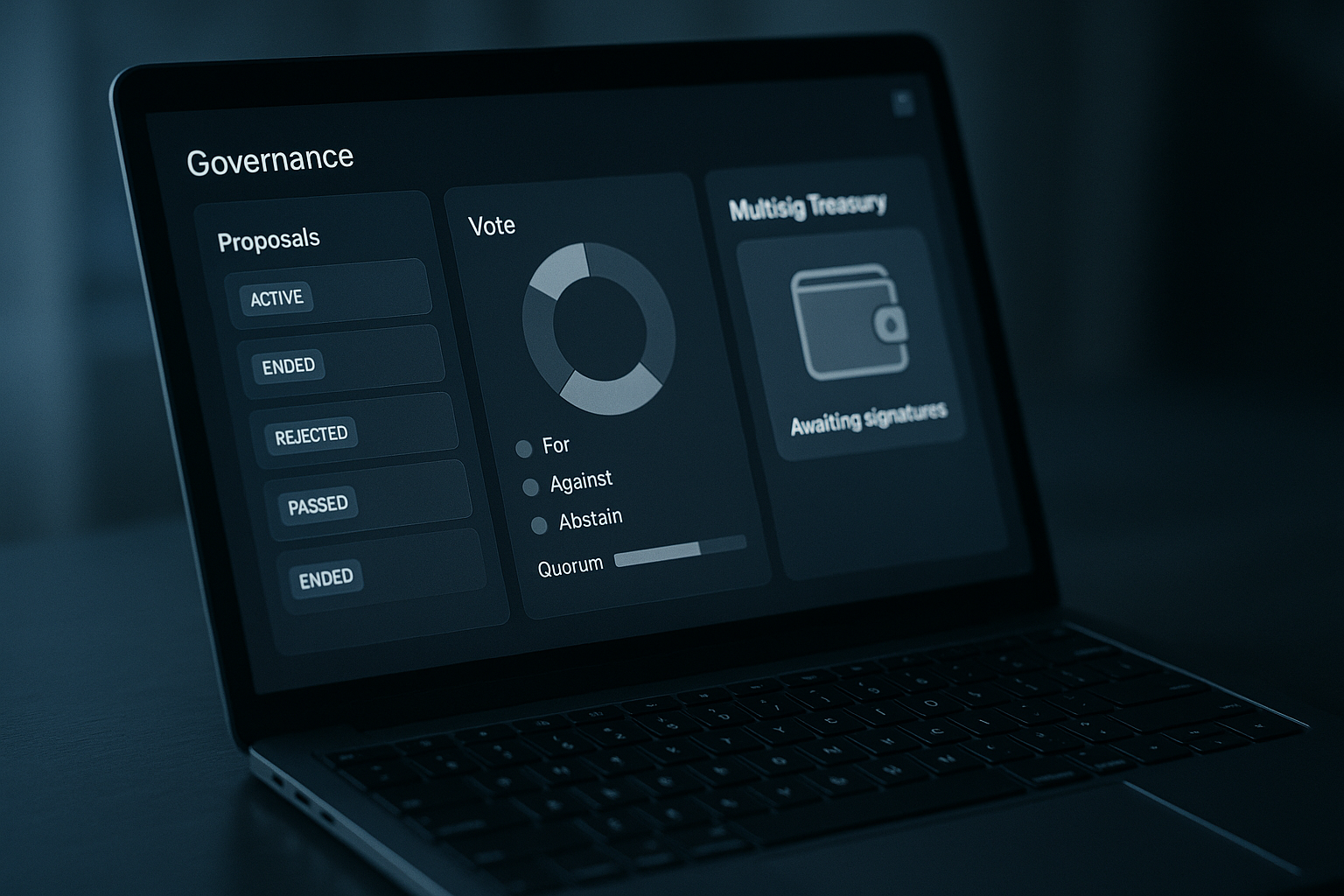
15. Community Governance Passes and Fundraising
Communities use NFTs as governance passes—proof you belong and can participate. Rights range from voting to proposal creation to treasury-gated grants. For fundraising, a compliant wrapper can tie an NFT to membership rights while keeping financial returns separate or out entirely. The architecture decouples social capital (the pass) from financial instruments (if any), making programs flexible. The design risks are concentration (a few wallets dominate), sybil attacks, and unclear expectations around perks or longevity.
How to do it
- Define scope: Voting, proposal rights, access, or perks; avoid implying returns if none exist.
- Sybil resistance: Pair with VCs or proof-of-personhood checks for one-member-one-vote decisions.
- Delegation: Allow vote delegation for busy contributors.
- Compliance: If tokens tie to revenue, use licensed venues and disclosures.
Numbers & guardrails
- Caps: Consider capping voting power per wallet or using quadratic voting to soften concentration.
- Longevity: Publish a clear roadmap for renewals and treasury transparency.
Synthesis: Governance NFTs work when rights are explicit, sybil resistance is addressed, and fundraising (if any) follows the rules.
Conclusion
The practical promise of NFTs isn’t pictures—it’s programmable rights you can verify. Across gaming, real estate, identity, tickets, loyalty, media, supply chains, credentials, and more, the same pattern repeats: choose the correct standard, minimize on-chain personal data, mirror legal reality, and design for ordinary users who neither know nor care about blockchain internals. When you do, you get durable records, interoperable access, cleaner audits, and fewer disputes. Your next step is small: pick one workflow—like event access, warranty tracking, or credential verification—and pilot it with a tight scope, clear metrics, and a fallback for non-crypto users. Done right, NFTs become invisible infrastructure that makes everyday experiences smoother, safer, and more portable. Start with one high-friction process, ship a pilot, measure outcomes, and iterate.
FAQs
1) What’s the difference between ERC-721 and ERC-1155 in real projects?
ERC-721 suits one-of-one items—titles, unique avatars, single tickets. ERC-1155 shines when you batch many IDs and need both fungible and non-fungible inventory (e.g., 5,000 general-admission tickets, 50 VIP passes, 12 unique backstage experiences) under one contract. That saves gas, simplifies drops, and reduces indexer strain. Many teams use both: 1155 for bulk, 721 for prestige items.
2) Are royalties “built in” to NFTs?
Royalties are not magic money; they’re a signal. EIP-2981 standardizes how contracts expose royalty info, but marketplaces choose whether and how to enforce it. For B2B deals (licenses, subscriptions), handle payouts in contracts or off-chain invoicing. For consumer resales, assume royalties may vary by venue and plan accordingly.
3) Can I store personal data or medical records in an NFT?
Don’t. Keep sensitive data off-chain in systems designed for privacy and regulation. Use the token as a pointer and consent/audit signal. If you must prove attributes (age, license status), use Verifiable Credentials and show only what’s required.
4) How do NFT tickets stop fraud?
They bind a specific ticket to a keypair and make duplicates easy to detect. Organizers can disable transfers near showtime, add price caps, and airdrop perks to verified holders. Large events have demonstrated mobile app distribution at scale, which is what matters for usability.
5) What’s a “soulbound” token and when should I use it?
It’s a non-transferable token. Use it sparingly for credentials or badges that should not be tradable (e.g., safety certifications). The minimal interface (EIP-5192) provides an on/off lock state; combine it with VCs for the actual claim and revocation logic.
6) How do I link a real product to an NFT securely?
Use cryptographic NFC chips or secure QR with anti-copy measures, manufacture-time injection of keys, and server-side anomaly detection. Publish a clear re-mint process after verified inspection to prevent counterfeit recycling. For consumer trust, show provenance and care info at scan. Forbes
7) Do NFTs “fix” carbon markets?
They improve transparency around issuance, ownership, and retirement, but market integrity depends on standards, methodologies, and honest accounting. Oversight bodies are tightening quality bars; treat NFTs as infrastructure, not a substitute for real emissions cuts.
8) Is ENS only for crypto natives?
No. Names reduce errors for everyone and double as profiles. Teams can use libraries to resolve names in apps, and non-technical staff can update records via web dashboards. It’s a low-risk way to make wallets and contacts human-readable.
9) What if a user loses their wallet that holds a diploma or ticket?
Plan recovery: email-based re-issuance after identity checks, custodial accounts with 2-factor, or social recovery. For credentials, keep the authoritative VC re-issuable; for tickets, provide on-site fallback like NFC wristbands or desk reprints.
10) Are real estate NFTs legal everywhere?
Property law is local. Some registries are actively piloting tokenization, while others still require paper filings. The workable path is to wrap real-world ownership in a legally recognized entity and keep registry updates authoritative, with tokens mirroring that reality. Consult local counsel.
References
- “ERC-721: Non-Fungible Token Standard.” Ethereum Improvement Proposals. 2018. https://eips.ethereum.org/EIPS/eip-721
- “ERC-1155: Multi Token Standard.” Ethereum Improvement Proposals. 2018. https://eips.ethereum.org/EIPS/eip-1155
- “ERC-2981: NFT Royalty Standard.” Ethereum Improvement Proposals. 2020. https://eips.ethereum.org/EIPS/eip-2981
- “ERC-4907: Rental NFT, an Extension of EIP-721.” Ethereum Improvement Proposals. 2022. https://eips.ethereum.org/EIPS/eip-4907
- “ERC-5192: Minimal Soulbound NFTs.” Ethereum Improvement Proposals. 2022. https://eips.ethereum.org/EIPS/eip-5192
- “Verifiable Credentials Data Model v2.0.” World Wide Web Consortium (W3C). 2025. https://www.w3.org/TR/vc-data-model-2.0/
- “Decentralized Identifiers (DIDs) v1.0.” World Wide Web Consortium (W3C). https://www.w3.org/TR/did-core/
- “ENS Documentation.” Ethereum Name Service. https://docs.ens.domains/
- “IBM Food Trust—How to use App Connect with Food Trust.” IBM. https://www.ibm.com/docs/en/app-connect/12.0.x
- “Applying GS1 Standards for Supply Chain Visibility in Blockchain Applications.” GS1 US. https://www.gs1us.org/industries-and-insights/by-topic/supply-chain-visibility/applying-standards-blockchain-applications
- “UEFA Super Cup tickets successfully distributed to mobile devices.” UEFA. 2018. https://www.uefa.com/news-media/news/0248-0f8e628e94c0-440fe0d61096-1000–uefa-super-cup-tickets-successfully-distributed-to-mobile-p/
- “Dubai Land Department—Real Estate Tokenization.” Government of Dubai. https://dubailand.gov.ae/en/eservices/real-estate-tokenization/
- “Carbon credit standards approval extended to 98% of market.” Reuters. 2024. https://www.reuters.com/sustainability/climate-energy/carbon-credit-standards-approval-extended-98-market-2024-05-02/
- “Verifiable Credentials Overview.” World Wide Web Consortium (W3C). 2025. https://www.w3.org/TR/vc-overview/