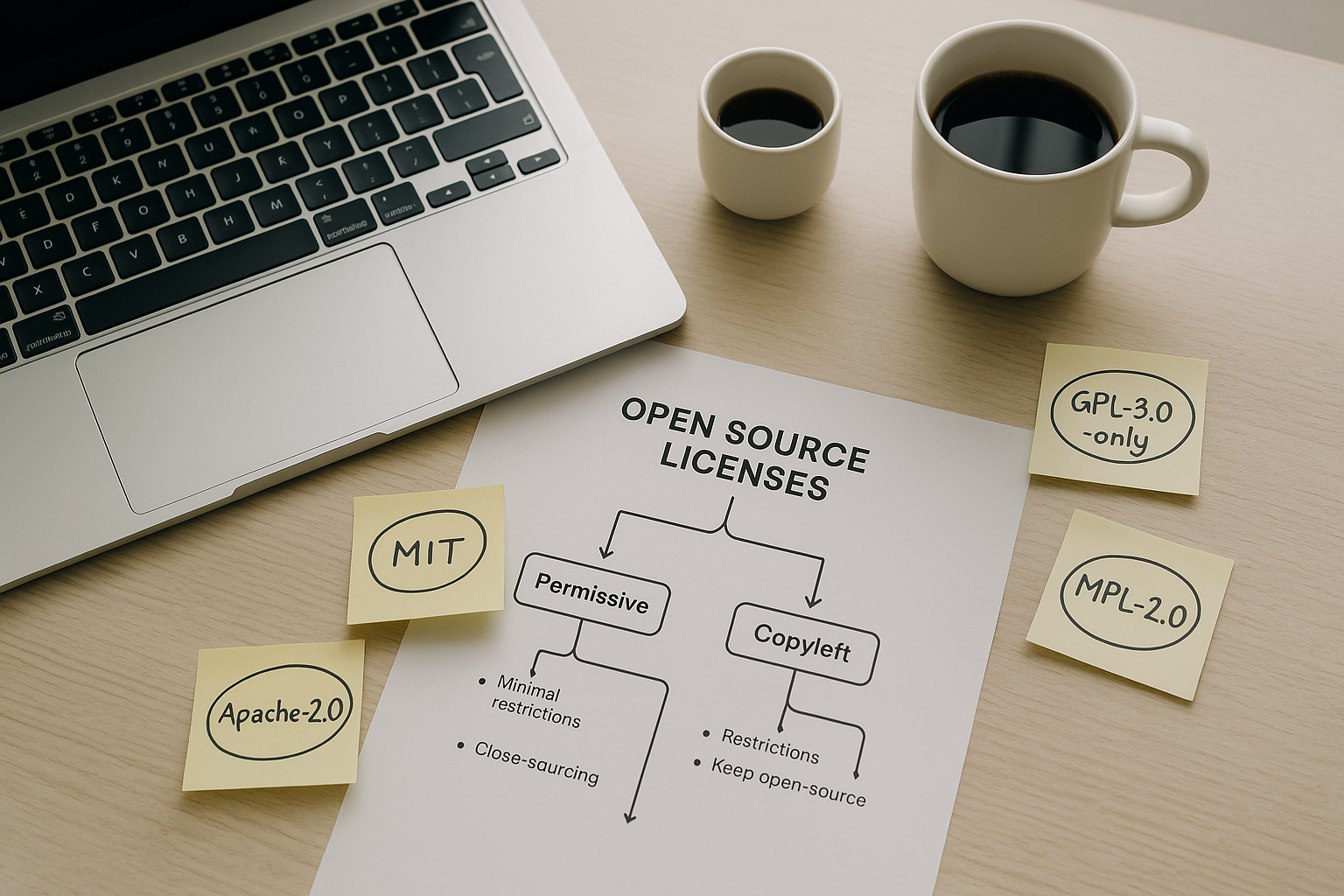
Choosing an open source license is a strategic decision that shapes how others use, modify, and share your work. An open source license is a legal permission set that grants rights to use, study, change, and redistribute your code under stated conditions. The “right” license matches your goals (adoption, collaboration, business model) with obligations you can honor (attribution, disclosure, patents). Because licenses are legal instruments, this article is general information, not legal advice; consult qualified counsel for decisions with material risk. By the end, you’ll have a practical workflow you can apply to any repository and a short list of licenses that fit your intent without surprises.
Definition up front: An open source license tells others what they may do with your code—and what they must do in return (such as keeping notices, sharing modifications, or offering patent rights). The best choice balances your desire for reach and contribution with your tolerance for obligations and downstream constraints.
Quick-glance steps you’ll follow:
- Clarify goals, audience, and distribution model.
- Map every dependency and its license.
- Decide where you sit on the permissive↔copyleft spectrum.
- Understand copyleft “scope” (weak, file-level, network).
- Consider patents, trademarks, and contributor grants.
- Estimate your attribution and notice workload.
- Pick an OSI-approved license and an SPDX identifier.
- Set contribution rules (CLA vs DCO; inbound=outbound).
- Apply the license correctly and automate compliance.
1. Define Goals, Distribution, and Risk Appetite
Start by making your intentions explicit: what outcome do you want the license to produce, and what obligations are you prepared to carry? If your primary goal is mass adoption, you’ll lean toward a permissive license that minimizes obligations on users. If your goal is to ensure improvements remain open, you’ll consider copyleft terms that require sharing modifications. Your distribution model matters just as much: a library embedded in third-party products triggers different obligations than a hosted service that never ships code, and a developer tool has different community expectations than a consumer app. Clarify whether you anticipate commercial add-ons, dual licensing, or partnerships that depend on allowing proprietary linking. Write down your constraints (for example, “avoid patent retaliation clauses” or “must keep NOTICE files simple”) because these become the criteria by which you choose among acceptable options. This framing keeps the later steps grounded in outcomes rather than brand recognition or misconceptions about “popularity.”
Why it matters
- A license that fights your goals creates friction—fewer adopters, fewer contributions, or blocked deals.
- Being explicit about distribution (library vs app vs SaaS) avoids surprises with copyleft scope.
- Many future debates (“Can partner X integrate?”) are answered by your initial intent statement.
Mini-checklist
- Audience: Individual devs, startups, enterprises?
- Distribution: Library, CLI, embedded, desktop, mobile, SaaS?
- Openness objective: Adoption, reciprocity, or both?
- Business plans: Paid editions, cloud offering, OEM deals?
- Constraints: Corporate policy, export controls, trademarks?
Synthesis: With goals and risk appetite written down, you’ll evaluate licenses on how well they enable those outcomes while keeping the operational burden acceptable.
2. Inventory Dependencies and Check Compatibility
Before you can pick your own license, you need to understand the licenses you’re already bound by through dependencies. Every package, library, snippet, or asset you include imposes terms; some are trivial (keep a copyright notice), while others are conditional (share modifications to certain files). Build a simple bill of materials listing each dependency, its version, and its license (e.g., MIT, Apache-2.0, BSD-3-Clause, MPL-2.0, EPL-2.0, GPL-3.0-only, LGPL-3.0-only, AGPL-3.0-only). Confirm whether any dependency has “additional terms” (a NOTICE file with extra attribution, a separate patent grant, or exceptions). Check whether your intended outbound license is compatible with all inbound licenses; “compatibility” here means your combined distribution can obey all obligations simultaneously. Remember that compatibility differs by direction: code under permissive terms typically can be included in copyleft projects, but the reverse is restricted unless the copyleft license allows it.
How to do it
- Use tooling (e.g., FOSSA, Snyk Open Source, ClearlyDefined, ScanCode) to extract license metadata.
- Manually validate edge cases (custom headers, exceptions, multi-license options like “EPL-2.0 OR GPL-2.0-only”).
- Note network-use clauses (AGPL) if you operate a service.
- Flag any “source-available” or non-OSI licenses; treat them as distinct from open source.
- Record SPDX identifiers to standardize names (e.g., Apache-2.0, not “Apache 2”).
Numbers & guardrails
- Aim for 100% of shipped artifacts to have a known SPDX license ID.
- Keep a single source of truth (a THIRD_PARTY_NOTICES or DEPENDENCIES.md) with ≤ 1 place to update.
- If ≥1 dependency imposes copyleft terms that you cannot accept, consider alternatives or architectural boundaries (plugins, IPC).
Synthesis: This inventory reveals non-starters early and tells you which licenses will “fit” without contortions, preventing costly redesigns or compliance clean-up later.
3. Choose Your Position: Permissive vs Copyleft
The core strategic decision is how strongly you want to require downstream sharing. Permissive licenses (MIT, BSD-2-Clause, BSD-3-Clause, Apache-2.0) allow nearly any reuse so long as attribution and notices are preserved; they maximize adoption and commercial friendliness. Copyleft licenses (GPL family, AGPL, LGPL, MPL) require that modifications or certain forms of combining code remain under the same or compatible license, preserving openness at the cost of tighter obligations. There is no universally “better” choice—only a better fit for your goals. If you want a broad ecosystem, extensions, and vendor uptake, permissive is usually the simplest path. If you want improvements to flow back and you can accept constraints on proprietary use, copyleft aligns your incentives with contributors’.
Quick comparison (small table)
| Aspect | Permissive (MIT/Apache/BSD) | Copyleft (GPL/AGPL/LGPL/MPL) |
|---|---|---|
| Adoption friction | Low | Medium to high |
| Reciprocity | Optional (via norms) | Required by terms |
| Patent grant | Apache-2.0 includes it | Varies by license |
| Suitable for libraries | Very | Depends on scope |
Numbers & guardrails
- If your goal is maximize adoption, permissive licenses typically reduce due-diligence cycles by 1–2 review steps.
- If your goal is ensure reciprocity, expect ≥1 extra compliance step (source disclosure, offer for source, or NOTICE curation).
- Apache-2.0’s explicit patent grant is valuable in patent-sensitive ecosystems.
Synthesis: Decide which trade-off you value more—reach with minimal friction, or guaranteed sharing—then keep that North Star in view as you consider specific licenses.
4. Understand Copyleft Scope (Weak, File-Level, Network)
If you lean copyleft, the next choice is scope—what exactly triggers the obligation to share source and under what boundaries. Strong copyleft like GPL-3.0-only applies when your program is combined into a single work, often interpreted to cover static or dynamic linking. Weak copyleft like LGPL-3.0-only generally allows linking from proprietary programs so long as modifications to the LGPL’d components themselves are shared and relinking remains possible. File-level copyleft like MPL-2.0 requires sharing modifications to the files you change under MPL, while allowing larger works under different licenses. Network copyleft like AGPL-3.0-only adds obligations when users interact with the software over a network, closing the “service as a loophole” gap. Understanding scope prevents surprises when your project is used as a library, embedded in firmware, or offered as a hosted service.
Common mistakes
- Assuming “dynamic linking is always OK” without considering license text and jurisdiction.
- Forgetting that AGPL obligations can trigger for hosted services even when you don’t distribute binaries.
- Mixing incompatible copyleft levels in a single binary without a clear separation layer.
- Overlooking that MPL obligations attach at the file level, not the whole program.
Mini case
A team ships a server under AGPL-3.0-only to ensure modifications stay open when others host it. They also provide an API client library under Apache-2.0 to encourage adoption by closed-source apps. This dual choice balances reciprocity for the server with frictionless uptake for clients.
Synthesis: Pick the copyleft scope that enforces your reciprocity goals where it actually matters (server vs client vs library) without over-restricting legitimate uses you want to encourage.
5. Address Patents, Trademarks, and Contributor Rights
Even if copyright dominates open source discussions, patents and trademarks influence risk. Licenses like Apache-2.0 include an explicit patent grant and a patent retaliation clause (revoking rights if a contributor sues over patents), which many companies prefer. The GPL family also addresses patents, but the language and implications differ; read the terms, especially around “conveying” and “additional permissions.” If you or your contributors own relevant patents, decide whether you’re comfortable granting rights to users; many communities expect this. Trademarks (project names, logos) are generally separate from the code license; reserve them if you plan certification programs or brand standards. Finally, remember contributor rights: without clear inbound terms, you might lack the legal scope to relicense or defend the project.
Tools/Examples
- Patent-aware pick: If you need permissive terms and a patent grant, Apache-2.0 is a common default.
- Trademarks: Keep a separate TRADEMARKS.md or policy; your code license rarely grants brand use.
- Inbound rights: State whether contributions are under inbound=outbound (same as project license) or a CLA that grants broader rights.
Numbers & guardrails
- If you anticipate ≥1 commercial partnership, confirm your license includes a patent grant acceptable to enterprise legal teams.
- Use a single authoritative document describing trademark use; avoid scattering brand rules across repos.
Synthesis: Decide upfront how you want to handle patents, brands, and contributor rights; the right combination de-risks adoption and keeps future licensing options open.
6. Estimate Attribution, NOTICE, and Disclosure Workload
Every license comes with operational obligations: keep notices, include the license text, and sometimes disclose source or offer relinkable objects. Under permissive licenses, the workload is typically maintaining a LICENSE file, preserving headers, and shipping a NOTICE file if required (Apache-2.0). Under copyleft, you may need to provide source code for corresponding files, include build scripts, or provide an offer to supply source on request; MPL-2.0 limits disclosure to modified files, while GPL can require offering the complete corresponding source for the covered work. Assess whether your team can realistically meet these obligations for every distribution channel (packages, containers, app stores, firmware updates). Underestimate this, and you risk non-compliance that erodes trust and delays releases.
Mini-checklist
- LICENSE: Full license text present and accurate.
- HEADERS: File headers where recommended by the license.
- NOTICE: Included and curated for Apache-2.0 projects and dependencies.
- SOURCE/OFFERS: If copyleft applies, publish or offer corresponding source as required.
- THIRD-PARTY: Keep a single THIRD_PARTY_NOTICES with dependency attributions.
Numbers & guardrails
- Budget 1–2 checklist items per release for NOTICE and dependency updates.
- For copyleft distributions, expect ≥1 extra packaging step (source bundle or link) per release.
- Keep duplicate notices to 0 by centralizing attribution in one maintained file.
Synthesis: Choose a license whose compliance workload you can operationalize consistently; obligations you can’t meet are liabilities, not values.
7. Pick an OSI-Approved License and Lock the SPDX Identifier
Now choose the concrete license. Favor OSI-approved licenses to align with community norms and corporate policies. If you want minimal friction, MIT or BSD-2/3-Clause are common and simple; if you want permissive plus a patent grant, pick Apache-2.0. For weak copyleft at the file level (ideal for libraries with contained reciprocity), consider MPL-2.0. For strong reciprocity across combined works, consider GPL-3.0-only or GPL-3.0-or-later; for library-style linking from proprietary programs, LGPL-3.0-only fits. For hosted-service reciprocity, AGPL-3.0-only ensures network-use modifications are shared. Once selected, record the SPDX identifier precisely (e.g., Apache-2.0, MIT, MPL-2.0) and avoid custom wording or mixing terms; “almost MIT” invites compliance errors.
How to do it
- Use the canonical license text; don’t edit terms or add clauses.
- Prefer the “-only” or “-or-later” form intentionally for GPL family depending on your upgrade policy.
- Add the SPDX tag to each source file header when feasible (e.g., // SPDX-License-Identifier: Apache-2.0).
- Include a canonical LICENSE file at the repo root.
Numbers & guardrails
- Keep to 1 primary license; if dual licensing, document clear boundaries.
- Use 1 SPDX ID across the codebase unless you intentionally multi-license submodules.
- Avoid non-OSI licenses if your goal is ecosystem adoption; many companies block them.
Synthesis: Pick a widely understood, OSI-approved license that matches your goals, and lock its SPDX identifier to remove ambiguity for users and tooling.
8. Set Contribution Policy: CLA vs DCO and Inbound=Outbound
Choosing a license is only half the story; you also need rules for contributions. A CLA (Contributor License Agreement) is a document contributors sign to grant you specific rights (often the right to relicense or enforce), sometimes assigning copyright or granting patent rights. A DCO (Developer Certificate of Origin) is a lighter-weight attestation attached to each commit stating the contributor has the right to submit the work under the project’s license. Many community projects choose DCO for simplicity and inclusiveness; companies running dual-license models often prefer CLAs to keep relicensing options open. Decide whether your project uses inbound=outbound (contributors license their code under the same terms you license the project) or a more expansive CLA. Publish the policy in CONTRIBUTING.md and automate checks in CI.
Tools/Examples
- DCO bot workflows in popular forges to enforce Signed-off-by lines.
- CLA Assistants that track signatures and link them to accounts.
- Inbound=Outbound policy statements that remove ambiguity and reassure contributors.
Numbers & guardrails
- If you foresee dual licensing or future relicensing, a CLA that grants relicensing rights is prudent.
- If community growth is paramount, minimize barriers: a DCO and clear inbound=outbound may reduce friction by 1 extra step compared to CLAs.
Synthesis: Adopt a contribution policy that supports your licensing strategy and community goals, then automate it so it’s effortless and consistent.
9. Apply the License Correctly and Automate Compliance
The final step is making the choice “real” in your repository and release process. Add the canonical license text as LICENSE at the root, include any required NOTICE, and add SPDX headers where recommended. Document how to comply in README.md (for example, where to find third-party attributions). If you distribute binaries or containers, build a job that outputs the list of included licenses and, for copyleft projects, publishes a source bundle or link alongside each release. Integrate a scanner into CI to alert on new dependencies with incompatible licenses or missing metadata. If your use case evolves (e.g., you introduce a cloud service or a proprietary plugin), revisit whether your chosen license still matches your goals and whether a dual-license or additional component license is warranted.
Mini-checklist
- Files: LICENSE, NOTICE (if needed), COPYRIGHT, CONTRIBUTING.md.
- Headers: SPDX identifiers in source files as appropriate.
- CI: License scanner and notice generator on pull requests and releases.
- Docs: Clear instructions for users on attribution and source retrieval (if applicable).
- Review: Periodic check that distribution channels include required materials.
Numbers & guardrails
- Treat 0 missing notices as the standard; scanners should block release if any are missing.
- Re-run license compliance on every release; drift accumulates silently otherwise.
- Keep the compliance checklist to ≤10 steps to ensure it’s routinely followed.
Synthesis: Operationalizing your license choice protects your intent, simplifies audits, and signals professionalism to users and partners.
Conclusion
Picking the right open source license is not about memorizing acronyms; it’s about aligning legal terms with the outcomes you want and the obligations you can honor. By clarifying goals, mapping dependencies, deciding on permissive versus copyleft, understanding copyleft scope, and accounting for patents and notices, you create a decision you can stand behind. Recording the choice with a precise SPDX identifier, setting contribution rules that match your strategy, and automating compliance turns a one-time selection into a sustainable practice. The result is a project others can trust and adopt quickly, and a foundation that supports collaboration without accidental lock-in or risk. Apply the nine steps, ship with confidence, and invite contributions—your license will do the rest. Ready to put this into practice? Pick your target license, add it to your repo, and run a scan before your next release.
FAQs
What is the difference between permissive and copyleft licenses?
Permissive licenses (such as MIT, BSD, Apache-2.0) allow broad reuse with minimal obligations, mainly attribution and notice preservation. Copyleft licenses (such as GPL, AGPL, LGPL, MPL) require that certain forms of modification or combination remain under the same or compatible terms, ensuring that improvements stay open. Choose permissive when you prioritize frictionless adoption; choose copyleft when you prioritize reciprocity. The right pick reflects your goals and the kind of ecosystem you want to cultivate.
Which open source license should I use for a library?
For libraries intended for widespread integration, permissive licenses like MIT or Apache-2.0 minimize adoption barriers. If you want modifications to the library itself to stay open while allowing proprietary linking, weak or file-level copyleft (LGPL-3.0-only or MPL-2.0) can be a good fit. Consider your dependency licenses and any patent concerns; if patent grants matter in your ecosystem, Apache-2.0 is often preferred over MIT.
Does AGPL force me to release my entire application?
AGPL requires offering the modified AGPL-covered program’s source code when users interact with it over a network. It does not automatically apply to unrelated, separate programs on the same server, but combinations or derivatives can trigger obligations. If you run a hosted service based on an AGPL server and modify it, you should be prepared to provide the corresponding source to users of that service.
Is GPL compatible with MIT or Apache-2.0?
MIT-licensed code can generally be included in GPL-licensed projects because MIT’s permissive terms don’t conflict with GPL’s requirements. Apache-2.0 is also compatible with GPL-3.0, but not with GPL-2.0 in many interpretations due to Apache’s explicit patent terms and conditions. Always verify the specific license versions and consult authoritative guidance when in doubt.
What is an SPDX identifier and why should I use it?
An SPDX identifier is a standardized short name for a license (for example, Apache-2.0, MIT, GPL-3.0-only). Using SPDX IDs in your LICENSE file and source headers removes ambiguity, enables automated tooling to detect licenses reliably, and simplifies audits and attribution. It’s a low-effort practice that pays dividends in compliance and clarity.
Do I need a CLA, or is a DCO enough?
It depends on your goals. A DCO keeps contribution overhead low and reassures contributors that their patches are accepted under the project’s existing license. A CLA can grant you rights to relicense or enforce more flexibly, which some companies need for dual-license models or defensive actions. If you do use a CLA, make the process transparent and quick; if you want maximum inclusivity, a DCO with inbound=outbound licensing is often sufficient.
How do patents affect my license choice?
If your project sits in a patent-sensitive space, choosing a license with an explicit patent grant (like Apache-2.0) can reduce legal uncertainty for adopters. Patent retaliation clauses deter contributors from asserting patents against users of the software. If contributors hold relevant patents, clarify in your contribution policy that they grant necessary rights; otherwise, adopters may hesitate to use the project at scale.
Can I change my project’s license later?
Relicensing is possible but can be complex. If you’re the sole copyright holder, you can change the license by updating the repository and release terms. If there are many contributors, you either need their consent (or a CLA that granted you relicensing rights) or you must limit the change to code you exclusively own. Plan ahead by choosing contribution terms that match your long-term strategy.
What’s the simplest license for commercial use?
Permissive licenses like MIT and BSD-2/3-Clause are straightforward for commercial adopters because they impose minimal obligations and no copyleft. Apache-2.0 adds an explicit patent grant, which many enterprises appreciate. If your business model thrives on low friction and broad embedding, these licenses are strong defaults. Just be sure to maintain attributions and notices as required.
Is “source-available” the same as open source?
No. “Source-available” licenses allow users to view the code but often impose restrictions that violate open source criteria (for example, limits on commercial use or field of endeavor). They can be valid choices for some business models, but they are not OSI-approved open source licenses. If ecosystem adoption and compatibility matter, prefer OSI-approved options.
References
- Open Source Definition and License List — Open Source Initiative — https://opensource.org/licenses
- Choose a License (License Picker and Explanations) — GitHub — https://choosealicense.com
- Apache License, Version 2.0 (Text and FAQ) — The Apache Software Foundation — https://www.apache.org/licenses
- GNU Licenses and FAQs — Free Software Foundation — https://www.gnu.org/licenses
- SPDX License List and Identifiers — The Linux Foundation (SPDX) — https://spdx.org/licenses
- Mozilla Public License 2.0 and FAQ — Mozilla — https://www.mozilla.org/MPL/2.0
- Eclipse Public License and FAQ — Eclipse Foundation — https://www.eclipse.org/legal/epl-2.0
- Developer Certificate of Origin — The Linux Foundation — https://developercertificate.org
- ClearlyDefined (License Data) — ClearlyDefined — https://clearlydefined.io
- ScanCode Toolkit (License and Package Scanning) — AboutCode — https://scancode-toolkit.readthedocs.io