Medical Disclaimer: The information provided in this article is for educational and informational purposes only and is not intended as medical advice. Always consult with a qualified healthcare provider or geriatric specialist before integrating robotic assistive devices into a care plan for a senior.
As of March 2026, the global landscape of elder care is undergoing a seismic shift. We are no longer discussing “the future” of robotics in healthcare; we are living in it. With the “Silver Tsunami”—the rapid increase in the population over age 65—reaching its peak, traditional caregiving structures are stretched to their limits. Healthcare robots for seniors have emerged not as replacements for human touch, but as essential tools to bridge the gap between independence and safety.
In this deep dive, we explore how assistive systems—ranging from robotic exoskeletons that restore mobility to AI-driven companions that combat loneliness—are redefining what it means to age with dignity.
Key Takeaways
- Autonomy Reclaimed: Assistive robots enable seniors to perform Activities of Daily Living (ADLs) without constant human supervision.
- Mental Well-being: Social robots like ElliQ and PARO are clinically proven to reduce cortisol levels and alleviate feelings of isolation.
- Safety & Prevention: Advanced sensors and fall-detection algorithms provide 24/7 monitoring that is less intrusive than traditional cameras.
- Caregiver Support: Robotics alleviate the physical strain on professional and family caregivers, reducing burnout and injury.
Who This Is For
This guide is designed for family caregivers looking for home solutions, healthcare administrators planning the next generation of assisted living facilities, and seniors themselves who want to understand how technology can help them stay in their homes longer (known as “aging in place”).
1. The Demographic Necessity: Why We Need Healthcare Robots
To understand the rise of healthcare robots for seniors, we must first look at the demographic data. As of 2026, the ratio of potential caregivers to seniors has dropped to historic lows in developed nations like Japan, Germany, and the United States.
The “Care Gap” is the primary driver of innovation. Human caregivers are susceptible to physical injury (particularly back strain from lifting patients) and emotional burnout. Robots, conversely, can perform repetitive tasks, monitor vitals 24/7, and provide physical support without fatigue. This transition is less about replacing humans and more about task delegation—allowing humans to focus on the emotional and complex aspects of care while robots handle the mechanical and routine.
2. Categories of Assistive Robotic Systems
Healthcare robotics is not a monolith. The technology is categorized based on the specific problem it solves for the aging population.
Physical Assistance and Mobility
Mobility is the cornerstone of independence. When a senior loses the ability to move freely, their mental and physical health often declines rapidly.
- Robotic Exoskeletons: These wearable devices, such as the Cyberdyne HAL (Hybrid Assistive Limb), use bio-electrical signals from the user’s skin to assist in walking. They are used both for rehabilitation and as long-term mobility aids.
- Smart Walkers and Wheelchairs: These are not your standard walkers. They utilize LiDAR and computer vision to navigate obstacles, provide power-assisted uphill climbs, and even offer automatic braking on descents.
- Transfer Robots: Devices like the Robear are designed to lift patients from a bed to a wheelchair, a task that frequently causes injuries to human nurses.
Social and Emotional Companionship
Isolation is often called the “silent killer” of the elderly. Social robots are designed to provide interaction, remind users of appointments, and facilitate communication with family.
- Companion Pets: The PARO robotic seal is perhaps the most famous example. Used extensively in dementia wards, it responds to touch and sound, providing the therapeutic benefits of a real pet without the maintenance.
- Proactive AI Companions: ElliQ by Intuition Robotics acts as a “sidekick” for happy aging. It initiates conversations, suggests activities, and uses AI to learn the user’s personality and preferences.
- Telepresence Robots: Robots like Ohmni allow family members to “drive” a robot through a senior’s home, providing a more presence-based interaction than a simple FaceTime call.
ADL Support and Medication Management
Activities of Daily Living (ADLs) include eating, bathing, and taking medication. Robots are now sophisticated enough to assist with these granular tasks.
- Robotic Arms for Feeding: For seniors with tremors or limited upper-body mobility (e.g., Parkinson’s or ALS), robotic arms can help them eat independently.
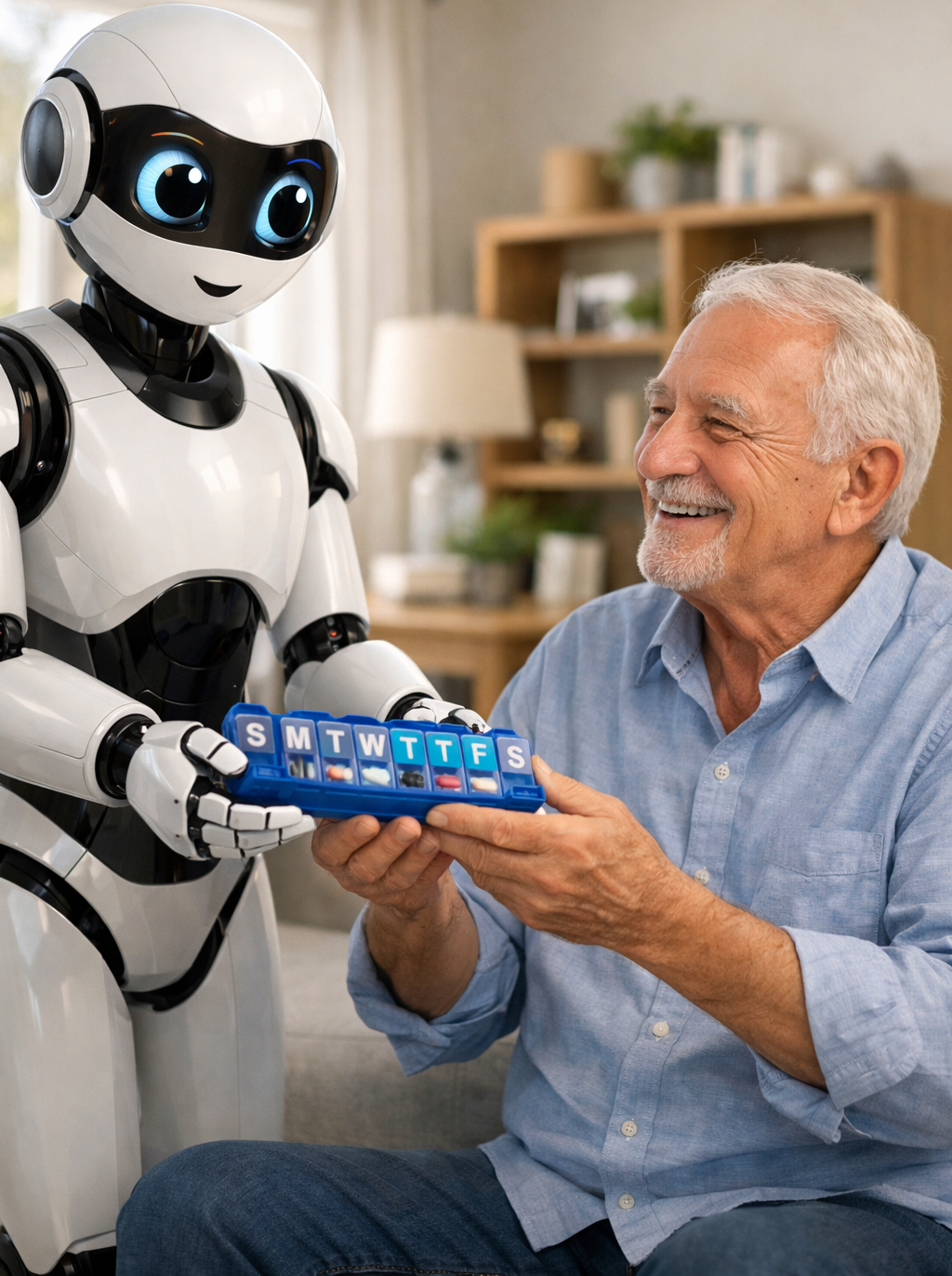
- Automated Medication Dispensers: These systems use facial recognition to ensure the right person is taking the right pill at the right time, alerting caregivers if a dose is missed.
3. The Role of AI and Computer Vision in 2026
The “brain” of modern healthcare robots for seniors is powered by advanced Artificial Intelligence. In 2026, we have moved past simple programmed responses to Adaptive Learning.
Fall Detection and Prevention
Falls are the leading cause of injury-related deaths among seniors. Traditional pendants require the user to be conscious and able to press a button. Modern healthcare robots use Computer Vision and Pose Estimation to identify when a person has fallen.
How it works: The robot’s sensors scan the room for “anomalous orientations.” If it detects a user on the floor, it can approach them, ask if they are hurt, and automatically trigger an emergency call while providing a video feed to responders.
Cognitive Assistance for Dementia
For those with early-stage Alzheimer’s or dementia, robots act as an external memory. They can guide a user through the steps of making tea or remind them where they placed their glasses, reducing the “agitation” that often comes with memory loss.
4. Comparison of Popular Healthcare Robots (2026)
| Robot Name | Primary Function | Best For | Key Feature |
| ElliQ 3 | Social Companion | Loneliness / Memory | Proactive conversation AI |
| PARO | Therapeutic Tool | Dementia / Stress | Bio-feedback haptic sensors |
| Moxi | Logistics / Nursing | Hospital settings | Fetches supplies / Lab runs |
| Labrador Caddie | Physical Support | Home mobility | Carries items / Height adjustable |
| Aeolus Robot | Multi-purpose | Home care | Can use a vacuum or open doors |
5. Practical Implementation: How to Choose the Right System
Choosing a healthcare robot for a senior is a significant decision that involves balancing budget, technical literacy, and the specific needs of the individual.
Step 1: Assess the Primary Need
Do not buy a “do-it-all” robot if the only issue is medication adherence. Identify if the need is Physical (lifting/walking), Cognitive (reminders/dementia), or Social (isolation).
Step 2: Evaluate Home Infrastructure
Most modern robots require stable Wi-Fi and enough floor space to navigate. A cluttered home can be a “minefield” for a robot’s sensors. Consider “robot-proofing” the home by removing thick rugs and ensuring doorways are wide enough for mobility units.
Step 3: The “Acceptance” Factor
The most advanced robot in the world is useless if the senior is afraid of it or finds it intrusive. Introduce the technology gradually. Many families find that “pet-like” robots (like PARO) have a higher acceptance rate than humanoid robots.
6. Common Mistakes When Using Healthcare Robots
Even with the best intentions, families and facilities often run into hurdles. Avoid these common pitfalls:
- The “Set and Forget” Fallacy: Robots are tools, not total replacements. They require software updates, battery charging, and occasional human intervention.
- Privacy Oversights: Many robots use cameras and microphones. It is vital to understand where that data is stored. Ensure the device complies with modern data protection standards (like the EU’s AI Act or HIPAA in the US).
- Ignoring the Learning Curve: While AI is getting better at understanding natural language, there is still a learning curve. Be patient during the “onboarding” phase.
- Over-reliance: Ensure the senior still has regular human contact. A robot should facilitate human connection (via video calls, for example), not replace it entirely.
7. The Ethical Landscape: Privacy, Consent, and “Dehumanization”
The integration of robotics into elder care brings up profound ethical questions. Critics often worry about the “dehumanization” of care—the idea that we are offloading our duty to care for our elders to machines.
Data Sovereignty
In 2026, robots are “data sponges.” They know when a senior wakes up, what they eat, and who they talk to. The ethical challenge lies in Informed Consent. Does a senior with cognitive decline have the capacity to consent to being monitored by an AI? Manufacturers are currently working on “Privacy-by-Design,” where processing happens locally on the robot (Edge Computing) rather than in the cloud.
The “Human Touch”
There is a consensus among gerontologists that robots should be used to automate tasks, not relationships. By letting a robot handle the “heavy lifting” or the “medication nagging,” the human caregiver can spend their limited time on meaningful conversation and emotional support.
8. The Economic Impact: Cost vs. Benefit
Healthcare robots for seniors are an investment. As of March 2026:
- Companion Robots: Range from $1,500 to $4,000, often with a monthly subscription for AI services.
- Mobility Exoskeletons: Can cost between $15,000 and $50,000, though many are now available via monthly leasing programs for home use.
- Facility Robots: Large-scale service robots for nursing homes are usually leased for $2,000–$5,000 per month.
While the upfront cost is high, the “cost of inaction” is often higher. If a robot prevents one hip fracture (which can cost $40,000+ in medical bills and lead to a permanent loss of independence), the device has paid for itself many times over.
9. Future Trends: What’s Next for 2027 and Beyond?
As we look toward the end of the decade, two major trends are emerging:
- Soft Robotics: Moving away from hard plastics and metals to “soft” materials that feel more human-like and are safer to interact with in close quarters.
- Universal Design Integration: Future homes will likely come “robot-ready,” with built-in charging docks and floor sensors integrated into the architecture itself.
- Brain-Computer Interfaces (BCI): Allowing seniors with severe physical limitations to control their assistive robots using only their thoughts.
Conclusion
The rise of healthcare robots for seniors marks a turning point in how society values and protects its aging members. These systems represent a synergy of compassion and engineering. By addressing the physical, social, and cognitive challenges of aging, assistive robots are not just “gadgets”—they are guardians of independence.
As we have seen, the successful integration of these tools requires a balanced approach. It requires recognizing the limitations of technology while embracing its potential to solve the “care gap.” For families and caregivers, the journey begins with education and a willingness to adapt. The goal is simple: to ensure that growing older doesn’t mean growing less “human” or less connected.
Would you like me to create a customized comparison guide for specific robot models currently available in your region?
FAQs
1. Will robots eventually replace human caregivers?
No. Current research and industry trends suggest that robots are “force multipliers.” They handle the repetitive, dangerous, or mundane tasks, allowing human caregivers to focus on emotional support, complex medical decision-making, and personal connection.
2. Are healthcare robots covered by insurance or Medicare?
As of 2026, coverage is expanding but remains inconsistent. Some high-end mobility aids and rehabilitation exoskeletons are covered under “Durable Medical Equipment” (DME) if prescribed by a doctor. Social companions are rarely covered by standard insurance but may be eligible for HSA/FSA spending.
3. How do these robots handle stairs?
Most current home robots are designed for single-level living. While companies like Boston Dynamics have developed stair-climbing capabilities, these are not yet common in affordable consumer-grade healthcare robots. “Aging in place” usually involves modifying the home to be on one level.
4. What happens if the robot malfunctions?
Most healthcare robots have “fail-safe” modes. For example, if a transfer robot loses power, it is designed to slowly lower the patient rather than dropping them. It is essential to have a manual backup plan for all critical care tasks.
5. Can these robots help with dementia-related “wandering”?
Yes. Many assistive systems can be integrated with smart home locks and sensors. If the robot detects the senior attempting to leave the house at an unusual hour, it can alert caregivers or use “redirection” techniques (talking to the senior) to keep them safe.
References
- World Health Organization (WHO): Global Report on Assistive Technology (2025-2026 Update).
- International Federation of Robotics (IFR): Service Robots and the Healthcare Revolution.
- IEEE Xplore: Journal of Gerontechnology: Haptic Feedback in Senior Care Robotics.
- AARP Innovation Labs: The 2026 Longevity Economy® Outlook.
- Journal of Rehabilitation Robotics: Clinical Outcomes of Exoskeleton-Assisted Gait Training.
- MIT Media Lab: Personal Robots Group – Long-term Social Interaction with the Elderly.
- National Institute on Aging (NIA): Technology and the Aging Brain – 2026 Research Summary.
- The Lancet Digital Health: The Efficacy of Robotic Pets in Reducing Agitation in Dementia Patients.