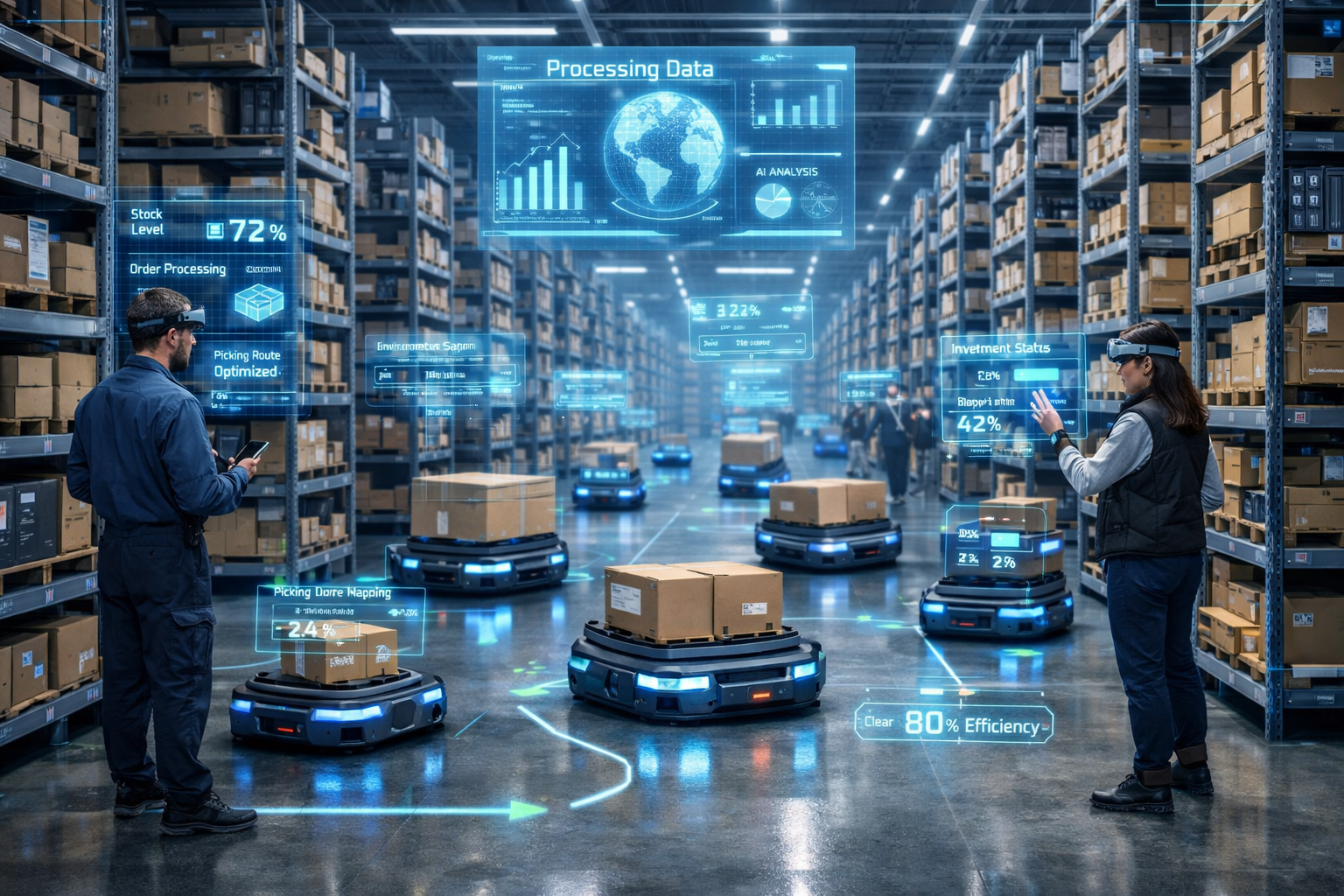
As of March 2026, the global logistics landscape has moved past the “trial phase” of digital transformation. What was once considered “futuristic”—fully autonomous fleets, real-time digital twins, and AI-orchestrated labor—has become the baseline for competitive survival. Smart warehouse infrastructure is no longer just about buying a few robots; it is an integrated ecosystem where hardware, software, and human intelligence converge to create a self-optimizing organism.
Definition and Scope
Smart warehouse infrastructure refers to the interconnected network of physical assets (robotics, shelving, sensors) and digital layers (WMS, WES, AI) that automate the journey of a product from inbound receiving to outbound shipping. Unlike traditional warehouses that rely on static storage and manual labor, a smart facility uses real-time data to adjust to shifting demand, labor shortages, and global supply chain disruptions.
Key Takeaways for 2026
- Software Orchestration: The focus has shifted from “buying more robots” to “orchestrating” them. Warehouse Execution Systems (WES) now act as the brain, preventing “automation Frankenstacks.”
- Predictive Operations: AI has moved from retrospective reporting to real-time “Decision Intelligence,” predicting bottlenecks before they occur.
- Connectivity as Utility: Private 5G networks and Edge computing are now as essential to a warehouse as electricity, providing the ultra-low latency required for thousands of connected devices.
- The Green Mandate: Sustainability is now a core performance indicator, with solar-integrated facilities and circular economy practices becoming industry standards.
Who This Is For
This guide is designed for supply chain executives, warehouse operations managers, logistics technology investors, and industrial architects. Whether you are managing a legacy 3PL (Third-Party Logistics) provider or building a micro-fulfillment hub from the ground up, understanding these structural shifts is critical for navigating the 2026 fiscal environment.
The Evolution of Warehouse Infrastructure: From Storage to Intelligence
Historically, warehouses were viewed as “necessary evils”—expensive, static cost centers designed to hold inventory. The primary goal was density. However, the explosion of omnichannel retail and the “instant gratification” economy of the early 2020s shattered this model.
By 2026, the warehouse has evolved into a strategic hub. Modern smart warehouse infrastructure is characterized by its flexibility. We have entered the era of the “Elastic Warehouse,” where the physical layout can change overnight thanks to modular shelving and mobile robotics.
The Shift to “Native Case Handling”
A significant trend in 2026 is the move away from traditional pallet-only operations toward native case handling. Instead of moving entire pallets for small orders, infrastructure is now built for “auto-traying” and direct case-to-shelf systems. This reduces “touches”—the number of times a human or machine handles a product—thereby increasing speed and reducing the margin for error.
The Digital Backbone: Next-Gen WMS and WES
At the heart of any smart warehouse infrastructure are the software layers. In 2026, the line between the Warehouse Management System (WMS) and the Warehouse Execution System (WES) has blurred, but their distinct roles remain vital.
1. The Predictive WMS
Modern WMS platforms are now “cloud-native” and “versionless.” As of March 2026, over 90% of leading warehouses have migrated to SaaS-based systems to avoid the “update fatigue” of legacy on-premise software.
Key AI Features in 2026:
- Dynamic Slotting: AI continuously analyzes order patterns and moves high-velocity SKUs to the most accessible locations (the “golden zone”) without human intervention.
- Intelligent Labor Assignment: Rather than static shifts, the WMS uses predictive analytics to assign tasks based on real-time congestion, worker fatigue levels, and robot availability.
- Waveless Processing: Traditional “wave” picking (grouping orders by time) has been replaced by continuous “waveless” flow, where orders are processed the second they hit the system.
2. The Orchestration Layer (WES)
The biggest mistake companies made in the early 2020s was creating an “Automation Frankenstack”—a collection of robots from different vendors that couldn’t talk to each other.
The WES acts as the connective tissue. It sits between the high-level business logic of the WMS and the physical movements of the robots. It ensures that a conveyor belt doesn’t move faster than the robotic arm at the end of the line can pick. By 2026, orchestration is the primary driver of ROI (Return on Investment).
Robotics and Automation: From AMRs to “Lights Out” Warehousing
The physical aspect of smart warehouse infrastructure has seen a radical shift toward Autonomous Mobile Robots (AMRs) and Automated Storage and Retrieval Systems (AS/RS).
Autonomous Mobile Robots (AMRs) vs. AGVs
In 2026, the old Automated Guided Vehicles (AGVs)—which followed fixed magnetic strips or wires—are largely obsolete in new builds. They have been replaced by AMRs equipped with LiDAR and 3D vision.
Why AMRs dominate in 2026:
- Obstacle Avoidance: They can navigate around a spilled pallet or a human co-worker without stopping the entire fleet.
- Fleet Reconfiguration: You can add or remove 50 robots from the floor in minutes via a software dashboard.
- Multi-Agent Coordination: Robots now use “swarm intelligence” to coordinate paths, preventing traffic jams in high-traffic aisles.
The Rise of “Dark Warehouses”
The “Dark Warehouse” (or “Lights Out” warehouse) is a facility designed to operate without human intervention for 16 to 24 hours a day. While fully dark warehouses are still reserved for specific high-volume industries like pharmaceuticals or grocery, the infrastructure to support them—such as automated cooling systems and robotic maintenance bays—is becoming a standard feature in smart warehouse design.
Robotic De-palletizing and Pallet-Building
One of the toughest manual jobs in a warehouse is breaking down mixed pallets. As of 2026, AI-enabled vision systems allow robotic arms to handle “non-uniform” objects. They can identify, grasp, and stack boxes of different sizes and weights with 99.9% accuracy, a feat that was impossible just five years ago.
The Connectivity Layer: 5G, Edge Computing, and IoT
Connectivity is the “nervous system” of smart warehouse infrastructure. Without reliable, high-speed communication, even the most advanced robots become expensive paperweights.
Private 5G Networks
By March 2026, private 5G has become the gold standard for large-scale logistics. Unlike Wi-Fi, which can suffer from “dead zones” behind metal racking, 5G offers:
- Ultra-Low Latency: Sub-10ms response times, essential for real-time robot coordination.
- High Device Density: The ability to connect up to 1 million devices per square kilometer.
- Network Slicing: The ability to “carve out” a dedicated piece of the network specifically for mission-critical robots, ensuring they are never slowed down by someone downloading a large file in the office.
Edge Computing
Edge computing involves processing data locally on the warehouse floor rather than sending every sensor reading to a distant cloud server. This is critical for safety; if a robot needs to make a split-second decision to stop for a pedestrian, that decision must happen at the “Edge.”
The “Internet of Warehouse Things” (IoWT)
Every pallet, forklift, and even the HVAC unit is now an IoT sensor.
- Environmental Monitoring: Sensors track temperature and humidity for sensitive goods (Cold Chain).
- Predictive Maintenance: IoT sensors on conveyor motors listen for specific vibration frequencies that indicate a bearing is about to fail, allowing for repairs before a breakdown occurs.
Digital Twins and Virtual Simulation
A Digital Twin is a real-time, 3D virtual replica of the physical warehouse. In 2026, you don’t make a single physical change to a warehouse without testing it in the “twin” first.
Use Cases for Digital Twins in 2026:
- Scenario Modeling: “What happens to our throughput if we increase our SKU count by 20% for the holidays?” The digital twin can run thousands of simulations in minutes to find the optimal layout.
- Bottleneck Identification: By visualizing real-time heat maps, managers can see where robots are clustering and adjust the orchestration logic to smooth out the flow.
- Real-Time Troubleshooting: If an AS/RS system fails, a technician can use an Augmented Reality (AR) headset to “see” inside the digital twin and identify the exact mechanical fault.
Sustainability and Green Warehousing (ESG)
In 2026, “Green Warehousing” is no longer a marketing slogan; it is a regulatory and financial requirement. Sustainability is now baked into the infrastructure design.
Energy-Efficient Systems
- Solar Integration: Warehouses have massive roof surface areas. Modern smart warehouses use integrated photovoltaic (PV) systems paired with industrial-scale battery storage to go “off-grid” during peak hours.
- Smart Lighting: LED systems equipped with occupancy and “daylight harvesting” sensors ensure that lights are only on when and where they are needed.
- Regenerative Braking: Much like an electric car, modern AS/RS cranes and AMRs use regenerative braking to feed electricity back into the system during deceleration.
The Circular Economy
Infrastructure is now designed for “zero-waste” fulfillment. This includes:
- Sized-to-Fit Packaging: Automated machines that measure a product and create a custom-sized box in real-time, eliminating the need for plastic void-fillers.
- Water Harvesting: Using the warehouse’s vast roof to collect rainwater for gray-water systems and cooling towers.
The Human Factor: Collaborative Robots and Upskilling
Despite the rise of automation, humans remain the most flexible “assets” in a warehouse. However, their roles have fundamentally changed.
Cobots (Collaborative Robots)
The era of humans being replaced by robots is shifting toward humans being augmented by them. Cobots work side-by-side with people. For example, a cobot might hold a heavy heavy box in place while a human performs a delicate quality inspection.
Augmented Reality (AR) and Wearables
As of March 2026, “pick-to-light” systems have been largely replaced by AR glasses. Workers see holographic arrows pointing them to the exact bin they need, reducing training time from weeks to hours.
Upskilling: The New Requirement
The “Warehouse Associate” of 2026 is often a “Robot Supervisor” or a “Data Analyst.” Companies that succeed in this transition are those that invest heavily in upskilling their workforce to manage the very machines that once threatened their jobs.
Common Mistakes in Smart Warehouse Migration
Even with the best technology, infrastructure projects often fail due to poor planning. Here are the most common pitfalls as of 2026:
- Ignoring Data Quality: Automation is only as good as the data feeding it. If your inventory dimensions are incorrect in the system, your robots will fail to pick them.
- Scaling Too Fast: Trying to go from a manual warehouse to a “Dark Warehouse” in one step usually leads to operational collapse. The “Pilot and Scale” model is the only proven path to success.
- Underestimating Connectivity: Many firms invest millions in robots but try to run them on standard enterprise Wi-Fi. The resulting latency leads to “ghost stops” and reduced throughput.
- Neglecting Cybersecurity: Every IoT sensor is a potential entry point for hackers. In 2026, cybersecurity must be a foundational part of the infrastructure, not an afterthought.
Future Outlook: The Warehouse of 2030
Looking beyond 2026, we see the rise of Hyper-local Micro-fulfillment. Warehouses will get smaller and move closer to urban centers. We will likely see “Vertical Warehousing” becoming the norm in cities where land is at a premium.
Furthermore, the integration of Blockchain into the warehouse infrastructure will provide “immutable” tracking of every item, ensuring 100% transparency for consumers who want to know the exact carbon footprint and ethical origin of their products.
Conclusion: Next Steps for Your Warehouse
The future of smart warehouse infrastructure is characterized by intelligence, agility, and sustainability. As of March 2026, the gap between the “tech-haves” and the “tech-have-nots” is widening. A smart warehouse is no longer a luxury; it is the central nervous system of a resilient business.
To begin your journey, I recommend these immediate next steps:
- Audit Your Data: Ensure your Master Data Management (MDM) is robust. Clean data is the fuel for AI.
- Invest in a WES: If you have multiple automation systems, prioritize an orchestration layer to unify them.
- Test a Digital Twin: Start with a small-scale virtual model of one high-congestion zone to see immediate ROI in flow optimization.
- Evaluate Your Connectivity: Perform a site survey to determine if your current network can handle a 200% increase in connected devices over the next 24 months.
Building the warehouse of the future is not a destination, but a continuous process of iterative improvement. By focusing on flexible infrastructure and human-centric technology, you can ensure your logistics operation remains competitive in the volatile economy of the late 2020s.
Would you like me to create a 12-month implementation roadmap for migrating a manual facility to a basic smart infrastructure?
FAQs
Q: What is the average ROI for a smart warehouse infrastructure project in 2026? A: While it varies by scale, most mid-to-large enterprises report a full ROI within 18 to 30 months. The primary drivers are a 25–30% reduction in labor costs and a significant increase in throughput and order accuracy.
Q: Can I implement smart infrastructure in an older building? A: Yes. One of the biggest trends in 2026 is “Retrofit Automation.” AMRs and modular AS/RS systems are designed to work around existing pillars and uneven floors, though you may need to upgrade your electrical and networking systems first.
Q: How do smart warehouses handle “Peak Season” volatility? A: Smart infrastructure uses “Elastic Capacity.” Through Robotics-as-a-Service (RaaS), companies can rent additional AMRs for the holiday season and integrate them into their WES in a matter of days.
Q: Is “Dark Warehousing” actually achievable for small businesses? A: For most small businesses, a “Fully Dark” warehouse is not cost-effective. Instead, they should focus on “Task-Specific Automation,” where specific high-volume tasks (like sorting or packing) are automated while humans handle the variable aspects of the business.
Q: What are the biggest security risks for a smart warehouse? A: The primary risks include data breaches via IoT devices and ransomware attacks on the WMS. In 2026, it is mandatory to use Zero Trust Architecture and regular “Penetration Testing” for all connected warehouse assets.
References
- DHL Trend Research (2025/2026). Logistics Trend Radar 7.0. Official outlook on AI and robotics in global supply chains.
- Gartner Logistics (2026). Magic Quadrant for Warehouse Management Systems. Analysis of cloud-native WMS platforms.
- IEEE Xplore (2025). Multi-Agent Robot Coordination in High-Density Warehousing. Academic study on AMR swarm intelligence.
- McKinsey & Company (2026). The Future of Work in Logistics: Upskilling the Human Element. report on workforce transition.
- MHI (Material Handling Institute) (2026). The Annual Industry Report: The Evolution of Smart Infrastructure.
- Supply Chain Brain (2026). Real-World Use Cases for Digital Twins in Warehousing.
- Microsoft Dynamics 365 (2026). Future-Proofing Your Supply Chain with AI and Cloud WMS.
- Thyssenkrupp Supply Chain Services (2025). 2026 Outlook: Redefining Transportation and Warehousing.
- MDPI Computers (2025). The Integration of IoT and 5G in Industrial Automation.
- Exotec Research (2026). The Role of Digital Twins in Modern Order Fulfillment.
- IMD Business School (2026). Sustainability Trends and the Circular Economy in Logistics.
- Maersk Insights (2026). Warehousing Trends Across Emerging Markets (IMEA).