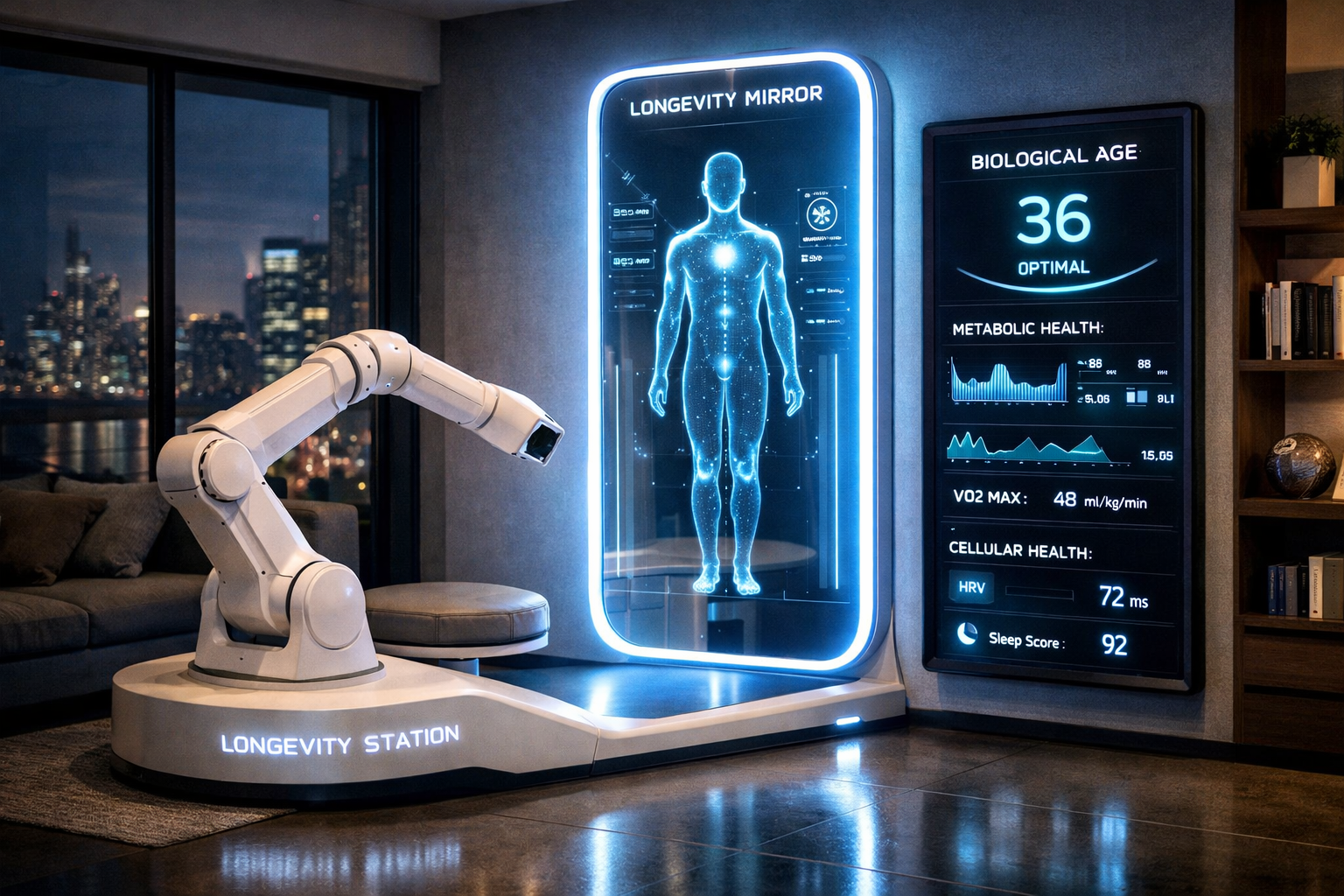
As of March 2026, the concept of the “doctor’s office” is undergoing its most radical transformation since the invention of the stethoscope. We are entering the era of the Longevity Station—a dedicated, tech-integrated space within the home where AI-driven at-home diagnostic robots monitor, analyze, and optimize human health in real-time.
Gone are the days of waiting six months for an annual physical that only provides a static snapshot of your health. Today, “Longevity” isn’t just a buzzword; it is a measurable, actionable data point. By combining autonomous robotics with advanced biometrics, these stations allow individuals to detect chronic diseases years before symptoms appear, effectively shifting our global healthcare paradigm from “reactive sick-care” to “proactive well-care.”
What is a Longevity Station?
A Longevity Station is a decentralized medical hub located within a private residence. It typically consists of a suite of interconnected devices, including at-home diagnostic robots, smart sensors (like the NuraLogix Longevity Mirror), and AI-powered analytical software. These systems work in tandem to collect biomarkers—ranging from blood glucose and arterial stiffness to facial blood flow patterns—providing a 360-degree view of an individual’s internal health.
Key Takeaways
- Real-Time Diagnostics: Continuous monitoring replaces periodic testing, allowing for the immediate detection of health anomalies.
- Robotic Precision: Autonomous devices like the Vitestro Aletta are bringing clinical-grade blood collection and fluid analysis into the home setting (pending regional regulations).
- Biological Age vs. Chronological Age: The primary metric of success for these stations is the reduction of “biological age” through personalized lifestyle interventions.
- Data Sovereignty: Users now own their health data, using AI to bridge the gap between raw biometrics and clinical action.
Who This Is For
This technology is no longer exclusive to Silicon Valley biohackers. In 2026, Longevity Stations are being adopted by:
- The Aging Population: Seniors looking to maintain independence through early detection of mobility or cognitive decline.
- Chronic Disease Managers: Individuals with diabetes or hypertension who require high-frequency monitoring.
- High-Performance Professionals: Those seeking to optimize cognitive and physical output through metabolic tracking.
- Health-Conscious Families: Parents utilizing non-invasive “Longevity Mirrors” to track the developmental health of their children.
The Evolution of Home Diagnostics: From Scales to Stations
The journey to the Longevity Station began with the simple bathroom scale. For decades, weight was the only metric we could track at home. The 2010s brought us the “Wearables Revolution,” introducing heart rate and step counting via smartwatches. However, these were still “proxy” measurements—they told us what our bodies were doing, but not necessarily how our bodies were functioning at a cellular level.
In late 2024, the industry saw a significant pivot. While pioneers like Forward Health attempted to place “CarePods” (self-serve AI kiosks) in shopping malls, the model faced operational hurdles. The real demand, it turned out, wasn’t in the mall—it was in the master bathroom.
By 2026, the “Home-as-a-Clinic” model has triumphed. Companies have realized that the most valuable health data is gathered when a user is in their natural environment, relaxed, and consistent. This realization birthed the modern Longevity Station, which integrates three distinct pillars: Sensing, Analysis, and Automation.
The Anatomy of an At-Home Diagnostic Robot
At the heart of every Longevity Station is the diagnostic robot. Unlike the industrial robots seen in car factories, these are “socially-integrated” machines designed for precision, safety, and human comfort.
1. Transdermal Optical Imaging (TOI)
The “eyes” of the longevity station are often found in devices like the NuraLogix Longevity Mirror. Using a technology called Transdermal Optical Imaging, these robots use high-resolution cameras to detect minute changes in blood flow beneath the skin of the face.
- How it works: By analyzing the way light reflects off hemoglobin, the AI can calculate blood pressure, heart rate, respiratory rate, and even mental stress levels—all in under 30 seconds without a single cuff or needle.
2. Autonomous Robotic Phlebotomy
The most significant hurdle for home diagnostics has always been blood. In the past, you had to visit a lab for a venous draw. As of early 2026, robots like the Vitestro Aletta have pioneered autonomous blood collection.
- The Technology: These robots use a combination of ultrasound and near-infrared imaging to map a patient’s veins with sub-millimeter precision.
- The Experience: A robotic arm identifies the optimal insertion point, performs the draw, and even labels the tubes for the lab—or processes them internally using “Lab-on-a-Chip” technology.
3. Lab-on-a-Chip (Microfluidics)
Integrated into the base of the Longevity Station is a microfluidic processor. This “internal lab” can take a tiny sample of blood or urine and run complex assays.
- Biomarkers Tracked: Glucose, HbA1c, LDL/HDL cholesterol, CRP (inflammation), and even early-stage cancer markers via liquid biopsy.
Technical Deep Dive: How AI Powers Longevity
The “Robot” isn’t just the arm or the camera; it’s the AI Engine that lives in the cloud or on the “edge” of the device. In 2026, these systems utilize Agentic AI—a form of artificial intelligence that doesn’t just answer questions but takes proactive steps.
Biological Age Modeling
One of the most complex tasks these stations perform is calculating a user’s Biological Age. While you might be 45 years old chronologically, your “internal clock” might be 38 or 52.
The AI uses the Gompertz-Makeham law of mortality as a baseline, which describes the age-dependent component of the mortality rate:
$$\mu(x) = \alpha e^{\beta x} + \gamma$$
Where:
- $\mu(x)$ is the death rate at age $x$.
- $\alpha$ and $\beta$ represent the aging-related increase in mortality.
- $\gamma$ represents age-independent mortality.
By inputting thousands of daily data points into this and other epigenetic models (like the Horvath Clock), at-home diagnostic robots can predict health trajectories and suggest specific interventions (e.g., “Increase Zone 2 cardio by 20 minutes to lower arterial stiffness”) to “reverse” the biological clock.
Leading Longevity Station Components in 2026
If you were to build a Longevity Station today, these are the primary components currently dominating the market:
| Device | Primary Function | Key Biomarkers | Est. Cost (2026) |
| NuraLogix Longevity Mirror | Non-invasive vitals | BP, Stress, Pulse, BMI | $899 + Subscription |
| Withings Body Scan 2 | Metabolic/Nerve health | Arterial Age, Nerve Activity | $600 |
| Vitestro Aletta (Home Ed.) | Robotic Phlebotomy | Full Blood Panels | $2,500+ (Lease only) |
| Oura Ring Gen 5 | Sleep/Recovery | HRV, Body Temp, SpO2 | $399 |
| NutriSense CGM Robot | Glucose Management | Continuous Glucose | $299/mo |
The Philosophy of Preventive Medicine: “Well-Care” vs. “Sick-Care”
The traditional medical model is “reactive.” We wait for a symptom (pain, fatigue, a lump), then we visit a doctor, who then orders a test. This is Sick-Care.
Longevity Stations flip this script. By having a robot monitor you daily, the “test” is always happening. We are moving toward Continuous Diagnostics.
The “Early Warning System”
Imagine your diagnostic robot detects a 5% increase in your C-Reactive Protein (CRP) levels over three days, alongside a slight dip in your Heart Rate Variability (HRV). To a human, this feels like nothing. To the AI, this is a clear signal of systemic inflammation or an impending viral infection. The station might recommend an extra hour of sleep and a specific anti-inflammatory diet before you even feel a sniffle.
Common Mistakes and Industry Lessons
As the world embraces at-home robotics, several pitfalls have emerged. Learning from the failures of early 2020s tech is essential for a successful longevity journey.
1. The “Nocebo” Effect of Over-Monitoring
One of the most common mistakes users make is developing Health Anxiety (Orthosomnia/Orthorexia). When a robot provides real-time data, some individuals become obsessed with “perfect” numbers.
- The Fix: Modern Longevity Stations now include “Mental Health Filters” that only alert users when a trend is clinically significant, rather than showing every minor fluctuation.
2. Failure to Calibrate Hardware
At-home diagnostic robots are precision instruments. A common mistake is neglecting the maintenance of fluid sensors or camera lenses.
- The Lesson: Just like a car, your Longevity Station requires a “Tune-up” every 6 months to ensure the robotic arm and optical sensors remain within medical-grade tolerances.
3. Ignoring the “Human in the Loop”
The failure of Forward Health’s CarePods taught the industry that technology cannot replace the doctor-patient relationship—it can only enhance it.
- The Correction: The most successful longevity platforms in 2026 are Hybrid Models. The robot collects the data, but a human Longevity Physician reviews the “red flags” and provides the final clinical sign-off.
Safety, Ethics, and Data Privacy
Entrusting a robot with your blood, your face, and your most intimate health metrics raises massive privacy concerns.
Data Breaches in the Age of Bio-Robotics
In 2026, health data is more valuable than credit card numbers on the dark web. Leading manufacturers now use Edge Computing, meaning your health data is processed locally on the robot and never sent to a central server in an unencrypted state.
- Sovereignty: Users can now grant “one-time access” keys to their doctors, ensuring that even the manufacturer cannot see their specific biological markers without permission.
FDA Regulation and the TEMPO Pilot
The FDA’s 2026 Guidance has created the TEMPO Pilot Program, which allows for faster approval of “low-risk” diagnostic robots. However, “High-Risk” functions—like autonomous needle insertion—remain under strict scrutiny.
Safety Disclaimer: At-home diagnostic robots are intended for monitoring and screening purposes. They do not replace emergency medical services. If you are experiencing a medical emergency, contact your local emergency number (e.g., 911) immediately.
The Social Impact: Will Longevity Be for Everyone?
There is a growing concern that Longevity Stations will create a “Biological Divide.” If only the wealthy can afford at-home diagnostic robots, the gap in life expectancy between social classes could widen significantly.
The Democratization of Tech
However, history suggests that as technology matures, prices drop. Much like the smartphone, the “Longevity Station” of 2026 (costing $5,000+) is expected to become the “Longevity App” and “Smart Mirror” of 2030 (costing under $500).
Governments are also beginning to realize that subsidizing these robots is cheaper than paying for late-stage cancer treatments or heart surgeries in public hospitals.
Practical Examples: A Day in the Life with a Longevity Station
Case Study 1: Sarah, 68 (Geriatric Care)
Sarah’s Longevity Station includes a mobility robot that monitors her gait as she walks past it. In February 2026, the robot detected a “micro-stumble” and a 2-degree shift in her center of gravity. It alerted her physical therapist, who intervened with specific balance exercises. This “pre-fall” detection prevented a hip fracture—the leading cause of mortality in her age group.
Case Study 2: Mark, 34 (The Biohacker)
Mark uses his Longevity Station to optimize his nutrition. By using his robotic phlebotomy device once a week, he tracks how different supplements affect his blood lipids and inflammatory markers. He has successfully lowered his biological age by 4 years since he began his protocol in 2025.
Looking Ahead: Longevity Stations in 2030
The future of at-home diagnostics goes beyond just “seeing” and “testing.” The next generation of robots will likely include:
- 3D-Printed Supplements: The station will analyze your blood and then immediately 3D-print a custom “poly-pill” containing the exact vitamins and minerals you need for that specific day.
- Molecular Scanning: Using Raman Spectroscopy, future robots may be able to “see” your glucose or cholesterol levels through the skin without any needles at all.
- Digital Twins: Every data point from your station will feed into a “Digital Twin”—a virtual model of your body that doctors can use to test surgeries or medications before performing them on you.
Conclusion: Taking the First Step Toward Your Future Health
The rise of at-home diagnostic robots and Longevity Stations represents the ultimate empowerment of the individual. We are no longer passive passengers in our own bodies; we are the pilots, equipped with the most advanced “flight instruments” ever created.
While the full “robotic lab” experience may still be an investment, the transition toward longevity is something anyone can start today. The “Station” is more than just a collection of gadgets—it is a commitment to the idea that aging is a manageable condition rather than an inevitable decline.
Next Steps for the Reader:
- Audit Your Current Biometrics: Start with what you can measure today (sleep, heart rate, weight).
- Research the “Longevity Mirror”: Look into NuraLogix or similar TOI technologies as a non-invasive entry point.
- Consult a Longevity Physician: Find a doctor who is trained to interpret the high-frequency data these robots provide.
- Prioritize Data Privacy: Only invest in hardware that offers end-to-end encryption and local data storage.
The future isn’t just about living longer; it’s about living better for longer. Your home is ready to become the most advanced clinic you’ve ever visited.
FAQs
1. Are at-home diagnostic robots legal in the US?
As of March 2026, many components (like smart scales and mirrors) are FDA-cleared as “General Wellness” or “Class II Medical Devices.” Fully autonomous robotic phlebotomy is currently in clinical trials in the US but is already CE-marked for use in the EU.
2. Can these robots replace my primary care doctor?
No. These robots are “Diagnostic Assistants.” They provide the data and the “early warning,” but clinical diagnosis and treatment plans should always be handled by a licensed healthcare professional.
3. How much does a basic Longevity Station cost?
A basic setup, including a high-end smart scale (Withings Body Scan 2) and a longevity mirror (NuraLogix), will cost approximately $1,500. A full setup with robotic fluid analysis can exceed $5,000.
4. Is my health data safe from insurance companies?
Current regulations (like HIPAA and updated 2026 privacy laws) generally prevent insurance companies from using your private “wellness” data to increase premiums, but you should always read the Terms of Service for any connected device.
5. Do I need medical training to use these robots?
No. These devices are designed for “Consumer-Grade Simplicity.” The AI handles the complex analysis and provides “Human-First” recommendations in plain English.
References
- International Federation of Robotics (IFR). (2026). Top 5 Global Robotics Trends 2026.
- U.S. Food and Drug Administration (FDA). (2026). Updated Guidance: General Wellness: Policy for Low Risk Devices.
- NuraLogix Corporation. (2026). Transdermal Optical Imaging: The Science of the Longevity Mirror.
- Vitestro B.V. (2026). Aletta ARPD: Clinical Trial Results and European Deployment Data.
- Withings Health Solutions. (2026). Body Scan 2: White Paper on Multi-Biomarker Analysis.
- Stanford Center on Longevity. (2026). The New Map of Life: Technological Interventions for Healthy Aging.
- Medtronic Digital Health. (2025). Securing the Future of Connected Medical Devices.
- Journal of Biohacking and Longevity. (2026). Biological Age Reversal: A Meta-Analysis of Home-Based Interventions. Would you like me to create a personalized “Longevity Station” shopping list based on your specific health goals or budget?