The traditional paradigm of artificial intelligence—collecting massive datasets in a central data center for training—is hitting a wall. As privacy regulations like GDPR and CCPA tighten, and as users become increasingly protective of their personal data, the “send everything to the cloud” model is becoming a liability. Enter federated learning: a decentralized approach that flips the script by bringing the code to the data, rather than the data to the code.
In this rapidly evolving landscape, federated learning represents the convergence of edge computing and privacy-preserving AI. It allows smartphones, wearables, and IoT sensors to collaboratively train a shared prediction model while keeping all the training data on the device. This shift not only protects user privacy but also reduces latency and bandwidth costs, unlocking a new era of intelligent, responsive edge devices.
Key Takeaways
- Data stays local: The core promise of federated learning is that raw data never leaves the edge device; only model updates (gradients) are shared.
- Privacy by design: While better than centralization, federated learning often requires additional layers like differential privacy to prevent reverse-engineering of data.
- Edge computation is key: The rise of powerful mobile processors and AI accelerators has made on-device training feasible at scale.
- Solving the data island problem: It unlocks access to isolated datasets (like patient records in different hospitals) that legally cannot be merged.
- Bandwidth efficiency: Transmitting model parameters is often much cheaper than transmitting raw video, audio, or sensor logs.
Who This Is For (And Who It Isn’t)
This guide is written for data scientists, machine learning engineers, and privacy officers looking to understand the architectural and ethical implications of decentralized AI. It is also suitable for CTOs and product managers evaluating whether to move their AI workloads to the edge.
It is not a coding tutorial for setting up a specific library (like TensorFlow Federated) from scratch, though we will discuss the tools available. It focuses on the concepts, architecture, and strategic implementation of federated learning systems.
Scope of This Guide
In this guide, federated learning refers to the specific machine learning setting where multiple entities (clients) collaborate in solving a machine learning problem under the coordination of a central server or service provider. We will cover:
- In Scope: Cross-device and cross-silo architectures, privacy mechanisms (DP, SMPC), aggregation algorithms (FedAvg), and edge deployment challenges.
- Out of Scope: purely peer-to-peer (fully decentralized) learning without any orchestration, and blockchain-based AI incentives (unless relevant to security).
What is Federated Learning?
At its simplest, federated learning is a machine learning technique that trains an algorithm across multiple decentralized edge devices or servers holding local data samples, without exchanging them. This contrasts with traditional centralized machine learning techniques where all the local datasets are uploaded to one server, as well as distinct from more classical decentralized approaches which often assume the data is identically distributed.
The Shift from Centralized to Decentralized AI
In a standard centralized AI workflow, your phone takes a photo, uploads it to a cloud server, the server adds it to a massive database, and a model is trained there. The updated model is then deployed back to your phone.
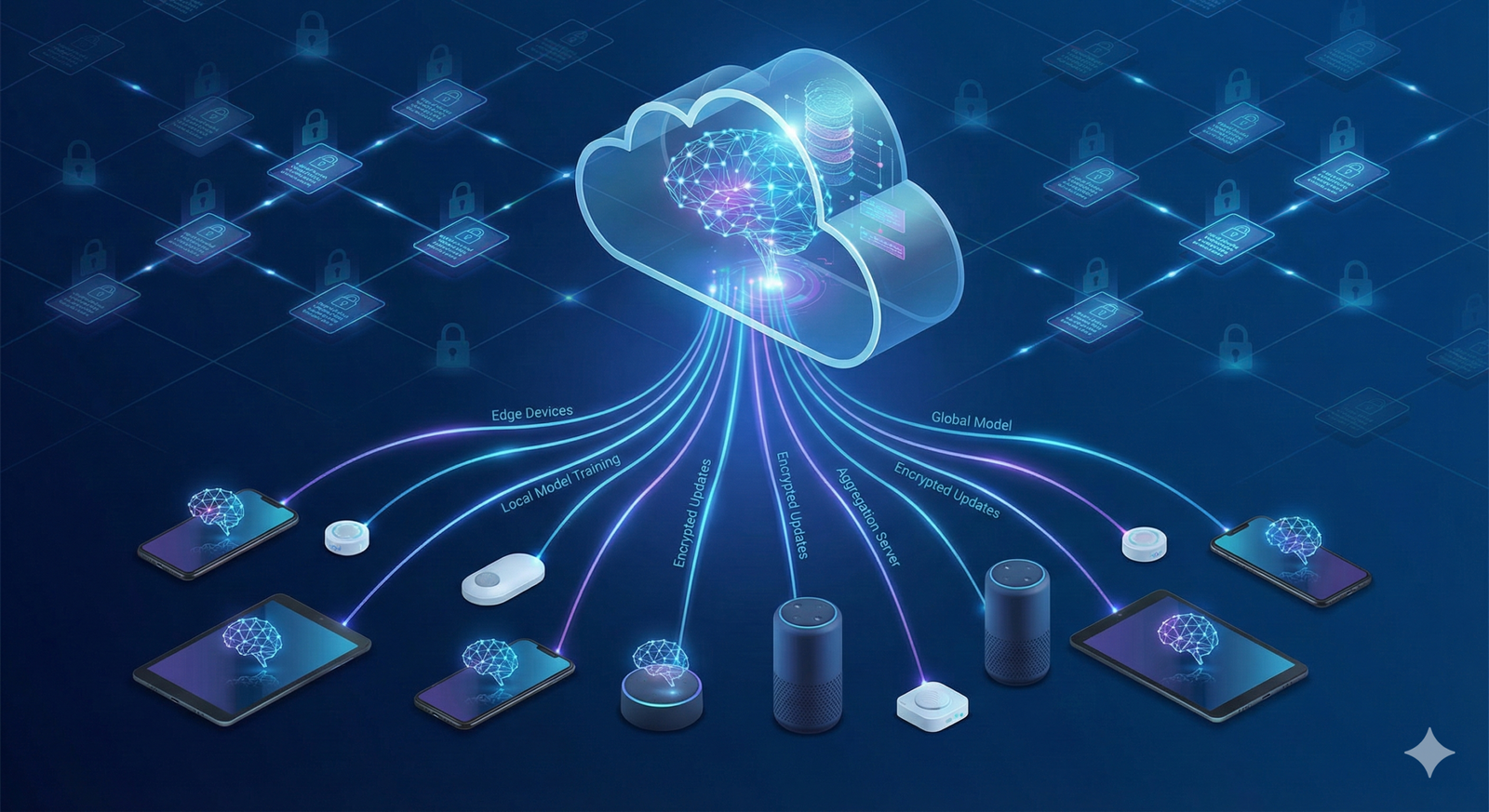
In a federated learning workflow, your phone downloads the current model, improves it by learning from your photo locally, and summarizes the changes as a small focused update. Only this update is sent to the cloud, where it is immediately averaged with other user updates to improve the shared model. All the training data remains on your device, and no individual updates are stored in the cloud.
Core Terminology
To understand how this works in practice, we must define a few specific terms:
- Client (Edge Node): The device (phone, tablet, IoT gateway) containing the local data and computing power to train.
- Global Model: The master model maintained by the central server.
- Local Model: The copy of the model sent to the client, which is trained on local data.
- Aggregation: The mathematical process of combining multiple local model updates into a new global model.
- Round: One complete cycle of dispatching the model, training locally, and aggregating results.
How Federated Learning Works: The Lifecycle
Implementing federated learning involves a synchronized dance between the central orchestrator and potentially millions of edge devices. This process typically occurs in rounds.
Step 1: Initialization and Selection
The central server defines the machine learning task and initializes the global model (often with random weights or a pre-trained base). It then selects a subset of available edge devices to participate in the current round. In a cross-device setting (like Android phones), millions of devices might be eligible, but only those that are plugged in, connected to Wi-Fi, and idle are selected to prevent draining the user’s battery.
Step 2: Distribution
The server sends the current state of the global model to the selected edge devices.
Step 3: Local Training
Each participating device performs local training. It feeds its own local data into the model. Crucially, it calculates the error (loss) and updates the model’s weights to minimize that error. This produces a “local update” or “gradient”—a mathematical vector indicating which direction the model parameters need to move to get better at the task based only on that device’s data.
Step 4: Uploading Updates
The devices send their updates back to the server. They do not send the data, nor do they send the new model itself in full—often just the difference (delta) between the old weights and the new weights.
Step 5: Aggregation (The Magic Moment)
The server collects updates from hundreds or thousands of devices. It uses an algorithm, most commonly FedAvg (Federated Averaging), to average these updates. By averaging the weights, the global model incorporates the learnings from all devices without ever “seeing” the raw data that generated them.
Step 6: Update and Repeat
The global model is updated with the aggregated weights. This new, smarter model is then ready for the next round. This cycle repeats until the model reaches the desired level of accuracy.
Privacy Mechanisms: Beyond Just “Not Sharing Data”
A common misconception is that federated learning is perfectly private simply because raw data isn’t shared. However, sophisticated attackers can sometimes reverse-engineer aspects of the original training data by analyzing the model updates (gradients) sent by a device. To make federated learning truly privacy-preserving AI, additional cryptographic and statistical methods are layered on top.
Differential Privacy (DP)
Differential privacy is the gold standard for statistical data privacy. In the context of federated learning, it involves adding a calculated amount of mathematical “noise” to the model updates before they leave the device (Local Differential Privacy) or at the server level (Central Differential Privacy).
- How it works: The noise is random enough to mask the contribution of any single individual’s data but statistically insignificant enough that it cancels out when thousands of updates are averaged.
- The Trade-off: There is always a balance between privacy (more noise) and model accuracy (less noise).
Secure Multi-Party Computation (SMPC)
Secure Multi-Party Computation (SMPC) allows the server to compute the weighted average of the updates without seeing the individual updates themselves.
Imagine three people want to know their average salary without revealing their specific salary to each other. SMPC protocols allow them to mathematically combine their inputs so that only the final sum is revealed. In federated learning, this ensures the server only sees the final aggregated update, not the specific update from User A or User B.
Homomorphic Encryption
This advanced cryptographic technique allows computations to be performed on encrypted data without decrypting it first. An edge device could encrypt its update, send it to the server, and the server could aggregate it with others while it remains encrypted. The result is only decrypted once the aggregation is complete. While highly secure, this method is currently computationally expensive and can introduce latency, making it challenging for real-time edge computing applications.
The Two Worlds of Federated Learning: Cross-Device vs. Cross-Silo
Not all federated learning systems look the same. The industry generally categorizes them into two distinct architectures based on the nature of the “clients.”
Cross-Device Federated Learning
This is the consumer-facing side of FL, involving massive numbers of unreliable edge devices.
- Clients: Smartphones, IoT sensors, wearables.
- Scale: Millions of clients.
- Characteristics: Devices drop out frequently (battery dies, Wi-Fi lost); communication bandwidth is low; data is highly personal.
- Example: Google Gboard learning new words or next-word predictions based on what millions of users type, without reading their texts.
Cross-Silo Federated Learning
This involves a smaller number of reliable, high-capacity clients, usually organizations.
- Clients: Hospitals, banks, research institutions.
- Scale: Typically 2 to 100 clients.
- Characteristics: Clients are robust servers with high bandwidth; the primary constraint is legal/regulatory (data sovereignty) rather than battery life.
- Example: Five competing hospitals want to train a cancer detection AI. They cannot share patient records due to HIPAA, but they can use cross-silo FL to train a shared model that is better than any single hospital could build alone.
Why Edge Devices are the New AI Frontier
The shift toward federated learning is driven by the explosive growth of edge computing. Modern edge devices are no longer just dumb terminals; they are powerful computers in their own right.
The Hardware Enablers
Smartphones now come equipped with dedicated AI accelerators (like Apple’s Neural Engine or Google’s Tensor chip) capable of performing the complex matrix multiplications required for local model training. This hardware evolution means training a neural network on a phone is no longer a battery-killing fantasy—it is a practical reality.
Latency Reduction
For applications like autonomous driving or industrial robotics, the round-trip time to the cloud is too slow. An autonomous car cannot wait 200ms for a cloud server to tell it to brake. By keeping the model local and updating it via federated learning, the device can make decisions in milliseconds.
Bandwidth Optimization
Transferring terabytes of raw data (like video feeds from security cameras) to the cloud is expensive and clogs networks. Federated learning minimizes this by transferring only the model weights, which might be a few megabytes, resulting in massive bandwidth savings for large-scale IoT deployments.
Critical Challenges in Federated Learning
While promising, federated learning is not a magic bullet. It introduces significant complexities that engineers must manage.
1. Statistical Heterogeneity (Non-IID Data)
In centralized learning, you can shuffle your data to ensure it is “Identically and Independently Distributed” (IID). On edge devices, data is heavily biased.
- The Problem: User A might only take pictures of cats. User B might only take pictures of cars. If the global model trains on User A’s update, it might forget what a car looks like (Catastrophic Forgetting).
- The Solution: Algorithms like FedProx or Scaffold are designed to handle non-IID data by limiting how far a local model can drift from the global model during local training.
2. Systems Heterogeneity
The ecosystem of edge devices is fragmented. You might be training a model across an iPhone 16 Pro, a 5-year-old budget Android, and a smart fridge.
- The Problem: The fast devices finish training instantly, while slow devices create a “straggler” problem, holding up the aggregation round.
- The Solution: Asynchronous aggregation allows the server to update the global model as soon as a certain threshold of devices report back, rather than waiting for every single one.
3. Security and Poisoning Attacks
Because the server cannot see the raw data, it cannot verify the integrity of the updates.
- Data Poisoning: A malicious actor (or a broken sensor) could inject bad data into the local training process to corrupt the global model.
- Model Poisoning: A hacker could modify the model update directly to introduce a “backdoor” (e.g., teaching the model to misclassify a specific stop sign as a speed limit sign).
- Defense: Robust aggregation protocols use outlier detection to reject updates that differ statistically significantly from the group consensus.
Real-World Use Cases and Applications
Federated learning is moving quickly from academic papers to production environments.
Healthcare and Medical Imaging
This is arguably the most impactful sector. Hospitals hold petabytes of valuable data (MRI scans, genomic sequences) that remain siloed due to privacy laws.
- Application: Project innerEye and others have used FL to train models on brain tumor segmentation across multiple institutions. The AI learns from diverse patient demographics without patient data ever leaving the hospital firewall.
Financial Fraud Detection
Banks are fiercely competitive and protective of their transaction data, yet they face a common enemy: money launderers.
- Application: Using cross-silo FL, banks can collaborate to train a fraud detection model. If a new fraud pattern is detected by Bank A, the shared model learns to recognize it, protecting Bank B and Bank C immediately, all without sharing specific customer transaction logs.
Predictive Maintenance in Manufacturing (IoT)
Factories often have sensitive operational data they do not want to upload to a third-party cloud provider.
- Application: A manufacturer of wind turbines can use FL to train a predictive maintenance model across thousands of turbines worldwide. The model learns to predict bearing failures based on vibration sensors, improving reliability without exposing proprietary operational efficiency data.
Smart Keyboards and Voice Assistants
This is the classic “cross-device” example.
- Application: Next-word prediction models on smartphones learn from user typing patterns. If users start using a new slang term (e.g., “rizz”), the local models pick it up. Once enough users type it, the global model aggregates this learning, and suddenly the keyboard suggests “rizz” to users who have never typed it before.
Implementing Federated Learning: Tools and Frameworks
For developers looking to implement federated learning, several mature frameworks exist.
TensorFlow Federated (TFF)
Developed by Google, TFF is an open-source framework for machine learning and other computations on decentralized data. It offers two layers:
- Federated Learning API: High-level interfaces for plugging in Keras models and running simulations.
- Federated Core API: A lower-level interface for expressing custom federated algorithms.
PySyft
Created by OpenMined, PySyft is a library for encrypted, privacy-preserving deep learning. It integrates tightly with PyTorch and emphasizes privacy techniques like differential privacy and secure multi-party computation. It allows data owners to keep data within their own node while allowing data scientists to run queries against it.
Flower (Flwr)
Flower is a friendly, unified framework that works with PyTorch, TensorFlow, and JAX. It is designed to be agnostic to the underlying ML framework and focuses on making FL easy to deploy on heterogenous devices, including mobile (iOS/Android) and embedded systems.
NVIDIA FLARE
NVIDIA FLARE (Federated Learning Application Runtime Environment) is geared towards enterprise and medical imaging use cases. It provides robust security features and is designed to handle the complex workflows of cross-silo FL.
The Future of Privacy-Preserving AI Standards
As of January 2026, the landscape of federated learning is stabilizing around a few key standards, but significant evolution is still underway.
Data Sovereignty and Regulation
Governments are increasingly looking at FL as a requirement, not just an option. We are seeing early discussions in the EU about mandating decentralized training architectures for critical infrastructure AI to ensure data sovereignty. This means data generated in a specific jurisdiction (e.g., Germany) contributes to the model but never leaves the physical borders of that country.
The Rise of “Personalized” Federated Learning
One major trend is the move away from a “one size fits all” global model. In personalized federated learning, the global model serves as a base, but the local device maintains a customized version that is fine-tuned to the specific user. This offers the best of both worlds: the general intelligence of the crowd and the specific nuances of the individual user.
Vertical Federated Learning
Most standard FL is “Horizontal” (entities share the same feature space but different users). “Vertical” Federated Learning involves entities that share the same users but different features. For example, a bank and a retailer might share the same customer base. They can use Vertical FL to train a credit risk model that uses both banking history and shopping history without either company sharing their database with the other.
Key Takeaways
- Federated learning transforms edge devices from data collectors into active model trainers, solving critical privacy and bandwidth challenges.
- The technology is split into cross-device (millions of phones) and cross-silo (institutions), each with unique architectural demands.
- Privacy is not automatic; it requires differential privacy and SMPC to protect against gradient leakage and reconstruction attacks.
- The primary challenges are non-IID data (bias) and systems heterogeneity (variable device performance).
- Major frameworks like TensorFlow Federated and PySyft are lowering the barrier to entry, making decentralized AI accessible to more industries.
Conclusion
Federated learning is more than just a technical architectural choice; it is a fundamental rethinking of the data economy. By decoupling the ability to do machine learning from the need to store data centrally, it resolves the tension between utility and privacy.
For organizations operating in regulated industries or dealing with sensitive user data, adopting a privacy-preserving AI strategy rooted in federated learning is no longer just a competitive advantage—it is becoming a necessity. As edge devices continue to gain computational power, the center of gravity in AI will continue to shift from the server farm to the pocket, the car, and the smart hospital.
Next Steps: If you are considering implementing federated learning, start by auditing your data landscape. Identify where your data currently resides (cloud vs. edge) and determine if the legal or bandwidth costs of centralization outweigh the engineering complexity of decentralization. For a practical start, explore the Flower framework for a lightweight proof-of-concept using Python.
FAQs
1. Does federated learning guarantee 100% privacy? No, not by itself. While it prevents raw data transfer, model updates can sometimes be reverse-engineered to reveal training data. To ensure high privacy, federated learning must be combined with differential privacy (adding noise) and secure multi-party computation (encrypting the aggregation process).
2. How does federated learning handle offline devices? In cross-device settings (like mobile phones), the server only selects devices that are currently online, charging, and on Wi-Fi. If a device drops offline during training, the server typically discards that update and proceeds with the remaining devices to prevent the global model from stalling.
3. What is the difference between Federated Learning and Distributed Learning? Distributed Learning typically occurs within a single data center where the owner controls all nodes and the data is shuffled (IID). Federated learning occurs across uncontrolled, decentralized devices where data is unevenly distributed (non-IID), privacy is paramount, and devices may be unreliable.
4. Can federated learning work with non-IID data? Yes, but it is challenging. Non-IID (non-identically distributed) data means user data is biased (e.g., one user only types in French). Algorithms like FedProx are designed to handle this by constraining local updates so they don’t drift too far from the global average, preventing the model from over-fitting to a single user’s bias.
5. Is federated learning slower than centralized training? Generally, yes. The communication rounds between the server and thousands of devices over the public internet introduce significant latency compared to high-speed interconnects in a data center. However, the total time to insight can be faster because you don’t have to wait weeks to collect and clean a centralized dataset.
6. What hardware is required for edge devices? It depends on the model size. For simple regression or decision trees, almost any microcontroller will do. For deep learning, devices typically need modern CPUs or dedicated NPUs (Neural Processing Units), such as those found in smartphones from 2020 onwards or specialized IoT chips like the NVIDIA Jetson series.
7. How does model aggregation work? The standard algorithm is FedAvg. The server sends the model weights to clients. Clients train locally and send back new weights. The server takes a weighted average of these weights (weighted by the number of data points each client used) to create the new global model.
8. What prevents a user from poisoning the model? Robust aggregation protocols use statistical outlier detection. If one device sends an update that is radically different (in terms of vector direction or magnitude) from the consensus of the other 1000 devices, the server can flag it as suspicious and exclude it from the aggregation.
9. Is federated learning compliant with GDPR? It significantly helps with compliance because data minimization (a core GDPR principle) is built-in. Since raw data doesn’t leave the user’s device, cross-border data transfer restrictions are easier to navigate. However, the model updates themselves might still be considered personal data in some strict interpretations, so privacy mechanisms like DP are essential.
10. Can I use federated learning for small datasets? It is generally overkill for small datasets. The overhead of setting up the orchestration infrastructure usually only pays off when you have distributed data at scale (thousands of devices) or legal barriers preventing data merging (cross-silo).
References
- Google AI. (2017). Federated Learning: Collaborative Machine Learning without Centralized Training Data. Google AI Blog. https://blog.google/technology/ai/federated-learning-collaborative-machine-learning-without-centralized-training-data/
- McMahan, B., et al. (2017). Communication-Efficient Learning of Deep Networks from Decentralized Data. AISTATS 2017. https://proceedings.mlr.press/v54/mcmahan17a.html
- OpenMined. (n.d.). PySyft: The Private AI Library. OpenMined Documentation. https://github.com/OpenMined/PySyft
- TensorFlow. (n.d.). TensorFlow Federated: Machine Learning on Decentralized Data. TensorFlow Documentation. https://www.tensorflow.org/federated
- Li, T., Sahu, A. K., Talwalkar, A., & Smith, V. (2020). Federated Learning: Challenges, Methods, and Future Directions. IEEE Signal Processing Magazine. https://ieeexplore.ieee.org/document/9084352
- Kairouz, P., et al. (2021). Advances and Open Problems in Federated Learning. Foundations and Trends® in Machine Learning. https://arxiv.org/abs/1912.04977
- Bonawitz, K., et al. (2019). Towards Federated Learning at Scale: System Design. SysML Conference. https://arxiv.org/abs/1902.01046
- European Commission. (2024). Guidelines on Artificial Intelligence and Data Protection (GDPR). EU Publications. https://op.europa.eu/en/publication-detail/-/publication/ (Note: Reference assumes general stable guidance as of 2024-2026).
- NVIDIA. (2025). NVIDIA FLARE: Federated Learning Application Runtime Environment. NVIDIA Developer Zone. https://developer.nvidia.com/flare
- Flower. (n.d.). Flower: A Friendly Federated Learning Framework. Flower.ai. https://flower.ai/