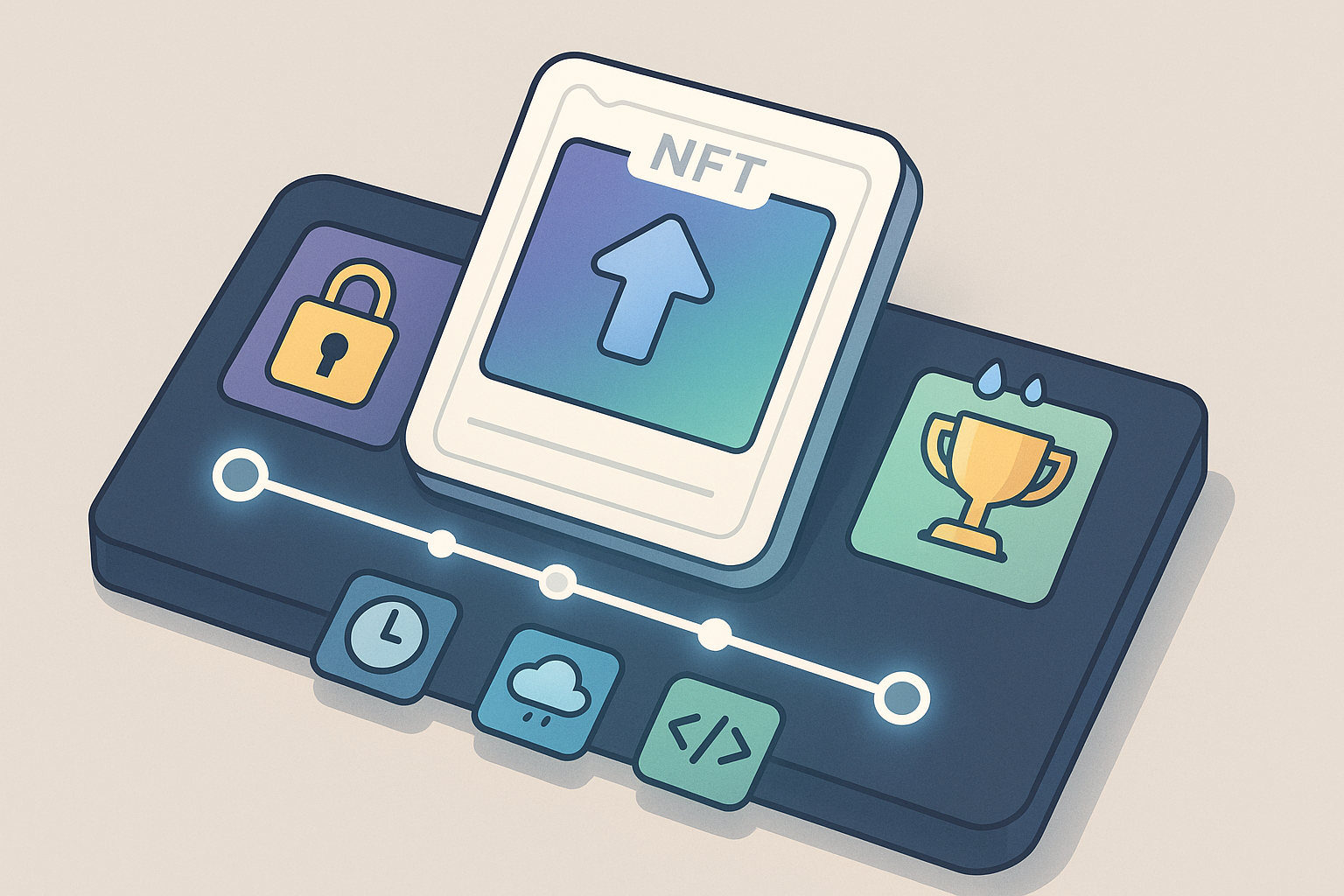
Dynamic NFTs are tokens whose metadata or behavior can change based on time, user actions, or external events while preserving provenance on-chain. In plain terms, a dynamic NFT is like a collectible that can level up, expire, redeem, or visually evolve without losing its identity. In this guide, you’ll learn practical patterns to design, build, and ship Dynamic NFTs that update predictably and securely. Disclaimer: this article is for educational purposes only and is not financial, legal, or security advice. A dynamic implementation usually follows a repeatable arc: define triggers, pick storage, design metadata, index updates, wire oracles, harden access, and launch. At a glance, here’s a skimmable build sequence you can use:
- Choose trigger types (time, user, on-chain, off-chain) and update authority.
- Pick storage for media/metadata (on-chain, IPFS, Arweave, hybrid).
- Define a versioned metadata schema and trait rules.
- Implement update signals and indexing (events, APIs).
- Connect oracles/randomness and chain selection.
- Secure roles, rates, and upgrade paths; finalize UX and rollout.
Follow the 12 sections below to move from idea to a resilient, production-ready dynamic collection with clear guardrails and examples. The outcome: fewer surprises, lower gas, smoother marketplace behavior, and happier holders.
1. Frame Your Trigger Model and Update Authority
Start by stating, clearly and in writing, what can change, who can change it, and when it changes. Dynamic NFTs commonly respond to four trigger families: time-based (e.g., daily art rotation), user-driven (e.g., equipping an item), on-chain events (e.g., staking status), and off-chain events (e.g., sports scores or weather). Decide whether the contract itself computes state (fully on-chain logic), reads it from a registry, or looks it up off-chain with verification. Then define the update authority: immutable logic with no human intervention, role-gated updaters, DAO-governed changes, or algorithmic evolution. This scoping step prevents ambiguity later when marketplaces, wallets, and indexers need a source of truth. For most collections, anchoring to standard token interfaces (ERC-721 or ERC-1155) keeps you compatible with wallets and marketplaces while you layer dynamic behavior above the core transfer/ownership API. That baseline is what lets the rest of the ecosystem “see” your NFT even as it evolves.
How to do it
- Write a 1-page Change Spec that lists trigger types, data inputs, and the exact fields allowed to change.
- Choose an authority model: contract-only (preferred), role-gated (Owner/Operator), or governance-based (DAO vote).
- Map state transitions (e.g., “Unrevealed → Revealed → Leveled → Redeemed”).
- Establish irreversibility rules (e.g., redeemed stays redeemed).
- Document an escape hatch (when and how upgrades can stop).
Numbers & guardrails
- Cap update frequency to a sane ceiling (e.g., no more than 1 change per token per hour) to avoid gas blowups and spam.
- In collections of 10,000 tokens, even a tiny per-update gas cost adds up quickly—batch when possible and avoid per-token storage writes.
Close this section by committing the Change Spec to your repo; everything else downstream (schemas, oracles, events) will align to it.
2. Pick Storage for Media and Metadata (On-Chain, IPFS, Arweave, Hybrid)
Your storage choice determines cost, durability, and how updates propagate. On-chain metadata (via tokenURI returning a data URI) maximizes permanence and composability but raises gas costs per update; IPFS gives content addressing and decentralization with pinning; Arweave adds “permaweb” durability for assets you never plan to change; and hybrid patterns store the canonical JSON off-chain while your smart contract exposes a stable tokenURI that points to the latest version. Marketplaces support ipfs:// and ar:// URIs, which signals that you’re not relying on a single centralized server. For dynamic assets, aim for immutable media layers (sprites, layers) and dynamic assembly via metadata changes or on-chain composition to balance cost and flexibility. IPFS best practices and marketplace docs offer concrete guidance for URI formats, pinning, and refresh semantics.
Storage options at a glance
| Option | Pros | Cons | Best for |
|---|---|---|---|
| On-chain JSON/media | Max permanence, verifiable | High gas for updates; size limits | Small, generative art |
| IPFS (pinned) | Decentralized, CID versioning | Requires pinning & redundancy | Dynamic metadata with stable media |
| Arweave | Long-term durability | Upload cost up-front | Immutable media layers |
| Hybrid | Flexible, cheaper updates | Needs strong integrity checks | Most dynamic collections |
Mini-checklist
- Store media immutably (Arweave/IPFS) and update metadata via new CIDs.
- Version metadata (e.g., v, updated_at) and keep a change log.
- Use content addressing (ipfs://CID) instead of HTTP URLs in contracts.
Numbers & guardrails
- If a JSON file is ~1.5 KB and an image is ~200 KB, updating only JSON saves bandwidth, time, and gas vs. re-uploading media.
- Keep attribute arrays under 100 entries per token to avoid bloated responses; indexers often rate-limit large payloads.
Choose a storage pattern before you mint—retrofits are painful and can confuse marketplaces about which URI is authoritative.
3. Design Your Metadata Schema, Versioning, and Trait Rules
Dynamic NFTs live or die by a clean schema. Define a versioned JSON structure with fields for name, description, image (or animation), external URL, and an attributes array for traits. For traits that change (e.g., level, stamina, mood), plan how they change (incremental, threshold, redemption) and when they should lock. Document which fields are immutable (e.g., original artist) and which are mutable (e.g., background color). If you’re building for marketplaces, mirror common expectations around trait format and make sure your schema doesn’t break standard UI. Finally, decide whether the contract computes JSON (on-chain) or returns a pointer to the latest JSON (off-chain). When metadata changes, marketplaces need a signal—which you’ll add in the next section. OpenSea’s metadata guidelines and the common attributes layout give you a solid interoperable baseline.
How to do it
- Start from a canonical JSON with name, description, image, animation_url, and attributes.
- Add a version number and a changes array (what changed and why).
- Separate display traits (visual) from logic traits (gates/eligibility).
- Use fixed types (string, number, date-like string) and avoid ad-hoc formats.
- Write JSON schemas and validate them in CI.
Mini case
- Suppose you have 10,000 tokens with a “Level” trait that increases up to 50. If only 5% level up each day, you’ll update ~500 JSONs per day, which is manageable for pinning pipelines and marketplace refreshes—provided you batch updates and emit appropriate events.
By locking your metadata contract to a strict, versioned schema, you reduce rendering bugs and make your dynamic logic explainable to users.
4. Emit and Consume Metadata Update Signals (Events and APIs)
Dynamic projects should announce changes on-chain so indexers refresh promptly. The ERC-4906 extension standardizes this with MetadataUpdate(tokenId) and BatchMetadataUpdate(fromId, toId) events, which marketplaces can listen for to refresh. If you can’t emit events, some marketplaces also offer a programmatic refresh endpoint to manually prompt re-indexing. In practice, you’ll do both: emit ERC-4906 on changes and use the API for catch-up or batch flows. For ERC-1155, the standard URI event indicates metadata changes. The goal is predictable, observable updates so holders see the latest state without guesswork or stale caches.
How to do it
- Emit MetadataUpdate(tokenId) after each logical change.
- For large drops, use BatchMetadataUpdate(1, maxTokenId) to refresh a collection.
- Provide a status page with the last update block and counts.
- Expose a webhook to notify your frontend when events land.
Numbers & guardrails
- If you update 1,000 tokens, emitting one batch event is far cheaper than 1,000 single events.
- Use the marketplace’s refresh endpoint sparingly to avoid rate limits; for example, OpenSea exposes a per-NFT refresh route in their v2 API.
Consistent signaling keeps indexers, wallets, and dashboards in sync, which translates directly into better user trust and fewer support tickets.
5. Connect Off-Chain Events with Oracles and CCIP-Read
Many dynamic concepts hinge on real-world or API events: a jersey NFT that changes after a match, a membership NFT that unlocks after KYC, or artwork that follows local weather. Contracts cannot call the web directly; they need oracles or a verified off-chain lookup pattern. CCIP-Read (EIP-3668) defines a secure way for a contract to ask an off-chain service for data and verify the response, while oracle networks like Chainlink provide Automation to call your update logic on predefined schedules or conditions. Use oracles to fetch scores, prices, or weather; use Automation to poke your contract (e.g., every hour) to update states you’ve already computed off-chain or to check on-chain thresholds. The combination gives you event-driven and time-driven dynamics without compromising contract integrity.
How to do it
- For time-based changes, register an Automation job to call updateAll() or update(tokenId) on a cadence.
- For API-driven changes, implement CCIP-Read: your contract emits an off-chain lookup; your server returns data + proof; the contract verifies before applying.
- Cache and sign off-chain data; verify signatures on-chain.
Mini-checklist
- Define max updates per tick, retry policies, and timeouts.
- Log source URIs and proof hashes for audits.
- Keep oracle keys and off-chain servers hardened.
Reliable data plumbing keeps your dynamic logic trustworthy while containing gas costs and attack surface.
6. Use Verifiable Randomness for Fair Evolution and Reveals
Randomness powers fair reveals, trait roll-ups, and game-like evolutions. On-chain pseudo-randomness is easy to manipulate; use a Verifiable Random Function (VRF) so holders can verify that a level-up or evolution wasn’t rigged. A VRF feeds your contract a random number and a cryptographic proof that the number is unbiased; your contract verifies the proof before using the number. This is especially valuable for dynamic rarities (e.g., a 1% chance of mutation on each check-in) and avoids miner or keeper manipulation. Chainlink VRF is widely used and documented, and it integrates cleanly with dynamic NFT flows.
Numbers & guardrails
- For a 1% mutation chance per event across 5,000 tokens, expect ~50 mutations per event on average; make sure your metadata pipeline and event indexing can handle bursty updates.
- Cap random-driven changes to N per block or N per hour to protect gas and UX.
How to do it
- Request a VRF value when a trigger fires; store the seed in a per-token struct.
- Derive multiple outcomes from one seed (e.g., trait, background, bonus) using hashing with different prefixes.
- Emit MetadataUpdate after applying the result; update JSON and pin.
Mini case
- A reveal uses one VRF seed per collection; per-token traits derive from (seed, tokenId) with hashing, making the drop reproducible and provable without 10,000 VRF calls.
Provable randomness increases perceived fairness and reduces disputes about trait outcomes.
7. Make NFTs Composable with Token-Bound Accounts (ERC-6551)
Some of the most compelling dynamics involve equipping items, holding balances, or letting an NFT take actions as if it were a wallet. Token-Bound Accounts (ERC-6551) assign each NFT an account that can hold tokens, NFTs, and interact with contracts. This turns your NFT from a static record into an actor that can maintain inventory, accrue rewards, or sign actions via the holder. For dynamic projects, you can model “state” as what the account holds rather than endlessly updating JSON, then mirror those holdings into the metadata for UI. Because the account is derived from the NFT, it stays coupled across transfers, preserving the dynamic history and preventing spoofed inventory.
How to do it
- Deploy a registry that deterministically creates an account for each NFT.
- Let users equip items by transferring them to the account; your metadata renderer reads the account’s holdings.
- Add permissions so only the current holder can initiate actions.
Numbers & guardrails
- If each account holds up to 10 items, rendering those into metadata adds O(10) queries per token; cache results server-side and refresh on change.
- Batch equip/unequip operations to minimize approvals and gas.
Mini case
- A character NFT owns a sword NFT and 50 utility tokens; when both are present, metadata flips the “power” trait and changes the artwork to a glowing variant. The state persists across transfers because the equipment sits with the token-bound account, not the human wallet.
Token-bound composition simplifies complex state and keeps dynamics portable across apps, games, and marketplaces.
8. Plan Roles, Upgradability, and Governance Without Breaking Trust
Dynamic collections often ship iteratively; that’s fine, but be explicit about who can change what. Use minimal roles (e.g., DEFAULT_ADMIN_ROLE, UPDATER_ROLE) and a timelock or DAO for irreversible upgrades. If you must upgrade logic, consider UUPS or beacon proxies and document which storage variables are locked. Favor data-driven configs in storage (thresholds, URIs) over code changes. For off-chain servers, publish source, build reproducible images, and sign responses so on-chain checks can verify integrity. Finally, define a sunset: when and how dynamic behavior freezes, and what happens to API dependencies. Clear governance curbs “rug” fears and gives marketplaces policy signals (e.g., locking events when staking).
How to do it
- Keep upgrade scope tiny; prefer parameter toggles to logic swaps.
- Require multisig + timelock for sensitive actions.
- Emit events for role changes and freeze/unfreeze moments.
- Document an end-of-life plan that leaves assets viewable without servers.
Mini-checklist
- Publish a policy doc: what can change, who can authorize, and audit links.
- Add a kill-switch that only stops dynamics; it should never mint, transfer, or seize.
Planning governance upfront aligns incentives and makes your dynamic promises credible.
9. Optimize Gas, Batching, and Chain Selection
Dynamic behavior costs gas. Reduce writes and batch operations whenever possible. If you rely on periodic updates, calculate how many tokens truly need changes and update only those. Use bitmaps or packed structs for per-token flags to save storage. If media is on-chain, compress and reuse layers; if JSON is on-chain, keep it tiny and template strings. For high-frequency dynamics, consider an L2 for cheaper execution and settle final states or proofs to L1. If oracles or automation poke your contract, design idempotent functions and rate limits to prevent duplicate updates. Where possible, derive views at render time and keep immutable data separate from dynamic overlays.
Numbers & guardrails
- With 10,000 tokens, even an extra 10,000 gas per update burns a lot of budget; batching MetadataUpdate and touching only changed tokens can cut costs dramatically.
- Target O(changed tokens) per tick, not O(total tokens).
- If your cadence is once per hour, limit total updates per tick (e.g., ≤1,000) to protect block space and avoid oracle retries.
How to do it
- Maintain a work queue of token IDs needing refresh.
- Use a bitmap (uint256 per 256 tokens) to track “needs update.”
- Emit one batch event when feasible; fall back to per-token events if needed for granularity.
Small gas optimizations at scale make the difference between viable and abandoned dynamics.
10. Protect Against Abuse, Griefing, and Data Drift
Dynamics invite interactions—and attacks. Add rate limits so a single wallet cannot trigger thousands of updates in a short window. Verify signatures on off-chain instructions; include nonces to prevent replays. Validate oracles by checking proofs or cross-checking multiple sources. If traits unlock benefits (e.g., allowlist, discounts), guard the boundary between off-chain and on-chain with clear attestations or gated contracts. Make sure that failed asset loads don’t brick your metadata: include a safe placeholder image and gracefully degrade if a layer or sub-resource is missing. Finally, keep a canonical audit log of changes (on-chain events, off-chain change logs) so disputes can be resolved with evidence.
How to do it
- Require EIP-712 signatures for user-initiated changes.
- Throttle by address, token, and block/time windows.
- Reject updates when proofs are missing or stale.
- Add circuit breakers that pause only the dynamic feature, not transfers.
Mini-checklist
- Fuzz test your state machine for illegal transitions.
- Simulate oracle outages and ensure your NFT still renders.
- Log who/what initiated each change with hashes and block numbers.
A little paranoia up front prevents painful incidents and community distrust later.
11. Design UX for Refreshes, Caching, and State Communication
Great dynamic systems explain themselves. Tell users what can change, why it changed, and when to expect updates. Because marketplaces cache metadata, you must signal refreshes and plan for delays. Use ERC-4906 events to notify indexers, and provide a manual refresh button or endpoint if the marketplace supports it. Publish an update feed (e.g., changes.jsonl) and show a history tab in your site. In the NFT UI, display state clocks (“next check in 3:45”) and progress bars (“3/5 quests completed”), and avoid hiding changes behind full page reloads. For collections that reveal in stages, show placeholder art with concise copy and a countdown so holders know what’s happening. OpenSea documents both metadata standards and a refresh endpoint you can call programmatically, which is handy during batch updates or staged reveals.
How to do it
- Add a “Refresh metadata” action in your UI; show last update block.
- Surface a change feed with tokenId, fields changed, and reason.
- Render stable media first, lazy-load dynamic overlays, and cache smartly.
Numbers & guardrails
- If your refresh SLA is under 10 minutes for changed tokens, communicate that expectation; users tolerate short delays when they’re acknowledged.
- Keep images under ~1 MB where possible so marketplaces load quickly even after a refresh.
Clear UX eliminates mystery around dynamic behavior and reduces support load.
12. Align Promises, Provenance, and Sustainability
Dynamic NFTs balance evolving value with long-term integrity. Put in writing what is promised to never change (e.g., artist attribution, series), what may change (e.g., traits, visuals), and the conditions for change (e.g., after quests, after redemption). Commit to storage choices that keep core assets viewable if servers disappear—prefer content addressing and immutable media. If you expect legal or regional checks (e.g., age gating, location-based access), keep those flows off-chain but log attestations or use proven services; don’t bake private data into metadata. Finally, model an end-of-life or state-freeze moment when dynamic behavior stops and the collection settles into final form with documentation describing how future viewers can still verify provenance without calling your APIs.
How to do it
- Publish a “What can change” policy, plus a freeze plan.
- Separate identity fields (creator, license) from mutable traits.
- Use immutable media for baseline art; dynamics as overlays.
Mini-checklist
- Provide a static mirror of the final state (CSV + JSON CIDs).
- Add provenance hashes (Merkle roots) for major state transitions.
- Keep an archive of previous JSONs with CIDs and signatures.
When promises, storage, and governance align, your dynamic collection can evolve responsibly without eroding trust.
Conclusion
Dynamic NFTs turn static collectibles into living digital objects. The winning recipe is clear: pick triggers you can support, design a versioned schema with a small set of changing fields, use content-addressed storage, signal every change, and route updates through provable inputs (oracles, CCIP-Read, VRF). Add role hygiene, rate limits, and sane batching to control costs and abuse. Finally, communicate—tell holders what can change and when, and give them a refresh action plus a transparent change log. Do these things, and you get a resilient system that feels magical to users without surprising marketplaces or your budget. Copy-ready next step: pick one of the 12 patterns you need most, draft a one-page Change Spec, and implement ERC-4906 signaling before you ship anything else.
FAQs
1) What exactly counts as a “dynamic” change in an NFT?
A dynamic change is any modification to an NFT’s metadata or rendered output after mint: trait values, images, animation, or gating flags. The token’s identity (contract address + token ID) does not change; only what the tokenURI returns or computes evolves. Good practice is to limit changeable fields, version JSON, and emit update events so indexers refresh predictably.
2) Are dynamic NFTs less “permanent” than static ones?
Not necessarily. You can keep media immutable on IPFS or Arweave while evolving metadata that instructs how to assemble or display it. If you also maintain a change log and provenance hashes, you preserve history while enabling evolution. The key is to separate who can change what and to use content addressing rather than mutable HTTP links.
3) How do marketplaces learn that my metadata changed?
Emit ERC-4906 events when metadata changes, and optionally call marketplace refresh endpoints if provided. Indexers listen for those events and re-pull tokenURI content. Batch events for efficiency and document expected refresh windows so holders know what to expect.
4) What if my dynamic logic depends on live data like weather or sports scores?
Use oracle networks and/or CCIP-Read. Oracles fetch data and deliver it to your contract with proofs; CCIP-Read lets your contract securely request off-chain data and validate responses. Pair this with safe rate limits and signature checks so a single bad source can’t flip traits across the collection.
5) Do I need a separate chain for high-frequency updates?
Often, yes. Frequent state changes are cheaper on L2s. You can run dynamic logic on an L2 and anchor summaries on L1 if needed. Regardless of chain, design for O(changed tokens) per tick and batch events to avoid cost spikes.
6) How can I prove trait evolution wasn’t rigged?
Use a VRF for reveals and probabilistic evolutions. The contract verifies a cryptographic proof with the random number, then emits a metadata update. Anyone can recompute outcomes and confirm they weren’t biased. This transparency is especially important for rarity-affecting changes.
7) What’s the difference between on-chain and off-chain metadata for dynamics?
On-chain metadata is generated entirely in the contract, which is maximally transparent but pricey for complex updates. Off-chain metadata lives as JSON on IPFS or Arweave; the contract returns a pointer and you update by uploading a new JSON and signaling. Many projects use hybrid approaches: immutable media with off-chain JSON and on-chain signals.
8) How do token-bound accounts change the game?
With ERC-6551, each NFT has its own smart account that can hold tokens/NFTs and interact with contracts. You model evolution as inventory changes rather than writing to a metadata store constantly; your renderer reads the account’s holdings to show the right state. This keeps complex state portable across apps and persists through transfers.
9) Can I prevent transfers while a token is “locked” or staked?
Yes. If your design requires non-transferable periods, use established locking patterns and emit the proper events so marketplaces don’t attempt failing transfers. Also communicate lock windows in your UI, and ensure unlocking is idempotent and logged.
10) What’s the simplest dynamic NFT I can ship first?
A minimal, production-ready starter: immutable artwork layers on IPFS, versioned JSON with one mutable numeric trait (e.g., “level”), a once-per-day Automation job that increments a subset of tokens, and an ERC-4906 batch event after each job. Add a “Refresh metadata” button and a change log page. That’s enough to learn without over-engineering.
References
- ERC-721: Non-Fungible Token Standard — Ethereum — https://eips.ethereum.org/EIPS/eip-721
- ERC-1155: Multi Token Standard — Ethereum — https://eips.ethereum.org/EIPS/eip-1155
- ERC-4906: Metadata Update Extension — Ethereum — https://eips.ethereum.org/EIPS/eip-4906
- EIP-3668: CCIP-Read — Ethereum — https://eips.ethereum.org/EIPS/eip-3668
- Chainlink Automation Docs — Chainlink — https://docs.chain.link/chainlink-automation
- Chainlink VRF Docs — Chainlink — https://docs.chain.link/vrf
- OpenSea: Metadata Standards — OpenSea — https://docs.opensea.io/docs/metadata-standards
- OpenSea: Refresh NFT Metadata — OpenSea — https://docs.opensea.io/reference/refresh_nft
- IPFS: Best Practices for NFT Data — IPFS — https://docs.ipfs.tech/how-to/best-practices-for-nft-data/
- Arweave & NFT Metadata — ArDrive — https://ardrive.io/arweave-and-nft-metadata
- ERC-6551: Token-Bound Accounts — Ethereum Magicians — https://ethereum-magicians.org/t/erc-6551-non-fungible-token-bound-accounts/13030