Crowdfunding platforms let startups raise capital online from a broad community of supporters—customers, fans, and retail investors—not just a handful of institutions. In plain terms, they are regulated marketplaces that match a company’s funding need with thousands of small checks, across models like rewards, equity, loans, and revenue share. This article is for founders and operators evaluating whether to use crowdfunding to finance a product launch or a growth milestone. It explains how these platforms change the rules of fundraising—and when they don’t.
Disclaimer: This guide is for education, not legal, tax, or investment advice. Discuss specific plans with qualified professionals.
Quick definition: Crowdfunding platforms are online intermediaries that host campaigns through which the public can pledge for rewards or invest in a startup using securities such as equity, convertible instruments, or revenue-linked notes.
Skimmable decision steps: Decide on a funding model → check legal eligibility → define a goal and timeline → build a campaign page and investor materials → budget fees and fulfillment → prepare marketing and updates → launch → deliver and report results.
In the next sections, you’ll get 12 concrete ways these platforms reshape startup funding, with numbers, guardrails, and mini-cases you can apply immediately.
1. Lowering the Barriers to Capital Formation
Crowdfunding lowers both the minimum check size and the friction of participating, allowing retail backers to invest or pledge in amounts that are accessible while issuers can raise meaningful totals. Securities-based crowdfunding in the United States permits companies to raise up to a defined ceiling within a rolling 12-month period when using a registered intermediary, and it standardizes disclosures so that non-accredited investors can participate within regulated limits. In practice, that means a consumer hardware startup can raise six or seven figures from thousands of small tickets without running a traditional roadshow, while the platform handles escrow, transaction processing, and basic compliance workflows. For many founders, the result is a real alternative to waiting months for a priced venture round.
Numbers & guardrails
- Raise limit (US, Reg CF): up to $5,000,000 in a 12-month period through a registered portal or broker.
- Non-accredited investor limits (US): typically 5% of income or net worth at lower levels, 10% at higher levels, with dollar floors and caps; accredited investors have no Reg CF investment limit.
- Typical minimum check: often $10–$1,000 depending on platform and campaign (set by issuer/platform policy).
Mini case
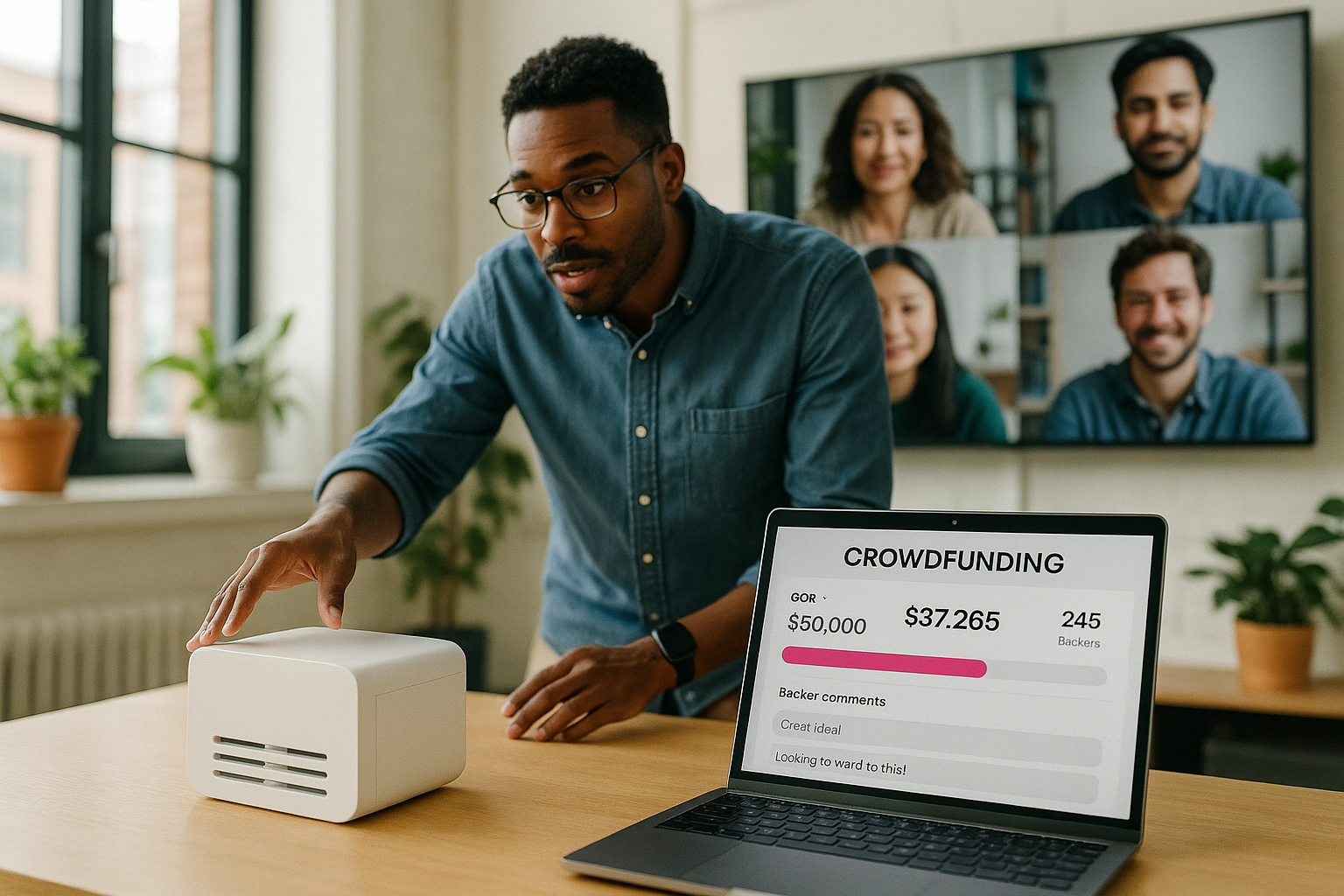
A consumer device startup targets $250,000. At an average ticket of $250, they need about 1,000 backers. With a conversion rate near 3% from a warmed audience of 40,000 email/social followers, the math closes. If the average ticket lifts to $350, the backer count drops to 715, lowering fulfillment load.
Synthesis: By compressing minimum checks and automating compliance, platforms broaden who can invest and how fast a raise can start, without lowering regulatory safeguards.
2. Turning Customers into Owners and Advocates
The most disruptive feature of crowdfunding is community equity—inviting the people who love your product to own a piece (or at least share in economic upside). When your earliest adopters become investors or revenue-share partners, they don’t just buy; they recruit, review, and return. This alignment reduces pure paid-acquisition dependence and turns financial backers into distribution nodes. In rewards campaigns, the same dynamic appears as escalating reward tiers that convert superfans into evangelists. When you layer in structured updates and Q&A, you get an advocacy loop that institutional rounds rarely match.
Why it matters
- Organic reach: Investor-customers share updates and refer friends because their upside is aligned.
- Reduced CAC: Warm community lowers the marginal cost of future launches and add-ons.
- Better feedback: Backers bring edge-case usage data and early defect reports.
Mini case
A DTC beverage brand sells 3,000 pre-order bundles at $60 average pledge, generating $180,000 revenue and 3,000 ambassadors. A subsequent equity round invites 600 of them at $250 average, adding $150,000 and a durable base for retail launches.
Synthesis: Converting superfans into financial stakeholders builds a flywheel—each launch seeds the next with a larger, more motivated audience.
3. Market Validation Through All-or-Nothing and Pre-Orders
Rewards platforms popularized all-or-nothing funding: if a campaign doesn’t hit its target, no funds are collected. This structure offers creators budget certainty and gives backers confidence that projects won’t be underfunded and undeliverable. For physical products, pairing all-or-nothing with staged reward tiers and stretch goals provides a live demand curve before committing to tooling or minimum order quantities (MOQs). Even equity campaigns benefit from this validation: a sell-out round publicly signals momentum to partners, retailers, and future investors.
How to do it
- Model your true minimum: Set the minimum you need to deliver (tooling, BOM, freight, taxes, fees).
- Use tiered rewards: Anchor an early-bird price to drive day-one velocity; cap quantities to preserve urgency.
- Plan for slippage: Add a contingency buffer for overruns; don’t hide risk—state it plainly.
Mini case
A tabletop device costs $42 landed per unit (materials, assembly, freight). With a $79 early-bird and $99 standard tier, and a 5% platform fee plus 3% payments, the team needs 2,500 units at an $85 blended price to cover $212,500 COGS and $20,000 fixed campaign costs. They set an all-or-nothing goal of $240,000. If they don’t hit it, nobody is charged—risk is contained.
Synthesis: All-or-nothing enforces budget reality and demonstrates demand before you scale production.
4. New and Flexible Instruments: From SAFEs to Revenue Share
Crowdfunding isn’t one instrument; it’s a menu. For early-stage equity, many issuers use SAFEs (Simple Agreements for Future Equity) to close quickly with transparent dilution math; for cash-flowing businesses, revenue-share loans repay from a percentage of sales until a fixed multiple is met. Some platforms also list convertible notes and priced equity for later stages. This flexibility lets you match capital to risk and cash flow, rather than forcing a one-size-fits-all round.
Tools & examples
- SAFE (post-money): one-document security; founders can estimate dilution precisely; typical negotiables are valuation cap and MFN. Y Combinator
- Revenue share loan: investors receive, say, 1.5–3.0× their principal over time, paid from a set % of revenue until the cap is reached.
- Convertible note: debt that converts to equity at a future round (cap/discount).
- Priced equity: standard preferred stock with a set price per share.
Numbers & guardrails
- Revenue share math: At a 6% revenue share on $1,000,000 annual revenue, repayments total $60,000 that year; at a 2.0× cap on a $200,000 raise, the obligation ends at $400,000 cumulative.
Synthesis: Picking the right instrument aligns investor expectations with your operating reality and reduces negotiation drag.
5. Compliance-by-Design: Intermediaries, Disclosures, and Investor Limits
Securities crowdfunding rules require offerings to run through registered intermediaries with defined disclosures, escrow, investor education, and communication channels. This “compliance-by-design” reduces the chance of ad-hoc mistakes that would be easy to make running a raise over email and PDFs. Platforms layer KYC/KYB, anti-fraud checks, and standardized risk warnings; issuers complete structured forms (e.g., Form C in the US) that publish financials, cap table basics, and a use-of-proceeds narrative. Retail investors get guardrails, while issuers get a checklist and a single system of record.
Mini checklist
- Verify the portal or broker is registered for the jurisdiction you target.
- Prepare financial statements at the right assurance level (self-certified, reviewed, or audited per raise size).
- Publish material risks; keep communication on the platform to preserve a clean audit trail.
- Track investor limits and eligibility rules; the portal automates most checks. SEC
Region notes
- EU platforms operate under the ECSPR regime with a strong investor-protection focus coordinated by ESMA and national regulators. UK rules are administered by the FCA, with updated frameworks for public offer platforms.
Synthesis: The platform and regulator share the same goal: widen access while standardizing disclosures so retail participation is safer.
6. Speed and Parallelism: Run Crowdfunding Alongside Other Capital Sources
Traditional fundraising often means serial conversations with a small number of decision makers. Crowdfunding flips this to parallel communication with many small ones, front-loaded into a launch window. From first teaser to close, a well-prepared campaign frequently completes on a timeline measured in weeks, not quarters, because documents, investor verification, and payments are templated. Founders also run parallel tracks: an equity campaign to aggregate community checks while negotiating a lead investor for a priced round. The public momentum and social proof can help the institutional close, while the institution’s term sheet can anchor the community round’s valuation.
How to accelerate without cutting corners
- Pre-commit: Soft-circle 20–40% of your goal before launch to spark early momentum.
- Publish a calendar: Announce key milestones (AMA, demo stream, “last 72 hours”).
- Use roll-up vehicles: Aggregate many micro-checks into a single line item to keep your cap table tidy (see §9).
Mini case
A climate-tech startup lines up $150,000 in soft commits, launches a $500,000 community round, and crosses 30% on day two. A strategic investor follows for $250,000, enabling a combined close at target in under 30 days—with one cap table entry for 400 small checks via an RUV.
Synthesis: Templated rails plus parallel storytelling compress the raise, provided you pre-commit anchors and coordinate the close.
7. The Distribution & PR Flywheel You Don’t Have to Pay For Twice
Platforms are not just payment pipes—they are discovery engines. Homepages, newsletters, category rankings, and editorial features expose your raise to investors who browse by theme or traction. While you should still drive the majority of traffic, platform distribution acts like second-order reach: it rewards early velocity with visibility, which brings more backers, which lifts you in rankings. Some platforms monetize this with promoted placements or extra fees for traffic they drive, but used wisely, these channels offset paid acquisition you’d buy elsewhere.
Tips to unlock the flywheel
- Front-load day-one: Launch with existing customers so algorithms see velocity.
- Packaging matters: Clear video, hero visuals, and a focused “why now.”
- Cadence: Short, value-packed updates keep you in email digests and “trending” carousels.
Mini case
An audio gadget campaign sees 65% of contributions from owned channels and 35% from “platform discovery” once it trends; the latter comes with a 15% fee on traffic the platform drives, which the team budgets for because blended CAC remains favorable.
Synthesis: Treat the platform like a marketplace—optimize for ranking signals and plan for the economics of traffic they deliver.
8. Transparency and Diligence: Structured Pages, Q&A, and Updates
Crowdfunding pages standardize how you present your offer: problem, solution, team, traction, financials, terms, and risks. This structure reduces hidden information and enables apples-to-apples comparisons for investors. Ongoing updates and open Q&A threads give a public record of promises and progress, which raises the bar on communication and puts discipline around claims. In securities campaigns, disclosures include financial statements and risk factors; in rewards campaigns, all-or-nothing targets and delivery timelines are explicit. The result is a transparent dossier that beats scattered decks and emails.
Common mistakes
- Vague risks: Use concrete risk statements (“supply chain lead times may extend by 8–12 weeks”) not platitudes.
- Hiding metrics: If you cite conversion rates or cohort behavior, show the math and caveats.
- Silent periods: Momentum stalls when updates stall; schedule them.
Mini case
A SaaS team publishes MRR snapshots and churn cohorts, answers 42 investor questions in public, and pins an update clarifying roadmap trade-offs. Result: higher investor confidence, fewer repetitive DMs, and a cleaner diligence trail for a future priced round.
Synthesis: Transparency is not marketing fluff; it’s a compounding asset that reduces friction at every subsequent raise.
9. Keeping the Cap Table Clean with Roll-Up Vehicles (RUVs)
One practical fear about community rounds is a messy cap table. Roll-Up Vehicles (RUVs) solve this by pooling hundreds of micro-checks into a single legal entity that appears as one shareholder on your cap table. Investors subscribe to the RUV; the RUV invests into your round under your standard terms (SAFE, note, or equity). You get community access without operational drag—one line item, one set of notices, one point of contact for consents. RUVs are purpose-built variants of SPVs designed for founder-led aggregation.
Why founders use RUVs
- Simplicity: Replace hundreds of entries with one.
- Speed: Standard docs and a portal for investor onboarding.
- Cost control: Predictable admin over the life of the vehicle.
Mini case
A software company runs a SAFE at a $20M cap and accepts $600,000 in small checks into an RUV. Instead of 500 new entries, the cap table shows 1. Investor updates go to the RUV manager, who relays to participants—founders avoid logistical overhead while preserving community ownership.
Synthesis: If you want the “many backers” upside without cap table sprawl, an RUV is the practical bridge.
10. Global Reach with Local Rules: Selling Across Borders
Crowdfunding often attracts cross-border backers, but issuers must obey local investor-protection rules and platform eligibility criteria. In the EU, the unified ECSPR framework harmonizes many requirements, while national regulators still supervise implementation. In the UK, the FCA maintains tailored rules for investment-based platforms and is rolling out a regime for public offer platforms. Practically, this means choosing a platform authorized where your investors reside, providing clear risk warnings, and planning for tax/VAT and shipping realities if you’re running rewards.
Mini checklist
- Confirm the platform’s authorization in each target market.
- Budget for VAT/GST in reward fulfillment; clarify who pays duties.
- Localize risk disclosures and investor education pages.
- Mind currency and FX timing; some platforms collect in multiple currencies.
Mini case
An EU hardware startup lists on a platform passported under ECSPR and ships rewards globally with DDU terms to avoid customs surprises. They price in EUR but disclose FX swings; investor communications include an English default and local language FAQs.
Synthesis: Global backers are a strength—if you localize compliance, taxes, and logistics from day one.
11. Liquidity (Sometimes): Secondary Markets and Transfer Options
Private investments are illiquid, but some platforms offer bulletin-board-style secondary markets where existing investors can express interest to buy or sell shares during specified trading windows. Liquidity is not guaranteed—eligibility varies by security, and trades clear only when a matching counterparty appears—but these mechanisms can shorten holding periods for a subset of investors and help price discovery. Understanding how these markets operate, their fees, and any lockups helps set correct expectations.
Numbers & guardrails
- Trading cadence: Some markets open for one week per month on a fixed schedule.
- Eligibility: Not all securities are tradable; nominee or custodian structures may be required.
- Reality check: A listing doesn’t guarantee a buyer; plan to hold to exit.
Mini case
A UK investor wants to reduce a position in a crowdfunded portfolio company. During the monthly window, they list at a modest premium, but no buyer appears; the order rolls off—demonstrating why secondary access should be treated as optional, not assured.
Synthesis: Treat secondary markets as a potential bonus, not a core part of your financing plan.
12. When Crowdfunding Is the Wrong Fit (and What to Do Instead)
Crowdfunding isn’t a universal solution. If your product has thin gross margins (say, under 40–50% landed after freight and fees), rewards campaigns can become cash traps. If your business needs few, concentrated buyers (enterprise SaaS, defense), broad retail participation may add noise without capital. Highly technical hardware with long certification cycles or uncertain unit economics may also struggle to set honest timelines. In these cases, consider a deep-tech grant, a strategic pilot with milestone-tied payments, or a small SAFE with a specialized lead.
Red flags & alternatives
- Low margin physical goods: Prefer equity or revenue share to avoid under-funded fulfillment.
- Enterprise-only go-to-market: Raise from angels with domain expertise; target pilot contracts instead of pledges.
- Complex regulatory path: Budget legal timelines and consider staged raises tied to approvals.
Numbers & guardrails
- Fees: Plan ~5% platform + ~3% payments; rewards platforms may charge higher fees on traffic they drive.
- Goal math: If your break-even at 100% funded is unrealistic, your target is wrong—rebuild your BOM, MOQs, and freight assumptions.
Synthesis: Crowdfunding works best when margins, timelines, and audience fit the medium; when they don’t, pick instruments and partners that do.
A small reference table you can reuse
| Model | What you give | Backer expectation | Biggest strength | Watch-outs |
|---|---|---|---|---|
| Rewards (all-or-nothing) | Product/perks | On-time delivery | Demand validation before tooling | COGS, freight, delays |
| Equity (SAFE/notes/priced) | Ownership or future equity | Exit or dividends | Scales to larger totals | Dilution, disclosures |
| Revenue share / loan | % of revenue until cap | Cash returns over time | Aligns with cash flow | Sales volatility, cap math |
Conclusion
Crowdfunding platforms change the who, how, and when of startup finance. They open the door to retail participation under standardized rules; let you pick instruments that match your cash flow and stage; and convert customers into owners who fuel distribution. Used well, they compress timelines, produce cleaner validation signals, and build a durable audience for future launches. Used poorly, they amplify manufacturing risk, margin mistakes, and communication gaps. The through-line is discipline: choose the right model, show your math, and treat your community like long-term partners. If you’re ready to test whether crowdfunding fits your roadmap, run a tight pre-launch, front-load commitments, and ship transparent updates—then compound the momentum with every campaign.
CTA: If this helped, share it with a co-founder and start a draft campaign brief today.
FAQs
1) What’s the difference between rewards crowdfunding and equity crowdfunding?
Rewards campaigns collect pre-orders or perk pledges without selling ownership; your promise is delivery. Equity campaigns sell a slice of the company (now or later via a SAFE/note) with disclosures, investor limits, and a portal. Rewards are great for validating demand and financing production; equity suits larger raises or businesses that won’t ship a physical perk. Many teams do both: first a rewards launch for validation, then an equity round for growth. Kickstarter
2) How do I pick the right funding goal for a rewards campaign?
Start from landed COGS, MOQs, freight, taxes, platform and payment fees, and a contingency buffer. Your all-or-nothing target should be the minimum that funds delivery without magic. If you’d be in trouble at exactly 100% funded, raise the goal; if you’d regret missing it at 90%, lower it a bit—provided delivery still works. Platforms offer guidance and fee transparency to help you model. help.kickstarter.com
3) What fees should I expect?
Plan roughly 5% platform fees plus ~3% payment processing on most major rewards platforms, with possible higher fees on traffic the platform itself drives. Securities portals may charge different structures to issuers or investors; always read the fee page and offering docs. Indiegogo
4) Can retail investors really invest in startups—and how much?
Yes, within regulated limits on registered platforms. In the US, non-accredited investors can invest a percentage of income or net worth up to defined caps across all crowdfunding offerings within a 12-month period; accredited investors have no Reg CF limit. The platform automates these checks during onboarding.
5) What’s a SAFE, and why do many community rounds use it?
A SAFE is a Simple Agreement for Future Equity—a lightweight investment contract that converts into shares in a later equity round. The popular post-money SAFE lets founders and investors estimate dilution more precisely, avoiding maturity dates and interest. It speeds closes and reduces legal friction for small checks.
6) How does a revenue-share note work?
Instead of selling ownership, you promise to pay a fixed multiple (for example, 1.5–3.0×) of the investment from a percentage of your revenue until that cap is reached. Repayments rise and fall with sales; the faster you grow, the sooner investors are paid out. This model fits steady cash-flow businesses and local ventures.
7) Can I keep my cap table clean if hundreds invest?
Yes—use a Roll-Up Vehicle (RUV) or similar SPV offered by specialist providers. The RUV aggregates many investors into one legal entity so your cap table shows a single line item, while backers get portal access to documents and updates.
8) Are there secondary markets for crowdfunded shares?
Some platforms operate bulletin-board-style secondary markets with scheduled trading windows. Not every security is eligible, and demand can be thin—so treat liquidity as a bonus, not a plan. Always read the market’s rules and calendar. Seedrs
9) How do platforms protect investors?
Regimes require campaigns to run on registered intermediaries, present standardized disclosures, educate investors, and enforce investment limits. In the EU and UK, ESMA and the FCA coordinate and enforce investor-protection frameworks specific to crowdfunding.
10) Should I run crowdfunding and talk to VCs at the same time?
You can—many founders run a community round to validate demand while negotiating a lead. Use soft commits to front-load momentum, keep your terms consistent, and, if necessary, place community investors into an RUV so the cap table remains tidy for the institutional close. help.angelliststack.com
References
- “Regulation Crowdfunding.” U.S. Securities and Exchange Commission — Jun 21, 2024. https://www.sec.gov/resources-small-businesses/exempt-offerings/regulation-crowdfunding
- “Updated Investor Bulletin: Regulation Crowdfunding for Investors.” U.S. SEC Office of Investor Education and Advocacy — Oct 14, 2022. https://www.sec.gov/resources-for-investors/investor-alerts-bulletins/ib_crowdfundingincrease
- “Regulation Crowdfunding: Guidance for Issuers.” U.S. Securities and Exchange Commission — Oct 16, 2024. https://www.sec.gov/resources-small-businesses/regulation-crowdfunding-guidance-issuers
- “Crowdfunding.” Financial Conduct Authority (UK) — Last updated Mar 20, 2023. https://www.fca.org.uk/consumers/crowdfunding
- “PS25/10: Final rules for public offer platforms.” Financial Conduct Authority (UK) — Policy Statement. https://www.fca.org.uk/publications/policy-statements/ps25-10-final-rules-public-offer-platforms
- “Investment Services and Crowdfunding.” European Securities and Markets Authority — ESMA overview page. https://www.esma.europa.eu/esmas-activities/investors-and-issuers/investment-services-and-crowdfunding
- “Why is funding all-or-nothing?” Kickstarter Help Center. https://help.kickstarter.com/hc/en-us/articles/115005047893-Why-is-funding-all-or-nothing
- “Setting Your Campaign Goal.” Kickstarter Lessons — Feb 8, 2025. https://updates.kickstarter.com/kickstarter-lessons/setting-your-campaign-goal/
- “Fees & Pricing for Campaigners.” Indiegogo Help Center. https://support.indiegogo.com/hc/en-us/articles/204456408-Fees-Pricing-for-Campaigners-How-much-does-Indiegogo-cost
- “InDemand — How it Works.” Indiegogo for Entrepreneurs. https://entrepreneur.indiegogo.com/how-it-works/indemand/
- “How To Buy And Sell Shares On The Secondary Market.” Seedrs (Republic Europe) — Investors’ Guide. https://www.seedrs.com/investors-site/guides/how-to-buy-and-sell-shares-on-the-secondary-market/
- “Safe Financing Documents.” Y Combinator — SAFE overview and downloads. https://www.ycombinator.com/documents
- “Revenue Share Loan — How it works.” Wefunder Help Center. https://help.wefunder.com/contract/295250-revenue-share