The creator economy has rapidly evolved from a hobbyist frontier into a massive global industry. Yet, for millions of YouTubers, TikTokers, streamers, and Instagram influencers, the infrastructure of labor rights remains stuck in the past. While top-tier talent commands millions, the vast “middle class” of creators often operates without a safety net, facing inconsistent pay, vague contract terms, and the constant threat of algorithmic obsolescence.
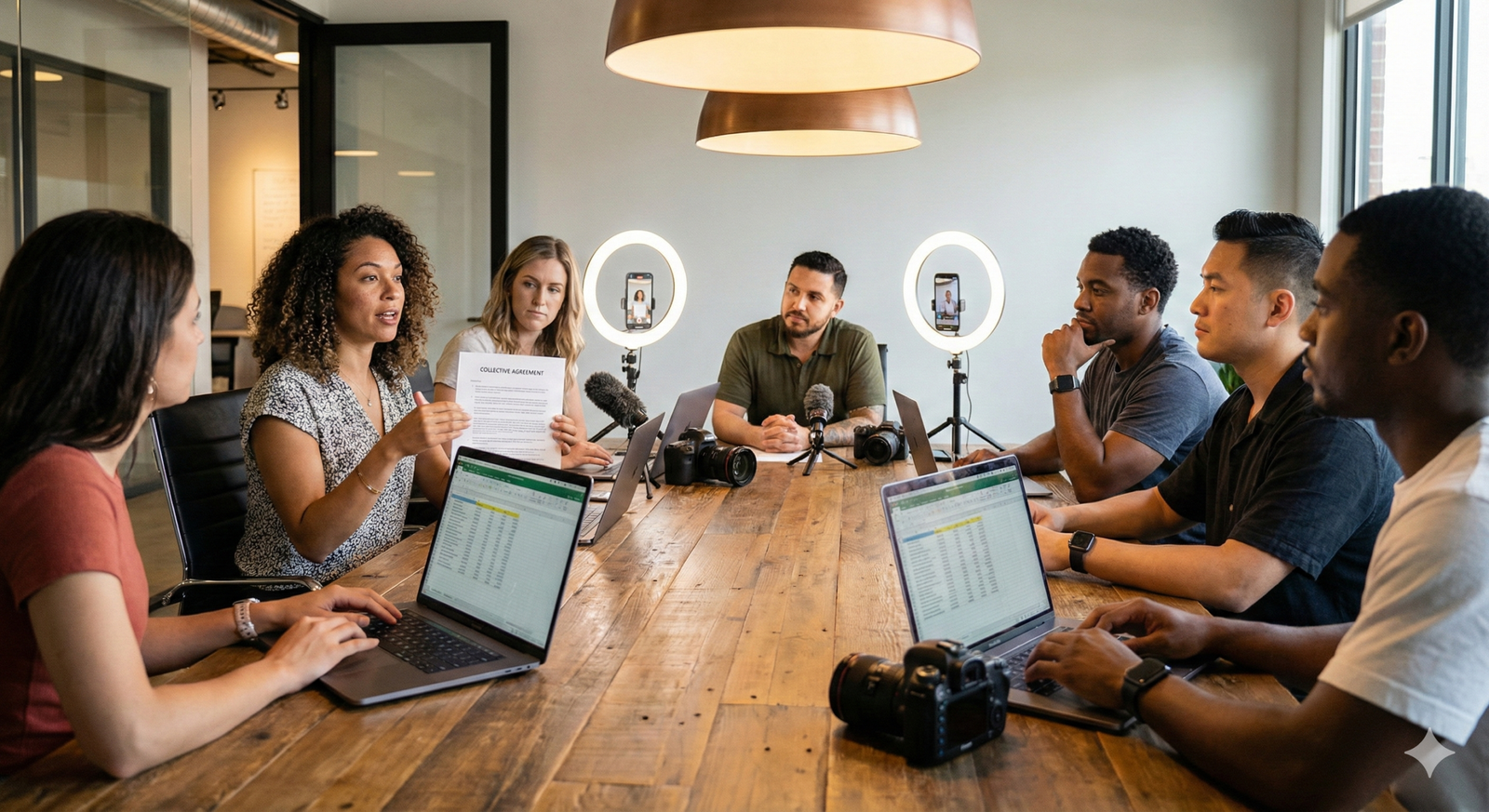
This disparity has ignited a fervent discussion around creator unions and collective bargaining. Can independent digital workers band together to demand better treatment from trillion-dollar platforms and multinational brands? Or does the very nature of being an “independent contractor” make traditional unionization impossible?
In this comprehensive guide, we will explore the legal realities, the current landscape of creator organizations, and practical strategies for negotiating fairer contracts in an industry that is still writing its own rules.
Key Takeaways
- The Classification Hurdle: Most creators are independent contractors, not employees, which legally complicates traditional unionization and collective bargaining due to antitrust laws.
- Guilds vs. Unions: Understanding the difference is vital. Guilds and associations (like the Creators Guild of America) advocate for standards, while unions (like SAG-AFTRA) can legally bargain for specific covered work.
- SAG-AFTRA’s Role: The expanding “influencer agreement” allows certain content creators to qualify for union benefits, primarily when doing sponsored brand work that functions like advertising.
- Algorithmic Bargaining: A major frontier for collective action is demanding transparency regarding the algorithms that effectively act as a creator’s “manager.”
- Individual Negotiation: Until collective bargaining is universal, creators must master contract redlining—specifically regarding usage rights, exclusivity, and payment terms.
Scope of This Guide
What this guide covers:
- The legal distinction between employees and independent contractors in the creator economy.
- The current status of unions, guilds, and trade associations relevant to influencers.
- Practical applications of collective bargaining in the gig economy.
- A deep dive into negotiating brand contracts as an individual creator.
- The intersection of AI, algorithmic transparency, and labor rights.
What this guide does not cover:
- Specific legal advice for your personal situation (always consult a lawyer).
- Tutorials on how to grow your follower count or create content.
- Political commentary unrelated to labor economics.
The Power Imbalance: Why Creators Are Organizing
To understand why the push for creator unions is gaining momentum, we must first analyze the power dynamics at play. The creator economy is often described as a “democratization of media,” but the economic reality is frequently feudal.
The “Algorithmic Boss”
Unlike a traditional job where a manager assigns tasks, creators report to an algorithm. This “invisible manager” determines visibility, reach, and ultimately, income. When a platform changes its algorithm without warning, a creator’s income can vanish overnight. There is no HR department to complain to, and no severance package when the algorithm moves on.
Monopsony Power
In economics, a monopsony occurs when there is only one buyer for a product or service. While there are multiple social platforms, for specific formats (e.g., long-form video), YouTube holds a near-monopoly. For short-form, TikTok dominates. This concentration of power allows platforms to set take rates (the percentage of revenue they keep) unilaterally. Creators have little leverage to say, “I want 70% of ad revenue, not 55%,” because there is often no viable alternative platform with the same audience scale.
The Payment Lag
In the world of brand deals, “Net 60” or “Net 90” payment terms are common. This means a creator might deliver work today but not see payment for three months. For independent creators who front the costs of production, equipment, and sometimes hiring their own team, this creates a severe cash flow crunch that traditional employees do not face.
Lack of Benefits
Health insurance, retirement matching, paid time off, and unemployment insurance are nonexistent for the vast majority of creators. When a creator gets sick or burns out, their income stream simply stops.
The Legal Hurdle: Employees vs. Independent Contractors
The single biggest obstacle to creator unions is the legal classification of influencers. In the United States and many other jurisdictions, labor laws regarding unions are designed for employees, not independent contractors.
The Antitrust Problem (Sherman Act)
Under U.S. law, specifically the Sherman Antitrust Act, independent contractors are viewed as individual business entities. If a group of businesses (creators) gets together to agree on a minimum price for their services (e.g., “Nobody accepts less than $50 CPM”), federal regulators could view this as price-fixing or a cartel, which is illegal.
Employees are exempt from this because labor laws (like the National Labor Relations Act) specifically allow them to organize. Contractors do not have this exemption. This means a “YouTubers Union” cannot legally force YouTube to the bargaining table to negotiate ad revenue splits in the same way the United Auto Workers can force GM to negotiate wages.
The “Dependent Contractor” Debate
Some labor experts advocate for a third category: the “dependent contractor.” This classification recognizes workers who are technically freelancers but are economically dependent on a single platform (like Uber drivers or YouTubers). Countries like Canada and Spain have explored variations of this, granting specific collective bargaining rights to these workers without classifying them as full employees. As of 2026, this remains a fiercely debated topic in legislative bodies globally.
The Landscape of Creator Organizations
Despite the legal hurdles, creators are organizing. Several bodies exist to support influencers, ranging from formal unions to advocacy groups and trade associations.
1. SAG-AFTRA (The Influencer Agreement)
The Screen Actors Guild – American Federation of Television and Radio Artists (SAG-AFTRA) is the heavy hitter in entertainment labor. Recognizing the shift in media consumption, they introduced the Influencer Agreement.
- How it works: This agreement covers content creators who produce sponsored video and audio work. If a creator signs a brand deal, that specific job can be covered by a SAG-AFTRA contract.
- The Benefit: It allows creators to qualify for the union’s health and pension plans based on their influencer earnings. It also ensures the brand pays directly into the benefit funds.
- The Limitation: It largely applies to commercial work (brand deals), not the passive ad revenue generated from platforms like YouTube or Twitch.
2. The Creators Guild of America (CGA)
The CGA operates differently from a traditional union. It functions more like a professional association or a guild in the medieval sense—focused on standards, accreditation, and advocacy.
- Mission: To professionalize the industry, provide verified data on rates, and lobby for legislative protection.
- Value: By publishing data and best practices, they help creators negotiate better individually without violating antitrust laws. They provide the “information symmetry” that is often lacking.
3. The American Influencer Council (AIC)
The AIC is a trade association for career creators. Trade associations generally focus on industry growth, networking, and lobbying rather than adversarial bargaining against employers. They are crucial for establishing the legitimacy of the profession in the eyes of the government and advertisers.
4. The YouTubers Union (FairTube)
Based in Europe (specifically originating in Germany), the YouTubers Union partnered with IG Metall, a massive industrial union. Because European labor laws are generally more permissive regarding dependent contractors and collective representation, they have had some success in opening direct lines of communication with YouTube regarding arbitrary bans and demonetization, illustrating that regional differences play a huge role in what is possible.
Collective Bargaining: What Would It Actually Look Like?
If the legal hurdles were cleared, or if platforms voluntarily agreed to bargain (unlikely, but possible), what would a collective bargaining agreement (CBA) for creators cover? It would likely go far beyond just “more money.”
Standardized Dispute Resolution
Currently, if a creator is banned or demonetized, their only recourse is often tweeting at the platform’s support account and hoping for a reply. A CBA would establish a formal grievance procedure with neutral arbitration, ensuring that creators cannot be fired (de-platformed) without due process.
Minimum Rate Floors
While price-fixing is illegal for contractors, a CBA could establish minimums for platform-based incentives. For example, a “Creator Fund” payout could have a guaranteed floor per 1,000 views, preventing the “race to the bottom” where platforms lower payouts as content supply increases.
Data Transparency
Collective bargaining could force platforms to reveal the mechanics of the algorithm to a neutral auditor. This wouldn’t mean making the code public, but it would ensure the platform isn’t shadow-banning creators based on protected characteristics (race, gender, political affiliation).
Portable Benefits
A massive goal for the gig economy is a portable benefits system. Instead of benefits being tied to one employer, platforms would contribute a small percentage of creator earnings into a central fund. This fund would purchase health insurance and retirement plans that belong to the creator, regardless of which platform they are currently using.
How to Negotiate Like a Union of One
Until collective bargaining becomes a widespread reality, creators must advocate for themselves. However, you can adopt the tactics of a union negotiator when dealing with brands. This section details how to negotiate fairer contracts today.
1. Scope of Work (SOW) Creep
Brands often ask for “one video” but the contract describes three rounds of revisions, social cuts, cross-posting, and whitelisting.
- The Fix: Define the SOW strictly. “One 60-second video, one round of minor revisions. Additional revisions or cuts are billed at $X.”
2. Usage Rights and Whitelisting
This is where creators lose the most money.
- Organic Usage: The brand posts your content on their feed. (Usually included).
- Paid Media (Whitelisting): The brand runs ads using your handle or content. This is incredibly valuable.
- The Negotiation: Never give “usage in perpetuity” (forever). Limit usage to 30, 60, or 90 days. If they want to run ads with your face for a year, that costs significantly more (often 30-50% of the base fee per month of usage).
3. Exclusivity Clauses
A brand might pay you $1,000 for a video but demand you “cannot work with any competitors for 6 months.”
- The Problem: If you review tech, and you can’t work with “competitors” of Samsung, does that mean you can’t review an iPhone? That kills your channel.
- The Negotiation: Narrow the exclusivity. Instead of “all technology,” specify “Android smartphones.” Reduce the time window to the duration of the campaign plus 30 days.
4. Indemnification
Contracts often have clauses saying the creator indemnifies (protects) the brand from lawsuits.
- The Danger: If the brand’s product explodes and someone sues you because you advertised it, a bad contract means you pay the brand’s legal fees.
- The Negotiation: Demand mutual indemnification. You cover them if your content infringes copyright; they cover you if their product causes harm or their claims are false.
5. Payment Terms
- The Trap: “Net 90” means you are effectively lending the brand money for three months.
- The Negotiation: Request “Net 30” or “50% upfront, 50% on delivery.” Large corporations have slow accounts payable departments, but they can move faster if you push, especially if you offer a small discount for immediate payment (or a penalty for late payment).
Case Studies: Lessons from Other Industries
To understand the future of creator unions, we can look at adjacent industries that have undergone similar struggles.
The Writers Guild of America (WGA) 2023 Strike
The WGA strike was pivotal because it wasn’t just about pay—it was about AI and platform transparency. Writers demanded guardrails against AI replacing them and residuals based on streaming data transparency.
- Lesson for Creators: The fight isn’t just about the rate per video; it’s about owning your likeness (so AI can’t replicate you) and knowing how much money the platform actually makes from your work.
Uber and Lyft Drivers (The Gig Economy)
Rideshare drivers have fought a global battle regarding their status as contractors vs. employees. In places like California (Prop 22) and the UK, compromise models have emerged where workers remain independent but gain minimum earnings guarantees and healthcare subsidies.
- Lesson for Creators: Legislative change is possible, but it usually results in a hybrid model rather than full employment status. Creators should watch “gig worker” legislation closely, as it sets the precedent for digital influencers.
The Role of Artificial Intelligence in Collective Bargaining
AI is the new variable in the labor equation. Generative AI poses two distinct threats to human creators, making collective organization more urgent.
1. Dilution of Value As AI tools flood platforms with high-quality, synthetic content, the supply of “content” explodes. Basic economic theory suggests that when supply becomes infinite, price approaches zero. Human creators may need to organize to demand “human-created” tags or verified prioritization on platforms to maintain their value.
2. Likeness Rights We are already seeing brands use AI avatars instead of human influencers. A union or guild is essential to establish legal standards for “digital clones.” If a brand uses your previous footage to train an AI to make new videos of “you,” do you get paid? Without a collective agreement, the answer in many current contracts is “no.”
Who This Is For (and Who It Isn’t)
This guide is primarily for:
- Mid-tier creators: Those relying on brand deals and AdSense to pay rent, who are most vulnerable to exploitation.
- Career creators: Individuals treating content creation as a small business who need to understand liability and labor leverage.
- Policy advocates: Those interested in the intersection of labor law and the digital economy.
This guide is less relevant for:
- Hobbyists: If you post purely for fun with no intent to monetize, labor contracts are likely not a concern.
- Mega-celebrities: Creators with massive leverage (e.g., MrBeast) act more like studios than workers; they have their own legal teams and do not necessarily need collective bargaining to get fair terms.
Common Mistakes in Creator Activism
When pushing for labor rights, creators often fall into specific traps that undermine their efforts.
- Thinking “Union” means “Employee” Many creators reject unions because they value their freedom and do not want to be employees of YouTube or TikTok. It is crucial to frame the conversation around guilds and standards that protect independence while curbing exploitation, rather than forcing an employment model that doesn’t fit the industry.
- Ignoring Antitrust Laws Organizing a boycott or price floor on a Discord server might feel like justice, but it can legally be considered anti-competitive behavior. Advocacy groups must be careful to share aggregated, anonymized data (which is legal) rather than explicitly coordinating pricing.
- Focusing Only on Top-Line Revenue Fixating on “CPM” (Cost Per Mille) ignores the hidden costs of bad contracts: lost IP rights, harsh exclusivity, and lack of insurance. Collective bargaining is as much about safety and rights as it is about cash.
Future Outlook: What to Watch
As of 2026, the landscape is shifting. Here are the trends to watch regarding creator labor rights:
- The PRO Act (US): Legislation that could make it easier for independent contractors to organize is a perennial topic in Washington. If passed/amended to include gig workers, it would be a game-changer.
- Platform-Specific Guilds: We may see the rise of specific “TikTok Creator Councils” or “Twitch Partner Associations” that are formally recognized by the platforms, serving as a middle ground between a suggestion box and a union.
- Insurance Pools: Expect to see more private fintech companies stepping in to offer “union-like” benefits (insurance, tax withholding) to creators, effectively privatizing the safety net that unions usually provide.
Conclusion
The question “Can influencers negotiate fairer contracts?” has two answers. Individually? Yes, by increasing their business literacy, understanding contract law, and leveraging their unique audience connection. Collectively? It is difficult, but increasingly necessary.
As platforms leverage AI and algorithm changes to maximize their own profits, the human element of the creator economy becomes vulnerable. While a traditional “YouTubers Union” faces significant legal hurdles, the rise of guilds, the expansion of SAG-AFTRA, and the growing class consciousness among digital workers suggest that the era of the “wild west” is ending. The next phase of the creator economy will be defined not just by who creates the best content, but by who builds the strongest collective leverage.
Next Steps: If you are a professional creator, review your current contracts for the “red flags” mentioned above. Consider joining a trade association like the AIC or the Creators Guild of America to stay informed on industry standards.
FAQs
1. Can YouTubers legally form a union? Technically, no, not in the traditional sense of an employee union under US law (NLRA), because YouTubers are independent contractors. However, they can form guilds or trade associations to advocate for their interests, lobby for legislation, and publish voluntary standards, though they cannot force platforms to bargain collectively without changes to antitrust or labor laws.
2. What is the difference between a guild and a union? A union creates a legally binding relationship with an employer to negotiate specific terms (wages, hours) for employees. A guild is typically an association of independent artisans or professionals (like the Screen Actors Guild prior to labor reforms, or the Graphic Artists Guild) that sets standards, offers benefits, and advocates for the profession, but may not always have the power to strike or force binding contracts on all clients.
3. Does SAG-AFTRA cover TikTokers and YouTubers? Yes, under the “Influencer Agreement.” This agreement covers content creators who are creating branded, sponsored content. It allows them to pay into the union health and pension plans. However, it does not cover the passive ad revenue earned directly from platform views.
4. Why is “Work for Hire” bad for creators? “Work for Hire” is a copyright term meaning the client (brand) owns the work you created entirely, forever. You lose all rights to it. It is better to negotiate a “license,” where you retain ownership but grant the brand permission to use the content for a specific time and purpose.
5. Can a union stop YouTube from demonetizing me? Not currently. Platforms are private companies with terms of service that allow them broad discretion. However, a strong collective bargaining group could theoretically negotiate for a “just cause” provision or an independent appeals process to prevent arbitrary demonetization.
6. What is the Sherman Antitrust Act and why does it matter to creators? The Sherman Act prevents businesses from colluding to fix prices. Since creators are “businesses,” if they collectively agree to set a minimum price for ads, they could be sued for forming a cartel. This is the primary legal barrier preventing a widespread “creator strike” or fixed pricing model.
7. How can creators get health insurance if they aren’t employees? Currently, most must purchase individual plans on the open market. However, joining organizations like the Freelancers Union or qualifying for SAG-AFTRA through branded work can provide access to group rates or union-specific health plans.
8. What impact will AI have on creator contracts? AI is introducing new clauses regarding “likeness rights.” Creators need to ensure their contracts explicitly state that their voice, image, and content cannot be used to train AI models or create synthetic versions of them without separate compensation and consent.
References
- SAG-AFTRA. (n.d.). Influencer Agreement. SAG-AFTRA Official Site.
- Federal Trade Commission. (n.d.). The Antitrust Laws: Sherman Act. FTC.gov. https://www.ftc.gov/advice-guidance/competition-guidance/guide-antitrust-laws/antitrust-laws
- Creators Guild of America. (2024). Advocacy and Standards for the Digital Age. CGA. https://creatorsguild.net
- American Influencer Council. (n.d.). Trade Association for Career Creators. American Influencer Council. https://www.americaninfluencercouncil.com
- National Labor Relations Board. (n.d.). Employee Rights vs. Independent Contractors. NLRB.gov. https://www.nlrb.gov/resources/faq/nlrb
- IG Metall / FairTube. (2019). The YouTubers Union and FairTube Campaign. IG Metall. https://www.igmetall.de
- Writers Guild of America. (2023). 2023 MBA Contract Summary. WGA.org. https://www.wga.org
- Harvard Business Review. (2023). The Creator Economy Needs a Labor Movement. HBR.org. https://hbr.org