If you’ve built a smart contract and now need real-world data, verifiable randomness, cross-chain messages, or automated execution, this Chainlink tutorial shows you exactly how to integrate oracles in a safe, repeatable way. In one sentence, an oracle connects your onchain contract to trustworthy offchain information or services—and Chainlink is the most widely used oracle platform for doing that. In this guide you’ll learn which Chainlink service to use, how to wire it into Solidity, how to test it locally, and how to deploy with confidence. This is educational content, not security or financial advice; always review code and consult qualified auditors when stakes are high.
At a glance (the 10 steps you’ll follow): choose your dev stack → map the oracle job to a Chainlink service → read price data with Data Feeds → fetch any API with Functions → add fair randomness with VRF → schedule work with Automation → send messages or tokens across chains with CCIP → test with mocks and forks → deploy and verify → monitor and harden for production.
1. Pick a practical dev stack and scaffold your project
Start by choosing a development workflow you can live in every day because it influences how quickly you ship, how easily you test oracle paths, and how safely you deploy. The two popular stacks are Hardhat (JavaScript/TypeScript-first, rich plugin ecosystem) and Foundry (Rust-fast toolchain with Forge for testing and Anvil for local chains). Either stack works well with Chainlink’s contracts and examples, and both let you spin up local or forked test chains to simulate oracle callbacks. Hardhat’s “Ignition” deployment modules make repeatable deployments convenient, while Foundry’s speed and cheatcodes make integration tests feel lightweight. If you prefer zero-setup in the browser, Remix remains handy for quick trials, but you’ll eventually want a scriptable stack. You’ll also pick a client library: ethers.js is the usual choice; in v6, you construct a new ethers.JsonRpcProvider(rpcUrl) to talk to your node or a hosted endpoint. Keep everything in a monorepo if you can—contracts, scripts, tests—because debugging oracle flows often touches multiple layers.
How to do it
- Hardhat: mkdir app && cd app && npx hardhat –init, add ethers and plugins, configure networks, and create deployment tasks or Ignition modules.
- Foundry: curl -L https://foundry.paradigm.xyz | bash && foundryup, then forge init to scaffold; use anvil for a local chain and forge script for deploys.
- Provider: create an ethers v6 provider with new ethers.JsonRpcProvider(url) and a signer for sends; remember Provider is read-only, Signer sends transactions.
Mini-checklist
- Node and package manager installed; RPC URLs for testnets; a funded test wallet; .env for keys; a reproducible deploy script.
Close this step by committing a clean baseline. You now have a place to add Chainlink integrations without churn.
2. Map your oracle need to the right Chainlink service
Most integration mistakes come from choosing the wrong tool for the job. Chainlink offers several complementary services, each with a specific trust model and onchain interface. Data Feeds give you aggregated market data like asset prices. Functions runs your JavaScript offchain, calls any web API, and verifies decentralized execution before returning a result. VRF provides provably fair randomness. Automation (Upkeeps) runs your maintenance tasks on a schedule or condition. CCIP sends messages and tokens across chains with defense-in-depth security. Your selection depends on whether you need reference data, arbitrary API access, randomness, time-/event-based execution, or cross-chain communication. Think “read-only fact,” “compute & fetch,” “randomness,” “cron/state watcher,” or “cross-chain”. When in doubt, start from the smallest thing that works and avoid inventing your own oracle.
One-page table: which service when
| Job to be done | Chainlink service | Onchain pattern | Typical latency | Cost unit (high level) |
|---|---|---|---|---|
| Price/market data | Data Feeds | Read aggregator proxy | Low (read) | Gas to read |
| Any web API + lightweight compute | Functions | Request → fulfill callback | Moderate | Request fee + gas |
| Fair randomness | VRF | Request → fulfill callback | Moderate | Request fee + gas |
| Scheduled/conditional actions | Automation | checkUpkeep/performUpkeep | Low–moderate | Upkeep execution gas |
| Cross-chain messaging/tokens | CCIP | Router send/receive | Moderate | Message fee + gas |
Tools/Examples
- Data Feeds & API reference with aggregator proxies.
- Functions overview and guarantees.
- VRF guarantees and verification.
- Automation docs and economics overview.
- CCIP concept and architecture.
Picking the proper service aligns your trust boundaries and keeps your contract simpler, cheaper, and easier to audit.
3. Read onchain market data with Chainlink Data Feeds
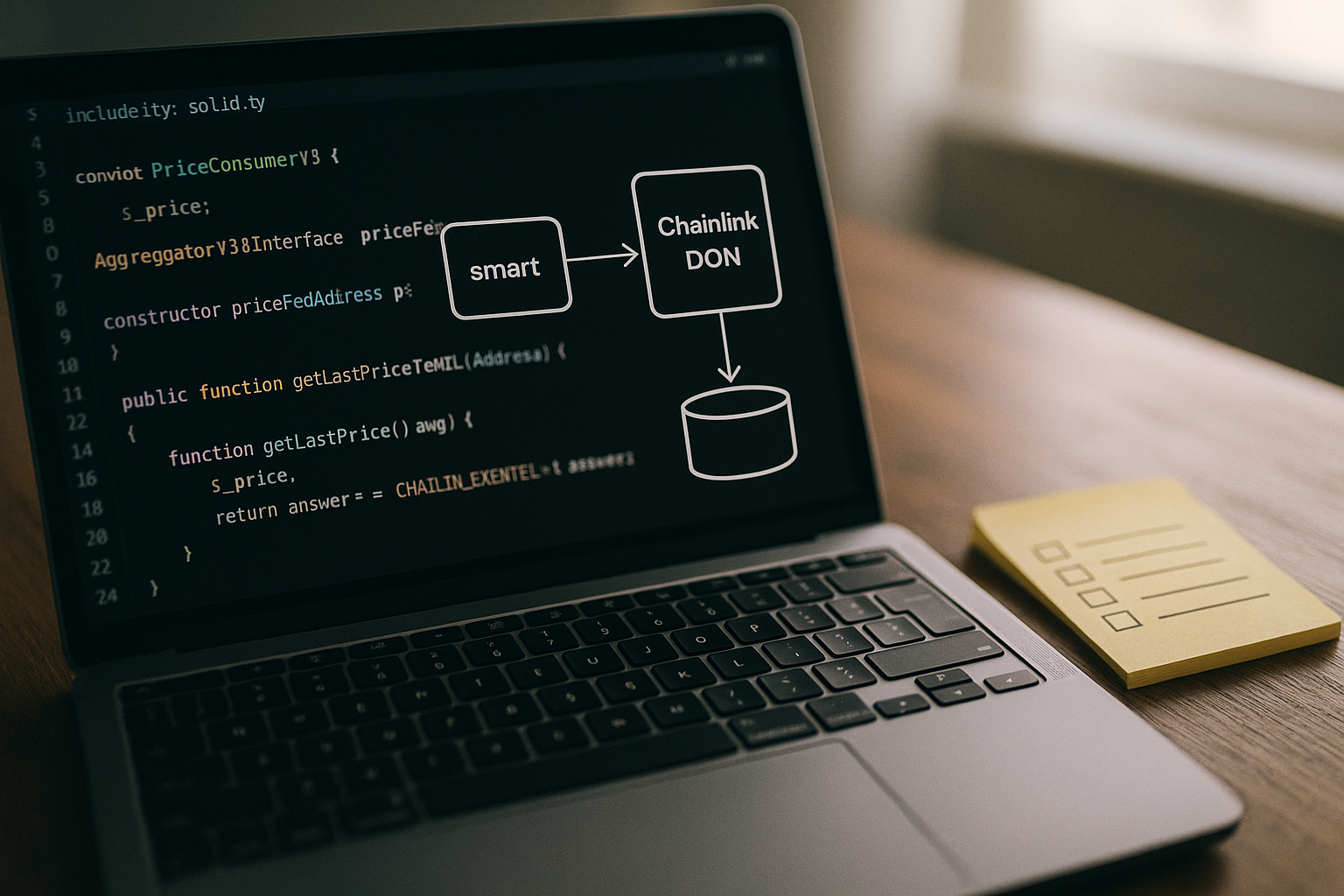
The most common integration is reading a Chainlink Price Feed: an aggregator proxy contract that publishes the latest value from a decentralized oracle network (DON) that pulls and reconciles data from multiple sources. In practice, your Solidity contract imports AggregatorV3Interface, points it to a known proxy address, and uses latestRoundData() to retrieve the current price and metadata. You scale values according to decimals() and avoid caching the answer onchain unless you have a reason; reading is cheap compared to writing. Always consult the official address list for your target chain, and prefer the Feed Registry when available to decouple from hard-coded proxies. If you need historical values, you can query prior rounds by ID. The read path is synchronous and gas-light; you only pay for a view call in Solidity or the gas of any state changes you make using that value. Chainlink Documentation
How to do it
- Import the interface: import “@chainlink/contracts/src/v0.8/shared/interfaces/AggregatorV3Interface.sol”;
- Set the proxy: AggregatorV3Interface feed = AggregatorV3Interface(<proxy_address>);
- Read the value: (, int256 answer,, uint256 updatedAt,) = feed.latestRoundData();
- Scale: use uint8 decimals = feed.decimals(); then scale math by 10**decimals.
Numbers & guardrails
- Decimals: Many USD pairs use 8 decimals, but verify via decimals() at runtime—do not assume.
- Staleness: Check updatedAt to ensure freshness for your use case.
- Registry: Where supported, use the Feed Registry to look up feeds by asset/denomination pair and avoid brittle addresses. GitHub
Common mistakes
- Hard-coding a testnet proxy in mainnet deployments.
- Failing to handle negative answer types in Solidity math.
- Ignoring round completeness or zero values.
When you follow the interface contract and registry pointers, you get resilient market data with minimal surface area and fewer upgrade worries.
4. Fetch any API or run custom code with Chainlink Functions
When your contract needs arbitrary web data (e.g., fetch an API that isn’t already onchain) or a small slice of offchain computation, use Chainlink Functions. You provide a JavaScript snippet that runs on a decentralized network of Chainlink nodes, they fetch and process offchain data, reach consensus, and deliver a verified response back to your contract’s callback. This saves you from managing your own oracle nodes and gives you defense against single-node manipulation. In Solidity, you inherit the consumer interface, create and send a request pointing to your Functions source and secrets (if needed), and implement a fulfill function that stores or responds to the result. You’ll estimate gas for the callback and fund requests appropriately. Functions are ideal when you need data that changes often or is specific to your app and not worth publishing as a public feed.
How to do it
- Author a Functions JavaScript source that fetches your API and returns a compact value.
- Configure secrets/headers as per docs; never embed secrets onchain.
- Create a request from your contract; set a reasonable callback gas limit.
- In fulfill, parse and validate the result, and gate any state changes behind sanity checks.
Numbers & guardrails
- Latency: Expect moderate end-to-end latency vs. a simple feed read; design UX accordingly.
- Fees: You’ll pay a request fee plus onchain gas for fulfillment; keep return payloads small.
- Idempotency: Make fulfill safe to call once; record request IDs to prevent replay.
Mini case
You build a sports fantasy app that needs live match stats from a paid API. A Functions script calls the API and returns a player’s current score. Your contract uses the score to settle micro-rewards after sanity-bounding the number to an expected range and round. The result is timely, verifiable, and updateable without deploying a new oracle.
Functions give you flexible reach into the web without rolling your own trust pipeline.
5. Add provably fair randomness with Chainlink VRF
Blockchain games, raffles, and randomized drops need randomness that users can verify onchain. Chainlink VRF (Verifiable Random Function) provides exactly that: you request random values, and the response includes a cryptographic proof that the randomness was generated correctly; the proof is verified onchain before your consumer gets the number. Integration involves creating or using a subscription, requesting randomness with parameters such as the number of words and callback gas limit, and handling the fulfillRandomWords function in your contract. Design around the fact that the result comes asynchronously; never assume the value in the same transaction as the request. Keep your callback lightweight and double-check bounds to avoid minting or payout errors.
How to do it
- Fund a VRF subscription and add your consumer contract.
- Call requestRandomWords with your key hash, sub ID, confirmations, num words, and gas limit.
- In fulfillRandomWords, use the randomness to update state atomically and emit events for offchain observers.
Numbers & guardrails
- Gas: Set a callback gas limit just big enough for your use case; avoid unbounded loops on randomness.
- Fairness: The onchain proof check prevents bias; don’t add extra offchain “randomness” that weakens guarantees.
- Throughput: Batch requests when possible to reduce per-request overhead.
Mini case
A raffle contract sells tickets and, after sales end, requests one random word. With totalTickets = 10,000, you compute winnerIndex = random % totalTickets. You log the index and pick the address at that index. The proof verification ensures users can confirm the draw’s integrity independently.
A correct VRF integration makes randomness a first-class, verifiable input instead of a risky afterthought.
6. Automate recurring or conditional tasks with Chainlink Automation
Many contracts need regular upkeep—settling a pool at intervals, rolling epochs, harvesting yield if profitable, or reacting to state thresholds. Chainlink Automation runs your check → perform loop on a decentralized network of keepers, so your logic executes reliably without a centralized server or hot wallet. You write a contract that implements checkUpkeep (pure/ view) to signal when work is needed and performUpkeep to do the work. Then you register an Upkeep with parameters like gas limit, funding, and trigger type (time-based or custom logic). Use Automation when user-driven triggers are insufficient or too fragile. Don’t overuse it—simple reads should remain reads; heavy loops should be split and rate-limited.
How to do it
- Implement checkUpkeep(bytes) returns (bool, bytes) to return “work needed” and encoded data.
- Implement performUpkeep(bytes) to execute; assume it could be called by Automation nodes only when checkUpkeep was true.
- Register and fund the Upkeep; set pragmatic gas limits.
Numbers & guardrails
- Cadence: Use time windows (e.g., every N blocks/seconds) so minor delays don’t break logic.
- Gas budget: Keep performUpkeep within your configured limit; fail safely if conditions change between check and perform.
- Economics: You pay gas for successful runs; batch cheap operations and avoid unnecessary writes.
Mini case
A DCA vault rebalances if the price deviates by more than 1.0%. checkUpkeep reads the Chainlink price and current allocation; if deviation exceeds the threshold, it returns true with the target trade size. performUpkeep executes trades and emits an event for indexing.
With Automation, you remove brittle cron servers and align reliability with your contract’s security model. automation.chain.link
7. Send messages and tokens across chains using Chainlink CCIP
If your app spans multiple chains, you’ll need a cross-chain rail that treats safety as a first principle. Chainlink CCIP (Cross-Chain Interoperability Protocol) provides secure messaging and token transfer primitives powered by DONs and layered security mechanisms. You interact with a Router contract to send a message or a token transfer; on the destination chain, a receiver contract processes the payload. CCIP’s defense-in-depth design reduces the risk inherent in bridging by combining decentralized oracle consensus with additional risk-management layers. Use CCIP when you must coordinate state across chains or move assets without maintaining bespoke relayers. As with other asynchronous oracles, treat delivery as eventual and design idempotent receivers.
How to do it
- Choose source and destination chains supported by CCIP; configure Router addresses.
- Encode your message or token transfer and specify gas/fee parameters.
- Implement a receiver that validates sender/selector and handles the message atomically.
Numbers & guardrails
- Fees: Cross-chain fees vary with route and payload size; keep messages compact and avoid large arrays or strings.
- Finality: Respect differing finality across chains; introduce lock/retry logic where appropriate.
- Auth: Validate the msg.sender as the trusted CCIP router on the destination chain.
Mini case
You mint rewards on Chain A but settle claims on Chain B. Your contract on A sends a compact claim hash through CCIP, and the receiver on B verifies the sender and records the entitlement, enabling a claim window there. This avoids maintaining a centralized relayer and keeps the trust model transparent.
CCIP lets you compose multi-chain features without stitching custom bridges together.
8. Test everything locally with mocks, forks, and assertions
Oracle integrations shine when your tests are rigorous. For Data Feeds, you can use mock aggregators or spin up a local chain and set the feed answer manually, then assert your contract’s math and guardrails. With Hardhat, forking a public testnet allows you to read real feed contracts in a deterministic environment. Foundry’s Anvil exposes a fast local node; pairing it with cheatcodes lets you simulate time, block numbers, and external calls. For Functions, VRF, and Automation, use official examples and test helpers to simulate requests and fulfillments; write tests that check your consumer’s state transitions, event emissions, and failure modes when callbacks revert. Resist the urge to rely only on end-to-end demo scripts—unit tests catch edge cases that demos gloss over. Ethers v6 keeps the Provider/Signer split explicit, which makes mocking read vs. write paths cleaner.
How to do it
- Mocks: Replace interfaces with local mocks that return known values and timestamps.
- Forks: Hardhat/Anvil fork a network and interact with the real aggregator proxies at known addresses.
- Assertions: Check scaling (decimals), staleness (updatedAt), and downstream math against expected bounds.
Numbers & guardrails
- Boundaries: Assert that scaled inputs fit within uint256 without overflow and that negative int256 answers are handled correctly.
- Staleness: Fail safe if a feed is older than your acceptable window.
- Async paths: For VRF/Functions, test both fulfillment success and refund/timeout paths.
Close this step with a coverage run and a short document explaining how to run the tests; future you will be grateful.
9. Deploy, verify, and wire your front end
Once tests pass, deploy to a public testnet, verify the contract, and connect a front end or script that reads/writes through your chosen provider. For quick experiments, Remix lets you compile and deploy from the browser and interact with the contract’s UI panels. For real projects, script deployments in Hardhat or Foundry so every environment is reproducible and your addresses are captured in artifacts for your front end. In ethers v6, set up a JsonRpcProvider for each environment and a Signer for write operations; remember that Providers are read-only abstractions while Signers actually send transactions with keys. After deploy, verify contracts so explorers can index your ABIs and your UI can fetch function signatures easily. Finally, record the Chainlink addresses you integrated (feed proxies, routers, registries) in config so you can switch networks safely.
Mini-checklist
- Scripted deployments with environment variables for RPC and keys.
- Contract verification step with source and metadata.
- Front-end config for Chain IDs, providers, and Chainlink contract addresses.
- Sanity tests live on testnet to confirm oracle paths behave as expected.
A disciplined deploy pipeline keeps oracle integrations boring—which is exactly what you want.
10. Harden security and add runtime monitoring
Oracles expand your contract’s boundary with the outside world; treat that boundary with respect. Validate every external input—feed values, randomness, API results—and plug them into business logic only after sanity checks like non-zero, within expected ranges, and fresh enough for risk tolerance. Use rate-limits and pause capabilities for abnormal conditions. Emit events at key decision points so you can monitor live behavior. For offchain integrations (Functions, Automation, VRF), make callback functions short, deterministic, and idempotent; log request IDs and outcomes. Keep your Upkeep logic defensive so race conditions between checkUpkeep and performUpkeep can’t be exploited. Review Chainlink’s security considerations and adopt a culture of “read twice, write once” for state changes triggered by oracle data. As you approach production, run a targeted review with an auditor who has seen oracle-driven exploits before.
Numbers & guardrails
- Bounds: Hard cap deposits/withdrawals tied to oracle prices to avoid mis-priced trades during volatility.
- Staleness: Reject updates older than your SLA window; consider dual-source checks when stakes are high.
- Fail-safe: Prefer explicit circuit breakers over implicit failures; design for safe halts.
Mini-checklist
- Require roles for configuration changes; log every config change.
- Use reentrancy guards where callbacks do external calls.
- Add observability: dashboards for feed freshness and callback success rates.
With healthy paranoia and instrumentation, you can integrate oracles without turning them into your system’s weakest link.
Conclusion
You’ve seen how to integrate oracles with smart contracts in a pragmatic 10-step path: pick a stack you’ll actually use, map the job to the right Chainlink service, wire the interface correctly, and treat every external value as untrusted input until proven otherwise. Data Feeds handle market data elegantly; Functions extends your reach to any API; VRF gives you randomness with proofs; Automation replaces fragile cron servers; CCIP opens safe cross-chain doors. Wrap those with thorough tests, scripted deployments, and principled safeguards, and you reduce both technical risk and operational toil. The payoff is significant: simpler contracts, clearer trust boundaries, and user experiences that feel dependable. Start by implementing one step in a throwaway repo today, then promote what works into your production codebase.
Call to action: Pick one service you need right now—Data Feeds, Functions, VRF, Automation, or CCIP—and integrate its minimal example into your test project before adding features.
FAQs
1) What’s the simplest way to pull a price into my contract?
Use Chainlink Data Feeds. Import AggregatorV3Interface, point to the feed’s proxy address for your network, call latestRoundData(), and scale the result using decimals(). Always check updatedAt to avoid stale reads and prefer the Feed Registry when available so you don’t hard-code addresses or redeploy just to change feeds.
2) How do I know whether to use Functions or publish my own data feed?
Pick Functions when the data is app-specific, short-lived, or requires custom offchain computation. Publishing a data feed makes sense only if the value benefits many consumers and justifies a DON’s ongoing operation. Functions reduces operational overhead by letting Chainlink nodes handle compute and consensus while you focus on input validation and business rules.
3) Can I trust randomness from VRF more than a hash-based trick?
Yes. Hash tricks like keccak(blockhash, msg.sender) are predictable and miner-influenced; VRF returns randomness plus a proof that the number was generated correctly, and the proof is verified onchain before use. This prevents bias and manipulation while keeping your consumer logic straightforward.
4) Do I need a backend server for scheduled tasks?
No. Automation provides decentralized scheduling and conditional execution without a centralized cron server. You implement checkUpkeep and performUpkeep, register an Upkeep with gas limits, and let the network handle triggering and execution economics. This reduces key-management risk and improves reliability.
5) What about cross-chain features—should I build my own bridge?
Avoid building bespoke bridges. CCIP offers a secure, audited path for message passing and token transfers across chains with layered security mechanisms and DONs. You interact with a Router, and on the destination you validate the sender before applying state changes. This saves you from maintaining relayers and handling complex failure modes.
6) Which dev stack should I start with if I’m new to Web3?
If you’re comfortable with JavaScript/TypeScript, start with Hardhat for its plugins and smooth ethers integration. If you value speed and powerful testing, try Foundry. Both support clean deployment pipelines and local testing; you can prototype in Remix first and then graduate to scripts for reproducibility. HardhatGitHub
7) How do I connect my app to the blockchain from the front end?
Use ethers.js. In v6, create a provider with new ethers.JsonRpcProvider(url), and use a Signer (e.g., from a wallet extension) for transactions. Providers are read-only abstractions; Signers add the ability to sign and send. Keep RPC URLs and chain IDs in config and avoid embedding secrets in the client.
8) What should I log or monitor in production?
Emit events for every externalized decision: Data Feed values used, VRF request and fulfillment IDs, Functions request IDs and returned payload hashes, Automation runs with success/failure, and CCIP message IDs. Build dashboards to watch freshness, error rates, and gas trends. Add circuit breakers so you can pause components safely during anomalies.
9) Can I test oracle flows without spending real tokens?
Yes. Use local chains (Anvil/Hardhat) with mocks, or fork a testnet and point at real proxies to simulate reads. For callback-style services (VRF/Functions/Automation), rely on examples and test helpers to simulate fulfillments; assert idempotency and bounds. The goal is to prove logic without relying on live networks during development. GitHub
10) What are common pitfalls when integrating oracles?
Hard-coding addresses, ignoring decimals and scaling, not checking staleness, doing heavy work in callbacks, assuming immediate availability for asynchronous results, and forgetting to guard against reentrancy. Each pitfall has simple fixes: use registries/configs, validate inputs, keep callbacks small, and write tests for failure paths.
References
- Price Feeds — Data model and usage, Chainlink Docs, https://docs.chain.link/data-feeds/price-feeds
- Data Feeds API Reference (AggregatorV3Interface), Chainlink Docs, https://docs.chain.link/data-feeds/api-reference
- Chainlink Functions — Overview, Chainlink Docs, https://docs.chain.link/chainlink-functions
- Chainlink VRF — Concepts and security, Chainlink Docs, https://docs.chain.link/vrf
- Automation — Supported networks and costs, Chainlink Docs, https://docs.chain.link/chainlink-automation
- CCIP — Architecture Overview, Chainlink Docs, https://docs.chain.link/ccip/concepts/architecture/overview
- CCIP — Product Overview, Chainlink Docs, https://docs.chain.link/ccip
- ethers.js v6 — Providers, ethers.org Docs, https://docs.ethers.org/v6/api/providers/
- Remix IDE — Creating and Deploying a Contract, Remix Docs, https://remix-ide.readthedocs.io/en/latest/create_deploy.html
- Foundry — Installation & Tooling (Anvil/Forge), Foundry Book, https://getfoundry.sh/getting-started/installation
- Foundry — forge install (reference), Foundry Reference, https://getfoundry.sh/forge/reference/install/