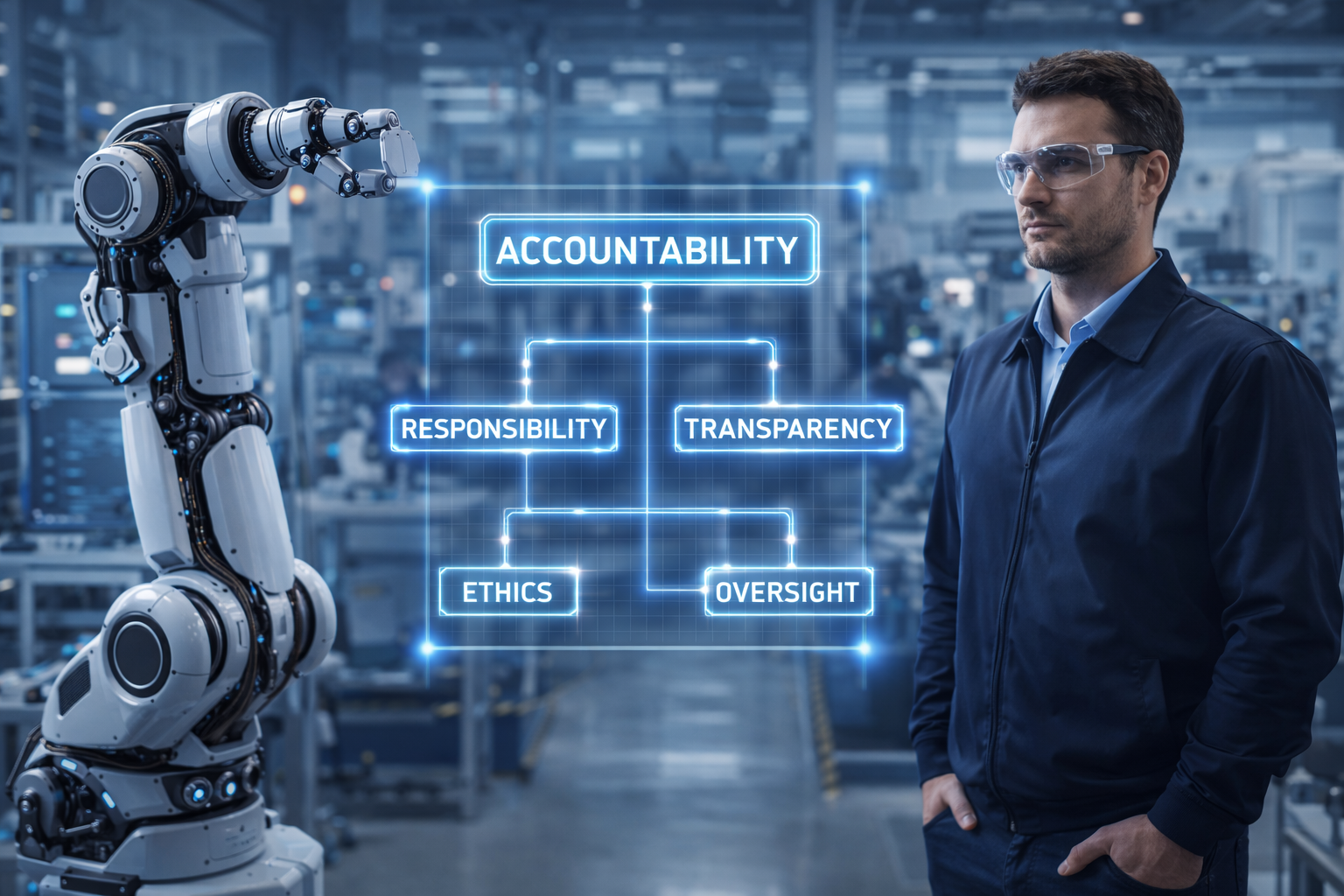
As of March 2026, the integration of artificial intelligence into physical machinery has moved from experimental labs to our public streets, hospitals, and factories. Unlike the “Virtual AI” that lives in our browsers and spreadsheets, Physical AI possesses the capacity to move, exert force, and manipulate the material world. This transition from digital bits to physical atoms brings with it a profound ethical and legal quandary known as the Autonomous Liability Gap.
The autonomous liability gap is a phenomenon where a machine performs an action that results in harm, yet because the machine’s behavior was autonomous—driven by complex, self-learning algorithms—no single human (the programmer, the manufacturer, or the operator) can be held traditionally liable for the specific outcome. This creates a “responsibility void” that threatens our existing legal systems and social contracts.
Key Takeaways
- The Agency Shift: Physical AI moves from being a “tool” to an “agent,” complicating traditional product liability.
- The Black Box Problem: Deep learning in robotics makes it difficult to trace the exact “why” behind a physical failure.
- Moral Crumple Zones: Humans are often blamed for systemic robotic failures because they are the easiest legal target.
- Need for New Frameworks: Existing tort laws (negligence and strict liability) are currently insufficient for 2026-era autonomous systems.
Who This Is For
This guide is designed for legal professionals navigating the shifting sands of tort law, roboticists and engineers building the next generation of physical agents, policymakers drafting AI governance, and business leaders deploying autonomous fleets who need to manage enterprise risk.
1. Defining Physical AI and the “Agency” Shift
To understand the liability gap, we must first distinguish Physical AI from its digital cousins. While a Large Language Model (LLM) might provide a wrong medical diagnosis (an informational harm), a Physical AI system—such as an autonomous surgical robot or a heavy-duty logistics drone—can cause direct physical injury or property damage.
From Tool to Agent
Historically, machines were viewed as “tools.” If a hammer breaks and hits someone, the manufacturer is liable for a defect, or the user is liable for misuse. However, as of March 2026, Physical AI exhibits probabilistic behavior. It does not follow a strict “if-then” script; instead, it interprets its environment through sensors and makes decisions based on a learned model.
When a machine begins to “decide” its path or its force-output based on environmental variables the programmer could not have foreseen, it transitions from a tool to an agent. This agency is the root of the ethics crisis: can a non-human entity be “responsible,” or must we always find a human “neck to wring”?
2. Understanding the Autonomous Liability Gap
The term “Liability Gap” was famously popularized by philosopher Andreas Matthias in 2004, but it has only become a mainstream legal crisis in the mid-2020s. The gap occurs when the following conditions are met:
- Autonomy: The machine can learn and change its behavior over time (stochastic learning).
- Unforeseeability: The manufacturer could not have predicted the specific harmful action during the design phase.
- Lack of Control: The user or operator was not in a position to intervene or “override” the action in time.
The “Responsibility Gap” vs. the “Liability Gap”
It is important to distinguish between the two:
- The Responsibility Gap is philosophical. It asks: Who is morally to blame?
- The Liability Gap is legal. It asks: Who pays for the damage?
In a society built on the rule of law, we cannot have one without the other. If a pedestrian is struck by an autonomous delivery bot that “decided” to swerve onto a sidewalk to avoid a puddle, and no human can be proven negligent, the victim is left without a path to justice. This erosion of victim compensation is the primary driver for urgent regulatory reform.
3. The Failure of Traditional Legal Frameworks
Our current legal systems rely on three primary pillars to handle accidents. Unfortunately, Physical AI breaks all of them.
Negligence
Negligence requires proving that a human failed to exercise “reasonable care.” In the context of Physical AI, how do you define a “reasonable” programmer? If the code is billions of parameters wide, a programmer can follow every industry standard and still produce a system that makes a fatal error in a “corner case” (a rare, unforeseen scenario).
Product Liability (Strict Liability)
This usually applies when a product is “unreasonably dangerous” due to a design or manufacturing defect. However, if an AI robot performs exactly as it was trained, but its training data lacked a specific rare occurrence, is that a “defect”? Strict liability assumes the product is static. Physical AI is dynamic; it updates, learns, and reacts.
Vicarious Liability
This is the “Principal-Agent” relationship (e.g., an employer is liable for an employee’s actions). Some argue we should treat robots as employees. However, robots do not have assets, and they cannot be “deterred” by the threat of a lawsuit. Without “legal personhood,” vicarious liability has no anchor.
4. The Concept of “Moral Crumple Zones”
A critical ethical concern in the 2026 landscape is the “Moral Crumple Zone,” a term coined by researcher Madeleine Elish. Just as the crumple zone of a car is designed to absorb the impact of a crash, humans in autonomous systems are often positioned to “absorb” the legal and moral blame for a system failure.
Example: The “Safety Driver” Trap
Consider the autonomous vehicle (AV) safety driver. The system performs 99.9% of the work, leading to human “automation bias” (the human tunes out because the machine is so good). When the 0.1% failure occurs, the human is expected to intervene within milliseconds. When they fail—because human biology isn’t wired for that kind of sudden transition—the law often blames the driver for “inattentiveness,” effectively shielding the developers from the systemic failure of the AI.
Common Mistake: Assuming that adding a “Human-in-the-loop” solves the liability gap. Often, it just creates a scapegoat.
5. Sector-Specific Impacts and Risks
The liability gap manifests differently depending on where the Physical AI is deployed.
Healthcare: The Robotic Surgeon
In 2026, AI-assisted surgery is standard. If an autonomous arm nicks an artery due to a sensor glitch caused by unexpected lighting in the OR, who is at fault?
- The Surgeon? They were supervising but didn’t move the arm.
- The Hospital? They maintained the hardware.
- The Developer? They wrote the vision algorithm.
Logistics: The Warehouse Fleet
In massive fulfillment centers, hundreds of robots move at high speeds. A “swarm” collision can cause millions in damage. Since swarm behavior is “emergent” (the result of many small interactions rather than one central command), pinpointing a single point of failure is mathematically impossible in many cases.
Defense: Lethal Autonomous Weapons Systems (LAWS)
This is the most extreme end of the spectrum. If a physical AI drone misidentifies a target and commits a war crime, the “Accountability Gap” becomes a matter of international law and human rights.
6. Proposed Solutions: Bridging the Gap
How do we fix this? Several models are being debated by the Global AI Accord of 2026.
The “Electronic Person” Status
The European Parliament previously suggested a specific legal status for robots. This wouldn’t give them “human rights,” but it would give them “legal personhood” (similar to a corporation). This would allow a robot to be sued, carry its own insurance, and be held liable as an entity.
Mandatory AI Insurance Fund
A more practical approach is the “No-Fault” insurance model, similar to workers’ compensation. Manufacturers of Physical AI would pay into a collective fund. If an autonomous system causes harm, the victim is compensated from the fund regardless of who was “at fault.” This prioritizes victim recovery over the “blame game.”
Algorithmic Explainability (XAI) requirements
Regulators are beginning to mandate that any Physical AI operating in public must use “Explainable AI.”
$$Risk_{Total} = P(Failure) \times Severity – \text{Explainability Score}$$
If a system’s logic is a “black box,” the manufacturer might face higher “Strict Liability” penalties than if the system can provide a human-readable log of its decision-making process.
7. Ethical Design: Embedding Responsibility
We cannot wait for the lawyers to catch up. Engineers must practice Value-Sensitive Design (VSD).
Constraints and Hard-Coding
While machine learning is powerful, physical safety often requires “hard-coded” guardrails. For example, a robotic arm should have physical limit switches that prevent it from moving into human spaces, regardless of what the AI “decides.”
Ethics of Data Sourcing
If a physical AI robot fails because it was only trained on data from high-light environments and it’s now operating in the rain, the ethical failure lies in the Data Procurement phase.
“A machine’s ‘unforeseeable’ action is often just a reflection of the engineer’s ‘unseen’ bias or lack of diversity in training scenarios.”
8. International Perspectives and Regulatory Trends
As of March 2026, the world is divided into three major regulatory camps:
| Region | Approach | Key Legislation |
| European Union | Rights-based / Precautionary | EU AI Act (Physical Robotics Addendum) |
| United States | Innovation-based / Tort-heavy | Algorithmic Accountability Act (2024 updated) |
| China | State-centric / Social Harmony | Regulations on Algorithmic Recommendation & Autonomy |
The EU is currently leading the charge in defining “High-Risk AI” (which includes almost all Physical AI) and requiring strict documentation that can be used in court to bridge the liability gap.
9. Common Mistakes in AI Liability Planning
- Treating AI like a VCR: Thinking that old “warranty disclaimers” will protect you. Courts are increasingly viewing AI as a “service” rather than a “product.”
- Ignoring the “Update” Clause: When a robot downloads a firmware update, its behavior changes. Many companies fail to re-verify safety after an Over-the-Air (OTA) update.
- Over-reliance on Disclaimers: Telling a user “stay 5 feet away” doesn’t absolve a manufacturer if the robot’s sensors are designed to operate in a 10-foot radius.
- Underestimating “Mental Model” Mismatch: Users often trust robots too much (over-trust) or too little. Both lead to accidents that the liability gap swallows.
10. Conclusion: The Path Forward
Navigating the autonomous liability gap requires a fundamental shift in how we view the relationship between humans and machines. We are moving away from a world of “clear-cut blame” and into a world of “distributed responsibility.”
The ethics of Physical AI aren’t just about preventing accidents; they are about maintaining the social trust necessary for these technologies to flourish. If the public perceives that robots can cause harm with impunity, the “tech-lash” will result in stifling regulations that kill innovation.
Next Steps for Stakeholders:
- Manufacturers: Invest in “Black Box” flight recorders for all physical robots to ensure forensic accountability.
- Legal Teams: Move toward “Strict Liability” insurance models rather than trying to prove negligence in neural networks.
- Engineers: Implement “Human-Aware” design that acknowledges the limitations of human intervention during “moral crumple zone” moments.
We must build systems that are not just “smart,” but “answerable.” The gap is wide, but with a combination of robust insurance, explainable architecture, and updated tort law, we can bridge it.
FAQs
1. Can a robot be sued in 2026?
Currently, in most jurisdictions, no. You cannot sue the robot itself; you must sue the legal entity behind it (the manufacturer, owner, or operator). However, some regions are exploring “limited legal personhood” for high-autonomy systems.
2. Who is at fault if an autonomous car crashes?
Under current 2026 trends, liability is shifting toward the manufacturer (Product Liability) if the system was in “Autonomous Mode.” However, if the car requested a “takeover” and the human failed to respond, the liability may be shared.
3. What is a “Black Box” in AI ethics?
It refers to the inability of humans to see the internal logic of a Deep Learning model. Because we can’t see “why” a robot made a decision, we can’t prove “intent” or “negligence” in the traditional sense.
4. Does “Human-in-the-loop” protect companies from lawsuits?
Not necessarily. If the task is too fast for a human to realistically intervene, a court may rule that the “Human-in-the-loop” was a design flaw intended to shift blame—a “Moral Crumple Zone.”
5. How does the EU AI Act affect robot manufacturers?
The Act classifies most Physical AI as “High Risk,” requiring rigorous data logging, transparency, and human oversight capabilities before the product can enter the market.
References
- Matthias, A. (2004). The responsibility gap: Ascribing responsibility for the actions of learning automata. Ethics and Information Technology.
- Elish, M. C. (2019). Moral Crumple Zones: Case Studies in Unmanned Aerial Vehicles and High-Stakes Automation. Ethics and Information Technology.
- European Commission (2024). Report on Liability for Artificial Intelligence and Other Emerging Digital Technologies.
- IEEE Standards Association (2025). P7000 Series: Process Standards for Addressing Ethical Concerns during System Design.
- Stanford Encyclopedia of Philosophy (2023). Ethics of Artificial Intelligence and Robotics.
- U.S. Department of Transportation (2025). Autonomous Vehicle 5.0: Safety Framework for Level 4 and 5 Autonomy.
- Danaher, J. (2020). Robot Betrayal: A Theory of Robotic Liability.
- Floridi, L. (2023). The Ethics of Artificial Intelligence: Principles, Challenges, and Opportunities.
- Journal of Law and Technology (2026). The Death of Negligence: Why Physical AI Requires a Strict Liability Revolution.
- International Federation of Robotics (2026). Safety Standards for Human-Robot Collaboration in Industrial Settings.