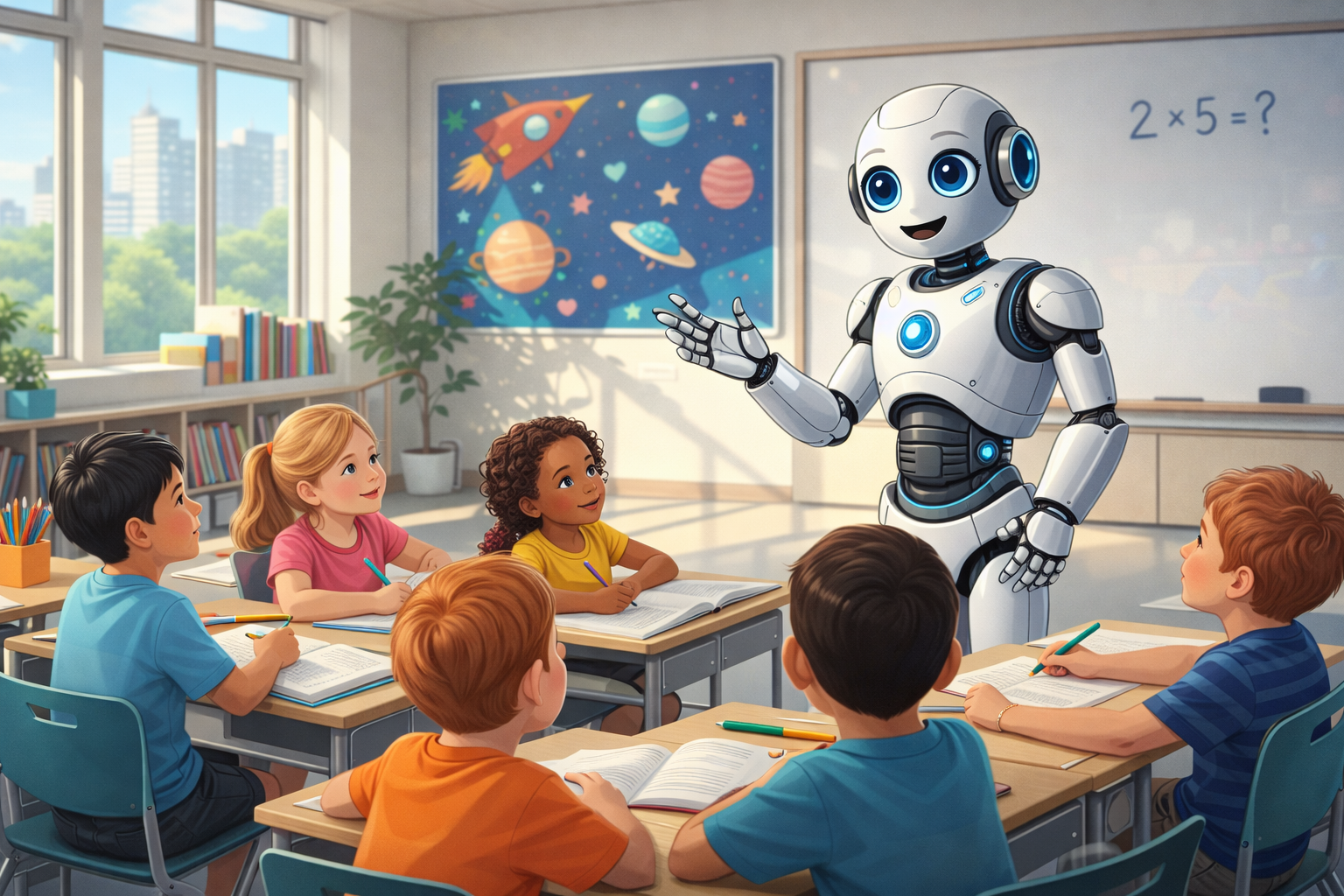
As of March 2026, the landscape of educational technology has shifted from passive screens to active, embodied interaction. The rise of AI tutors with physical presence—commonly referred to as social robots—marks a pivotal moment in how we conceptualize the “classroom of the future.” No longer relegated to the realm of science fiction, these humanoid and semi-humanoid assistants are now providing personalized, emotionally intelligent support to students across the globe.
Definition and Core Concept
An AI tutor with physical presence is an autonomous or semi-autonomous robotic system equipped with artificial intelligence (often powered by Large Language Models or LLMs) that interacts with learners through physical movement, speech, and non-verbal cues. Unlike a tablet-based app or a desktop chatbot, these robots occupy the same three-dimensional space as the student. This “embodiment” allows for joint attention—where both the robot and the student look at the same physical object—and social bonding that digital interfaces cannot replicate.
Key Takeaways
- Embodiment Drives Engagement: Research indicates that physical presence increases “on-task enjoyment” and retention compared to screen-based AI.
- Personalization at Scale: Modern AI tutors adapt their pace, tone, and curriculum in real-time based on a student’s facial expressions and performance.
- Special Education Breakthroughs: Social robots provide a predictable, non-judgmental environment that is particularly effective for children with Autism Spectrum Disorder (ASD).
- Human-Robot Collaboration: These tools are designed to augment, not replace, human educators by handling repetitive drills and data-driven personalization.
Who This Is For
This guide is designed for school administrators looking to invest in 2026 edtech, educators seeking to understand their evolving roles, EdTech developers building the next generation of HRI (Human-Robot Interaction) software, and parents curious about the efficacy of robotic tutoring for their children.
The Evolution of Educational Robotics: From Kits to Companions
To understand where we are in 2026, we must look at the trajectory of robotics in schools. For decades, “educational robotics” meant building and programming. Students used kits like LEGO Mindstorms or VEX Robotics to learn the fundamentals of engineering and logic. While valuable, these were tools to be built, not entities to learn from.
The shift toward AI tutors with physical presence represents a transition from “learning robotics” to “learning with robots.” Early precursors like SoftBank’s Pepper and NAO laid the groundwork by offering a humanoid form factor. However, their internal logic was often limited to rigid, pre-programmed scripts.
The breakthrough came with the integration of Generative AI and Affective Computing between 2023 and 2025. By 2026, robots like the Moxie (Embodied, Inc.) and QTrobot (LuxAI) have moved beyond simple voice commands. They now utilize multimodal LLMs to understand nuance, detect student frustration through computer vision, and engage in fluid, open-ended dialogue.
Why “Physical Presence” Matters: The Science of Embodiment
A common question among skeptics is: “Why do we need a physical robot when we have iPads?” The answer lies in the psychological phenomenon of social presence.
1. Joint Attention and Spatial Learning
When a physical robot points to a block on a table, the student’s brain processes that movement in 3D space. This fosters “joint attention,” a critical developmental milestone. Screen-based avatars lack this spatial context, making it harder for younger children to map digital instructions to physical tasks.
2. Non-Verbal Communication
Humans communicate 70–90% of information through non-verbal cues. AI tutors with physical presence can tilt their heads, use hand gestures, and maintain “eye contact.” In 2025, a landmark study published in Frontiers in Education demonstrated that students were 35% more likely to follow the instructions of a physical robot than an identical avatar on a screen, simply due to the perceived “authority” of its physical form.
3. The “Peer Learner” Effect
Robots are often designed to be roughly the height of a child. This diminishes the power imbalance often felt between a student and a human teacher. Many AI tutors are programmed to act as “learning companions” rather than “masters.” This “learning-by-teaching” paradigm—where a student helps the robot solve a math problem—has shown significant gains in student confidence and metacognitive skills.
Core Technologies Powering the 2026 AI Tutor
The capability of an AI tutor with physical presence is defined by three primary technological pillars:
Multimodal Large Language Models (M-LLMs)
In 2026, the “brain” of the educational robot is no longer a localized set of commands. It is a cloud-connected (or increasingly, “edge-processed” for privacy) M-LLM. This allows the robot to:
- Understand spoken language in various accents and dialects.
- Process visual data (e.g., looking at a student’s handwritten math work via a chest-mounted camera).
- Generate responses that are pedagogically sound, rather than just grammatically correct.
Affective Computing and Emotion AI
Advanced sensors allow robots to perform real-time sentiment analysis. If a student’s brow furrows (indicating confusion) or if their heart rate increases (detected via thermal sensors or optical heart rate monitoring), the AI tutor can pivot. Instead of pushing forward, it might say, “I see this part is a bit tricky. Should we try a different way?”
SLAM and Spatial Awareness
Simultaneous Localization and Mapping (SLAM) allows these tutors to navigate classroom environments safely. They can follow a student to a reading nook or move between desks to check on progress, ensuring they are integrated into the physical flow of the school day.
Primary Use Cases for AI Tutors with Physical Presence
1. Special Education and Neurodiversity
This remains the most impactful application of social robotics. For children with ASD, human interaction can sometimes be overwhelming due to its unpredictability. Robots provide a “safe” bridge. They are consistent, they don’t get tired of repetition, and they provide clear, simplified social cues.
- Example: QTrobot is currently used in over 500 schools globally to help students practice emotion recognition and turn-taking in a low-anxiety environment.
2. Language Acquisition and Literacy
Learning a new language requires immense “bravery” to speak and fail. Students often feel embarrassed practicing pronunciation with peers or teachers. A physical AI tutor provides a judgment-free zone.
- Practical Example: In 2026, “Robot-Assisted Language Learning” (RALL) programs in Japan and South Korea utilize robots to lead small-group English conversations, providing immediate phonemic feedback.
3. STEM and Computational Thinking
While the robot is the tutor, it is also a lab. Students can “peak under the hood” to see how the sensors work, effectively learning about AI and physics while the robot teaches them math.
Common Mistakes in Implementing Educational Robotics
Despite the benefits, many schools fail to see a return on investment due to several common pitfalls:
- Treating the Robot as a Novelty: Using the robot for “show and tell” rather than integrating it into the daily curriculum leads to a sharp decline in engagement after the first two weeks (the “novelty effect”).
- Poor Teacher Training: If educators feel threatened by the robot or find it too difficult to operate, it will collect dust in a closet. The robot must be framed as a “Teacher’s Aide,” not a “Teacher Replacement.”
- Ignoring Infrastructure Requirements: AI tutors with physical presence require robust, high-speed Wi-Fi and designated “parking stations” for charging. Many older school buildings struggle with the bandwidth required for real-time M-LLM processing.
- Privacy Oversights: Failing to secure parent consent for visual/audio data processing is a fast track to legal and ethical crises.
Ethical Considerations and Safety Disclaimers
Safety Disclaimer: The use of AI tutors in educational settings must always be overseen by a qualified human educator. These systems are tools for supplemental instruction and should not be used as the sole method of education or childcare.
Data Privacy (GDPR and COPPA)
As of 2026, the EU AI Act and updated COPPA (Children’s Online Privacy Protection Act) guidelines strictly regulate how robotic tutors handle “biometric data.” Schools must ensure that:
- Visual data is processed “on-device” whenever possible.
- Audio recordings are deleted after the session unless explicitly opted-in for longitudinal progress tracking.
The Risk of Displacement
While the “robot teacher” is a common trope, the human element of mentorship, empathy, and moral guidance cannot be automated. There is a risk that underfunded school districts might attempt to use AI tutors to increase student-to-teacher ratios, which research consistently shows negatively impacts long-term social development.
Implementing AI Tutors: A 5-Step Roadmap for Schools
If you are looking to introduce AI tutors with physical presence in the 2026–2027 academic year, follow this structured approach:
Step 1: Define the Pedagogical Need
Don’t buy a robot because it’s “cool.” Identify a specific gap. Is it 3rd-grade reading scores? Is it support for the Special Education department?
Step 2: Pilot with a Small Cohort
Select one grade level or one specific demographic (e.g., English Language Learners). Use a “control group” to measure the efficacy of the robot versus traditional screen-based software.
Step 3: Integrate with existing LMS
Ensure the robot can “talk” to your Learning Management System (like Canvas or Google Classroom). The data the robot collects on a student’s progress should automatically update the teacher’s dashboard.
Step 4: Curriculum Alignment
Work with the robot manufacturer to ensure the “lessons” the AI delivers are aligned with state or national standards. An AI tutor that teaches a different method of long division than the classroom teacher will only cause confusion.
Step 5: Ongoing E-E-A-T Validation
Continuously evaluate the Experience, Expertise, Authoritativeness, and Trustworthiness of the AI’s content. As LLMs can occasionally “hallucinate,” a human subject-matter expert must periodically audit the robot’s lesson plans.
The Market Leaders: Who is Winning in 2026?
As of March 2026, the educational robot market has consolidated into a few key players:
| Robot Model | Primary Focus | Best For | Status as of 2026 |
| Moxie (Embodied) | Socio-emotional | K-5 Education | Widely adopted in US private schools. |
| QTrobot (LuxAI) | Special Ed / Autism | Research & Therapy | Gold standard for ASD clinical integration. |
| NAO (United Robotics) | Higher Ed / STEM | Coding & Research | Transitional; widely used in university labs. |
| Buddy (Blue Frog) | Early Childhood | Pre-K Literacy | Popular in European primary schools. |
| Aero (Sony-backed) | Multipurpose | General Tutoring | Emerging leader in the Asian market. |
Conclusion: Towards the Hybrid Classroom
The integration of AI tutors with physical presence is not about replacing the magic of a human teacher; it is about reclaiming it. By delegating repetitive tasks—vocabulary drills, basic math fluency, and data tracking—to an embodied AI, we free human educators to focus on what they do best: inspiring, mentoring, and connecting.
As we move further into 2026, the “digital divide” is being replaced by the “robotic divide.” It is incumbent upon policymakers and tech developers to ensure that these powerful pedagogical tools are accessible to all students, regardless of socioeconomic status. The physical presence of an AI tutor can be a bridge to a more inclusive, personalized, and engaging educational experience.
Next Steps for You:
- For Educators: Request a demo of an AI tutor specifically designed for your subject area.
- For Administrators: Conduct a “Tech Audit” to see if your current Wi-Fi infrastructure can support high-bandwidth social robots.
- For Parents: Ask your school board about their policies on AI data privacy and human-in-the-loop oversight.
FAQs
1. Are AI tutors with physical presence safe for children?
Yes, as long as they are used within established safety guidelines. Most 2026 models feature “soft-touch” exteriors, collision-avoidance sensors, and strictly regulated privacy protocols. They are designed to be “cobots” (collaborative robots) that work alongside humans.
2. Can these robots truly understand a child’s emotions?
They use “Affective Computing” to recognize patterns in facial expressions, tone of voice, and body language. While they don’t “feel” emotions, they can react to them in a way that facilitates better learning. This is often called “simulated empathy.”
3. Will robots eventually replace human teachers?
No. While a robot can teach the content of a history lesson, it cannot provide the context of human experience, moral guidance, or the complex social-emotional support a human teacher offers. The consensus for 2026 is a “Human-in-the-loop” model.
4. What is the average cost of a physical AI tutor in 2026?
Prices vary significantly. “Consumer-grade” tutors like Moxie range from $800 to $1,500, while “Institutional-grade” humanoid robots like QTrobot or high-end NAO units can cost between $6,000 and $15,000, often including a software subscription.
5. Do these robots require a constant internet connection?
Most require high-speed Wi-Fi to access their cloud-based “brains” (LLMs). However, newer 2026 models are incorporating “Edge AI,” which allows basic functions and safety protocols to work offline to protect student privacy.
References
- UNESCO (2025). Artificial Intelligence and the Future of Education: A Global Perspective on Social Robotics. [Official Document]
- Journal of Human-Robot Interaction (2025). The Impact of Physical Embodiment on Cognitive Load in Primary Students. [Academic Paper]
- International Society for Technology in Education (ISTE). 2026 Standards for AI in the Classroom. [Industry Standard]
- LuxAI S.A. (2026). QTrobot: Longitudinal Study on Autism Intervention in Classroom Settings. [Clinical Documentation]
- Frontiers in Psychology (2025). Affective Computing in Pedagogical Agents: A Meta-Analysis. [Academic Journal]
- U.S. Department of Education (2025). EdTech National Plan: Integrating Robotics into K-12 STEM. [Government Report]
- Embodied, Inc. (2026). Moxie: Data Privacy and Security Whitepaper for Schools. [Corporate Policy]
- IEEE Robotics & Automation Society. Ethical Design of Socially Assistive Robots for Children. [Technical Standard]