The global agricultural sector faces a paradoxical challenge: it must produce more food to feed a growing population—projected to reach nearly 10 billion by 2050—while simultaneously reducing its environmental footprint. Traditional farming methods, which often rely on intuition, historical averages, and broad-spectrum treatments, are increasingly insufficient in the face of climate change, soil degradation, and resource scarcity. This is where AI for agriculture steps in, marking a transition from labor-intensive farming to data-driven intelligence.
Artificial Intelligence (AI) in agriculture is not just about robots picking strawberries; it is about the invisible, data-heavy lifting that happens before, during, and after the growing season. It involves using machine learning algorithms to predict crop yields with unprecedented accuracy, deploying computer vision to identify pests before they become infestations, and utilizing smart irrigation systems to optimize every drop of water.
In this guide, we explore how AI is reshaping the farm, specifically focusing on three critical pillars: predictive yields, precision irrigation, and pest management. We will examine how these technologies work, the benefits they offer, the realistic challenges of implementation, and what the future holds for smart farming.
Key Takeaways
- Data-Driven Decisions: AI shifts farming from reactive (fixing problems after they happen) to proactive (preventing problems based on data).
- Resource Optimization: Precision irrigation and targeted pest management significantly reduce water, fertilizer, and pesticide usage, lowering costs and environmental impact.
- Yield Security: Predictive models help farmers and supply chains anticipate harvest volumes, stabilizing markets and logistics.
- Vision Systems: Computer vision is the “eye” of AI in agriculture, allowing machines to “see” weeds, diseases, and crop maturity.
- Connectivity is Key: The success of AI depends heavily on robust data infrastructure, including IoT sensors and reliable internet connectivity in rural areas.
Who This Is For (And Who It Isn’t)
This guide is for:
- Farmers and Agronomists: Looking to understand how digital tools can improve efficiency and ROI.
- AgTech Investors and Entrepreneurs: Seeking a deep dive into the practical applications and value propositions of AI in the sector.
- Students and Researchers: Needing a comprehensive overview of the current state of agricultural AI.
- Sustainability Advocates: Interested in how technology reduces chemical runoff and water waste.
This guide is not for:
- Hobby Gardeners: While some concepts apply, the scale discussed here is primarily commercial and industrial.
- Those seeking specific coding tutorials: We focus on the application and strategy of AI, not the Python code behind the models.
1. The Core Concept: What Is AI for Agriculture?
AI for agriculture refers to the application of machine learning (ML), computer vision, and predictive analytics to optimize farming practices. Unlike simple mechanization—which replaced animal labor with tractors—AI replaces or augments human decision-making.
In the past, a farmer might look at the sky and decide it’s time to water, or look at a few yellowing leaves and decide to spray a whole field. Today, AI systems digest millions of data points from satellite imagery, soil sensors, weather stations, and drone feeds to make those decisions with mathematical precision.
The Data Pipeline
To understand how AI works on a farm, you must visualize the data flow:
- Data Acquisition: Sensors (IoT), drones, satellites, and farm machinery collect raw data (images, moisture levels, temperature).
- Aggregation: Data is sent to a cloud platform or edge computing device where it is cleaned and organized.
- Analysis (The AI Layer): Algorithms process the data. For example, a machine learning model might compare current weather patterns against 20 years of historical yields.
- Actionable Insight: The system provides a recommendation (e.g., “Spray Zone B for aphids”) or automatically triggers an action (e.g., turning on a drip irrigation valve).
2. Predictive Yields: Forecasting the Harvest
Predicting how much crop a field will produce is the “holy grail” of agriculture. Accurate yield prediction affects everything from financing and insurance to logistics and global food prices.
How Predictive Analytics Works
AI models for yield prediction rely on regression analysis and deep learning. They look for correlations between variables that a human might miss.
- Historical Data: The model ingests years of historical yield data for a specific crop and region.
- Environmental Factors: It layers on real-time data regarding precipitation, temperature accumulation (growing degree days), and solar radiation.
- Satellite Imagery (NDVI): Satellites measure the “greenness” of the biomass using indexes like the Normalized Difference Vegetation Index (NDVI). AI correlates this spectral data with plant health and eventual yield.
- Genetics: Advanced models even account for the specific seed variety and its genetic potential under forecasted weather conditions.
In Practice: From Field to Market
Imagine a large-scale corn producer. By using AI yield prediction:
- Early Season: The farmer can assess if the current planting density is sufficient or if replanting is necessary based on emergence rates analyzed by drone footage.
- Mid-Season: The model predicts a bumper crop. The farmer can pre-book extra storage silos and transport trucks months in advance, likely at a better rate.
- Supply Chain: Food processors (like a cereal company) use aggregated yield predictions to hedge commodity prices, ensuring they don’t overpay for raw ingredients.
The Accuracy Factor
While no model is a crystal ball, AI significantly reduces the margin of error. Traditional estimates might be off by 20-30%. Well-tuned AI models, fed with high-quality local data, can narrow this variance to under 5%, allowing for much tighter financial planning.
3. Precision Irrigation: Making Every Drop Count
Agriculture accounts for approximately 70% of global freshwater withdrawals. As climate change leads to more erratic rainfall and aquifer depletion, precision irrigation driven by AI is becoming a necessity, not a luxury.
The Shift from Schedule-Based to Demand-Based
Traditional irrigation often relies on a schedule (e.g., “water every Tuesday”) or simple observation. This often leads to over-watering (wasting water, leaching nutrients, causing root rot) or under-watering (stunting growth).
AI enables demand-based irrigation. The system calculates exactly how much water the plant needs right now and predicts what it will need tomorrow.
The Technology Stack
- Soil Moisture Sensors: Buried at various depths, these send real-time data on the volumetric water content of the soil.
- Evapotranspiration (ET) Models: AI calculates the rate at which water evaporates from the soil and transpires from the plant leaves based on wind, heat, and humidity.
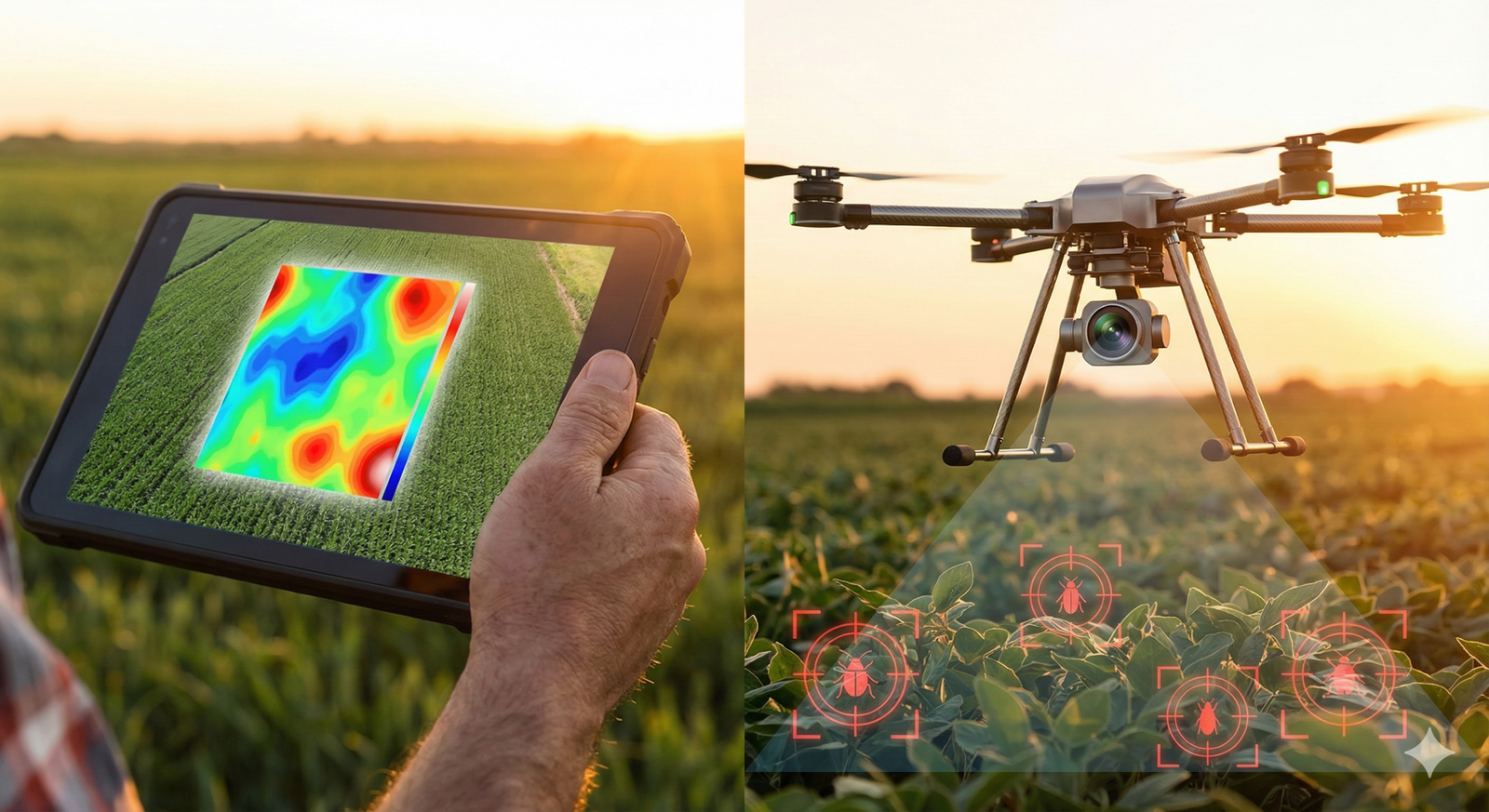
- Variable Rate Irrigation (VRI): The AI connects to the irrigation hardware (like center pivots). It creates a “prescription map,” telling the sprinklers to speed up (put down less water) over low-lying wet spots and slow down (put down more water) over sandy, dry hills.
Benefits of AI Irrigation
- Water Conservation: Studies consistently show water savings of 20-50% compared to conventional methods.
- Energy Savings: Pumping water requires massive amounts of electricity or diesel. Pumping less saves money.
- Improved Quality: For crops like wine grapes or almonds, precise water stress is sometimes required to maximize flavor or nut quality. AI manages this delicate balance better than human guesswork.
4. Intelligent Pest and Disease Management
Pests, weeds, and pathogens destroy a significant percentage of global crop production annually. The traditional response has been “prophylactic spraying”—covering the entire field with chemicals to prevent an outbreak. This is expensive, leads to chemical resistance, and harms beneficial insects. AI enables Integrated Pest Management (IPM) at scale.
Computer Vision and Pattern Recognition
The core technology here is Computer Vision. Just as facial recognition unlocks your phone, agricultural computer vision recognizes the “faces” of bugs, the shape of weeds, and the texture of diseased leaves.
- Weed Detection (See & Spray): Smart sprayers equipped with cameras are towed behind tractors. As they move over the field, the AI identifies a weed (green on brown soil, or even green on green crops) in milliseconds. It triggers a specific nozzle to spray only the weed, leaving the crop untouched. This can reduce herbicide use by up to 90%.
- Disease Scouting: Drones or autonomous rovers patrol fields, capturing high-resolution images. AI models trained on libraries of plant pathology (e.g., wheat rust, corn blight) analyze these images. They can detect the subtle discoloration of early-stage infection before it is visible to the human eye.
- Insect Monitoring: Digital traps equipped with cameras and pheromones capture insects. The AI counts and classifies them. If the population of a specific pest (like the fall armyworm) crosses a threshold, the farmer is alerted to intervene.
The Economic and Environmental Impact
- Cost Reduction: Agrochemicals are one of the highest input costs for farmers. Reducing spray volume directly improves the bottom line.
- Regulatory Compliance: As governments (especially in the EU) tighten regulations on chemical residues, AI allows farmers to maintain compliance while protecting yields.
- Resistance Management: By spraying only when and where necessary, farmers delay the evolution of pesticide-resistant weeds and bugs.
5. Beyond the Big Three: Other Emerging AI Applications
While yield, water, and pests are the pillars, AI for agriculture extends into other critical areas.
Soil Health Monitoring
Healthy soil is a living ecosystem. AI analyzes data from soil samples (chemical composition, microbial activity) combined with historical management practices (tillage, rotation) to recommend regenerative practices. It helps farmers understand carbon sequestration levels, potentially opening new revenue streams through carbon credits.
Autonomous Machinery and Robotics
Self-driving tractors are already in fields. AI handles the navigation, obstacle avoidance, and implement control. Beyond tractors, small swarm robots are being developed to perform delicate tasks like pruning vineyards or harvesting soft fruits (strawberries, tomatoes) which traditionally require expensive human labor.
Supply Chain Optimization
Post-harvest, AI helps reduce food waste. Algorithms analyze storage conditions (temperature, humidity, ethylene levels) to predict the shelf life of produce. This allows distributors to route “ripe” produce to nearby markets and “hardier” produce to distant export destinations, minimizing spoilage.
6. Implementation and Tools: Getting Started
For a farm to adopt AI, it requires a transition from analog to digital. This does not happen overnight.
Prerequisites for AI Adoption
- Digitization: Historical records (yield maps, soil tests) must be digitized. You cannot train an AI on paper notebooks stored in a shed.
- Connectivity: This is the biggest hurdle. AI relies on data transfer. Farms need reliable cellular (4G/5G), LPWAN (Low-Power Wide-Area Network), or satellite internet (e.g., Starlink) to move data from the field to the cloud.
- Hardware Layer: Installation of weather stations, soil probes, and telematics on tractors.
Choosing the Right Tools
Farmers face a fragmented marketplace. Solutions range from:
- Farm Management Software (FMS): Platforms like Climate FieldView or Granular that aggregate data and offer general insights.
- Specialized Niche Tools: Startups focusing solely on irrigation (e.g., sensing probes) or solely on drone analytics.
- OEM Integrated Tech: Major equipment manufacturers (John Deere, AGCO) build AI directly into their newest machinery.
Decision Criteria: When evaluating tools, farmers should ask:
- Does this integrate with my existing equipment?
- Do I own the data, or does the provider?
- Is the AI model trained on data from my region/climate?
7. Benefits vs. Challenges
To provide a balanced view, we must weigh the transformative potential against the friction of adoption.
The Benefits
- Efficiency: Doing more with less (land, water, chemicals).
- Predictability: Reducing the inherent volatility of farming.
- Sustainability: Lowering the carbon footprint and chemical load of agriculture.
- Labor Augmentation: As the agricultural workforce ages and shrinks, AI fills the labor gap.
The Challenges
- High Initial Investment: Smart sprayers and sensor networks are expensive. The ROI may take years to realize.
- Data Interoperability: A “Tower of Babel” problem exists where the tractor doesn’t talk to the drone, and the drone doesn’t talk to the irrigation pump. Data silos hinder the full potential of AI.
- The “Black Box” Problem: Farmers are practical. If an AI says “Spray now,” but doesn’t explain why, trust is hard to build. Explainable AI (XAI) is crucial here.
- Digital Divide: Smallholder farmers and those in developing nations risk being left behind, widening the gap between industrial and subsistence farming.
8. Common Mistakes and Pitfalls
Adopting AI for agriculture is a journey fraught with potential errors. Here is what typically goes wrong.
1. The “Silver Bullet” Mentality
The Mistake: Believing that buying a drone or software will instantly fix poor agronomic practices. The Reality: AI amplifies management quality. It makes a good farmer better, but it cannot fix fundamental issues like poor soil health or bad crop rotation choices.
2. Ignoring Ground-Truthing
The Mistake: Trusting the satellite map blindly without visiting the field. The Reality: “Ground-truthing” is essential. An AI might interpret a shadow as water stress, or a specific weed as a crop. Farmers must verify digital insights with physical inspection to calibrate the models.
3. Data Overload
The Mistake: Installing every sensor available and drowning in dashboards. The Reality: Data is useless without insight. Farmers should start with one problem (e.g., “I spend too much on irrigation”) and deploy technology specifically to solve that, rather than trying to digitize the whole farm at once.
9. Future Outlook: The Autonomous Farm
As of 2026, we are moving from “Automated” to “Autonomous.”
- Generative AI in Ag: Large Language Models (LLMs) are being fine-tuned on agronomic literature. Soon, a farmer might ask a chatbot, “I see yellow spotting on my soy leaves in the north field, and it rained 2 inches yesterday. What should I do?” and receive a contextualized, scientifically backed plan.
- Swarm Farming: Instead of one massive, heavy tractor compressing the soil, future farms may use swarms of small, electric, AI-driven robots that plant and weed 24/7.
- Digital Twins: Creating a full digital replica of a farm to run simulations. Farmers could simulate “What if I plant corn instead of soy and we have a drought?” to see the AI-predicted outcome before buying a single seed.
Conclusion
AI for agriculture is not about replacing the farmer; it is about upgrading the farmer’s toolkit. In an era defined by climate uncertainty and resource constraints, relying solely on tradition is a risky strategy. Technologies offering predictive yields, precision irrigation, and intelligent pest management provide the shield and sword necessary to secure the future of food.
For the agricultural industry, the path forward involves a careful, calculated integration of these tools. It requires skepticism of hype, a demand for interoperability, and a commitment to data integrity. Ultimately, the most successful farms of the future will be those that blend the biological wisdom of the past with the digital intelligence of the present.
Next Steps: If you are a grower or land manager, start small. Choose one pain point—whether it’s water costs or weed control—and pilot a single AI-driven solution this coming season. Measure the results against your control fields to validate the ROI for your specific operation.
FAQs
1. How accurate is AI in predicting crop yields?
AI accuracy varies by crop and data quality, but mature models for major commodities like corn, wheat, and soy can achieve accuracy rates of 90-95% roughly one to two months before harvest. Accuracy improves as the season progresses and more weather/growth data is ingested.
2. Is AI for agriculture only for large corporate farms?
Initially, yes, due to cost. However, the technology is democratizing. Smartphone-based apps for pest identification and soil health are now accessible to smallholder farmers. Additionally, “Farming as a Service” (FaaS) allows smaller farms to rent high-tech equipment like drone sprayers only when needed.
3. Can AI replace human agronomists?
No. AI acts as a force multiplier for agronomists. It processes data faster than a human can, identifying patterns in vast datasets. However, the complex, contextual decision-making—considering economics, family goals, and nuanced local factors—still requires human expertise.
4. How does AI help with organic farming?
AI is a huge boon for organic farming. Since organic farmers cannot use synthetic pesticides, they rely on mechanical weeding and strict prevention. AI-driven robotic weeders and early pest detection systems allow organic farmers to scale up operations that were previously limited by the cost of manual labor.
5. What is the biggest barrier to AI adoption in farming?
Rural connectivity. Without reliable high-speed internet to transmit the massive amounts of data generated by cameras and sensors (upload speeds are crucial), cloud-based AI processing is impossible. Edge computing (processing data on the device itself) is helping to solve this.
6. Does AI reduce the environmental impact of farming?
Yes, significantly. By applying water, fertilizer, and pesticides only where and when needed (precision agriculture), AI reduces runoff into waterways, lowers greenhouse gas emissions from fertilizer production, and minimizes chemical residues on food.
7. How much does an AI agricultural system cost?
Costs vary wildly. A simple satellite imagery subscription might cost a few dollars per acre per year. A fully autonomous weeding robot can cost upwards of $50,000 to $150,000. Most software is moved to a SaaS (Software as a Service) model, charging per acre/hectare.
8. Is my farm data safe with AI providers?
Data privacy is a major concern. Farmers should review “Data Rights” agreements carefully. Reputable providers aggregate data anonymously to train models but ensure the farmer retains ownership of their specific field data. Look for companies that adhere to the “Ag Data Transparent” certification or similar standards.
9. What is NDVI and how does AI use it?
NDVI stands for Normalized Difference Vegetation Index. It is a measure of the difference between near-infrared (which vegetation strongly reflects) and red light (which vegetation absorbs). AI uses NDVI maps from satellites to assess plant health, vigor, and biomass density across a field.
10. Can AI predict weather better than standard forecasts?
AI improves micro-climate forecasting. While standard forecasts cover a broad area, farm-specific AI stations can learn how local topography (hills, valleys) affects wind and frost patterns on that specific farm, providing hyper-local weather predictions.
References
- Food and Agriculture Organization of the United Nations (FAO). (2024). The State of Food and Agriculture: Leveraging Automation and AI. Rome: FAO.
- United States Department of Agriculture (USDA). (2025). Precision Agriculture in the Digital Era: Adoption and Outcomes. Washington, D.C.: USDA Economic Research Service.
- Nature Sustainability. (2023). “Environmental benefits of AI-driven precision agriculture: A global meta-analysis.” Nature Journals.
- IEEE Geoscience and Remote Sensing Magazine. (2023). “Deep Learning for Crop Yield Prediction: A Survey.” IEEE.
- International Society of Precision Agriculture (ISPA). (2024). Definitions and Standards in Precision Agriculture.
- Deloitte Insights. (2024). The Future of Fresh: AI and the autonomous supply chain.
- World Economic Forum. (2025). Artificial Intelligence for Agriculture Innovation (AI4AI).
- Journal of Cleaner Production. (2023). “Smart irrigation systems: A review of machine learning and IoT implementations.”
- Bayer Crop Science. (2024). Digital Farming and Data Privacy Standards. (Industry white paper).
- John Deere. (2024). See & Spray™ Technology Technical Documentation. (Vendor documentation on computer vision application).