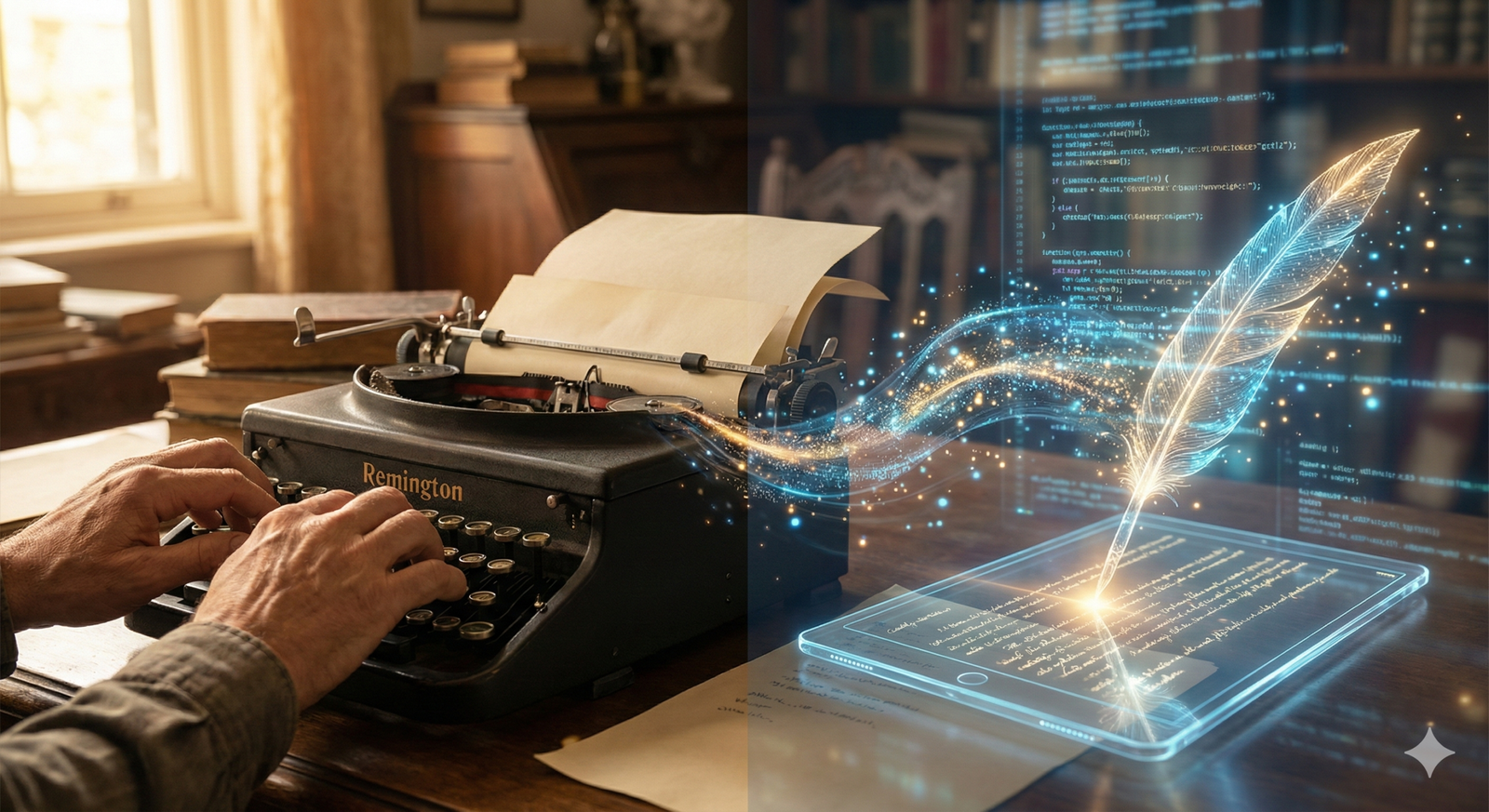
The solitary image of the writer—hunched over a desk, surrounded by crumpled paper, waiting for the muse to strike—is undergoing a radical transformation. We are entering the era of AI co-authors, where large language models (LLMs) like OpenAI’s ChatGPT, Google’s Gemini, and Anthropic’s Claude serve not just as spellcheckers, but as creative partners, brainstorming companions, and tireless drafting assistants.
For novelists and screenwriters, this shift brings equal parts excitement and trepidation. Can a machine truly understand the human condition? Can algorithms replicate the subtext of a screenplay or the lyrical prose of a literary novel? The short answer is no—at least, not on their own. However, when guided by a human hand, these tools can unlock narrative possibilities, dismantle writer’s block, and accelerate the journey from concept to final draft.
In this guide, AI co-authors refers to the strategic use of generative AI tools to assist in the creative writing process, from ideation and outlining to drafting and editing, while maintaining human creative control and intent.
Key Takeaways
- AI is a catalyst, not a replacement: The best results come from “centaur” teams—human creativity guiding AI speed and structure.
- Iterative prompting is essential: One-shot prompts rarely produce publishable prose; conversation and refinement are key.
- Different models have different strengths: Claude often excels at nuance and prose; ChatGPT is a master of structure; Gemini integrates well with research.
- Copyright is complex: As of early 2026, pure AI output is generally public domain in many jurisdictions; human contribution is required for protection.
- Ethics matter: Transparency with readers and respecting the origins of training data are critical considerations for the modern author.
The Rise of the Machine Muse: Understanding AI Co-Authors
To use these tools effectively, one must understand what they are doing. AI co-authors are prediction engines. They have ingested vast libraries of text—literature, scripts, articles, and internet discourse—and learned the statistical probability of which words follow others.
This sounds clinical, but in practice, it means the AI understands narrative tropes, structural beats, and character archetypes better than most humans do, simply because it has “read” more of them. However, it lacks lived experience, emotional memory, and true intent. It cannot feel heartbreak; it can only simulate how heartbreak is described in literature.
Who this is for (and who it isn’t)
This guide is designed for:
- Aspiring Novelists: Writers struggling to finish their first manuscript who need accountability and structural help.
- Screenwriters: Creatives looking to generate loglines, treatments, and dialogue variations quickly.
- Professional Authors: Writers seeking to speed up their workflow or brainstorm complex plot knots.
- Hobbyists and Roleplayers: Individuals creating content for D&D campaigns or fan fiction.
This is not for:
- Push-button Publishers: Those looking to generate an entire book in one click with zero editing. (This results in low-quality content that readers reject).
- Purists: Writers who fundamentally believe technology has no place in the creative arts (a valid stance, but outside the scope of this guide).
The Toolkit: Choosing Your Digital Partner
Not all AI co-authors are created equal. As of early 2026, the landscape of generative AI offers distinct flavors of assistance.
1. The Big Generalists (ChatGPT, Gemini, Claude)
These are the foundational models most writers start with.
- ChatGPT (OpenAI): excellent at logic, outlining, and maintaining conversation history. It is highly versatile but can lean into “default” corporate-sounding prose if not prompted specifically.
- Claude (Anthropic): Widely regarded by the creative community for having a more natural, “literary” prose style. It handles large contexts well, meaning you can feed it half a book, and it will remember character details.
- Gemini (Google): Strong integration with the Google ecosystem. If your research involves real-world facts or rapid information retrieval alongside writing, Gemini’s connection to Search provides a distinct edge.
2. The Specialized Storytellers
Tools built specifically on top of LLMs for fiction.
- Sudowrite: A tool designed for fiction writers. It includes features like “Sensory” (to describe a scene using all five senses) and “Story Engine” (to write chapter by chapter).
- NovelCrafter: A platform that acts as a “series bible,” allowing you to store character lore and world-building facts that the AI references while writing to ensure continuity.
3. Script-Specific Tools
- Prescript / AI Screenwriting plugins: These tools understand standard industry formatting (sluglines, parentheticals) and can convert prose into screenplay format automatically.
Phase 1: Ideation and World-Building
The “blank page problem” is perhaps the most universal struggle in writing. AI co-authors eliminate this fear by providing an endless stream of “what if” scenarios.
Brainstorming “What If” Scenarios
Instead of asking for a whole story, treat the AI as a writer’s room partner.
- Bad Prompt: “Give me an idea for a sci-fi book.”
- Good Prompt: “I want to write a sci-fi mystery set on a generation ship that has forgotten its mission. List 10 potential inciting incidents that are not related to a murder.”
The AI can generate lists of conflicts, settings, or magical systems. You might reject nine out of ten ideas, but the tenth might spark a connection you hadn’t considered.
Constructing the “Series Bible”
Before writing a single scene, you can use AI to flesh out your world. This is crucial for consistency.
- Lore Generation: Ask the AI to create a history for your fictional kingdom, complete with economic systems and religious schisms.
- Magic Systems: “Create a magic system based on the concept of ‘memory loss’ with strict limitations and costs.”
- Technology: “Describe three futuristic gadgets a detective in 2080 would use, explaining how they work physically.”
Tip: Keep a separate document (or use a tool like Notion or Obsidian) to store these facts. You will need to feed them back to the AI later to remind it of the rules it helped create.
Phase 2: Character Development and Voice
Flat characters kill stories. AI co-authors can help deepen your cast by acting as a simulator.
The Interview Method
One of the most effective techniques is to ask the AI to roleplay as your character.
- Prompt: “Act as ‘Elara,’ a cynical ex-thief who is trying to go straight. I am going to interview you about your childhood. Answer in the first person, using slang appropriate for a gritty fantasy city.”
By conversing with your character, you find their “voice”—their rhythm of speech, their prejudices, and their fears. You can ask them difficult questions (“Why did you betray your brother?”) and see how they justify themselves.
Creating Character Profiles
Use the AI to generate detailed bios that go beyond hair color.
- Psychological Profile: Ask for the character’s Myers-Briggs type, Enneagram, or “Big Five” personality traits and how those traits would manifest under stress.
- The “Ghost”: In screenwriting terms, the “ghost” is the trauma from the past haunting the character. Ask the AI: “Give me 5 tragic backstories for a comedy character that explain why they use humor as a defense mechanism.”
Phase 3: Outlining and Narrative Structure
Many writers hate outlining, while others live by it. AI excels at structure because structure is pattern-based.
Beat Sheets and Frameworks
You can feed a rough synopsis to your AI co-author and ask it to organize the story into established narrative structures:
- Save the Cat: “Take this synopsis and break it down into the 15 beats of Blake Snyder’s Save the Cat.”
- The Hero’s Journey: “Map this story onto Joseph Campbell’s monomyth structure.”
- The Dan Harmon Story Circle: “Apply the 8-point story circle to this episode idea.”
Identifying Plot Holes
Once you have an outline, ask the AI to be a critic.
- Prompt: “Analyze this outline for plot holes, logical inconsistencies, or pacing issues. Be critical. Where does the tension lag?”
This “adversarial” prompting forces you to strengthen your story logic before you commit to writing thousands of words.
Phase 4: Drafting and The “Tennis Match” Method
This is where the heavy lifting happens. Writing the actual prose or dialogue. A common mistake is asking the AI to “write Chapter 1.” The result is usually generic, rushed, and summarized.
Instead, use the Tennis Match Method: you write a bit, the AI writes a bit, and you edit.
- The Setup: You write the first 200 words of a scene to establish the tone, setting, and voice.
- The Hand-off: Paste your text into the AI and say, “Continue this scene for 300 words. Focus on the sensory details of the environment and the internal hesitation of the protagonist. Do not resolve the conflict yet.”
- The Edit: The AI generates text. Do not keep it as is. It will likely be a mix of good ideas and clichés. Edit it heavily. Rewrite the dialogue. Fix the pacing.
- The Return: Paste your edited version back in and ask it to continue.
This iterative loop keeps the human in the driver’s seat while maintaining momentum. It prevents the “blank page paralysis” because you always have material to work with.
Descriptive Expansion
If you struggle with description, write the bare bones and ask the AI to “paint” the scene.
- Input: “He walked into the room. It was dirty and smelled bad.”
- Prompt: “Rewrite this sentence to be more atmospheric. Describe the grime on the walls, the specific smells, and the lighting to create a mood of noir dread.”
Phase 5: Screenwriting Specifics
Writing scripts requires a different visual language compared to novels. AI co-authors can act as script supervisors.
Formatting and Sluglines
LLMs are generally good at standard screenplay format (Scene Heading, Action, Character, Dialogue). You can paste a paragraph of a novel and ask: “Convert this scene into a standard screenplay format.”
Loglines and Pitch Decks
Summarizing a script into one sentence (a logline) is an art form. AI is surprisingly good at this.
- Prompt: “Read this synopsis and generate 10 loglines. Make them punchy, ironic, and high-concept.”
Dialogue Punch-up
Dialogue often sounds “on the nose” (characters saying exactly what they feel).
- Prompt: “Here is a scene where a couple is breaking up. The dialogue feels too direct. Rewrite it so they are talking about who gets to keep the cat, but the subtext is clearly about their failed relationship.”
The Ethics of AI Writing
Using AI co-authors raises significant ethical questions that every writer must navigate. This is a rapidly evolving area, but as of 2026, here are the core considerations.
1. Transparency and Disclosure
Readers value authenticity. If a book is marketed as “written by [Author Name],” there is an implicit contract that the human wrote it.
- Best Practice: Be transparent about your process. If you used AI for brainstorming or editing, many readers accept that. If AI generated 50% of the prose, failing to disclose this may be viewed as deceptive.
- Publisher Requirements: Amazon KDP and many traditional publishers now require authors to disclose if content is AI-generated (created by AI) or AI-assisted (edited/brainstormed by AI).
2. Copyright Issues
This is the legal minefield. In the United States, the Copyright Office has consistently ruled that works created entirely by non-humans cannot be copyrighted.
- Human Authorship Requirement: To copyright a work, there must be substantial human creative input.
- The Gray Area: If you use AI to generate text and then you heavily edit, rearrange, and rewrite it, the resulting text may be copyrightable, but the specific AI-generated fragments within it might not be.
- Advice: Treat AI output as a “raw material.” Never publish raw AI text if you want to claim full ownership. Your value—and your copyright claim—lies in your selection, arrangement, and modification of that material.
3. Impact on the Industry
There is a valid concern that AI floods the market with low-quality books, making it harder for human authors to be seen. By committing to high-quality, human-led collaboration (rather than mass generation), you contribute to a standard of quality rather than noise.
Common Pitfalls and How to Avoid Them
Working with AI co-authors is not magic; it requires skill. Beginners often fall into these traps.
1. The “Hallucination” of Facts
If you are writing historical fiction or hard sci-fi, never trust the AI’s facts. It will confidently invent dates, physics laws, and historical figures.
- Solution: Fact-check everything. Use the AI for structure and prose, not as a primary source of truth (unless using a browsing-enabled model like Gemini, and even then, verify).
2. “Purple Prose” and Clichés
AI models lean toward the average. They often overuse certain adjectives (e.g., “shimmering,” “tapestry,” “testament”). They tend to resolve conflicts too quickly and neatly.
- Solution: Create a “Negative Prompt” or a style guide. Tell the AI: “Do not use flowery language. Keep sentences short and punchy. Avoid words like ‘tapestry’ or ‘symphony’.”
3. Continuity Errors
LLMs have a “context window” (a limit on how much text they can remember). In a long novel, the AI will forget that a character lost an eye in Chapter 3.
- Solution: You are the continuity manager. Use the “Series Bible” method mentioned in Phase 1. Before starting a new chapter session, paste a summary of the relevant previous events into the chat context.
4. Loss of Voice
If you rely too heavily on the AI, the writing will sound “smooth but soulless.” It will lack your specific quirks and idioms.
- Solution: Use AI for the “boring parts” (transitions, summaries) and write the emotional climaxes yourself. Train the AI on your writing samples so it mimics your style.
Humanizing AI Output: The Art of the Edit
The difference between AI slop and a compelling novel lies in the human edit. When you receive text from an AI co-author, treat it as a “vomit draft”—a rough, messy first pass.
The Inclusion Checklist
To ensure your work resonates with a broad, human audience:
- Sensory Specificity: AI says “He cooked a good meal.” You change it to “The kitchen smelled of burnt garlic and cheap wine.”
- Subtext: AI creates dialogue where characters state their feelings. You rewrite it so they talk around their feelings.
- Inclusivity and Sensitivity: AI models can reflect biases in their training data. Review character descriptions and cultural depictions to ensure they are respectful, nuanced, and avoid harmful stereotypes. Ensure your cast reflects the diversity of the real world (or your fantasy world) authentically.
- Pacing: AI tends to have a uniform pace. You must manually adjust the rhythm—short, staccato sentences for action; long, meandering sentences for introspection.
Practical Examples: AI in Action
Scenario A: The Stuck Novelist
Problem: The writer is stuck in the “mushy middle” of the book. The characters are traveling from Point A to Point B, and it’s boring. AI Application: The writer pastes the previous chapter and asks: “List 5 unexpected obstacles that could happen on this journey that force the protagonist to face their fear of abandonment.” Result: The AI suggests a landslide, a betrayal by a guide, or a loss of supplies. The writer picks the “betrayal,” writes the scene, and momentum is restored.
Scenario B: The Indie Game Developer (Scripting)
Problem: A developer needs dialogue for 50 NPCs (non-player characters) in a town. AI Application: The developer creates a spreadsheet with columns for “NPC Name,” “Role,” and “Personality.” They feed this to the AI and ask: “Generate one greeting and one rumor for each NPC based on their personality.” Result: A task that would take days is done in 30 minutes, allowing the human to tweak the best ones and discard the rest.
The Future of AI in Publishing
As we look toward the latter half of the 2020s, the definition of authorship is expanding. We are seeing the rise of interactive fiction, where readers use AI to influence the story as they read, and customized novels, where the prose complexity adjusts to the reader’s literacy level.
However, the core value of a story—human connection—remains unchanged. AI co-authors are powerful engines, but they need a human driver to steer them toward meaning.
Related topics to explore
- Prompt engineering for creative writers
- Legal guide to copyrighting AI-assisted works
- Using Midjourney and DALL-E for book covers
- Self-publishing workflows with AI tools
- AI for audiobook narration and production
Conclusion
Embracing AI co-authors does not mean surrendering your creativity to a machine. It means upgrading your toolkit. Whether you are using ChatGPT to break a plot block, Gemini to research historical settings, or Claude to refine your prose, the goal remains the same: to tell a compelling story.
The writers who will thrive in this new era are not those who let the AI do all the work, nor those who reject it entirely. They are the writers who learn to conduct the orchestra—curating, editing, and guiding these powerful systems to produce art that is distinctly, undeniably human.
Ready to start? Open your preferred AI tool today and try the “Interview Method” with your protagonist—you might be surprised by what they have to say.
FAQs
Can I copyright a novel written with AI?
In the US, you generally cannot copyright text generated solely by an AI. However, if you significantly modify the text, organize it, and infuse it with your own creative choices, the human-created aspects of the work are copyrightable. It is a complex legal area, and documenting your human contribution is recommended.
Which AI is best for creative writing?
As of 2026, many writers prefer Claude for its natural, nuanced prose and large context window (ability to remember long stories). ChatGPT is excellent for outlining and structural logic. Sudowrite is best for a dedicated fiction interface with specialized features.
Will readers know if I use AI?
Readers are becoming better at spotting raw, unedited AI text due to its repetitive patterns and lack of specific sensory details. However, if you use AI as a co-author—editing heavily and rewriting—it becomes seamless with your own style. Transparency is up to you and your publisher’s guidelines.
Is using AI cheating?
Writing is a result, not just a process. If AI helps you finish a book that would otherwise remain unwritten, it is a tool, not a cheat code. However, relying on it to do the thinking for you robs you of the satisfaction of artistic growth. Use it to assist, not replace, your imagination.
How do I stop the AI from forgetting my plot?
Use the “Series Bible” technique. Keep a summary document of characters, plot points, and rules. Periodically paste relevant sections of this bible into the chat to “refresh” the AI’s memory before starting a new scene. Specialized tools like NovelCrafter handle this automatically.
Can AI write a screenplay?
AI can write a screenplay format very well and can generate decent dialogue. However, it often struggles with subtext, visual storytelling, and pacing. It is best used for generating drafts, formatting, and brainstorming scenes rather than writing a shooting script from scratch.
Does AI steal from other authors?
LLMs are trained on vast datasets of text from the internet. While they do not “copy-paste” text, they learn patterns from existing works. This has led to ethical concerns and lawsuits regarding fair use. Using AI to mimic a specific living author’s style is generally considered unethical in the writing community.
How much does it cost to use these tools?
Basic versions of ChatGPT, Gemini, and Claude are often free. Professional tiers (Plus/Advanced/Pro) usually cost around $20/month. specialized tools like Sudowrite often use a subscription model based on word count, ranging from $10 to $100+ per month.
References
- OpenAI. (2025). ChatGPT System Card and Creative Writing Capabilities. OpenAI Official Documentation. https://openai.com
- Anthropic. (2025). Claude 3.5 Model Card: Capabilities in Nuanced Text Generation. Anthropic Research. https://www.anthropic.com
- United States Copyright Office. (2023). Copyright Registration Guidance: Works Containing Material Generated by Artificial Intelligence. Federal Register. https://www.copyright.gov/ai/
- Google DeepMind. (2024). Gemini for Creative Collaboration: Technical Report. Google DeepMind. https://deepmind.google/technologies/gemini/
- Author’s Guild. (2024). Best Practices for Artificial Intelligence in the Literary Field. The Author’s Guild. https://www.authorsguild.org
- Sudowrite. (2025). The Story Engine Manual: A Guide to Recursive Fiction Writing. Sudowrite Documentation. https://www.sudowrite.com
- Snyder, B. (2005). Save the Cat! The Last Book on Screenwriting You’ll Ever Need. Michael Wiese Productions. (Referenced for structural frameworks applied to AI).
- VanderMeer, J. (2023). The Uncanny Valley of Text. Esquire. (Referenced for critical perspectives on AI prose).