For over a decade, the “chatbot” has been the face of automated customer service. We’ve all interacted with them—those helpful (and sometimes frustrating) pop-ups that answer basic questions like “Where is my order?” or “What are your store hours?” However, as of February 2026, the landscape has shifted fundamentally. We have moved past the era of simple retrieval into the era of the Agentic Workforce.
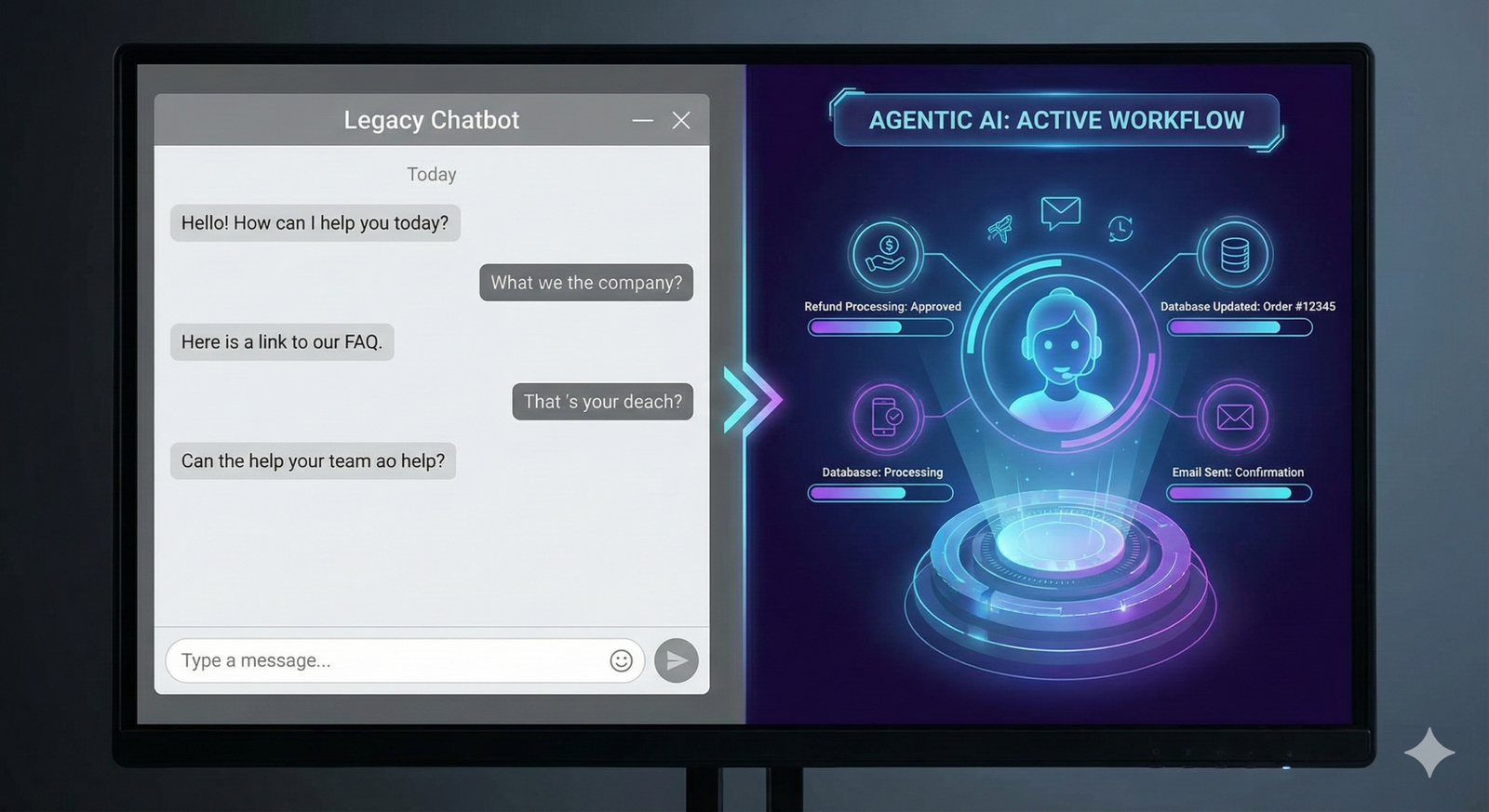
Agentic AI represents a leap from AI that talks to AI that acts. Unlike traditional chatbots that rely on pre-written scripts or basic pattern matching, agentic systems use Large Language Models (LLMs) to reason, plan, and execute complex tasks across multiple software systems. They don’t just tell you how to process a refund; they verify the return, check the warehouse inventory, process the transaction in the payment gateway, and send a confirmation email—all without human intervention.
Key Takeaways
- From Passive to Proactive: Agentic AI can anticipate customer needs based on behavior rather than waiting for a prompt.
- Tool Integration: The “agentic” part refers to the AI’s ability to use APIs, browse the web, and interact with CRMs like a human employee would.
- Reasoning Capabilities: These agents use iterative loops (thinking, acting, observing) to solve multi-step problems.
- Human-Centric Design: The goal is not total replacement but “augmentation,” allowing humans to handle high-empathy, high-stakes scenarios while AI handles the logic-heavy “grunt work.”
Who This Is For
This guide is designed for CX leaders, Chief Operations Officers, and digital transformation managers who have already implemented basic AI and are looking for the next competitive edge. If your current chatbot feels like a “glorified FAQ,” it is time to transition to an agentic model.
Defining the Agentic Shift: Chatbots vs. Agents
To understand where we are going, we must define where we’ve been. Traditional chatbots are generally deterministic. They follow an “If/Then” logic. If the user says “Pricing,” show the “Pricing Link.”
Agentic AI is probabilistic and goal-oriented. You give it a goal (e.g., “Retain this customer who is unhappy with their shipping delay”), and the agent determines the best path to achieve that goal.
The “Reasoning” Loop
The core of the agentic workforce is the ReAct (Reason + Act) framework. When an agent receives a request, it doesn’t just output text. It follows a loop:
- Thought: “The user wants to cancel their subscription because of a technical bug. I should first check their account status.”
- Action: Calls the CRM API to pull the user’s profile.
- Observation: Sees the user has been a loyal member for three years.
- Thought: “Since they are a long-term member, I should offer a credit before processing the cancellation.”
- Action: Generates a personalized offer and asks the user for their preference.
This ability to “think” before acting allows the AI to handle nuances that would break a traditional chatbot.
The Technical Pillars of Agentic CX
Building an agentic workforce requires more than just a subscription to an LLM. It requires an ecosystem that allows the AI to interact with your business infrastructure.
1. Retrieval-Augmented Generation (RAG)
Agents need access to your company’s specific knowledge—your manuals, your updated policy docs, and your real-time inventory. RAG allows the agent to “look up” information in a private database before generating a response, ensuring the information is accurate and grounded in fact.
2. Tool Use and API Orchestration
An agent is only as good as the tools it can use. In a CX context, this means giving the AI “permissions” to interact with:
- Zendesk/Salesforce: To read and write tickets.
- Stripe/PayPal: To process refunds or update billing.
- Shopify/ERP systems: To track shipments and inventory.
- Email/Slack: To notify human supervisors of complex issues.
3. Long-Term Memory
Traditional chatbots are often “amnesiacs.” Every time you start a new chat, they forget who you are. Agentic systems utilize “vector databases” to remember past interactions, preferences, and recurring issues, providing a truly personalized experience that scales.
Core Use Cases: Where Agents Outperform Chatbots
Complex Troubleshooting
Imagine a customer whose smart home thermostat isn’t connecting to Wi-Fi. A chatbot would send a link to a “Troubleshooting Guide.” An AI agent would:
- Ask the customer for the device ID.
- Ping the device to check its last online status.
- Check the local ISP for outages in the customer’s zip code.
- If no outage is found, walk the customer through a custom reset sequence based on their specific firmware version.
Proactive Retention
Using predictive analytics, an agentic system can identify a “churn risk.” For example, if a user has logged in five times in two days to the “cancel account” page but hasn’t pulled the trigger, an agent can initiate a reach-out. It can offer a personalized discount or a 1-on-1 call with a specialist, based on the user’s specific history.
Dynamic Upselling
Instead of showing generic “Customers also bought” widgets, an agent can engage in a conversation. “I see you’re buying the DSLR camera. Since you mentioned you’re interested in wildlife photography, would you like to see the compatible 300mm lenses that are currently on sale?”
The Human-in-the-Loop (HITL) Model
One of the biggest fears regarding AI is the “black box” problem—the idea that AI will make wild, unmonitored decisions. The agentic workforce relies on a Human-in-the-Loop architecture.
Safety Disclaimer: In financial and medical CX, agentic AI should never have final authority over high-risk actions (e.g., approving a loan or giving medical prescriptions) without a human supervisor’s secondary verification.
Escalation Triggers
Agents are programmed with “guardrails.” If a customer’s sentiment score drops (indicating high anger) or if the refund amount exceeds a certain threshold (e.g., $500), the agent seamlessly hands the entire “context package” to a human representative. The human doesn’t have to ask the customer to repeat themselves; they can see the entire reasoning chain the AI followed.
Implementing Agentic Workflows: A Step-by-Step Guide
Transitioning to an agentic workforce isn’t an overnight switch. It’s a strategic evolution.
Step 1: Data Readiness
Your AI is only as smart as your data. Ensure your knowledge base is digitized, structured, and updated. If your internal docs are messy, your agent will be confused.
Step 2: Define the “Tools”
List the top five actions your support team takes daily. Can these be accessed via API? If your refund process requires a physical signature and a fax, you can’t automate it. Modernize your internal APIs first.
Step 3: Start with a “Pilot Agent”
Don’t automate your entire help desk at once. Build an agent for one specific, high-volume task, such as “Order Modifications.” Monitor its “Success Rate” and “Hallucination Rate” for 30 days before expanding.
Step 4: Establish Tone and Personality
Your agent represents your brand. Use system prompts to define its persona. Is it “Professional and Concise” or “Warm and Empathetic”? Consistent branding is key to customer trust.
Common Mistakes to Avoid
- Over-Automation: Trying to remove humans entirely leads to a “uncanny valley” experience where customers feel ignored. Always provide an “Escape to Human” button.
- Neglecting Latency: Agentic reasoning (thinking before speaking) takes more processing power than a simple chatbot. Ensure your infrastructure can handle the delay, or use “thinking” indicators to manage user expectations.
- Lack of Guardrails: Giving an AI agent an “unlimited” refund tool is a recipe for disaster. Always set hard caps on what an autonomous agent can execute without approval.
- Ignoring Edge Cases: AI agents are great at the “happy path,” but they can struggle with bizarre, one-off scenarios. Regularly audit chat logs to find where the logic broke down.
Measuring Success in the Agentic Era
The old metrics like “Deflection Rate” are becoming obsolete. If an agent “deflects” a customer but doesn’t solve the problem, you’ve lost. In the agentic era, we focus on:
| Metric | Definition | Why it Matters |
| Resolution Rate | % of issues solved without human intervention. | Measures true autonomy. |
| Cost Per Resolution | Total cost of AI compute / Total solved issues. | Directly impacts ROI. |
| Sentiment Shift | Change in customer mood from start to end of chat. | Measures empathy and effectiveness. |
| Tool Accuracy | % of times the AI chose the correct API to call. | Measures the “logic” of the agent. |
The Future: Multi-Agent Systems
The next phase of the agentic workforce involves Multi-Agent Orchestration. Instead of one giant AI trying to do everything, you will have a “Manager Agent” that coordinates specialized agents:
- The Billing Agent handles payments.
- The Technical Agent handles bugs.
- The Logistics Agent handles shipping.
These agents “talk” to each other to solve a single customer issue, creating a highly efficient, modular support system.
Ethical Considerations and Data Privacy
As agents gain more power to act on behalf of users, privacy becomes paramount. As of February 2026, regulations like the AI Act (in various jurisdictions) require transparency. Customers must be informed when they are speaking to an agent, and they must have the right to request a human audit of any automated decision that affects their finances or service access.
Security Best Practices
- Prompt Injection Protection: Ensuring users can’t “trick” the agent into giving away free products or accessing other users’ data.
- Data Masking: Automatically scrubbing PII (Personally Identifiable Information) before it is processed by the LLM.
- Audit Logs: Keeping a record of every “Thought” and “Action” the agent took for future review.
Conclusion
The shift from chatbots to an agentic workforce is not merely a technical upgrade; it is a fundamental change in how businesses interact with their customers. We are moving away from a world where customers have to navigate a maze of “Press 1 for Sales” and toward a world where a sophisticated, reasoning partner is available 24/7 to solve their problems in real-time.
For businesses, the benefits are clear: significantly lower operational costs, higher customer satisfaction through instant resolution, and the ability to scale personalized service to millions of users simultaneously. For employees, the agentic workforce removes the burden of repetitive, soul-crushing tasks, allowing them to focus on high-value strategy and complex human connections.
Your Next Steps:
- Audit your current “Toolbox”: Identify which of your software systems have open APIs that an AI could potentially interact with.
- Pilot a “Specific” Agent: Choose your highest-volume, lowest-complexity ticket type and build a reasoning agent to handle it from start to finish.
- Evaluate your Knowledge Base: Ensure your documentation is ready for RAG (Retrieval-Augmented Generation) so your agents have a “source of truth.”
Would you like me to help you draft a specific “System Prompt” for your first Customer Experience agent to ensure it follows these “human-first” principles?
FAQs
What is the difference between a chatbot and an agent?
A chatbot is typically reactive and follows a set of pre-defined rules or generates text based on patterns. An AI agent is proactive and goal-oriented; it can plan its own steps, use external tools (like checking a database or processing a payment), and iterate on its strategy until the goal is achieved.
Is agentic AI safe for processing payments?
Yes, provided there are strict guardrails in place. Agents should interact with payment gateways through secure APIs with limited permissions (e.g., they can issue a refund up to $50 but cannot change banking details). Human-in-the-loop oversight is recommended for high-value transactions.
Will an agentic workforce replace human support agents?
It is more likely to augment them. Agents handle the repetitive, logic-based tasks that currently take up 70–80% of support volume. This allows human agents to handle more complex, emotionally charged, or high-stakes issues that require nuanced judgment and empathy.
How do I prevent my AI agent from “hallucinating” or lying?
By using Retrieval-Augmented Generation (RAG) and Groundedness Checks. Instead of letting the AI guess an answer, you force it to look up information from your verified knowledge base. If the information isn’t there, the agent is programmed to say “I don’t know” and escalate to a human.
How much does it cost to implement an agentic workforce?
Costs vary depending on the LLM used (e.g., GPT-4, Claude 3, or open-source models) and the volume of interactions. While initial setup and API costs can be higher than simple chatbots, the “Cost Per Resolution” is typically 60–90% lower than human-only support.
References
- Gartner (2025): “The Rise of Autonomous Agents in Enterprise CX.”
- Salesforce: “State of Service Report: AI and the Future of Customer Support.”
- OpenAI Documentation: “Function Calling and Tool Use in LLMs.”
- Harvard Business Review: “How Generative AI Is Changing the Way We Manage Customer Experience.”
- Anthropic: “Core Views on AI Safety and Model Grounding.”
- Stanford HAI: “The Impact of Agentic Workflows on Productivity.”
- Zendesk: “Integrating AI Agents into Multi-Channel Support Workflows.”
- McKinsey & Company: “Economic Potential of Generative AI: The Next Productivity Frontier.”