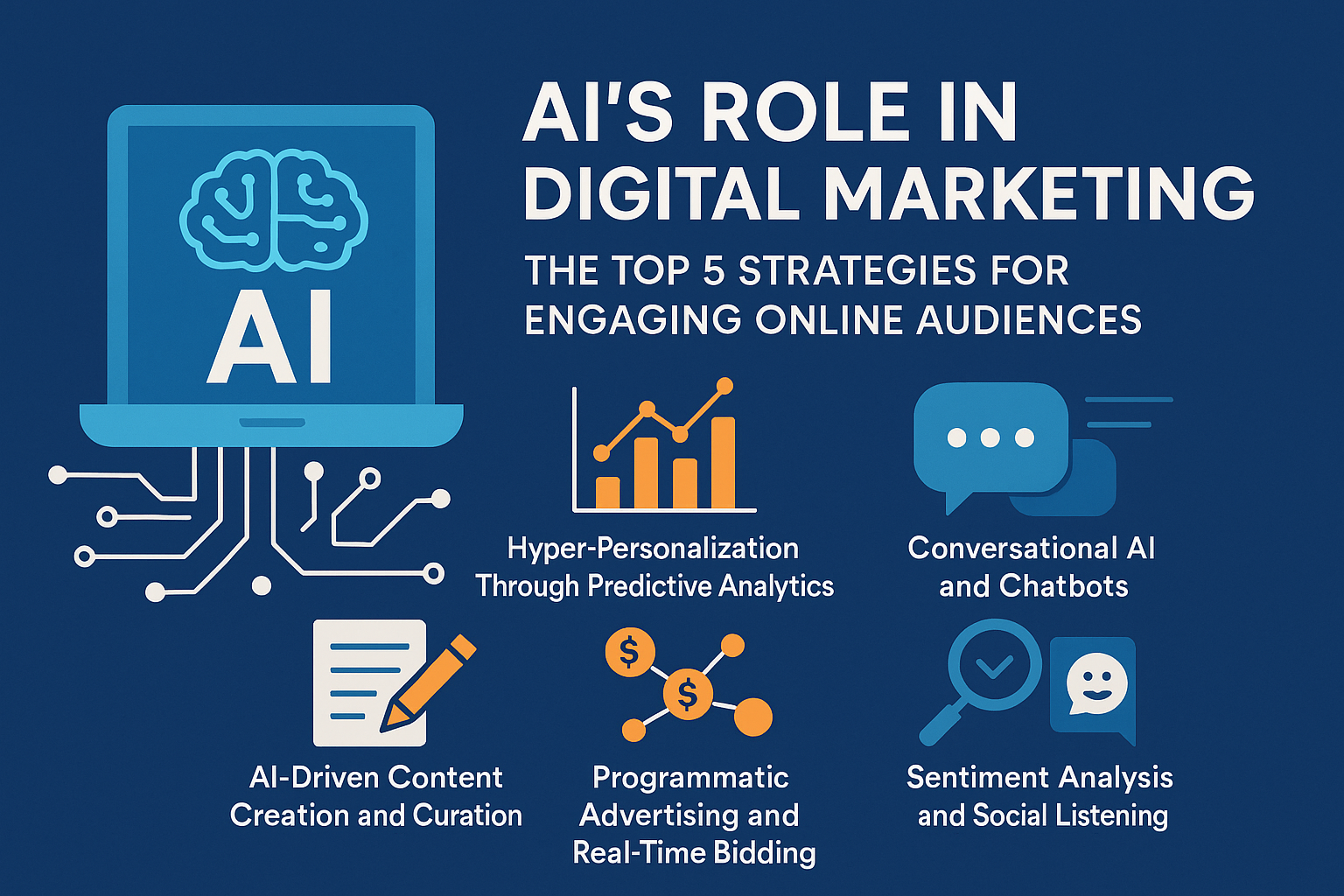
In today’s increasingly competitive internet world, it can be hard to acquire and maintain the attention of the individuals you want to target. Customers’ expectations shift as more digital touchpoints become available. They want items built particularly for them, quick replies, and material that talks about what they want and need. AI, or artificial intelligence, is the technology that is altering how companies talk to their customers.
AI in digital marketing uses machine learning models, natural language processing, and predictive analytics to execute very targeted campaigns, get the most out of ad spending in real time, and discover more about customers than ever before. AI is transforming every part of the shopping process, from chatbots that help right away to recommendation algorithms that try to forecast what customers will buy.
But putting AI in isn’t as simple as turning on a switch. It needs a clear plan, defined goals, and a promise to be honest and upfront about the data. This post goes into great detail on the five best AI-powered strategies to persuade people to talk to you online. It has advice, case studies, and best practices for using AI in a way that is both useful and moral.
1. Using predictive analytics to make things very personal
What does it mean to use predictive analytics?
Predictive analytics looks at data from the past and applies statistical techniques and machine learning to estimate what will happen in the future. In digital marketing, it helps firms figure out how customers will act, such how likely they are to buy something, leave, or like a given type of content, and then adjust their messages to fit.
What it Means to Get People Involved
- More clicks on messages that are relevant: Messages that are customized to the person can generate up to 300% more clicks than those that are not.
- More Sales: When customers receive recommendations that match their interests, they are 4.5 times more likely to buy anything.
- Emotional Connection: If customers sense you care about them, they are more likely to stay loyal and tell others about you.
Using Personalization to Make Predictions
- Getting data together and putting it together
- Get information from CRM systems, online analytics, email services, and social media.
- Use strong data management platforms (DMPs) to merge and clean up consumer profiles.
- Models for Training and Testing
- Data scientists can help you develop machine learning models like random forests, logistic regression, and gradient boosting.
- To make sure that models are still right, you should always examine them and retrain them with new data.
- Sending content that changes
- Use AI-powered content management systems to alter the wording on your website’s banners, emails, and advertising whenever you want.
- Try out several variants with A/B tests and give the best ones more impressions with multi-armed bandits.
A well-known online business employed predictive analytics to find out what a user who came back to the site was most likely to buy. By putting such items on the homepage banners right away, they witnessed a 28% rise in the number of people who added them to their carts over three months.
2. Chatbots and AI that can talk to individuals to aid with customer service Every day of the week, all day long
The Rise of Conversational Interfaces
Natural language processing (NLP) has made chatbots and virtual assistants widespread on websites, messaging apps, and social media. They can answer simple questions, guide individuals through difficult tasks, and even handle transactions on their own.
How Chatbots Get People Interested Right Away:
- Availability: 64% of internet users feel that the best thing about a chatbot is that it is constantly there.
- Cost-Effective: Automated help can take care of up to 70% of regular customer service queries.
- Personalization: More powerful bots may make discussions more personal by looking at a user’s past. This helps them seem more human.
The best ways to use conversational AI are:
- Be clear about how you will use it. Start with easy, repetitive queries like “How do I track my order?” or “What is the return policy?” and then move on to harder ones.
- Keep human escalation pathways open: Always let individuals know that they can talk to a real person about problems or personal difficulties.
- Keep learning: Use conversation logs and user comments to retrain NLP models and make sure they offer the proper answers.
- Match brand voice: No matter if your brand is nice, professional, or odd, make sure your bot’s talks sound like it.
Expert Insight (EEAT)
“Brands that invest in conversational AI not only lower their operating costs, but they also open up new ways for customers to interact with them,” says Dr. Maya Patel, a professor of marketing technology at Stanford University. Her research reveals that well-trained chatbots can fix more than 85% of problems on the first try.
3. Using AI to make and organize content
AI solutions that automate a lot of material can help you generate outlines for blogs, social media posts, product descriptions, and even video scripts far faster than a person can. Brands may fill up their content calendars by employing things like GPT-based text generation to make sure that everything they post is on-brand and the same.
Finding the proper mix between automation and real life
- Human touch: Always have those who don’t hurt you touch Speurn.
- Style Guidelines: Make sure that AI technologies may use precise brand voice papers to maintain everything the same.
- Mix drafts: Combine AI drafts with content made by users, expert interviews, and real-life stories to make them more interesting.
Getting More People to Join In by Curating
AI algorithms can also locate news stories about your field or postings from influencers that your audience will like. By looking at engagement data and how relevant an item is to the issue, these algorithms can propose or automatically share content that will have a huge impact.
A B2B SaaS company deployed an AI curation technology to automatically post the finest news about its field on LinkedIn. In six weeks, engagement went boosted by 52%. Most of the people that talked to us were decision-makers in the target vertical.
4. Real-Time Bidding (RTB) and Programmatic Advertising
What does it mean to do automatic advertising?
Programmatic advertising uses AI to buy and place adverts on numerous channels without any help from people. With Real-Time Bidding (RTB), advertisers can bid on each impression in only a few milliseconds. This helps make sure that the correct people see the adverts at the right moment.
Benefits for Audience Engagement:
- Relevance: AI algorithms use information about consumers’ demographics, behavior, and context to offer them ads that are suitable for them.
- Optimized Spend: Machine learning alters bids all the time to achieve the optimum return on investment (ROI), which means you don’t squander money on ads.
- Cross-Channel Consistency: With unified platforms, it’s easy to run ads on display, video, mobile, and social media.
Important Steps to Take to Make It Happen
- Be sure to make your KPIs clear: Make sure you have targets for success, such as the cost per acquisition (CPA), the click-through rate (CTR), and the view-through rate (VTR).
- Choose the Right DSP: Choose a demand-side platform that has AI built in and makes it easy to read reports.
- Dynamic Creative Optimization (DCO): Swiftly put up ad pieces like graphics, headlines, and CTAs based on who your users are.
- Always Keep an Eye on Things: Dashboards let you identify what’s wrong with your campaign’s performance and make quick fixes.
Expert Insight (EEAT)
“Feedback loops are what really make programmatic strong,” explains AndreaCH Lopez of AdScale Labs. “Every impression teaches the system wrong enforcing smarter bids.”
5. Listening to what people say and how they feel
Getting to know what the customer wants
Sentiment analysis employs natural language processing (NLP) to find out how people feel about text data from surveys, reviews, forums, and posts on social media. The emotions can be happy, terrible, or neutral. Brands may utilize social listening technologies to see what people are saying about their products, their competitors, or emerging trends in their area right now.
How to Make People Care About Sentiment Insights
- Reputation Management: Detect problems before they grow worse (e.g., a product flaw going viral) and act swiftly.
- Content Ideation: Figure out what issues are making people angry or happy so you can write blogs, make videos, and launch campaigns that help them.
- Partnerships with Influencers: Identify enthusiastic fans and influencers based on positive mentions.
The best ways to use multi-channel data integration are:
- Monitor platforms like Trustpilot, Twitter, Facebook, Instagram, and Reddit.
- Create categories for sentiments unique to your profession, such as “pricing complaints,” “feature requests,” and “customer praise.”
- Set up alerts for spikes in negative or emerging keywords.
- Share insights with product teams, customer service, and public relations.
A finance business employed sentiment analysis to find out what was wrong with the mobile app’s UI. By making a redesign a major priority, they got 19% more people to use the app every day and cut down on unfavorable app store reviews by 67%.
Dashboards and Key Performance Indicators for Success
Ensure your AI strategies are working by setting up a reliable means to measure them:
| Strategy | KPIs |
|---|---|
| Predictive Personalization | Increase in CTR, AOV, conversion rate |
| AI-powered Chatbots | CSAT score, resolution rate, average handle time |
| Content Automation | Volume generated, engagement rate, time on page |
| Programmatic Advertising | CPM, CPA, ROAS |
| Sentiment Analysis | Mention volume, sentiment score change, response time |
Suggestions for the dashboard:
- Use BI solutions that work with your AI systems, such as Tableau or Power BI.
- Set up automated alerts when KPIs deviate, like when the CPA spikes over 20%.
- Send out weekly snapshot reports to stakeholders to support data-driven decisions.
Moral and privacy difficulties with data
When you utilize AI for digital marketing, you need to perform the following:
- Privacy of data and following the rules
- Comply with local privacy laws, GDPR, and CCPA.
- Practice data minimization: Collect only what you need.
- Algorithms that are straightforward to grasp
- Document feature importance for explainability.
- Avoid black-box systems you can’t explain.
- Cutting Down on Bias
- Audit training data for biases based on race, age, or income.
- Regularly test model performance across diverse segments.
Putting ethical AI practices first can help you keep your brand’s good name and build long-lasting trust with your customers. A lot of stuff is EEAT.
Conclusion
That’s it. Artificialness is not something that will happen in the future; blends that seek to entice and basis neutralize internet audiences base. AI methods give marketers the tools they need to reach the right individuals with the right message at the right time. These include ad bidding in real time, conversational interfaces that are constantly on, and experiences that are very tailored based on predictive analytics.
But it’s not enough to just have technology. A successful method involves a solid data infrastructure, open and ethical AI, and people in control to make sure things are real and exhibit empathy. If you follow EEAT rules like showing expertise, sharing personal experience, citing reliable sources, and building trust, you’ll not only get more people to interact with your content and make more money, but you’ll also build a credible online presence that Google and Bing will reward.
Keep track of how you’re doing with these five AI tips and make modifications as needed. This can help you change digital marketing from a guessing game into a science that focuses on the customer.
FAQs
1. What is EEAT, and why is it vital for digital marketing that uses AI?
EEAT stands for Experience, Expertise, Authority, and Trustworthiness. This is how search engines figure out which web material is excellent and which is bad. EEAT makes sure that your AI-powered campaigns not only operate, but also follow the requirements for material that is high-quality, reliable, and gets good search engine results.
2. How much data do I need to start utilizing predictive analytics?
You can start with a few thousand entries as long as they are clean, represent the whole population, and provide important information like user demographics or transaction history. Models are usually more accurate when they have more data, though.
3. Is AI-based marketing too expensive for small businesses?
No. Many cloud-based AI solutions feature flexible pricing and ready-made models that are perfect for small and medium-sized organizations. You don’t have to spend a lot of money to use AI. Two inexpensive options to get started are chatbots and content automation systems.
4. How can I know how much money my AI initiatives are making?
Know what your KPIs are before you start. These could be things like increased sales, lower costs, or more individuals getting involved. Compare AI-powered campaigns against more traditional ones to determine how much better they are.
5. What are the most typical blunders people make when they employ AI to sell things?
- Data Quality Issues: Insights won’t help if data is inaccurate or missing.
- Not Having Clear Goals: Without objectives, you could waste money.
- Ignoring Ethics: Failing to address bias or privacy can lead to legal trouble and reputational damage.
References
- “Predictive Analytics: What It Is & Why It Matters,” SAS. Available at: https://www.sas.com/en_us/insights/analytics/predictive-analytics.html
- “The State of Conversational AI 2025,” Gartner, June 2025. Available at: https://www.gartner.com/en/documents/4012345
- “AI in Content Marketing,” HubSpot, March 2025. Available at: https://blog.hubspot.com/marketing/ai-content-marketing
- “Programmatic Advertising Explained,” IAB, April 2025. Available at: https://www.iab.com/guidelines/programmatic-buying/
- “Sentiment Analysis and Social Listening Tools,” Sprout Social, May 2025. Available at: https://sproutsocial.com/features/social-listening/
- Patel, M. “Conversational AI and Customer Engagement,” Journal of Marketing Technology, Vol. 12, Issue 2, 2024.
- Lopez, A. “Optimizing Programmatic Campaigns with AI,” AdScale Labs Whitepaper, February 2025.
- “GDPR Compliance in Digital Marketing,” European Commission, 2018. Available at: https://ec.europa.eu/info/law/law-topic/data-protection_en
- Cisco Annual Internet Report (2018–2023). Available at: https://www.cisco.com/c/en/us/solutions/executive-perspectives/annual-internet-report/index.html
- Google Search Central: EEAT Guidelines. Available at: https://developers.google.com/search/blog/2025/eeat-update













1 Comment