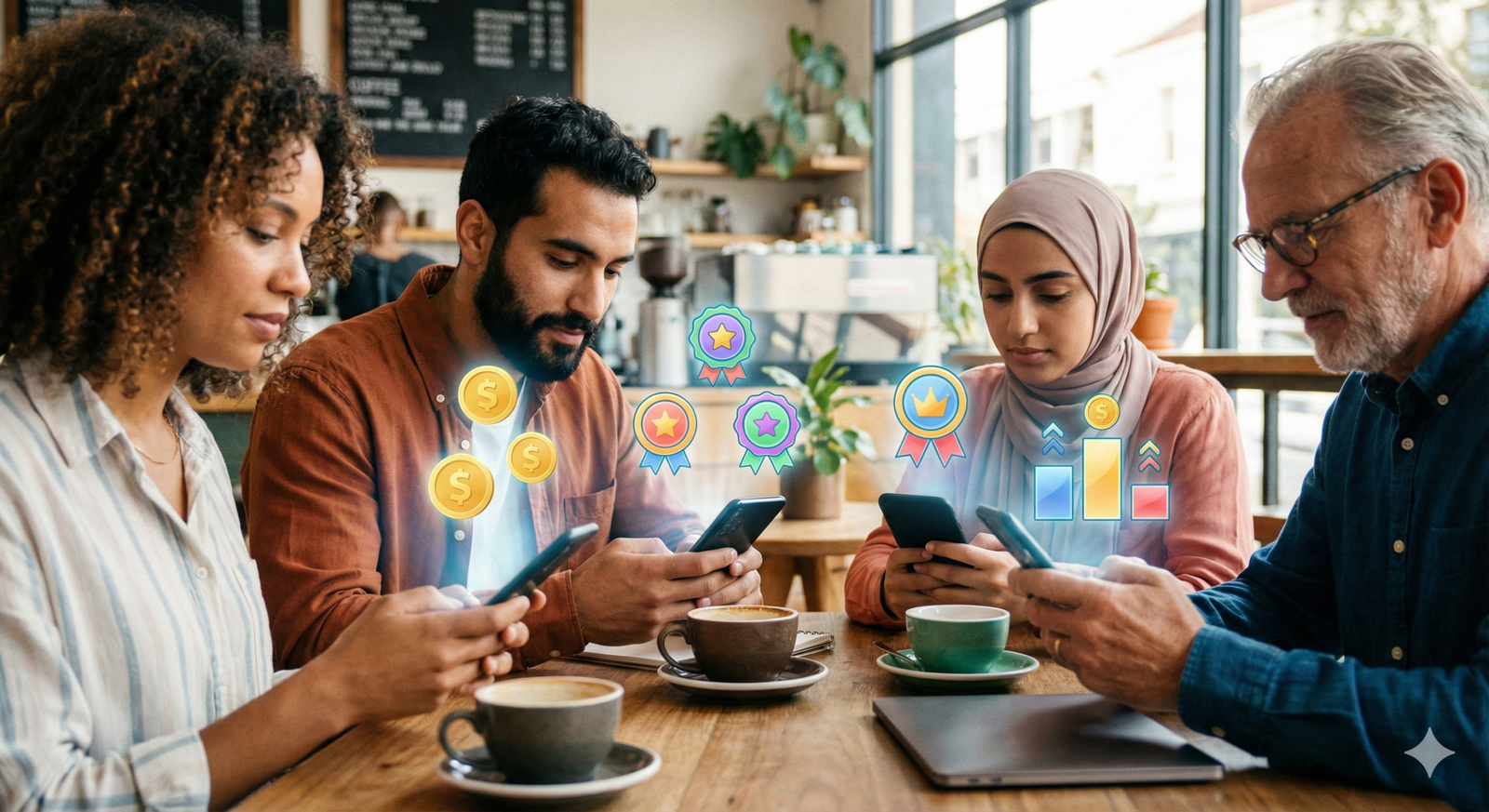
In the digital age, our social lives have been subtly transformed into a massive, multiplayer online game. Every time you post a photo, write a comment, or swipe right, you are participating in a complex system of rewards and feedback loops designed to keep you engaged. This is the gamification of social interaction—the application of game-design elements and game principles in non-game contexts to drive user engagement and organizational productivity.
While the term “gamification” often conjures images of corporate training modules or language learning apps like Duolingo, its most profound and pervasive impact has been on how humans connect with one another. From the “like” button to the “verified” checkmark, the infrastructure of our digital conversations is built on points, badges, and leaderboards.
This guide explores the mechanics, psychology, and societal impact of social gamification. We will examine how these tools shape our behavior, the fine line between engagement and addiction, and how we can navigate this gamified landscape with intention.
Key Takeaways
- Social Metrics are Points: Likes, shares, and follower counts act as “points” that quantify social capital and influence behavior through instant feedback loops.
- Badges Define Identity: Verification ticks, “Top Fan” labels, and achievement icons serve as status symbols that differentiate users and incentivize specific behaviors.
- Leaderboards Create Hierarchy: Algorithms often function as invisible leaderboards, prioritizing content and creators, which can induce social anxiety and competitive comparison.
- Psychological Drivers: These systems exploit fundamental human drives for competence, autonomy, and relatedness, often leveraging dopamine-driven reward cycles.
- The Double-Edged Sword: While gamification can build community and foster loyalty, it can also lead to polarization, burnout, and the commodification of human connection.
Scope of This Guide
In this guide, gamification refers to the use of game mechanics (points, levels, rewards) in social platforms and communication tools to influence user interaction. It does not cover the development of actual video games or educational gaming software, except where they overlap with social networking features.
1. The Mechanics of Social Play: The PBL Triad
At the heart of most gamified systems lies the “PBL Triad”: Points, Badges, and Leaderboards. While these elements are explicit in video games, in social media and digital communities, they are often integrated so seamlessly that we fail to recognize them as game mechanics.
Points: Quantifying Social Worth
Points are the most granular unit of gamification. They provide immediate feedback and a way to keep score.
- The “Like” Economy: The most ubiquitous form of points is the “like” (or heart, or upvote). It turns a qualitative interaction (someone appreciating your thought) into a quantitative metric. This allows users to measure the success of a post instantly.
- Streaks and Consistency: Snapchat’s “Snapstreaks” are a prime example of points used to measure consistency. The number next to a friend’s name isn’t just a statistic; it represents an investment of time. Breaking a streak feels like losing progress in a game, leveraging the psychological principle of loss aversion.
- Karma and Reputation: Platforms like Reddit use “Karma” to calculate a user’s net contribution to the community. Unlike a simple “like,” karma is cumulative, turning a user’s profile into a scorecard of their digital citizenship.
In Practice: Consider a user posting on LinkedIn. They are not just sharing news; they are watching the “impression” count (points) climb. If the post performs well, they feel a sense of “winning” the algorithm for the day. If it flatlines, they may feel they have “lost,” prompting them to adjust their strategy for the next round.
Badges: Status and Identity
Badges are visual representations of achievements. In social interaction, they serve as shorthand for status, expertise, or group membership.
- Verification: The blue checkmark (or gold/grey variations) is the ultimate social badge. It separates the “elite” players from the standard users. Historically denoting authenticity, these have evolved on platforms like X (formerly Twitter) into subscription perks, changing the game from “achievement-based” to “pay-to-win.”
- Community Awards: Reddit awards or Facebook’s “Top Fan” diamonds allow users to bestow badges on others. This decentralizes the reward system, allowing the community to act as the game master, reinforcing specific types of humor or viewpoints.
- Profile Flair: Dating apps allow users to display badges for interests (e.g., “Foodie,” “Gamer”). While functional, these act as character stats, allowing potential matches to quickly assess compatibility, much like checking a character sheet in an RPG.
Leaderboards: The Hierarchy of Visibility
Leaderboards rank users against one another. In social contexts, these are often dynamic and algorithmic rather than static lists.
- Follower Counts: This is the public-facing leaderboard. Users with higher counts are perceived as having “won” the social game, granting them higher authority and attention.
- The Algorithm as Referee: The “For You” page or the news feed is a personalized leaderboard. Content that appears at the top has “won” the competition for your attention against millions of other posts.
- Trending Topics: This is a leaderboard of ideas. Getting a hashtag to trend is a cooperative game played by thousands of users trying to force a topic onto the global scoreboard.
2. The Psychology Behind the Screen
Why do these mechanics work so effectively on the human brain? The power of gamification in social interaction is rooted in behavioral psychology and neuroscience.
The Dopamine Loop and Variable Rewards
B.F. Skinner, a behavioral psychologist, discovered that the most effective way to condition behavior is not through consistent rewards, but through variable ratio schedules of reinforcement.
- The Slot Machine Effect: When you pull-to-refresh your email or social feed, you don’t know what you’re going to get. Sometimes it’s nothing (boring); sometimes it’s a jackpot (a viral post, a message from a crush). This uncertainty releases dopamine, the neurotransmitter associated with anticipation and craving.
- Anticipation vs. Satisfaction: Interestingly, the brain releases more dopamine during the anticipation of the reward than during the receipt of it. The gamified structure of notifications (“You have 3 new interactions”) keeps users in a perpetual state of anticipation.
Self-Determination Theory (SDT)
SDT suggests that human motivation is driven by three needs: Autonomy, Competence, and Relatedness. Social gamification hacks these drivers:
- Competence: Gaining followers or likes validates our skills (humor, photography, insight). We feel “good” at being social.
- Relatedness: Interactions, even quantitative ones, simulate connection. A badge says, “I belong to this tribe.”
- Autonomy: This is where the illusion lies. We feel we are choosing to engage, but the design choices (infinite scroll, auto-play) subtly erode our autonomy, guiding us down pre-determined paths.
Social Comparison Theory
Leon Festinger’s Social Comparison Theory posits that individuals determine their own social and personal worth based on how they stack up against others.
- Upward Comparison: Looking at “players” with higher scores (more money, better bodies, happier lives). This often leads to feelings of inadequacy.
- Downward Comparison: Looking at those “doing worse” to boost self-esteem.
- Quantified Comparison: In the analogue world, social standing is ambiguous. In the gamified digital world, it is precise. You have 400 followers; they have 405. The game makes the comparison explicit and inescapable.
3. Real-World Applications: How Different Sectors Gamify Connection
The gamification of interaction isn’t limited to Facebook or Instagram. It has permeated various aspects of our digital lives.
Dating Apps: The Swipe Game
Dating apps are perhaps the most aggressively gamified social tools.
- The Mechanic: The “Swipe” is a game mechanic. It turns decision-making into a rapid-fire, kinetic action.
- The Reward: A “Match” screen often explodes with confetti or vibrant colors, mimicking the “Level Up” screen in a video game.
- Elo Scores: Historically, apps like Tinder used an Elo score (a rating system from chess) to rank users on desirability. High-ranking players were shown to other high-ranking players. While apps claim to have moved away from strict Elo systems, the algorithmic sorting of potential partners fundamentally gamifies romance.
The Workplace: Productivity as a Multiplayer Game
Tools like Slack, Microsoft Teams, and project management software have turned work into a social game.
- Status Indicators: Being “Active” (green dot) is a badge of presence.
- Reaction Emojis: These serve as micro-points for workplace communication. A message with 10 “fire” emojis is a “winning” contribution.
- Sales Gamification: CRM platforms often have explicit leaderboards for sales teams, visualizing revenue as a race, pitting colleagues against one another to drive performance.
Education and Learning Communities
Platforms like Duolingo or Khan Academy use social gamification to drive learning.
- Leagues: Users are placed in weekly leagues based on XP (experience points). To advance (or avoid relegation), they must outperform strangers.
- Friend Quests: Collaborative challenges where two users must work together to achieve a goal, leveraging social accountability—you don’t want to be the reason your friend loses the reward.
4. The Value of Gamification: Community and Loyalty
Despite the potential for critique, gamification provides tangible benefits for building communities and facilitating interaction.
1. Lowering the Barrier to Interaction
For introverted or socially anxious individuals, unstructured social interaction can be terrifying. Gamified mechanics provide a script.
- Structured Engagement: Clicking a “like” button is a low-stakes way to say “I hear you.” It removes the pressure of formulating a witty comment.
- Icebreakers: Badges or profile levels give users explicit topics to discuss. “I see you have the ‘Marathon Runner’ badge” is an easier opening line than a cold approach.
2. Identifying and Rewarding Super-Users
Communities rely on a small percentage of users to create the vast majority of content (the 1% rule). Gamification identifies these power users.
- Reputation Systems: In technical forums like Stack Overflow, points and badges ensure that answers come from credible sources. A user with 100k reputation is trusted because they have “played the game” of helping others successfully for years.
- Incentivizing Altruism: Without points or “Accepted Answer” badges, the motivation to spend hours debugging a stranger’s code would rely purely on altruism. Gamification adds a layer of status reward to the altruism.
3. Creating Shared Rituals
Points and leaderboards create a shared reality for a community.
- Example: Twitch chat is a chaotic stream of text, but mechanisms like “Hype Trains” (where users contribute subscriptions to fill a meter) unify the group toward a common, timed goal. It turns a passive viewing experience into a collective, interactive event.
5. The Dark Side: When the Game Plays You
While the mechanics can foster connection, they are often optimized for engagement (time spent on app) rather than utility (value provided to user). This misalignment leads to several negative outcomes.
The Gamification of Hate
Algorithms—the invisible referees of the social game—often weigh “engagement” heavily. Anger and outrage generate more comments and shares than agreement.
- The Conflict Loop: Consequently, the “game” encourages provocative, polarizing behavior. Users learn that to get points (visibility), they must be extreme. This creates a perverse incentive structure where nuance is punished and conflict is rewarded.
Burnout and “Performative” Living
When social interaction is scored, it becomes a performance.
- The panopticon of the feed: Users feel pressure to curate their lives to maximize their score. This leads to “influencer burnout,” where the line between living and documenting life disappears.
- Metric Anxiety: A drop in engagement numbers can feel like a personal rejection. For creators whose livelihood depends on these metrics, the volatility of the “game” causes immense stress.
Context Collapse
In a video game, the rules are consistent. In social gamification, the context often shifts.
- Example: A heartfelt post about a personal tragedy sits next to a meme, both competing for the same “likes.” The gamified structure flattens emotional nuance, treating grief and humor as interchangeable units of “content” to be scored.
6. Navigating the Leaderboards: A User’s Guide
As of 2026, we cannot simply “opt out” of digital communication. However, we can choose how we play the game. Here are strategies for maintaining agency in a gamified world.
Re-evaluating Your Metrics
The platform defines “success” as high engagement (likes/views). You must define your own victory conditions.
- Depth over Width: Instead of chasing follower counts, focus on the number of meaningful Direct Messages (DMs) or offline conversations initiated through the platform.
- The “Hide Likes” Option: Many platforms (Instagram, X) now allow users to hide interaction counts. Utilizing this feature removes the scoreboard from your view, allowing you to focus on the content rather than the score.
Conscious Consumption vs. Auto-Play
- Break the Streak: If you find yourself maintaining a Snapstreak or a login streak purely to avoid losing the icon, deliberately break it. This reasserts your autonomy and proves that the relationship exists outside the gamified mechanic.
- Friction is Your Friend: The game wants to be frictionless. Introduce friction. Turn off notifications. Use grayscale mode on your phone to make the “badges” less colorful and stimulating.
Recognize the “Dark Patterns”
Be aware of design choices intended to manipulate you:
- False Urgency: “3 people are looking at this profile right now.”
- Infinite Scroll: Removes the “stopping cue” (the end of a level).
- Variable Rewards: If you find yourself refreshing a feed repeatedly hoping for a “hit,” recognize you are in a Skinner box and step away.
7. The Future of Social Gamification (2026 and Beyond)
The gamification of social interaction is evolving. We are moving from simple 2D metrics to complex, immersive economies.
Web3 and Tokenized Social Capital
While the initial hype of NFTs has settled into niche utility, the underlying concept of Social Tokens remains a potential future trajectory.
- Ownership Economy: Instead of just getting “likes,” users might earn tokens for their contributions to a community. This turns “social capital” into “financial capital.”
- Pros/Cons: This could financially reward creators more fairly, but it risks hyper-financializing friendship, where every interaction has a transactional value attached.
The Metaverse and Spatial Gamification
As social interaction moves into 3D spaces (VR/AR), gamification will become spatial.
- Avatar Customization: The ultimate badge is the digital skin. In virtual worlds, status is conveyed through digital fashion and assets that are scarce and verifiable.
- Proximity Chat: Interaction may move away from global leaderboards back to “local” interactions, where you can only hear people “near” you in the digital space, mimicking the physics of real-world parties but with gamified overlays (e.g., seeing a floating name tag with someone’s interests).
AI-Mediated Socializing
Artificial Intelligence is beginning to play the game for us.
- Auto-Replies: AI agents suggesting replies or drafting comments creates a scenario where AI bots are “playing” the social game against each other, with humans merely supervising the score.
- Synthetic Companions: We are seeing the rise of AI friends—entities designed purely to fulfill the social needs of the user, perfectly gamified to provide maximum “relatedness” reward with zero social risk.
8. Designing for Connection: An Ethical Framework
For developers, community managers, and business leaders building these systems, there is a responsibility to design ethically.
From “Time Spent” to “Time Well Spent”
- Metric Shift: Move away from optimizing for session duration. Optimize for “meaningful social interactions” (MSIs).
- Ending the Infinite: Design stopping cues. Let users know when they are “caught up.”
Transparent Mechanics
- Algorithm Transparency: Users should know why a certain post is on their leaderboard. Is it there because it’s popular, or because it’s paid for?
- Opt-in Gamification: Allow users to choose their game. Some may want the competitive leaderboard; others may want a quiet, un-scored space.
Conclusion
The gamification of social interaction is not inherently good or evil; it is a tool that amplifies human tendencies. Points can encourage helpfulness or narcissism. Badges can foster community or elitism. Leaderboards can inspire excellence or induce anxiety.
Understanding that we are players in a designed system is the first step toward reclaiming our social autonomy. By recognizing the mechanics of the PBL triad, we can look past the bright colors and dopamine hits to ask the only question that matters in any game: Is this fun, and is it worth playing?
If the digital points don’t lead to real-world fulfillment, it might be time to put down the controller.
Frequently Asked Questions (FAQs)
Q: What is the difference between gamification and game design? A: Game design involves creating a full-fledged game (like Super Mario or Fortnite) primarily for entertainment. Gamification is the application of game mechanics—like points, levels, and leaderboards—to non-game contexts, such as social media, marketing, or education, to influence behavior.
Q: Do “likes” actually release dopamine in the brain? A: Yes. Neuroscientific studies suggest that receiving positive social feedback, such as “likes” on social media, activates the brain’s reward system (the ventral striatum), releasing dopamine similar to how the brain responds to food, sex, or gambling wins.
Q: Are social media streaks considered a form of addiction? A: They can be. Features like streaks leverage the “sunk cost fallacy” and “loss aversion,” compelling users to log in daily not because they want to connect, but because they don’t want to lose their progress. This compulsive usage pattern aligns with behavioral addiction.
Q: How can I stop comparing myself to others on social media? A: One effective method is to curate your feed to remove accounts that trigger inadequacy. Additionally, using platform features to hide “like” counts can help shift your focus from quantitative comparison to the qualitative content itself.
Q: What is “dark gamification”? A: Dark gamification refers to the use of game mechanics to manipulate users into behaviors that benefit the platform but may harm the user. Examples include aggressive notifications, difficult-to-cancel subscriptions, or algorithms that promote polarizing content to keep users engaging through anger.
Q: Will gamification in social media increase in the future? A: Likely, yes. As competition for attention grows, platforms will likely adopt more immersive gamification strategies, including the use of AI, augmented reality (AR), and digital assets (like NFTs) to create deeper, more “sticky” engagement loops.
Q: Is gamification effective for workplace social interaction? A: It can be effective for engagement and clarity (e.g., acknowledging a message with an emoji). However, if overused (e.g., public leaderboards for individual performance), it can create a toxic, hyper-competitive culture that erodes trust and psychological safety.
Q: Can gamification be used for good causes? A: Absolutely. “Gamifying” altruism has been successful in apps like “Charity Miles” or crowdsourced science projects (like folding proteins), where social leaderboards drive real-world positive impact.
References
- Festinger, L. (1954). A Theory of Social Comparison Processes. Human Relations.
- Ryan, R. M., & Deci, E. L. (2000). Self-determination theory and the facilitation of intrinsic motivation, social development, and well-being. American Psychologist.
- Alter, A. (2017). Irresistible: The Rise of Addictive Technology and the Business of Keeping Us Hooked. Penguin Press.
- Zichermann, G., & Cunningham, C. (2011). Gamification by Design: Implementing Game Mechanics in Web and Mobile Apps. O’Reilly Media.
- Deterding, S., et al. (2011). From Game Design Elements to Gamefulness: Defining Gamification. MindTrek.
- Eyal, N. (2014). Hooked: How to Build Habit-Forming Products. Portfolio.
- Center for Humane Technology. (2021). The Ledger of Harms. Retrieved from humanetech.com.
- Pew Research Center. (2024). Teens, Social Media and Technology 2024. Retrieved from pewresearch.org.
- Wei, E. (2019). Status as a Service (StaaS). Remains of the Day. Retrieved from eugenewei.com.
- Hamari, J., Koivisto, J., & Sarsa, H. (2014). Does Gamification Work? A Literature Review of Empirical Studies on Gamification. 47th Hawaii International Conference on System Sciences.