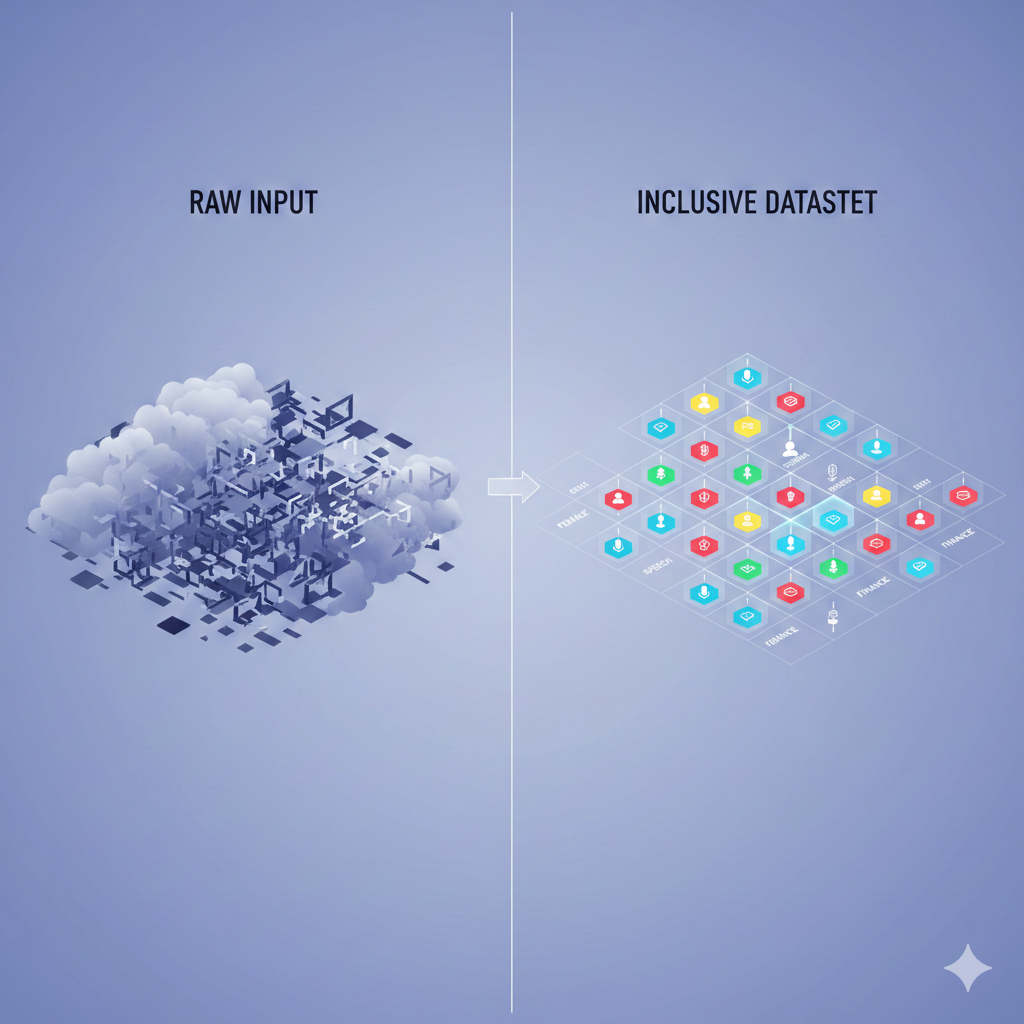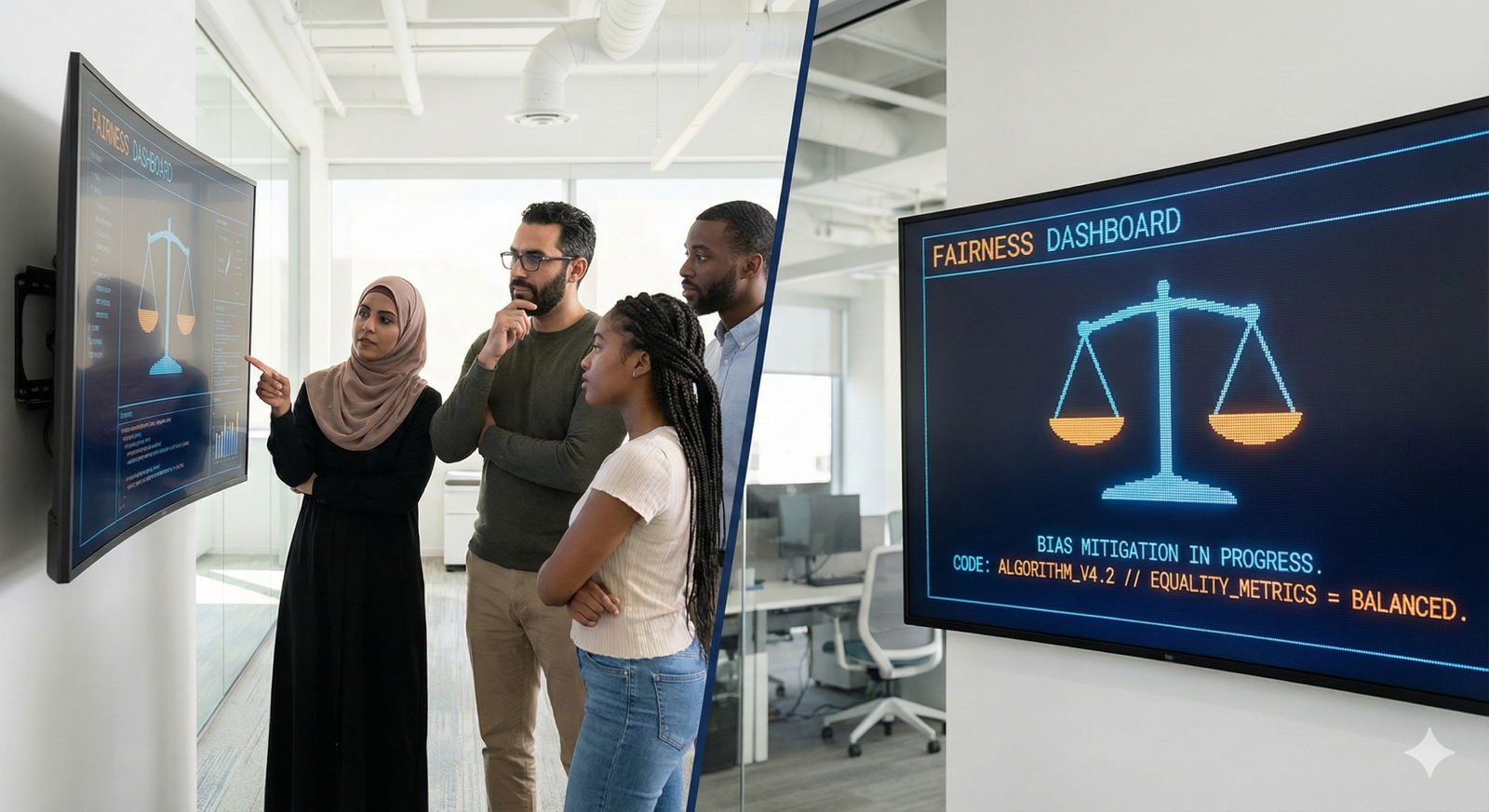
Artificial Intelligence (AI) and Machine Learning (ML) systems are no longer experimental toys confined to research labs; they are the engines powering decisions that fundamentally alter human lives. From approving mortgages and filtering job applications to predicting recidivism rates and diagnosing diseases, algorithms are acting as modern gatekeepers. However, these systems are not impartial. They learn from data that reflects the history of the world—a history often marred by prejudice, exclusion, and systemic inequality. Without rigorous oversight, ML models can amplify these biases, leading to “algorithmic discrimination” at scale.
This creates an urgent need for ML fairness auditing: the systematic process of evaluating models to ensure they treat all user groups equitably, regardless of sensitive attributes like race, gender, age, or disability.
In this comprehensive guide, we will explore the landscape of ML fairness auditing. We will move beyond high-level theory into the practical reality of how data scientists, ethicists, and organizations can audit their systems using state-of-the-art tooling. Whether you are a developer looking to debug a classifier or a business leader concerned about compliance and reputation, this guide provides the framework you need.
Key Takeaways
- Fairness is contextual: There is no single mathematical definition of fairness; choosing the right metric (e.g., Demographic Parity vs. Equal Opportunity) depends entirely on the use case and real-world impact.
- Bias creeps in everywhere: It is not just about “bad data.” Bias enters during problem formulation, data collection, feature engineering, and model deployment.
- Tooling is mature but requires human oversight: Libraries like IBM’s AI Fairness 360, Microsoft Fairlearn, and Google’s What-If Tool are powerful, but they are diagnostic aids, not magic wands.
- Mitigation is a trade-off: Fixing bias often involves trade-offs with model accuracy or complexity, requiring difficult ethical decisions.
- Auditing is continuous: Fairness is not a “one-and-done” checkbox; it requires continuous monitoring as data distributions shift over time.
What is ML Fairness Auditing?
ML fairness auditing is the practice of assessing a machine learning model to determine if it performs differently for specific subgroups of a population. These subgroups are usually defined by protected attributes (also known as sensitive features), such as ethnicity, sex, religion, or age.
The audit seeks to answer questions such as:
- Does this facial recognition system work as well for darker-skinned women as it does for lighter-skinned men?
- Is this hiring algorithm rejecting qualified older candidates at a higher rate than younger ones?
- Does this credit scoring model grant loans at equal rates to different demographic groups with similar financial histories?
The Difference Between Verification and Auditing
While model verification asks “Did we build the product right?” (i.e., does it meet accuracy requirements?), auditing asks “Did we build the right product?” (i.e., is it ethical, safe, and fair?). An audit is often performed by a third party or a specialized internal team separate from the model developers to ensure objectivity.
Why This Matters Now
The stakes are financial, legal, and reputational.
- Regulation: The EU AI Act, various US state laws (like NYC’s Local Law 144 for hiring algorithms), and GDPR provisions are making algorithmic accountability a legal requirement.
- User Trust: When users discover a system is biased, trust evaporates instantly.
- Business Value: A biased model is often an inaccurate model. If a bank’s model systematically denies creditworthy applicants from a specific demographic, the bank is leaving money on the table.
Sources of Bias: Where Does it Come From?
To audit for fairness, one must first understand where bias originates. It is a common misconception that bias only comes from “unbalanced training data.” In reality, bias is a lifecycle problem.
1. Historical Bias (World Bias)
This bias exists in the world, even if the data is perfectly collected. For example, if a model is trained on historical hiring data to predict “successful” CEOs, and 95% of past CEOs were men due to historical sexism, the model will learn that “being male” is a predictor of success. The data accurately reflects a biased reality.
2. Representation Bias (Sampling Bias)
This occurs when the development data does not accurately represent the population the model will serve. A classic example is training a pedestrian detection system for self-driving cars using only images from sunny California, which then fails to detect pedestrians in snowy Canadian winters or chaotic Mumbai traffic.
3. Measurement Bias
This happens when the features or labels we choose are poor proxies for the real-world construct we want to measure. For instance, using “arrest records” as a proxy for “crime” is biased because certain communities are policed more heavily than others. A person in a heavily policed area is more likely to have an arrest record than a person in a lightly policed area, even if both committed the same crime.
4. Aggregation Bias
This arises when a “one-size-fits-all” model is used for diverse groups that have different conditional distributions. For example, a single model diagnosing diabetes might fail if the physiological indicators of diabetes differ significantly between different ethnic groups.
5. Evaluation Bias
This occurs during the auditing phase itself. If the benchmark dataset used to test the model is not representative (e.g., the benchmark faces are mostly white men), the model might report 99% accuracy while completely failing on minority groups.
Key Fairness Metrics Explained
One of the most challenging aspects of ML fairness auditing is that “fairness” has multiple, often conflicting, mathematical definitions. You generally cannot satisfy all fairness metrics simultaneously. The choice of metric depends on the context of the decision.
Here are the three most critical categories of fairness metrics used in auditing tools.
1. Demographic Parity (Statistical Parity)
Definition: The acceptance rate (positive outcome) must be equal across all groups. Formula: P(Y^=1∣A=a)=P(Y^=1∣A=b) Where Y^ is the prediction and A is the sensitive attribute.
When to use: Use this in hiring or advertising where you want to ensure equal representation or equal exposure, regardless of the underlying “ground truth” in the data. Critique: It can force the model to reject qualified individuals in the privileged group or accept unqualified individuals in the unprivileged group to balance the numbers.
2. Equal Opportunity (True Positive Rate Parity)
Definition: The ratio of true positives to actual positives should be the same for all groups. Among people who should qualify (e.g., will repay the loan), the model should accept them at the same rate regardless of group. Formula: P(Y^=1∣Y=1,A=a)=P(Y^=1∣Y=1,A=b)
When to use: This is the gold standard for risk assessment, lending, and healthcare. We want to ensure that qualified candidates are not missed because of their demographic.
3. Calibration (Predictive Value Parity)
Definition: If the model predicts a 70% risk, that risk should be accurate for all groups. A score of 0.7 should mean a 70% probability of the outcome for both Group A and Group B. When to use: Essential for risk scoring tools (like recidivism scores or insurance pricing) where the score itself is interpreted as a probability.
The Impossibility Theorem
It is mathematically impossible to satisfy Calibration, Equal Opportunity, and Demographic Parity simultaneously if the base rates (prevalence of the positive outcome) differ between groups. An auditor must document which metric was prioritized and why.
The ML Fairness Auditing Process: A Framework
An effective audit is structured and rigorous. Here is a standard workflow for auditing an ML system.
Step 1: Scope and Scrutinize
Before looking at code, auditors must define the context.
- Intended Use: What is the model for? Who will be affected?
- Protected Attributes: What are the relevant sensitive traits (race, age, gender, zip code)?
- Harm Definition: What does “harm” look like? Is it allocation harm (denying a loan) or representation harm (stereotyping)?
Step 2: Dataset Auditing
Evaluate the training and testing data before modeling begins.
- Check Representation: Are all subgroups represented adequately?
- Label Quality: Are the labels biased proxies?
- Exploratory Data Analysis (EDA): visualization of feature distributions across different groups.
Step 3: Model Assessment (The “What-If” Phase)
Run the model through a fairness auditing tool (detailed in the next section).
- Disaggregate Metrics: Do not look at global accuracy. Break down accuracy, precision, recall, and false positive rates by subgroup.
- Sensitivity Analysis: How does the prediction change if we flip the sensitive attribute (counterfactual fairness)?
Step 4: Remediation and Mitigation
If bias is found, apply mitigation techniques.
- Pre-processing: Resampling the data (over-sampling minorities) or re-weighting data points.
- In-processing: Changing the loss function of the algorithm to penalize unfairness during training (e.g., Adversarial Debiasing).
- Post-processing: Adjusting the decision thresholds for different groups after the model produces a score.
Step 5: Reporting (Model Cards)
Documentation is the output of the audit. Create a Model Card or a Datasheet for Datasets. This document explains the model’s intended use, its limitations, the data used, and the fairness metrics results.
Top ML Fairness Tools and Libraries
Several open-source libraries have matured to become the industry standard for fairness auditing. While they share features, they have distinct strengths.
1. IBM AI Fairness 360 (AIF360)
Best for: Comprehensive mitigation algorithms. AIF360 is arguably the most extensive toolkit available. It is an open-source Python library that contains a massive suite of metrics (over 70) and mitigation algorithms.
- Strengths: It covers the full pipeline: pre-processing, in-processing, and post-processing algorithms. If you want to fix the model, AIF360 provides the algorithmic implementations (like Reweighing, Disparate Impact Remover, and Calibrated Equalized Odds Post-processing).
- Weakness: It has a steeper learning curve due to its complexity and API structure.
2. Microsoft Fairlearn
Best for: Integration and visualization. Fairlearn focuses on assessing fairness-related metrics and mitigating unfairness using a technique called “reductions” (reducing fairness constraints to a sequence of cost-sensitive classification problems).
- Strengths: Its visualization dashboard is excellent. It allows stakeholders to interactively compare models on a scatter plot of Accuracy vs. Disparity, making the trade-off visible. It integrates tightly with the Azure ML ecosystem but works perfectly as a standalone Python library.
- Key Feature: The MetricFrame object makes it incredibly easy to calculate metrics across different groups with pandas-like syntax.
3. Google What-If Tool (WIT)
Best for: Interactive visual auditing and counterfactuals. WIT is a visualization tool that works inside Jupyter Notebooks or TensorBoard. It does not require writing code to analyze results.
- Strengths: It excels at Counterfactual analysis. You can click on a data point (e.g., a rejected loan applicant) and ask, “What is the smallest change to this person’s profile that would have flipped the decision to ‘accepted’?” This is powerful for explaining decisions.
- Key Feature: It allows you to manually adjust decision thresholds for different groups via sliders to see how it affects fairness metrics in real-time.
4. Aequitas
Best for: Public policy and non-technical stakeholders. Developed by the Center for Data Science and Public Policy at the University of Chicago, Aequitas is designed to be easy to use for policy analysts.
- Strengths: It focuses heavily on “bias audits” rather than mitigation. It produces a clear “Bias Report” that flags metrics that fall outside of a user-defined fairness threshold.
Practical Case Study: Auditing a Credit Risk Model
To demonstrate what this looks like in practice, let us walk through a hypothetical audit of a machine learning model used by a fintech company to approve personal loans.
Scenario
The company uses a Gradient Boosted Tree model. The features include income, debt-to-income ratio, employment history, and credit history. The sensitive attribute is Gender.
Step 1: The Baseline Check
The auditor runs the model on the test set and calculates global accuracy.
- Overall Accuracy: 82%
- Conclusion: The model looks performant.
Step 2: Disaggregated Analysis (Using Fairlearn)
The auditor uses Fairlearn to split the metrics by gender (Male vs. Female).
- Selection Rate (Male): 40% (40% of men get loans)
- Selection Rate (Female): 25% (25% of women get loans)
- Demographic Parity Difference: 0.15 (15 percentage points).
This indicates a disparity, but is it unfair? Women in this dataset might have lower income on average due to societal factors. So, the auditor checks Equal Opportunity.
Step 3: Checking Error Rates
The auditor looks at the False Negative Rate (FNR). A False Negative here means a creditworthy person was denied a loan.
- FNR (Male): 10%
- FNR (Female): 22%
The Audit Finding: The model is twice as likely to incorrectly reject a creditworthy woman as it is a creditworthy man. This is a clear violation of Equal Opportunity fairness and poses a massive reputational risk.
Step 4: Investigating the Cause (Using What-If Tool)
Using the What-If Tool, the auditor analyzes specific cases. They find that “Employment History” is weighted heavily. The data shows that women with gaps in employment (often due to maternity leave) are penalized disproportionately, even if their repayment history is perfect.
Step 5: Mitigation (Using AIF360)
The team decides to use a Pre-processing technique from AIF360 called Reweighing. They assign higher weights to the underrepresented group (creditworthy women) during training.
Step 6: Re-evaluation
After retraining, the metrics are:
- FNR (Male): 12%
- FNR (Female): 14%
- Overall Accuracy: 81%
The Result: The fairness gap closed significantly (from 12 points to 2 points) with a negligible drop in overall accuracy (1%). The model is now cleared for deployment with monitoring.
Mitigation Strategies: How to Fix Bias
Once an audit reveals bias, how do you fix it? The interventions happen at three stages of the pipeline.
Pre-processing (Fixing the Data)
This is often the most desirable approach because it cleans the root cause.
- Reweighing: Assigning different weights to training examples to ensure equal representation of groups.
- Oversampling/Undersampling: Changing the composition of the dataset.
- Disparate Impact Remover: Editing feature values to increase group fairness while preserving rank-ordering within groups.
In-processing (Fixing the Model)
These methods change how the model learns.
- Adversarial Debiasing: Using two neural networks. One tries to predict the outcome, and the other (the adversary) tries to predict the sensitive attribute based on the first network’s predictions. The model wins only if it predicts the outcome accurately without leaking information about the sensitive attribute.
- Regularization: Adding a fairness penalty term to the loss function.
Post-processing (Fixing the Predictions)
These methods treat the model as a black box and adjust the output.
- Threshold Adjustment: If the model outputs a probability score (0 to 1), you might set the approval threshold at 0.6 for Group A and 0.55 for Group B to equalize the True Positive Rate.
- Rejection Option Classification: For predictions with low confidence (near the decision boundary), give the favorable outcome to the unprivileged group.
Note on Legal Constraints: In some jurisdictions (like under US disparate treatment laws), explicitly using race or gender to adjust thresholds (Post-processing) can be legally risky. Pre-processing or blind In-processing is often preferred legally, though Post-processing is mathematically the most effective.
Challenges and Limitations
Fairness auditing is not a solved science. It is fraught with challenges.
1. The Fairness-Accuracy Trade-off
Often, making a model fairer reduces its overall accuracy. If a specific demographic has noisy data, forcing the model to be equally accurate on that group might degrade performance on the majority group. Stakeholders must decide how much accuracy they are willing to sacrifice for fairness.
2. Identifying Sensitive Attributes
You cannot audit for race if you do not have race data. Many companies do not collect demographic data for privacy reasons (GDPR, etc.). Without this data, auditors often have to use proxy detection (e.g., using zip code and surname to infer race), which introduces new errors.
3. Intersectionality
Most tools audit for one attribute at a time (e.g., Race OR Gender). However, bias often compounds at the intersection (e.g., Black Women). “Gerrymandering bias” can occur where a model appears fair to “Black people” and “Women” separately, but discriminates heavily against “Black Women.” Advanced auditing must look at intersectional subgroups.
Who is This For? (And Who It Isn’t)
This guide is for:
- Data Scientists and ML Engineers: Who need to implement code to check their models before deployment.
- Chief Risk Officers (CROs) and Compliance Leads: Who need to understand the frameworks for liability and regulatory adherence.
- Product Managers: Who need to define the “acceptance criteria” for an ML feature beyond just accuracy.
This guide is not for:
- General consumers: While helpful for literacy, the technical depth regarding libraries like AIF360 is aimed at practitioners.
- Those looking for a “fairness certificate”: No tool provides a stamp of approval. Fairness is a continuous process, not a certification.
Conclusion
ML fairness auditing is essentially a quality assurance process for the 21st century. Just as we would not deploy software without checking for security vulnerabilities, we should not deploy AI without checking for social vulnerabilities.
The tools—AIF360, Fairlearn, What-If Tool—are powerful allies. They allow us to peel back the layers of a “black box” and see the mechanics of decision-making. However, the most critical tool remains human judgment. An algorithm cannot tell you if a fairness metric is appropriate for your specific social context; only a diverse team of humans can do that.
As we move toward a future where AI agents handle increasingly complex tasks, the ability to audit these systems will become a foundational skill for every data organization. The goal is not just “unbiased” code, but technology that serves everyone.
Next Steps
- Select a Tool: If you use Azure, start with Fairlearn. If you need rigorous algorithmic mitigation, download AIF360.
- Establish a Baseline: Run a fairness audit on your current production models. Do not wait for a new release.
- Create a Model Card: Start documenting the intended use and limitations of your models today.
FAQs
Q: Can a model be fair if it doesn’t use race or gender as input features? A: Yes, it can still be unfair. This is known as “fairness through unawareness,” and it rarely works. Models are excellent at finding proxies. For example, a model might not know your race, but it might use your zip code, school attended, or purchase history, which are highly correlated with race, leading to the same biased outcomes.
Q: Which fairness metric is the best? A: There is no “best” metric. It depends on your goal. If you want to ensure equal representation (e.g., in a university intake), Demographic Parity is often used. If you want to ensure that qualified individuals are treated equally regardless of background (e.g., loan approval), Equal Opportunity is usually preferred.
Q: Does fairness auditing lower model accuracy? A: Frequently, yes, but not always. There is often a trade-off. However, in many cases, bias creates “artificial” accuracy by overfitting to majority groups. Removing bias can sometimes make the model more robust and generalizable to new data, actually improving long-term performance.
Q: Is ML fairness auditing a legal requirement? A: It is becoming one. In the EU, the AI Act categorizes many systems (hiring, credit, education) as “High Risk,” requiring conformity assessments that include bias monitoring. In the US, the FTC has enforced action against biased algorithms, and specific local laws (like in NYC) mandate audits for hiring tools.
Q: Can I audit a model if I don’t have access to the training data? A: Yes, using the Google What-If Tool or Aequitas, you can audit the outputs of a model (black-box auditing) as long as you have a test dataset with ground truth labels and sensitive attributes. You don’t need to see the internal weights or training data to measure the disparate impact of the predictions.
Q: How often should I audit my model? A: Auditing should be continuous. Models suffer from “drift”—the world changes, and data distributions shift. A model that was fair in 2023 might become biased in 2026 if the demographics of the user base change. Continuous monitoring (MLOps) is essential.
Q: What is a “Model Card”? A: A Model Card is a document (similar to a nutrition label) for machine learning models. It standardizes the reporting of model evaluations, intended uses, limitations, and fairness audits. It promotes transparency and helps users understand if the model is right for their context.
Q: What is the difference between individual fairness and group fairness? A: Group fairness ensures that defined groups (e.g., men vs. women) have similar aggregate statistics (like acceptance rates). Individual fairness ensures that similar individuals are treated similarly. For example, two people with identical credit scores and incomes should get the same loan rate, regardless of their group. Tools largely focus on group fairness, as individual fairness is harder to define mathematically.
References
- IBM Research. (2018). AI Fairness 360: An Extensible Toolkit for Detecting and Mitigating Algorithmic Bias. IBM. https://aif360.mybluemix.net/
- Microsoft. (2020). Fairlearn: A toolkit for assessing and improving fairness in AI. Microsoft Research. https://fairlearn.org/
- Google. (2019). The What-If Tool: Code-Free Probing of Machine Learning Models. Google AI. https://pair-code.github.io/what-if-tool/
- Barocas, S., Hardt, M., & Narayanan, A. (2019). Fairness and Machine Learning: Limitations and Opportunities. MIT Press. https://fairmlbook.org/
- Mitchell, M., et al. (2019). Model Cards for Model Reporting. Proceedings of the Conference on Fairness, Accountability, and Transparency (FAT*). https://arxiv.org/abs/1810.03993
- Mehrabi, N., et al. (2021). A Survey on Bias and Fairness in Machine Learning. ACM Computing Surveys. https://arxiv.org/abs/1908.09635
- European Commission. (2021). Proposal for a Regulation laying down harmonised rules on artificial intelligence (Artificial Intelligence Act). https://digital-strategy.ec.europa.eu/en/library/proposal-regulation-laying-down-harmonised-rules-artificial-intelligence
- University of Chicago. (2018). Aequitas: Bias and Fairness Audit Toolkit. Center for Data Science and Public Policy. http://www.datasciencepublicpolicy.org/projects/aequitas/