The landscape of industrial automation has undergone a radical shift. As of March 2026, the “walled gardens” of expensive, rigid robotic systems are being dismantled by a more agile, accessible technology: modular robotics. For decades, automation was the exclusive playground of Fortune 500 companies with multi-million dollar budgets and specialized engineering teams. Today, a small machine shop in Ohio or a boutique fulfillment center in London can deploy a sophisticated robotic cell for a fraction of the historical cost.
What is Modular Robotics?
Modular robotics refers to systems built from discrete, interchangeable components—such as actuators, links, sensors, and grippers—that can be reconfigured into different shapes and functions. Unlike a “fixed” industrial robot designed for a single task (like welding a specific car door), a modular robot is a “chameleon.” You might use it for high-speed pick-and-place on Monday and reconfigure it into a long-reach inspection arm by Wednesday. This flexibility is powered by standardized hardware interfaces and “software-defined” movement, often utilizing the ROS 2 (Robot Operating System) framework.
Key Takeaways for 2026
- Lower Entry Barriers: The rise of Robots-as-a-Service (RaaS) has shifted the financial model from high CAPEX to manageable monthly OPEX.
- Plug-and-Play Integration: Modern modules use “unified communication” protocols like EtherCAT or CAN bus, allowing parts from different manufacturers to work together instantly.
- Worker Empowerment: These systems are designed for “low-code” or “no-code” operation, meaning your existing shop floor staff can program them without a computer science degree.
- Rapid ROI: Most small businesses are seeing a full return on investment in under 12 months due to reduced setup times and increased throughput.
Who This Guide is For
This article is designed for SME (Small and Medium Enterprise) owners, operations managers, and independent manufacturers who need to increase productivity in the face of labor shortages and rising costs. If you have been hesitant to automate because you fear “locking in” to a technology that might be obsolete in two years, modularity is your answer.
The Evolution of Automation: Why Modular is the 2026 Standard
To understand why modularity is winning, we have to look at what it replaced. Traditional industrial robots were “black boxes.” If you bought a robot from a major vendor in 2015, you were married to their proprietary software, their expensive replacement parts, and their certified technicians.
In 2026, the industry has shifted toward an open-ecosystem model. The impact on small businesses is profound because it mirrors the “LEGO-ification” of hardware.
The Tipping Point: Hardware-Software Convergence
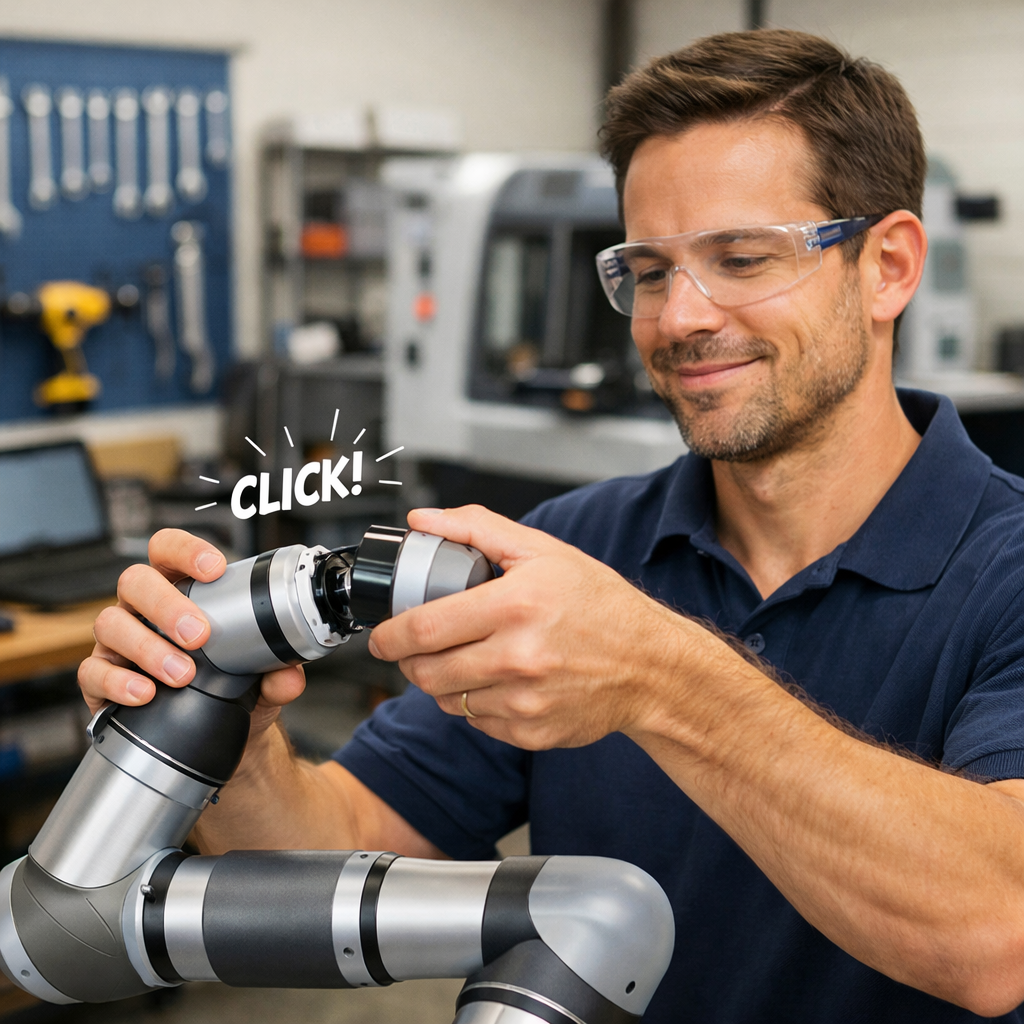
The real breakthrough came with the integration of Edge AI directly into the robotic joints (actuators). In 2026, a single robotic module isn’t just a motor; it is a smart device with its own processing power. When you click three modules together, they “handshake,” recognize their new geometry, and automatically update their motion planning. This eliminates the need for weeks of manual calibration.
The Anatomy of a Modular System
For a small business to succeed with this tech, you need to understand what you are actually buying. A modular system is typically composed of three layers:
1. The Physical Modules
- Actuators (Joints): These are the “muscles.” In 2026, companies like HEBI Robotics and Standard Bots offer actuators with built-in torque sensing, allowing the robot to “feel” its environment.
- Links (Bones): These are the structural beams. Carbon fiber or high-grade aluminum links can be swapped to change the robot’s reach.
- End-Effectors (Hands): Whether it’s a vacuum gripper for boxes or a precision welder, the “hand” of the robot is now a quick-change component.
2. The Communication Backbone
Modular robots utilize high-speed data protocols. This ensures that the base of the robot knows exactly what the tip is doing with millisecond precision. For SMEs, this means you can add “7th-axis” components (like a rail for the robot to slide on) just as easily as adding a peripheral to a laptop.
3. The Digital Twin
As of 2026, almost all modular systems come with a digital twin—a 3D simulation that runs on your tablet or PC. You can “build” and test your robot virtually before ever touching the physical hardware. This prevents expensive crashes and ensures the robot fits within your shop’s footprint.
Practical Applications for Small Businesses
How are real SMEs using this today? The impact spans across diverse sectors.
Precision Manufacturing
A small machine shop with five CNC machines can use a modular arm for “machine tending.” Because the arm is modular, the shop can move it from Machine A to Machine B depending on which job has the highest volume that week.
- Example: A 3-joint configuration for simple loading, upgraded to a 6-joint configuration for complex part flipping.
E-commerce and Logistics
Small fulfillment centers are using Autonomous Mobile Robots (AMRs) with modular tops. During the morning rush, the robot might have a shelf module to transport bins. In the afternoon, that top is swapped for a conveyor module to assist with outbound shipping.
Lab and Medical Automation
Small clinics and research labs are using modular “tabletop” robots. These are designed with high-precision actuators to handle liquid pipetting or slide sorting. The modularity allows labs to expand their capabilities as they secure more funding, adding one joint at a time.
The Financial Impact: ROI and the RaaS Revolution
The biggest barrier for small businesses has always been the “sticker shock.” In the past, a robot might cost $100,000, with another $50,000 in integration fees.
The RaaS Model (Robots-as-a-Service)
In 2026, over 40% of SMEs now choose RaaS. This is essentially a “Netflix for Robots.”
- Monthly Fee: $1,500 – $3,500 per month.
- Maintenance: Included in the subscription.
- Upgrades: When a new, more efficient actuator is released, the provider swaps it out for you.
Safety & Financial Disclaimer: While RaaS reduces upfront costs, always review the Total Cost of Ownership (TCO) over a 3-year period. Consult with a financial advisor regarding Section 179 tax deductions (or local equivalents as of March 2026) for equipment depreciation.
Calculating Your ROI
To calculate the impact on your business, use the following logic:
$$\text{ROI Time (Months)} = \frac{\text{Total System Cost}}{\text{(Monthly Labor Savings + Value of Increased Throughput) – Monthly Maintenance}}$$
In 2026, the average modular system for an SME has a “payback period” of 8.4 months.
Implementation Strategy: A Step-by-Step Roadmap
If you’re ready to bring modular robotics into your business, follow this “human-first” deployment plan.
Step 1: The “Low-Hanging Fruit” Audit
Don’t automate your most complex task first. Look for the “3 Ds”: Dull, Dirty, and Dangerous.
- Is a worker spending 6 hours a day stacking boxes?
- Is someone repetitive-motion-straining by loading a press?These are your ideal first modules.
Step 2: Choose Your Ecosystem
Don’t just buy a robot; buy into an ecosystem. Look for:
- Universal Compatibility: Does it support ROS 2?
- Availability of Parts: Can you get a replacement actuator in 24 hours?
- Software Ease-of-Use: Ask for a demo of the “No-Code” interface. If your best floor operator can’t learn it in two hours, keep looking.
Step 3: Simulation and “Digital First”
Use the manufacturer’s software to model your workspace.
- Check for “Reach Dead-Zones.”
- Ensure the robot’s “Singularity points” (mathematical glitches in movement) won’t interfere with your workflow.
Step 4: The “Cobot” Approach
Most modular robots in 2026 are Collaborative Robots (Cobots). They have force-limiting sensors that stop the robot if it touches a human. This eliminates the need for expensive safety cages, which is vital for small shops with limited space.
Common Mistakes Small Businesses Make
Even with modularity, things can go wrong. Here are the pitfalls to avoid as of 2026:
- Over-Engineering: Small business owners often try to build a “do-it-all” robot. Start with a 3-axis or 4-axis setup. You can always add the 5th and 6th axis later.
- Ignoring the “End-of-Arm” Tooling: The robot is only as good as its gripper. Budget at least 15–20% of your total cost for high-quality, task-specific grippers.
- Underestimating Training: Even “no-code” systems require a shift in mindset. Involve your employees early. If they feel the robot is a tool they control, rather than a replacement for their job, your success rate will double.
- Poor Data Integration: If your robot isn’t talking to your inventory software (ERP), you’re losing half the value. Ensure your modular system has an open API.
The Workforce Impact: Upskilling, Not Replacing
A common fear is that modular robotics will “kill” small business jobs. In reality, 2026 data shows the opposite. Small businesses that automate are growing faster and hiring more people to manage the increased volume.
The role of the worker shifts from “Manual Laborer” to “Robot Supervisor.” This “Physical AI” synergy allows a small team of 5 people to produce the output of a 20-person shop. This is how small businesses are finally competing with overseas mass manufacturing.
Future Outlook: What’s Coming in 2027?
We are already seeing the next wave: Generative Motion Planning. By 2027, you will likely be able to show a robot a task via a camera, and the AI will “reason” through the best way to move its modular joints to accomplish it. Modular robotics isn’t just a 2026 trend; it is the foundation of the “Sovereign Small Business”—companies that are self-sufficient, highly productive, and hyper-local.
Conclusion
Modular robotics has effectively “democratized” the industrial revolution. For the small business owner, the impact is a shift from surviving to scaling. By breaking down the barriers of cost, complexity, and rigidity, modular systems allow you to build exactly the workforce you need for today, with the built-in flexibility to change for tomorrow.
Next Steps for Your Business:
- Conduct a 1-week time study: Identify which tasks are currently bottlenecking your growth.
- Request a “Proof of Concept” (PoC): Most modular vendors in 2026 will allow you to send them a sample of your parts for a video demonstration of the robot in action.
- Start Small: Purchase a single smart actuator or a 2-joint starter kit to familiarize your team with the software environment.
FAQs
Q: Is modular robotics safe for small spaces?
A: Yes. Most modular systems are designed as “Collaborative Applications.” They utilize advanced skin-sensing and torque-monitoring technology (standardized in the 2025 ISO updates) that allows them to operate safely alongside humans without safety fences.
Q: How long does it take to reconfigure a modular robot?
A: For a trained operator, a physical hardware change (like adding a link) takes about 10–15 minutes. The software reconfiguration, thanks to “Self-Healing Workflows” in 2026, usually takes less than 5 minutes.
Q: Can I mix and match modules from different brands?
A: While “inter-brand” modularity is improving, it is still safest to stay within one “Ecosystem” (e.g., all HEBI or all Standard Bots). However, “End-of-Arm” tools are almost entirely universal now due to the UR+ and ISO 9409-1 standards.
Q: What kind of power supply do these robots need?
A: Most small-business modular robots run on standard 110V or 220V wall outlets. You typically do not need the specialized high-voltage industrial power required by older 20th-century robots.
Q: Does modularity mean the robot is less precise?
A: Not necessarily. While a fixed-cast robot is inherently stiffer, 2026 modular actuators use “Active Vibration Suppression” and high-resolution encoders to achieve repeatability within $\pm0.03mm$, which is more than enough for 95% of SME applications.
References
- International Federation of Robotics (IFR): World Robotics Report 2025: The SME Automation Surge. (Official Industry Data).
- NIST (National Institute of Standards and Technology): Guidelines for Reconfigurable Robotic Systems in Manufacturing. (Technical Standards).
- IEEE Spectrum: The Rise of the Modular Actuator: How Software-Defined Hardware Changed the Shop Floor. (Academic/Journalism).
- ROS.org: ROS 2 Humble Hawksbill Documentation for Industrial Modular Units. (Technical Documentation).
- Deloitte Insights: 2026 Manufacturing Industry Outlook: The Shift to Agentic AI and Physical Robotics. (Economic Analysis).
- Universal Robots (UR+): The Ecosystem Model for Small Business Integration. (Commercial Case Study).
- Journal of Mechanical Design: Optimal Configuration of Modular Robots for High-Variation, Low-Volume Production. (Academic Research).
- Robotic Industries Association (RIA): ANSI/RIA R15.06-2025: Safety Requirements for Industrial Robots and Robot Systems. (Safety Standards).