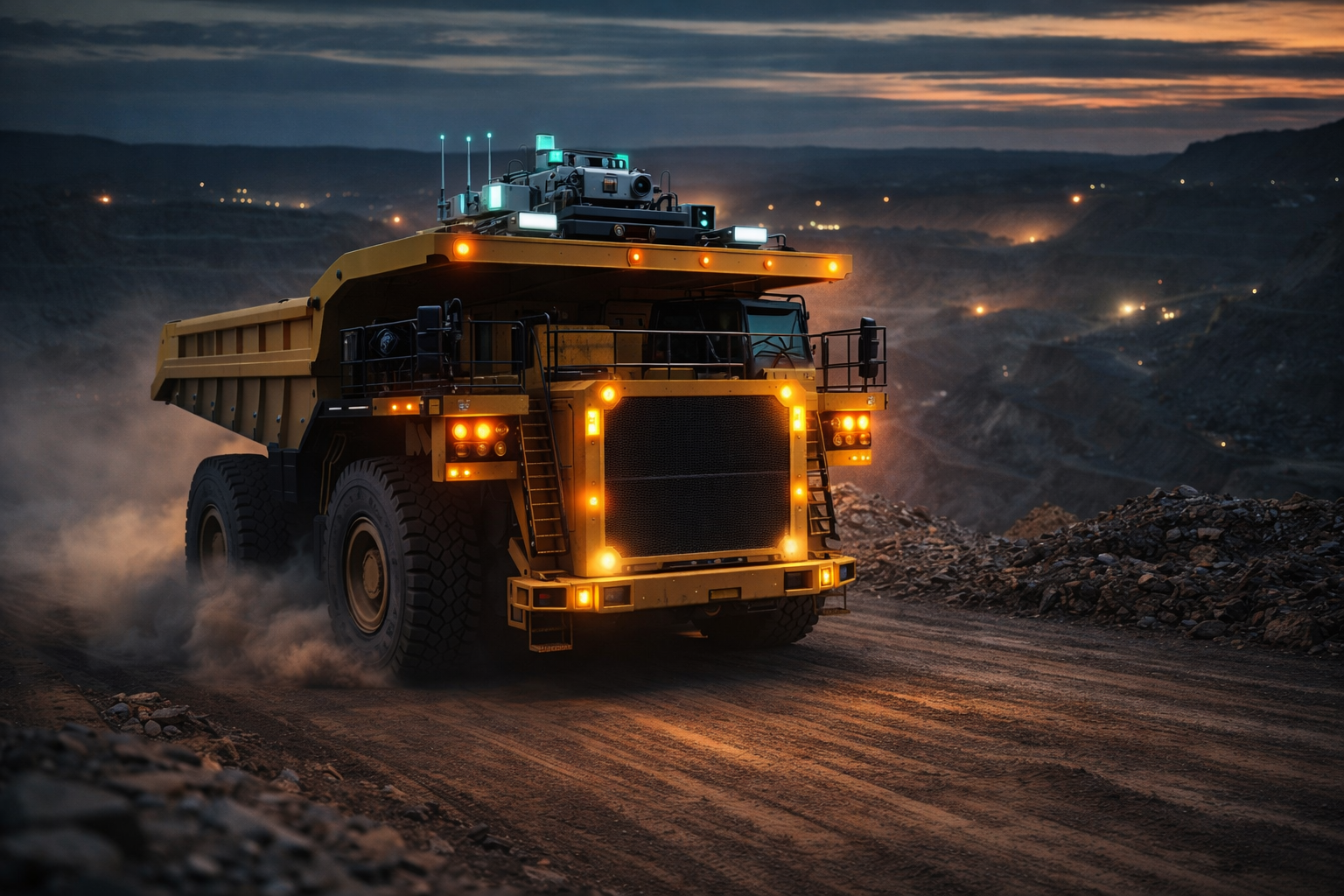
As of March 2026, the global mining landscape has reached a pivotal tipping point. What was once a series of experimental pilot programs in the remote Pilbara region of Australia has evolved into the standard operating procedure for Tier-1 mining companies worldwide. Autonomous mining vehicles (AMVs) are no longer “the future”; they are the primary engines of modern resource extraction, fundamentally altering the twin pillars of the industry: human safety and operational yield.
Definition of Autonomous Mining Vehicles
Autonomous mining vehicles are heavy-duty industrial machines—ranging from ultra-class haul trucks and drill rigs to underground loaders—equipped with sophisticated onboard logic, sensors, and communication systems. Unlike remotely operated vehicles (which require a human in a cockpit elsewhere), truly autonomous vehicles make real-time decisions regarding navigation, obstacle detection, and task execution without direct human intervention. They operate within a digital “geofence” managed by a centralized fleet management system (FMS).
Key Takeaways
- Safety Transformation: Implementation of autonomous haulage systems (AHS) has historically reduced safety incidents by 50% to 80% by removing humans from “hot zones.”
- Yield & Productivity: Autonomous fleets operate 24/7 with zero downtime for shift changes or breaks, typically yielding a 15% to 20% increase in productivity.
- Cost Efficiency: While capital expenditure is high, operational savings from reduced fuel consumption (10-15%) and extended tire life (up to 25%) offer an ROI within 2 to 3 years.
- Technological Synergy: Success depends on the integration of 5G/Private LTE connectivity, LiDAR, and AI-driven predictive maintenance.
Who This Is For
This guide is designed for mine site managers, C-suite executives in the extractive industries, technology investors, and safety compliance officers. Whether you are overseeing a greenfield project like Rio Tinto’s Gudai-Darri or retrofitting a legacy brownfield operation, understanding the granular mechanics of autonomy is essential for staying competitive in a volatile commodities market.
Safety & Financial Disclaimer: This article provides technical and industrial analysis. Implementing autonomous systems involves significant capital risk and requires rigorous site-specific safety audits. Always consult with certified engineers and regulatory bodies (such as MSHA in the US or DMIRS in Australia) before initiating automation protocols.
The Safety Imperative: Removing the Human from the Hazard
The most compelling argument for autonomy is not found on a balance sheet, but in the safety log. Historically, the “three Ds”—Dull, Dirty, and Dangerous—defined the mining profession. Autonomous vehicles directly address the “Dangerous” aspect by decoupling human presence from high-risk environments.
1. Eliminating Fatigue and Distraction
Human error remains the leading cause of industrial accidents. In a 12-hour shift, particularly during “the graveyard slot,” a driver’s reaction time and situational awareness inevitably degrade. Autonomous systems do not experience fatigue. They do not get distracted by mobile devices, nor do they suffer from the “highway hypnosis” common in repetitive haul loops. As of March 2026, data from early adopters shows that autonomous fleets have operated for millions of hours with zero injuries related to system logic.
2. “Zero-Entry” Mining Zones
By utilizing autonomous haulage and drilling, companies can establish “Zero-Entry” zones. These are areas of the pit where no manned vehicles or pedestrians are permitted during active operations. If a human or a manual vehicle inadvertently enters the geofenced area, the entire autonomous fleet is programmed to execute an immediate, synchronized emergency stop (E-Stop). This layering of “fail-safe” protocols creates a barrier between heavy machinery and human life that manual operations simply cannot replicate.
3. Precision in Hazardous Environments
Underground mining presents unique hazards, including rockbursts, seismic activity, and poor air quality. Autonomous Load-Haul-Dump (LHD) loaders can operate in recently blasted areas where the ground has not yet been “bolted and meshed” for human safety. By sending autonomous units into these high-risk pockets, mines can continue production while keeping workers in climate-controlled Remote Operations Centers (ROCs) hundreds of miles away.
Maximizing Yield: The 24/7 Productivity Engine
In the mining world, “yield” refers not just to the amount of ore extracted, but to the efficiency of the entire process from the pit to the processing plant. Autonomous vehicles optimize this value chain through surgical precision.
1. The Death of the Shift Change
In a traditional manned operation, the “hot seat” changeover—where one driver replaces another—can take 20 to 30 minutes. Across three shifts, that is 90 minutes of lost production per day, per truck. For a fleet of 50 trucks, this equates to 75 hours of lost hauling time daily. Autonomous vehicles do not stop for lunch, bathroom breaks, or shift changes. They only stop for scheduled maintenance or refueling (and even refueling is increasingly being automated or handled by fast-charging electric docks).
2. Consistency Over Speed
A common misconception is that autonomous trucks drive faster than humans. In reality, they often drive at the same or slightly lower speeds. The “yield” comes from consistency. An autonomous truck follows the exact same “sweet spot” on the haul road every time, maintaining an optimal throttle position that minimizes fuel burn and mechanical strain. Humans tend to accelerate aggressively and brake late; AI maintains a “harmonic speed” across the entire fleet, preventing the “accordion effect” where trucks bunch up at the primary crusher.
3. Superior Blast Accuracy and Fragmentation
Yield begins with the drill. Autonomous drill rigs (ADRs) utilize high-precision GNSS to place blast holes within a 5-centimeter tolerance. Manual drilling often sees deviations of 30 centimeters or more. This precision ensures that the subsequent blast breaks the rock into uniform sizes (fragmentation). Better fragmentation means the autonomous loaders can move material faster, and the crushers operate more efficiently, directly increasing the total throughput of the mine.
The Tech Stack: The Brains Behind the Brawn
To understand how these vehicles improve safety and yield, we must look at the five core technologies that constitute an autonomous mining ecosystem.
1. Perception Systems (LiDAR and Radar)
Modern AMVs use a “sensor fusion” approach.
- LiDAR (Light Detection and Ranging): Scans the environment with millions of laser pulses per second to create a high-definition 3D point cloud. This allows the truck to “see” a fallen rock or a stray light vehicle even in total darkness.
- Millimeter-Wave Radar: Essential for mining because it can penetrate the thick dust clouds and heavy rain common in open-pit environments where LiDAR might struggle.
2. High-Precision Positioning (GNSS and IMU)
Standard GPS is not accurate enough for a 400-ton truck. AMVs use Real-Time Kinematic (RTK) GPS combined with Inertial Measurement Units (IMUs). This allows the vehicle to know its position within centimeters, even when satellites are temporarily obscured by high pit walls.
3. V2X Communication
V2X stands for “Vehicle-to-Everything.” This is the “social network” for machines. An autonomous truck constantly broadcasts its position, velocity, and intended path to every other machine in the vicinity. If a loader is backing out, the haul truck “knows” and begins to decelerate before the loader is even in its line of sight.
4. Fleet Management Systems (FMS)
The FMS is the “Air Traffic Control” of the mine. It assigns trucks to specific shovels based on real-time ore grades and crusher capacity. As of 2026, these systems use machine learning to predict bottlenecks before they happen, rerouting the fleet to maximize “tons per hour.”
5. Edge Computing and AI
Processing 5 terabytes of data per year per truck requires massive onboard computing power. “Edge” computing allows the truck to make split-second safety decisions (like swerving for an obstacle) locally, rather than waiting for a signal to travel to a central server and back.
Comparative Analysis: Surface vs. Underground Autonomy
While the goals are the same, the execution differs wildly depending on the environment.
| Feature | Surface Mining (AHS) | Underground Mining |
| Primary Navigation | GNSS / Satellite | SLAM (Simultaneous Localization & Mapping) |
| Connectivity | 5G / Private LTE / Starlink | Leaky Feeder / Fiber / WiFi 6 |
| Obstacles | Dust, Light Vehicles, Berms | Narrow Walls, Smoke, Falling Rock |
| Leading Players | Caterpillar, Komatsu | Sandvik, Epiroc |
| Operational Scale | Massive fleets (50+ trucks) | Smaller, specialized “trains” |
In surface mining, the challenge is the sheer scale and the unpredictability of weather. In underground mining, the challenge is the “GPS-denied” environment, requiring vehicles to navigate using lasers to map the tunnel walls in real-time.
The Environmental and ESG Impact
In 2026, the “S” and “E” in ESG (Environmental, Social, and Governance) are increasingly satisfied by autonomy.
- Carbon Footprint: Autonomous driving patterns reduce fuel consumption by approximately 10-15%. In a fleet burning millions of liters of diesel annually, this represents a massive reduction in $CO_{2}$ emissions.
- Tire Conservation: Tires for ultra-class trucks can cost $100,000 each. By eliminating aggressive cornering and harsh braking, autonomous systems extend tire life by 20-25%, reducing the environmental waste of rubber and the carbon cost of manufacturing new sets.
- Electrification Synergy: Autonomy is the “bridge” to fully electric mines. Electric drivetrains are easier for computers to control than internal combustion engines. An autonomous electric truck can optimize its regenerative braking to “capture” energy while driving down into the pit, significantly extending its battery range.
Common Mistakes in Implementing Autonomy
Despite the benefits, many operations fail to see a return on investment due to three common errors:
1. Treating Autonomy as a “Plug-and-Play” Solution
Autonomy is a fundamental change to the mine plan, not just a vehicle upgrade. If the haul roads are not maintained to “autonomous standards” (consistent grades, specific berm heights, and clear drainage), the sensors will constantly trigger safety stops, destroying productivity.
2. Ignoring the “Human” in the Loop
The biggest hurdle is often cultural. When workers see autonomous trucks, they see “job killers.” Successful mines (like those operated by BHP) pivot their workforce toward higher-value roles: data analysts, pit controllers, and autonomous system technicians. Failing to provide a clear “upskilling” path leads to workforce resistance and potential sabotage of the new systems.
3. Connectivity Weak Points
Relying on “good enough” WiFi for an autonomous fleet is a recipe for disaster. Any “packet loss” in the communication stream results in the trucks stopping for safety. A robust, redundant Private 5G network is a non-negotiable prerequisite.
Case Study: Rio Tinto’s Gudai-Darri (The “Mine of the Future”)
Located in Western Australia, Gudai-Darri represents the pinnacle of autonomous integration. Opened as a greenfield site, it was designed from the ground up for machines.
- Fleet: 100% autonomous haul trucks (Caterpillar 789 series) and autonomous drills.
- Results: The mine has reported 15% lower load-and-haul unit costs compared to Rio Tinto’s conventional operations.
- Safety: Zero system-related injuries since inception.
- Innovation: Integration of “Autonomous Water Carts” which use the same AHS logic to suppress dust on haul roads without human intervention, further reducing the number of manual vehicles in the pit.
The Future: Toward “The Invisible Mine”
By 2030, we expect the emergence of “The Invisible Mine”—operations that are so highly automated and remotely managed that the physical footprint of human infrastructure (offices, mess halls, housing) at the site is halved. We are also seeing the rise of interoperability, where Caterpillar trucks can “talk” to Komatsu shovels using open-standard communication protocols (like ISO 21815).
Conclusion
Autonomous vehicles in mining have transitioned from a high-tech luxury to an operational necessity. The safety benefits—removing humans from hazardous environments and eliminating fatigue—provide the ethical “license to operate” in the 21st century. Simultaneously, the yield improvements—driven by 24/7 consistency, fuel efficiency, and precision drilling—ensure that mining remains economically viable in an era of declining ore grades and rising costs.
However, the transition is not merely a matter of buying new equipment. It requires a holistic overhaul of mine design, a robust investment in digital infrastructure (5G/AI), and a genuine commitment to workforce evolution. For those who get the formula right, the rewards are clear: a “zero-harm” workplace and a significant competitive advantage in the global market.
Next Steps for Your Operation:
Would you like me to develop a Step-by-Step Implementation Roadmap for transitioning a manual mine fleet to a Tier-1 Autonomous Haulage System?
FAQs
Q: How much does an autonomous haul truck cost compared to a manual one?
A: As of March 2026, an ultra-class autonomous truck typically carries a 20% to 30% premium over its manual counterpart, largely due to the “autonomy kit” (sensors, computers, and software licensing). However, when factoring in the removal of operator cabins (in “cab-less” models like Komatsu’s Innovative Autonomous Haulage Vehicle) and the 24/7 productivity gains, the total cost of ownership is often lower over the life of the machine.
Q: Can autonomous trucks work in extreme weather like snow or heavy rain?
A: High-end systems using Millimeter-Wave Radar and specialized “dust-penetrating” LiDAR can operate in conditions that would ground human drivers. However, extreme weather (like whiteout blizzards or monsoon rains) can still cause “nuisance stops” where sensors cannot distinguish between a solid obstacle and a dense wall of precipitation.
Q: Will automation replace all mining jobs?
A: It replaces specific jobs—mostly hauling and drilling—but creates others. There is currently a global shortage of “Autonomous System Technicians,” “FMS Controllers,” and “Data Scientists” within the mining sector. The nature of the work is shifting from physical labor to technical oversight.
Q: What is the biggest technical challenge to autonomy?
A: Connectivity. If a truck loses its “heartbeat” signal from the central server for more than a few milliseconds, it is programmed to stop. Maintaining seamless high-bandwidth coverage across a massive, deep open pit with changing topography is the most significant engineering hurdle.
Q: Does autonomy work in underground mines?
A: Yes, though it is more complex due to the lack of GPS. Systems like Sandvik’s AutoMine use “Lidar SLAM” to map tunnels. Underground autonomy is often more advanced in terms of “teleoperation,” where one operator in a remote office can control three or four loaders simultaneously.
References
- Grand View Research (2025). Autonomous Mining Equipment Market Size & Share Report, 2025-2033. [grandviewresearch.com]
- Rio Tinto (2024). Gudai-Darri: The Most Technologically Advanced Mine in the World. []
- Caterpillar Inc. (2025). Cat Command for Hauling: Performance Metrics and Safety Standards. []
- Komatsu Ltd. (2025). FrontRunner AHS: 10 Billion Tons Hauled Milestones. [komatsu.com/en/technology/smart-mining]
- International Council on Mining and Metals (ICMM). Safety and Health Excellence: The Impact of Automation. [icmm.com]
- MDPI Journal of Mining and Metallurgy (2025). Artificial Intelligence in Reducing Environmental Impact in the Mining Sector. [mdpi.com/journal/sustainability]
- Intel Market Research (2026). Autonomous Haulage Systems (AHS) Market Outlook 2025-2032. [intelmarketresearch.com]
- Mining Magazine (2025). Interoperability Standards in Modern Mining: The ISO 21815 Framework. [miningmagazine.com]