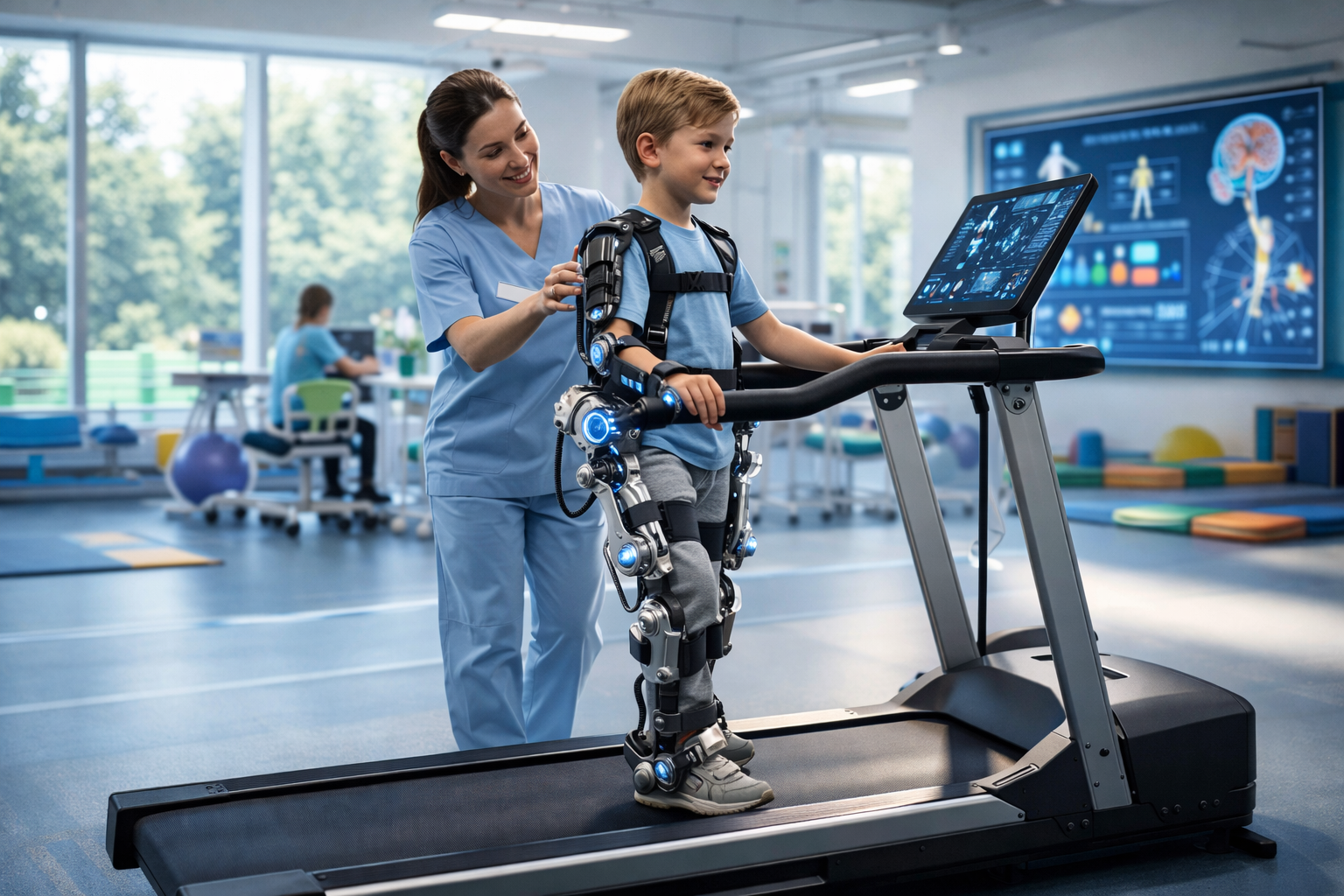
Adaptive gait training is a specialized form of physical therapy designed to help children with mobility impairments develop, regain, or improve their ability to walk. Unlike traditional walking exercises, “adaptive” training utilizes sophisticated technology—ranging from robotic exoskeletons to body-weight supported treadmill systems—to customize the walking experience to a child’s specific neurological and physical needs. It is rooted in the principle of neuroplasticity, the brain’s remarkable ability to reorganize itself by forming new neural connections in response to repetitive, functional movements.
Key Takeaways
- Precision Focus: Adaptive gait training uses real-time data to adjust resistance and assistance, ensuring every step contributes to motor learning.
- Neuroplasticity is King: High-intensity, repetitive stepping is the primary driver for “rewiring” the brain after a neurological injury or developmental delay.
- Holistic Integration: This is not a standalone treatment; it works best when paired with traditional therapy, orthotics, and home-based play.
- Early Intervention: As of March 2026, clinical evidence increasingly supports starting adaptive protocols as early as 12–18 months for children with high-risk diagnoses.
Who This Is For
This guide is written for parents, caregivers, and pediatric clinicians seeking to understand the shifting landscape of mobility therapy. It specifically addresses needs related to:
- Cerebral Palsy (CP): The most common cause of pediatric physical disability.
- Spina Bifida: Managing mobility challenges from birth.
- Traumatic Brain Injury (TBI) & Spinal Cord Injury (SCI): Re-learning gait after an acute event.
- Neuromuscular Disorders: Including Muscular Dystrophy and Spinal Muscular Atrophy (SMA).
- Global Developmental Delays: Helping children find their “first steps” when milestones are missed.
Safety Disclaimer: The information provided here is for educational purposes and does not constitute medical advice. Always consult with a licensed pediatric physiatrist or physical therapist before beginning any intensive gait training program. Specialized equipment should only be used under the supervision of certified professionals.
1. The Science of the Step: Understanding Biomechanics and Neuroplasticity
At the heart of adaptive gait training lies a complex interaction between the musculoskeletal system and the central nervous system. To understand why “adaptive” methods work, we must first look at how a child learns to walk.
The Gait Cycle
Walking is not just putting one foot in front of the other; it is a rhythmic, cyclical process involving two main phases:
- Stance Phase: When the foot is on the ground (60% of the cycle).
- Swing Phase: When the foot is in the air (40% of the cycle).
In children with neurological conditions, these phases are often disrupted. Spasticity (muscle tightness) may prevent the heel from touching the ground, or weakness may cause the “drop foot” during the swing phase. Adaptive training uses technology to “force” the body into a correct gait pattern, providing the sensory feedback the brain needs to recognize what a “normal” step feels like.
Leveraging Neuroplasticity
For decades, therapy focused on “compensatory” strategies—teaching a child to use a wheelchair because walking seemed impossible. Today, the focus has shifted to Restorative Neurology. The brain is most “plastic” (changeable) during the first five years of life. By providing thousands of correct steps in a single session—something impossible in traditional therapy where a therapist must manually move a child’s legs—adaptive gait training “records” the movement in the brain’s motor cortex.
2. The Technological Arsenal: Robotic-Assisted Gait Training (RAGT)
The most significant “frontier” in pediatric rehab is the integration of robotics. These machines do the heavy lifting, allowing the therapist to focus on the child’s posture and engagement.
Robotic Exoskeletons (Overground)
Devices like the Indego Therapy or specialized pediatric exoskeletons allow children to walk across the floor rather than on a treadmill. These are “active” devices; they sense the child’s intent to move and provide a motorized boost.
- Benefit: Provides real-world visual feedback. The child sees the room moving as they walk.
- Application: Best for children with some trunk control who need help with leg clearance and rhythm.
Robotic-Assisted Treadmill Systems (Stationary)
Systems like the Lokomat or the Hocoma Andago use a harness to suspend the child over a treadmill. Robotic “legs” are strapped to the child, moving their limbs in a perfect physiological pattern.
- Benefit: Allows for massive repetition (up to 1,000 steps in 30 minutes).
- Application: Ideal for non-ambulatory children or those with severe spasticity.
Body-Weight Supported Treadmill Training (BWSTT)
Not all adaptive training requires robots. BWSTT uses a simple harness system to take 20% to 40% of the child’s weight off their joints. This reduces the “cost” of walking, making it easier for a weak child to practice the movement.
3. Assessment and 3D Gait Analysis: Measuring Progress
In March 2026, we no longer rely solely on a therapist’s eye to measure progress. Adaptive gait training is driven by data.
The Gait Lab
Modern pediatric hospitals utilize 3D Gait Analysis. The child is covered in reflective markers, and infrared cameras track their movement in 360 degrees.
- Kinematics: Measuring the angles of the joints (hips, knees, ankles).
- Kinetics: Measuring the forces acting on the body (ground reaction forces).
- EMG (Electromyography): Measuring when and how much muscles are firing during each step.
Why Data Matters
Without data, therapy is guesswork. A child might look like they are walking better, but the data might show they are “cheating” by using their hip hikers instead of their glutes. Adaptive training software can see these micro-compensations and adjust the machine’s resistance to force the correct muscle to fire.
4. Orthotics and Functional Electrical Stimulation (FES)
Adaptive gait training doesn’t happen in a vacuum. It requires “hardware” (orthotics) and “software” (neuromuscular stimulation) to be effective.
The Role of AFOs (Ankle-Foot Orthoses)
Most children in gait training use some form of bracing. In the adaptive world, we use Dynamic AFOs. These aren’t the rigid plastic “boots” of the past. They are made of carbon fiber or flexible polymers that allow for some “spring” or energy return, mimicking the natural function of the Achilles tendon.
Functional Electrical Stimulation (FES)
FES involves placing electrodes on the skin. When the child reaches the “swing” phase of walking, a small electrical pulse causes the muscle to contract, lifting the foot.
- The “Adaptive” Edge: Modern FES units (like the Bioness or WalkAide) use tilt sensors and accelerometers to time the pulse perfectly with the child’s speed.
5. Overcoming Spasticity: The Physical Barriers to Walking
One of the biggest hurdles in pediatric rehab is spasticity—a condition where muscles are continuously contracted. This creates “stiffness” that resists the gait cycle.
Integrated Management
Adaptive gait training is most effective when the “noise” of spasticity is turned down. As of 2026, this often involves a “sandwich” approach:
- Medical Intervention: Botox injections or Selective Dorsal Rhizotomy (SDR) surgery to reduce muscle tightness.
- Intensive Training: Immediately following medical intervention, the child enters a 4–6 week “blast” of adaptive gait training to “fill” the newly relaxed muscles with functional patterns.
- Maintenance: Long-term use of adaptive cycles to prevent the return of contractures (permanent muscle shortening).
6. The Psychological Frontier: Gamification and Engagement
You cannot force a child to participate in boring therapy. The “Next Frontier” of rehab is making the training feel like a video game.
Virtual Reality (VR) Integration
Many robotic gait trainers now feature large screens. As the child walks, their avatar moves through a digital world. They might be “walking” through a forest to find treasure or kicking digital soccer balls.
- Biofeedback: If the child pushes harder with their left leg, their avatar moves faster. This teaches the child “internalized” control.
- Cognitive Loading: Walking while solving puzzles in VR helps the child prepare for the “real world,” where they must walk and talk at the same time.
7. Common Mistakes in Pediatric Gait Rehabilitation
Even with the best technology, progress can stall. Here are the most frequent pitfalls clinicians and parents face:
- The “More is Always Better” Myth: Overtraining can lead to fatigue-induced injury. A child’s nervous system needs downtime to process the new motor maps.
- Ignoring the Trunk: Many focus so much on the legs that they forget the core. Without a stable trunk, a child cannot have an efficient gait.
- Lack of Functional Carryover: If a child walks perfectly in a robot for 40 minutes but spends the rest of the day in a sedentary wheelchair, the brain won’t “keep” the progress.
- Starting Too Late: Waiting until a child is “old enough” to follow directions can mean missing the peak window of neuroplasticity.
8. Financial and Logistical Considerations (March 2026 Update)
As of March 2026, the cost of adaptive gait training remains a primary concern for many families.
Insurance Coverage
While insurance companies are increasingly recognizing the long-term cost savings of mobility (less need for surgery, fewer secondary complications), getting coverage for robotic sessions still requires a “Letter of Medical Necessity” (LMN).
- Pro Tip: Ensure your therapist documents “functional gains,” such as “increased independence in transfers” or “reduced caregiver burden,” rather than just “improved walking speed.”
The Rise of Home-Based Robotics
A major shift in 2026 is the availability of smaller, more affordable adaptive trainers for home use. While not as powerful as clinic-grade robots, these allow for the “daily dose” of repetition required for permanent neurological change.
9. A Day in the Life: What an Intensive Session Looks Like
To give parents a realistic expectation, let’s walk through a typical 90-minute intensive adaptive gait session.
- Warm-up (15 mins): Manual stretching and vibration therapy to “wake up” the muscles and reduce spasticity.
- The “Doffing and Donning” (10 mins): Securing the child into the harness and robotic exoskeleton. This requires precision to ensure joint alignment.
- The Active Phase (45 mins): Walking on the treadmill or overground. This includes intervals of high intensity (speed) and high precision (guided steps).
- Functional Carryover (15 mins): Taking the child out of the machine and immediately practicing a “real-world” skill, like walking to a toy, to “lock in” the motor patterns.
- Cool Down (5 mins): Sensory integration and feedback.
10. The Future: AI-Driven Adaptive Training
We are entering an era where the robot “learns” the child as much as the child learns the robot. Artificial Intelligence (AI) now analyzes gait deviations in real-time, predicting where a child might stumble and providing a microscopic “nudge” of assistance before the error even happens. This “Error-Augmentation” or “Error-Correction” is the absolute cutting edge of the field.
Conclusion
Adaptive gait training represents a fundamental shift in how we view pediatric disability. We are moving away from a model of “fixing” a child and toward a model of “optimizing” their unique neurological potential. By combining the raw power of robotics with the surgical precision of 3D data and the warmth of human-centered therapy, we are giving children a level of independence that was unthinkable a generation ago.
The journey is not fast, and it is rarely easy. It requires a “marathon” mindset—consisting of thousands upon thousands of steps. However, for a child who finds their first taste of upright, independent mobility in an adaptive trainer, those thousands of steps are worth every second of effort.
Next Steps for Families
- Consult a Specialist: Seek out a pediatric physiatrist who specializes in “technological interventions.”
- Request a Gait Analysis: Before starting any program, get a baseline 3D gait report.
- Check Local “Intensive” Programs: Many clinics offer 3-week “intensive” bursts that can jumpstart progress.
- Advocate: Work with your school district to see if adaptive equipment can be integrated into the Individualized Education Program (IEP).
FAQs
Q: At what age can a child start adaptive gait training? A: While it depends on the specific device, many body-weight supported systems can be adapted for children as young as 12–18 months. Early intervention is key to leveraging the highest periods of neuroplasticity.
Q: Is robotic training better than traditional physical therapy? A: It is not “better,” but rather “different” and “complimentary.” Traditional PT is essential for strength and balance, while robotic training provides the high-volume repetition that traditional PT cannot match.
Q: Will my child become “dependent” on the robot? A: No. The goal of adaptive training is “weaning.” The machine provides less and less help as the child’s brain takes over the movement. The robot is the training wheel, not the permanent vehicle.
Q: How often should we do these sessions? A: Most “intensive” protocols recommend 3 to 5 sessions per week for a period of 4 to 6 weeks, followed by a maintenance phase.
Q: Can children with cognitive impairments use these systems? A: Yes. In fact, the visual feedback from VR and the physical rhythm of the machine can often help children with cognitive or sensory processing issues focus better than they would in traditional exercises.
References
- American Academy for Cerebral Palsy and Developmental Medicine (AACPDM): Evidence-based reviews on robotic-assisted gait training. [aacpdm.org]
- National Institutes of Health (NIH): Research on neuroplasticity and pediatric motor learning. [nih.gov]
- Journal of Pediatric Rehabilitation Medicine: “Clinical Outcomes of RAGT in Children with CP.” (Published 2024/2025).
- American Physical Therapy Association (APTA): Pediatric Section clinical practice guidelines for locomotor training. [pediatricapta.org]
- Hocoma Academy: Technical documentation on the Lokomat and pediatric gait biomechanics.
- Gillette Children’s Specialty Healthcare: Outcomes data on 3D Gait Analysis in pediatric orthopedics.
- Mayo Clinic: Pediatric Rehabilitation research on Functional Electrical Stimulation (FES).
- The Lancet Neurology: “The Future of Pediatric Exoskeletons in Clinical Practice” (2025 Review).