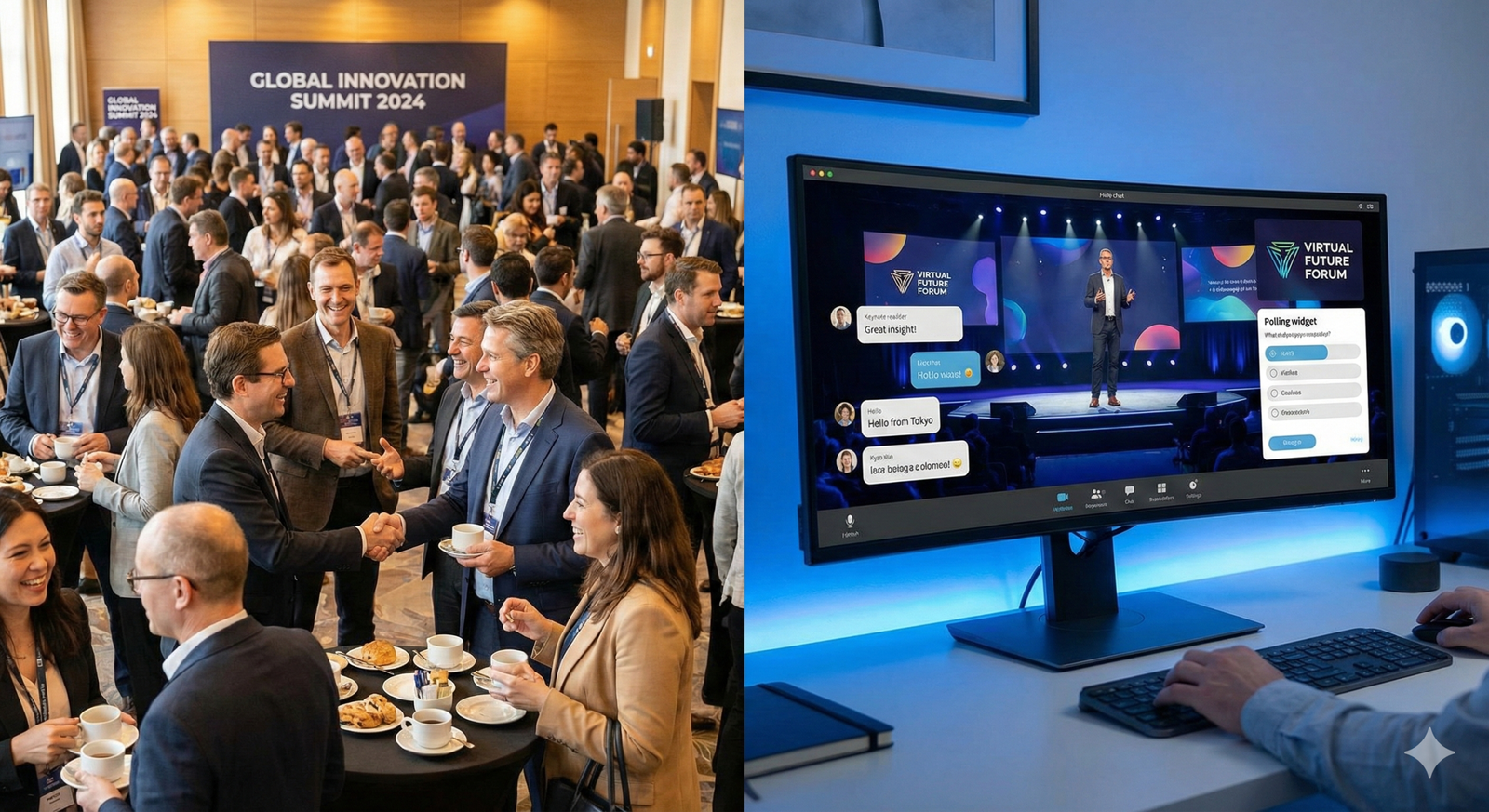
The debate between virtual and physical conferences is no longer a temporary reaction to a global crisis; it is a fundamental strategic question defining the future of professional gathering. For decades, the “conference” was synonymous with convention centers, lanyards, and hotel ballrooms. Today, the landscape has fractured into a spectrum of options ranging from immersive in-person galas to highly efficient digital summits and complex hybrid models.
As of 2026, the dust has settled on the reactionary pivot to digital, and a more nuanced reality has emerged. Organizations and attendees alike are scrutinizing the return on investment (ROI), the environmental impact, and the human value of every event. The question is not simply which format is “better,” but rather which format prevails for specific outcomes.
This guide provides a comprehensive, deep-dive comparison of virtual versus physical conferences. We will analyze the economics, the psychology of connection, the technological requirements, and the sustainability factors that should drive your decision-making process. Whether you are an event organizer attempting to allocate a six-figure budget or a professional deciding where to invest your limited time, this analysis will clarify the trade-offs.
Key Takeaways
- Intent Dictates Format: Physical events reign supreme for relationship building, trust, and serendipity. Virtual events dominate for education, reach, and accessibility.
- The Cost Equation is Complex: While virtual saves on travel and venues, high-quality production and platform fees can rival physical costs. Physical events carry a heavy “hidden cost” of time away from work for attendees.
- Hybrid is Hard but Necessary: Running a true hybrid event often means organizing two distinct events simultaneously, requiring double the resources, but it offers the highest potential reach.
- Sustainability is a Major Driver: Corporate ESG (Environmental, Social, and Governance) goals are pushing many large-scale international gatherings toward virtual or regional hub models to reduce carbon footprints.
- Content Longevity: Virtual conferences naturally create an on-demand content library, extending the lifecycle of the event far beyond the closing remarks.
Who This Guide Is For (and Who It Isn’t)
This guide is for:
- Event Organizers and Planners: Professionals needing to justify format decisions to stakeholders or clients.
- Marketing Directors: Leaders looking to maximize lead generation and brand awareness through events.
- Association Leaders: Decision-makers balancing member engagement with budget constraints.
- Attendees and Professionals: Individuals weighing the value of buying a ticket and traveling versus logging in remotely.
This guide isn’t for:
- Small Meeting Planners: If you are organizing a casual team sync or a board meeting, the stakes and logistics discussed here (large-scale production, venue sourcing) may be overkill.
- Purely Social Event Planners: While some principles apply, this guide focuses on professional, educational, and trade-focused gatherings.
Defining the Scope: What Do We Mean by “Prevail”?
To determine which format will prevail, we must first define the playing field. In this context, “prevail” does not mean one format will eradicate the other. Instead, it refers to which format will become the default standard for high-value professional interaction.
In scope for this discussion:
- Trade Shows: Events focused on exhibiting products.
- Academic and Scientific Conferences: Events focused on paper presentations and peer review.
- Corporate Summits: User conferences, sales kickoffs, and partner summits.
- Professional Development: Training seminars and certification workshops.
Out of scope:
- Internal team meetings (Zoom/Teams calls).
- Live entertainment or music festivals (though they have virtual components, the drivers are different).
1. The Economics of Gathering: A Cost-Benefit Analysis
The financial structure of virtual and physical conferences differs radically. Understanding these distinct economic models is crucial for organizers and attendees.
Physical Conferences: High Risk, High Revenue Potential
Physical events are capital-intensive. They require significant upfront deposits for venues, catering, and accommodation blocks often years in advance.
- Fixed Costs: Venue rental, audiovisual (AV) labor and equipment, union labor, insurance, and signage.
- Variable Costs: Food and beverage (F&B) is often the largest line item, scaling with attendance. Swag, printed materials, and shuttle transport also scale.
- Attendee Costs: The ticket price is just the tip of the iceberg. Flights, hotels, per diems, and—crucially—the opportunity cost of 3-4 days out of the office make physical attendance a major investment.
In Practice: A mid-sized physical conference (500 attendees) can easily cost $200,000 to $500,000 to produce. However, the revenue potential from sponsorship tiers (booths, branded dinners) and high ticket prices is well-established. Sponsors pay premiums for face time.
Virtual Conferences: Scalability and Tech Spend
Virtual events flip the economic model. The marginal cost of adding an attendee is near zero, allowing for massive scale.
- Platform Costs: Instead of a venue, you pay for a platform. Enterprise-grade platforms can cost $15,000 to $50,000+, depending on features like gamification, networking AI, and concurrent streams.
- Production Costs: To avoid “Zoom fatigue,” organizers invest in broadcast-quality production. This includes studio rentals for keynotes, professional video editing, and motion graphics.
- Attendee Costs: Usually significantly lower ticket prices (or free), with zero travel costs.
In Practice: A virtual event can be profitable with lower sponsorship rates simply because the overhead is lower. However, commanding a high ticket price for a virtual event is historically difficult. Attendees perceive digital content as lower value than an in-person experience.
The Verdict on Cost
For pure profit margin on ticket sales, Virtual often wins due to low overhead. For total revenue generation through high-ticket sponsorship and ecosystem building, Physical remains superior.
2. The Psychology of Connection: Networking and Serendipity
The primary reason professionals cite for attending conferences is networking. This is the battleground where physical and virtual formats diverge most sharply.
Physical: The Power of Proximity
Humans are biological entities wired for face-to-face interaction. Physical conferences offer:
- Serendipity: The “Hallway Track”—random encounters in the coffee line or shared cab rides—often generates more value than the scheduled sessions. These unplanned interactions are difficult to engineer digitally.
- Non-Verbal Communication: Trust is built faster when you can see body language, eye contact, and micro-expressions.
- Captive Audience: When someone travels to an event, they are mentally and physically “there.” They are less likely to tab-switch to their email or do laundry during a keynote.
Virtual: Structured and Data-Driven
Virtual networking struggles with serendipity but excels at precision.
- AI-Matchmaking: Platforms can analyze attendee profiles and suggest high-value connections, scheduling 1:1 video calls automatically.
- Barrier to Entry: Introverted attendees often find it easier to type a question in a chat box or join a text-based discussion than to approach a stranger at a cocktail hour.
- The “Ghosting” Problem: It is incredibly easy to blow off a scheduled virtual meeting if a work emergency pops up. The social contract is weaker online.
The Verdict on Networking
Physical wins decisively for deep relationship building and closing complex deals. Virtual is sufficient for transactional networking and initial introductions but rarely cements a long-term bond.
3. Accessibility, Inclusivity, and Reach
If networking favors the physical, accessibility is the stronghold of the virtual format.
Democratizing Access
Virtual conferences have dismantled geographic and economic barriers.
- Global Reach: A researcher in a developing nation, a parent who cannot find childcare, or a professional with a limited travel budget can attend a global summit virtually.
- Disability Inclusion: For individuals with mobility impairments, chronic pain, or sensory processing sensitivities, physical conferences can be exhausting or inaccessible. Virtual platforms allow for controlled environments, closed captioning, and screen readers.
- Visa Issues: International travel restrictions and visa backlogs can prevent key voices from attending physical events. Virtual attendance bypasses borders entirely.
The Language Barrier
Virtual events allow for real-time, AI-driven translation and transcription, making content accessible to non-native speakers in a way that live interpretation at physical venues rarely matches in cost-effectiveness.
The Verdict on Accessibility
Virtual prevails. It is the only truly inclusive format for a global audience.
4. Sustainability: The Environmental Impact
As corporate sustainability mandates tighten, the carbon footprint of events is under the microscope.
The Heavy Footprint of Physical Events
A single international conference can generate thousands of tons of CO2. The primary culprit is air travel, often accounting for 70-90% of an event’s total emissions. Add to this:
- Food Waste: Buffets are notorious for waste.
- Single-Use Plastics: Water bottles, swag wrappers, and signage.
- Venue Energy: HVAC and lighting for massive halls.
The Digital Footprint
Virtual events are not carbon-neutral—data centers, content delivery networks (CDNs), and end-user devices consume electricity. However, studies consistently show that the carbon footprint of a virtual attendee is less than 1% of a physical attendee who flies to the venue.
In Practice: Many organizations are now adopting a “hub-and-spoke” model to mitigate this. Instead of one massive global gathering, they host regional watch parties (physical) connected by a virtual backbone, reducing long-haul flights.
The Verdict on Sustainability
Virtual is the clear winner. For organizations with net-zero targets, reducing physical event travel is low-hanging fruit.
5. Content Consumption and Education
When the primary goal is learning, skill acquisition, and content consumption, the battleground shifts again.
Physical: The Immersive Experience
Learning in a physical setting is immersive. Being in a room with 500 other people reacting to a speaker creates an emotional anchor that helps memory retention. However, it is linear. You can only be in one room at a time. If two great sessions overlap, you miss one.
Virtual: The On-Demand Library
Virtual conferences excel at content utility.
- Concurrent Consumption: You can switch between tracks instantly.
- Longevity: Content is recorded and instantly available. The event becomes a repository of knowledge that can be referenced for months.
- Analytics: Organizers know exactly who watched what, for how long, and where they dropped off. This data is invaluable for refining educational content.
The Verdict on Education
Virtual prevails for pure information transfer and technical training. It allows for pausing, rewinding, and flexible consumption. Physical prevails for inspiration and motivation.
6. The Rise of the Hybrid Model
If virtual and physical both have “killer features,” the logical conclusion is to combine them. However, hybrid events are notoriously difficult to execute well.
The Definition of Hybrid
A true hybrid event is not just livestreaming a physical stage to a passive online audience. That is a broadcast. A hybrid event treats online and offline audiences as equal participants, with interaction bridging the gap.
The Challenges of Hybrid
- Split Attention: Speakers struggle to engage the room and the camera simultaneously.
- Cost: You are essentially paying for a venue and a high-end tech platform.
- Inequality: The “second-class citizen” effect is real. Virtual attendees often feel like they are watching a party through a window.
Successful Hybrid Strategies
To make hybrid prevail, organizers are moving toward asynchronous hybrid models.
- Live Physical / Virtual On-Demand: The physical event happens live. The content is recorded, edited for high quality, and released to a virtual community a week later for discussion.
- The “Hub” Model: Regional physical meetups watch a central virtual keynote together, combining global reach with local networking.
7. Strategic Decision Framework: How to Choose
When deciding between formats, organizers should use a decision matrix based on their primary objectives.
| Primary Objective | Recommended Format | Why? |
| Networking & Sales | Physical | Trust requires proximity; deals are closed over dinner. |
| Education & Certification | Virtual | Focus is on content; requires pausing, re-watching, and testing. |
| Brand Awareness | Virtual / Hybrid | Maximizes reach and “eyeballs” on the brand. |
| Community Building | Physical | Deepens bonds among existing core members. |
| Global Product Launch | Virtual | ensures simultaneous global access and controls the narrative. |
| VIP/Executive Summit | Physical | Exclusivity and high-touch service are key. |
Common Mistakes and Pitfalls
Regardless of the format chosen, failure usually stems from trying to replicate the other format’s strengths without adapting.
Mistakes in Virtual Events
- The “Lift and Shift”: Taking a traditional 8-hour agenda and putting it on Zoom. No one will sit at a computer for 8 hours straight. Virtual agendas must be shorter, punchier, and spread over more days.
- Ignoring Production Value: Bad lighting and poor audio destroy credibility instantly.
- Forced Networking: Awkward “breakout rooms” with no facilitator or topic often lead to silence and drop-offs.
Mistakes in Physical Events (Post-2020)
- Ignoring the Remote Audience: If you claim to be hybrid, you cannot ignore the chat stream.
- Lack of Digital Integration: Not having a robust mobile app for scheduling and connecting.
- Underestimating Costs: Inflation has hit the hospitality sector hard. Budgets from 2019 are irrelevant in 2026.
Future Outlook: Trends to Watch (2026 and Beyond)
As we look forward, several technologies and cultural shifts will influence which format prevails.
1. The Metaverse and Spatial Computing
While the initial hype has cooled, spatial audio and 3D environments are becoming more practical for virtual networking. “Proximity chat” in virtual spaces allows for more natural mingling than grid-based video calls.
2. Micro-Events
We are seeing a shift away from massive 20,000-person conferences toward smaller, highly curated micro-events (50-150 people). These are almost exclusively physical, focused on high-level networking, while the mass-market content moves to virtual channels.
3. Asynchronous Participation
The concept of “live” is becoming less important for educational content. Events are morphing into “seasons” of content (like a Netflix series) rather than a 3-day block of time.
4. Continuous Communities
The “event” is no longer a moment in time; it is a spike in activity within a 365-day community platform. The distinction between a “forum” and a “conference” is blurring.
Conclusion
So, which will prevail? The answer is a bifurcation of the market.
Physical conferences will prevail as premium, luxury products. They will become smaller, more expensive, and experience-driven. They will focus entirely on what cannot be digitized: the dinner, the handshake, the serendipitous encounter, and the shared energy of a room.
Virtual conferences will prevail as the mass-market standard for information transfer. They will become the primary vehicle for education, certification, and global announcements. They will be low-cost, high-frequency, and deeply integrated into our daily workflows.
For the modern professional, the future is not choosing one over the other. It is about curating a personal portfolio of events: attending one or two high-impact physical events a year for networking, while consuming a steady diet of virtual content to stay sharp and informed.
Next Steps for You
- If you are an organizer: Audit your event goals. If your goal is reach, go virtual. If your goal is loyalty, go physical. Stop trying to do everything for everyone.
- If you are an attendee: Scrutinize the agenda. If the value is in the speakers, buy the virtual pass. If the value is in the attendee list, book the flight.
FAQs
1. Are virtual conferences cheaper to organize than physical ones?
Generally, yes, virtual conferences are cheaper because they eliminate venue rental, catering, and travel costs. However, they are not “cheap.” High-quality virtual events require significant investment in technology platforms, video production, and digital marketing. A “cheap” virtual event often looks and feels low-quality, damaging the brand.
2. Can hybrid events actually work effectively?
Yes, but they are resource-intensive. The most successful hybrid events treat the two audiences differently. They might have a dedicated host for the virtual audience to keep engagement high during breaks in the physical room. Trying to run a hybrid event with a single team often leads to the virtual audience feeling neglected.
3. Do sponsors get ROI from virtual events?
Sponsors often struggle with virtual events because attendees ignore virtual booths. However, sponsors get better data from virtual events. They can see exactly who clicked their links and downloaded their whitepapers. Successful virtual sponsorship relies on sponsored sessions and thought leadership rather than passive logo placement.
4. What is the environmental impact difference between physical and virtual events?
The difference is massive. A virtual participant generates less than 1% of the carbon emissions of a physical participant who travels by air. For international events, moving to virtual is the single most effective way to reduce the event’s carbon footprint.
5. Will virtual reality (VR) replace physical conferences?
It is unlikely to replace them entirely in the near future. While VR offers immersion, the hardware friction (headsets are heavy and isolating) limits long-duration use. VR is currently best suited for short, interactive training simulations or social mixers, rather than full-day conferences.
6. How do I convince my boss to send me to a physical conference in 2026?
Focus on the networking and business development aspect. Explain that the educational content can be consumed online, but the relationships, trust-building, and competitive intelligence gathering can only happen in person. Quantify the value of the connections you intend to make.
7. What is “Zoom fatigue” and how does it affect virtual conferences?
Zoom fatigue is the exhaustion associated with the intense cognitive load of video conferencing. It occurs because the brain has to work harder to process non-verbal cues through a screen. To combat this, virtual conferences must have shorter sessions, more breaks, and varied content formats (not just slides).
8. Is the “Hallway Track” possible in virtual events?
It is difficult to replicate perfectly. Platforms use “roulette” style networking or topic-based breakout rooms to mimic it, but it lacks the spontaneity of physical movement. The virtual version is often more structured and intentional, which appeals to some but lacks the magic of random encounters.
References
- Harvard Business Review. (2021). The Psychology Behind Meeting Overload. Harvard Business Publishing. https://hbr.org/
- Nature. (2021). The carbon footprint of conference travel. Nature Sustainability. https://www.nature.com/
- EventMB. (2024). State of the Event Industry Report. Skift Meetings. https://meetings.skift.com/
- Cornell University. (2022). Comparing the environmental costs of virtual and in-person meetings. Cornell Chronicle. https://news.cornell.edu/
- PCMA. (2025). Trends in Hybrid Events and Audience Engagement. Professional Convention Management Association. https://www.pcma.org/
- Cvent. (2024). The Planner’s Guide to Virtual and Hybrid Event Strategy. Cvent Inc. https://www.cvent.com/