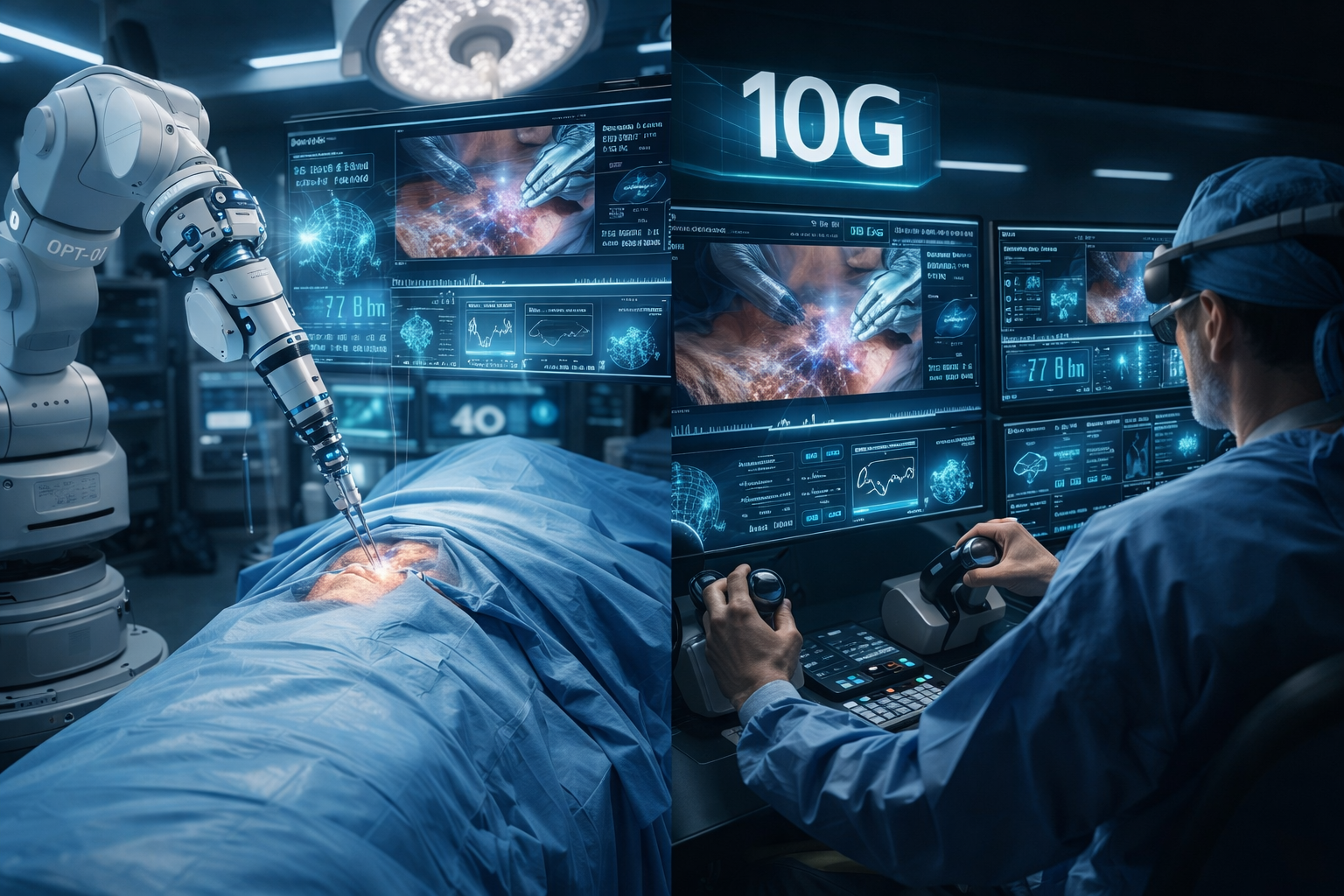
Remote telesurgery—the ability of a surgeon to operate on a patient located hundreds or even thousands of miles away—has long been the “holy grail” of medical technology. While the concept was proven decades ago with the historic Lindbergh Operation in 2001, it has remained a niche capability restricted by the limitations of network infrastructure. As of March 2026, the emergence of 10G networks has finally bridged the gap between experimental theory and mainstream clinical reality.
10G is not merely a “faster” version of the internet; it is a multi-gigabit platform defined by its symmetrical speeds, ultra-low latency, and “five-nines” reliability. For the surgical community, this translates to a seamless, lag-free experience where the movement of a master controller in New York results in the instantaneous, microscopic movement of a robotic scalpel in a rural clinic in sub-Saharan Africa.
Key Takeaways
- Latency Elimination: 10G networks utilize the L4S protocol to reduce queuing delays to near-zero, maintaining the sub-20ms latency required for surgical precision.
- Haptic Realism: High bandwidth allows for the transmission of tactile feedback, allowing surgeons to “feel” tissue resistance remotely.
- Democratization of Care: By removing geographical barriers, 10G enables top-tier specialists to provide emergency care in underserved regions without travel.
- Reliability: Unlike wireless 5G, 10G’s fixed-line fiber and DOCSIS 4.0 architecture provide the consistent uptime required for life-critical procedures.
Who This Is For
This deep dive is designed for healthcare administrators planning future surgical suites, biomedical engineers developing the next generation of robotics, telecommunications experts building medical-grade networks, and policy makers navigating the legal complexities of cross-border digital medicine.
The Technical Foundation: Why 10G is Different
To understand the impact of 10G on telesurgery, we must first define what “10G” means in the context of 2026. Unlike 5G, which is a wireless cellular standard, 10G is a cable and fiber-based initiative led by the broadband industry to deliver 10-gigabit speeds.
Symmetrical Speeds and DOCSIS 4.0
In traditional networks, download speeds far exceed upload speeds. In telesurgery, the upload speed from the patient’s side is arguably more important. The operating room must stream multiple feeds of 8K, 3D video, alongside real-time telemetry from anesthesia monitors and robotic sensors. 10G networks, powered by DOCSIS 4.0, provide symmetrical multi-gigabit capacity, ensuring that the “outbound” data from the surgical site never hits a bottleneck.
The L4S Protocol: Killing the Lag
The most significant hurdle for remote surgery has always been “jitter”—the fluctuation in the time it takes for data packets to arrive. Even a 50ms delay can cause a surgeon to overcompensate a movement, leading to tissue damage.
10G networks implement L4S (Low Latency, Low Loss, Scalable throughput). This technology manages network congestion by identifying and prioritizing “micro-bursts” of data. By virtually eliminating the “queuing delay” at the router level, 10G brings end-to-end latency down to a staggering 1 to 2 milliseconds.
Precision and Visualization: The Surgeon’s New Eyes
A surgeon is only as good as what they can see. In a traditional operating room, the human eye processes information with zero latency. In a remote setting, the network must replicate this experience perfectly.
8K and 3D Stereoscopic Imaging
10G’s massive bandwidth allows for uncompressed 8K video streaming. This is critical for procedures like neurosurgery or ophthalmology, where the difference between a nerve and a blood vessel is measured in microns. With 10G, surgeons can use stereoscopic (3D) head-mounted displays to “immerse” themselves in the patient’s anatomy, seeing depth and texture as if they were standing at the bedside.
Augmented Reality (AR) Overlays
Modern surgery often involves “image-guided” navigation. As of 2026, 10G networks allow for real-time AR overlays. A surgeon can see a patient’s pre-operative MRI scan superimposed directly onto the live robotic camera feed. Because the data transfer is so fast, the overlay stays perfectly aligned even as the patient’s internal organs shift during respiration or manipulation.
The “Touch” of 10G: Haptic Feedback Integration
The greatest limitation of early robotic surgery was the loss of the “sense of touch.” A surgeon operating a robot often relies entirely on visual cues to determine if they are pulling a suture too tight.
Tactile Data Streams
Haptic feedback requires the transmission of “force data” from the robot’s sensors back to the surgeon’s hand controllers. This data is incredibly sensitive to delay. If the “feel” of a needle piercing a vessel is delayed by even 30ms, the surgeon’s brain experiences a sensory disconnect, leading to “digital fatigue” and increased error rates.
10G networks provide a dedicated “fast lane” for haptic data. By using Edge Computing—where data is processed at a local hub near the surgical site rather than a distant cloud server—10G ensures that the tactile feedback is perceived as instantaneous.
Global Impact: Breaking the Geography Barrier
The most profound human impact of 10G networks in remote telesurgery is the democratization of specialized healthcare.
Rural and Underserved Access
In many parts of the world, including rural America and developing nations, there is a chronic shortage of specialized surgeons. A patient with a complex cardiac condition might have to travel 500 miles to reach a Level 1 Trauma Center.
With 10G infrastructure, a local community hospital can host a robotic surgical suite, allowing the world’s leading specialist to perform the procedure remotely. In 2025, we saw the first widespread “hub-and-spoke” model where a central university hospital supported a dozen rural clinics, saving thousands of lives that would have otherwise been lost to the “golden hour” of surgical delay.
Extreme Environments: Space and Military Applications
While terrestrial 10G is cable-based, the protocols developed for 10G (like L4S) are being adapted for satellite-linked “mobile surgical pods.” This has massive implications for battlefield medicine and long-duration space missions, where a surgeon on Earth (or in a secure bunker) can stabilize a patient in a high-risk environment.
Security, Privacy, and Post-Quantum Encryption
As surgery moves to the network, the “Operating Room” becomes a target for cyberattacks. The stakes are literally life and death.
The Threat of “Surgical Hijacking”
A “man-in-the-middle” attack or a Ransomware lockout during a live surgery is a nightmare scenario. 10G networks incorporate Zero Trust Architecture and Post-Quantum Cryptography (PQC). As of March 2026, medical 10G slices are often physically isolated from the public internet, using dedicated wavelength-division multiplexing to ensure that surgical data never touches a shared pipe.
Data Sovereignty and HIPAA in the Cloud
When a surgeon in France operates on a patient in Brazil, whose privacy laws apply? 10G providers are now offering “GDPR-compliant” and “HIPAA-certified” network paths that automatically encrypt and scrub metadata at the edge, ensuring that sensitive patient biometrics are never stored in unapproved jurisdictions.
Comparing Technologies: 5G vs. 10G in the O.R.
A common misconception is that 5G is the primary driver of telesurgery. While 5G is excellent for mobility, it has inherent weaknesses that 10G solves.
| Feature | 5G (Wireless) | 10G (Fixed/Fiber) |
| Latency Consistency | Variable (due to signal interference) | Constant (shielded cabling) |
| Bandwidth | Shared among all users in the cell | Dedicated symmetrical capacity |
| Reliability | Weather/Obstacle dependent | “Five-Nines” (99.999% uptime) |
| Use Case | Ambulances, remote diagnostics | Hospital-to-Hospital major surgery |
10G serves as the “backbone” for 5G. In a modern 2026 hospital, 5G might be used for a tablet-wielding nurse to check charts, but the 10G line is what plugs into the surgical robot.
Ethical and Legal Frameworks: The 2026 Reality
The technology is ready, but the legal system is still catching up. Several key hurdles remain:
- Malpractice and Liability: If a network blip causes a surgical error, who is at fault? The surgeon, the robot manufacturer, or the ISP? In late 2025, the first “Network Malpractice” insurance policies were introduced, specifically for 10G-enabled facilities.
- Cross-Border Licensing: Currently, a surgeon must be licensed in the state/country where the patient is located. The Global Telesurgery Accord of 2025 has begun to streamline this, allowing for “Digital Surgical Credentials” across participating nations.
- The “On-Site” Rule: Most regulations still require a qualified surgeon to be physically present in the room as a “backup.” While this ensures safety, it negates some of the cost-saving benefits of remote surgery.
Common Mistakes in Implementing Remote Surgical Networks
Implementing a 10G surgical program is a massive undertaking. Here are the most common pitfalls:
- Ignoring the “Last Mile”: A hospital may have 10G fiber to the building, but if the internal wiring is old Cat5e, the benefits are lost.
- Over-reliance on AI: Some administrators think AI can “fill the gaps” of a bad connection. While AI can predict movements, it cannot replace the real-time visual and haptic data required for safe outcomes.
- Underestimating Training: Operating a robot remotely feels different than being in the room. Surgeons require specific “latency-simulation training” to build muscle memory for the 1-2ms delay.
The Future: Beyond 2026
Looking ahead, we are moving toward Autonomous-Assist Surgery. In this model, the 10G network allows a remote surgeon to “oversee” three or four robots simultaneously. The robots perform the routine tasks (closing an incision, suturing), while the human surgeon steps in only for the critical, high-risk maneuvers.
10G is the “nervous system” of this new medical era. It connects the world’s best minds to the world’s most vulnerable bodies, ensuring that the quality of your healthcare is no longer determined by your zip code.
Conclusion
The impact of 10G networks on remote telesurgery cannot be overstated. We have moved past the era of “stuttering” video and “ghost” movements into a period of perfect digital replication. By 2026, the 10G platform has addressed the three pillars of surgical success: Ultra-Low Latency, Symmetrical High-Bandwidth, and Absolute Reliability.
However, technology is only half the battle. As we move forward, the medical community must focus on the “human-first” aspects of this transition. This includes rigorous training for tele-surgeons, the development of robust international legal frameworks, and ensuring that 10G infrastructure is deployed equitably to prevent a “digital divide” in life-saving care.
If you are a healthcare leader or a network architect, the time to prepare for 10G integration is now. The “Operation of the Future” isn’t coming—it’s already on the network.
Would you like me to develop a 10G implementation checklist for your surgical facility?
FAQs (Schema-Style)
What is the ideal latency for remote telesurgery?
For a surgeon to feel “natural,” latency must be under 10ms. For the surgery to be considered safe by clinical standards, the end-to-end latency must consistently remain under 200ms. 10G networks aim for 1-5ms of network-level latency.
Does 10G replace 5G in hospitals?
No. 10G and 5G are complementary. 5G provides mobility for portable devices and monitoring, while 10G provides the high-capacity, ultra-stable fixed-line backbone required for the surgical robots themselves.
Can 10G networks be hacked during a surgery?
While no network is 100% unhackable, 10G utilizes dedicated network slicing and post-quantum encryption to isolate surgical data from the public internet, making it significantly more secure than previous generations of broadband.
Is remote telesurgery currently legal?
Yes, but with caveats. Regulations vary by country and state. Most currently require a secondary surgeon to be physically present at the patient’s location to take over in case of a technical or medical emergency.
What surgical specialties benefit most from 10G?
High-precision fields like neurosurgery, cardiology, and ophthalmology benefit most because they require the ultra-high-definition 8K imaging and zero-lag haptic feedback that only 10G can provide.
References
- CableLabs (2025). 10G Technology: The Low Latency Roadmap for Medical Applications. Official Industry Specification.
- The BMJ (2026). Telesurgery 2.0: Clinical Trials and the Impact of Multi-Gigabit Infrastructure. British Medical Journal.
- IEEE Xplore (2025). L4S and Its Application in Haptic Feedback Loops for Remote Robotics. Technical Paper.
- World Health Organization (2024). Global Framework for Digital Health Equality: Closing the Surgical Gap. WHO Policy Documents.
- Journal of Robotic Surgery (2025). Comparative Analysis of Latency Jitter in 5G vs. DOCSIS 4.0 Environments.
- U.S. Department of Health & Human Services (2026). Cybersecurity Guidelines for Network-Based Medical Interventions.
- Nature Medicine (2026). The Psychology of Remote Operation: Cognitive Load in High-Bandwidth Telesurgery.
- Nokia Bell Labs (2024). UNEXT: Transforming Networks into Surgical Operating Systems.
- American College of Surgeons (2026). Statement on the Ethics of Remote Surgical Assistance and Supervision.
- MIT Technology Review (2025). How 10G Fixed the “Lag” Problem for Good.